31 Oct 2025 | Africa, Americas, Asia and Pacific, Iran, Middle East and North Africa, News, Nigeria, Tanzania, United States, Vietnam
Bombarded with news from all angles every day, important stories can easily pass us by. To help you cut through the noise, every Friday Index publishes a weekly news roundup of some of the key stories covering censorship and free expression. This week, we look at the deployment of the military against protesters in Tanzania and a rock band playing on the streets of Tehran.
Tanzania: Military deployed and curfews enacted
Protests have erupted in Tanzania following a disputed election and the deployment of the military to enforce a curfew across Dar es Salaam.
President Samia Suluhu Hassan, incumbent leader of the ruling Chama Cha Mapinduzi (CCM) party and one of only two female leaders in Africa, won 78.8% of the vote. Her victory has been disputed, especially as candidates from the top two opposition parties had been disqualified from running in the election. CCM has been in control of Tanzania since it gained independence in 1961.
Index covered the lead-up to the election, and reported on fears that the opposition leaders are being silenced.
Internet watchdog Netblocks has reported an internet blackout across the country following the beginning of the curfew.
Opposition leader Tundu Lissu has been imprisoned on charges of treason for his calls for electoral reform, whilst Luhaga Mpina, who leads the second largest opposition party was barred from taking part in the election.
Protests are still ongoing as demonstrators reject the election results.
Iran: Rock band shows sparks of rebellion
In a startling video we saw this week, Iranians have taken to the streets of Tehran to watch a rock band playing the White Stripes 2003 single Seven Nation Army.
The video has been widely shared, and shows women dancing in the street without wearing head coverings in a display of freedom on the streets.
Index has been following the clampdowns on musicians in Iran over the last few years.
This display follows a growing movement of defiance against mandatory hijab requirements across Iran that has built steadily since the 2022 Woman, Life, Freedom protests sparked by the murder of Mahsa Jina Amini.
Nigeria: Visa rejection for Nobel winner
91-year-old Nobel Laureate Wole Soyinka announced on Tuesday that the USA had revoked his non-resident visa.
Soyinka won the 1986 Nobel Prize in Literature and is widely known for his work as a playwright and poet. He previously renounced his permanent US residency in protest at the election of President Donald Trump.
Soyinka said: “I was given a date to report to their consulate with my passport. I declined the invitation. First of all, I didn’t like the date. Everybody knows what happened on that date, 9/11, many years ago, so it is rather unfortunate that they picked that date. So I said, ‘Sorry, I’m superstitious; I’m not coming on that day.’ And ultimately, I made it clear I was not going to apply for another date to bring in my passport. So I travelled out.
“When I came back – even before I came back – I got a letter from the ambassador.
“So we arranged a call, and I explained. Again, he offered a special visit by me at the consulate, and they would ask a few questions about the possible facts that existed that they didn’t know about when this visa was issued. We spoke, and I said, ‘Shall I be equally frank with you? I’m not interested.’”
Visa rules changed for Nigerians in July, with non-immigrant visas now receiving single-entry three-month permits as opposed to the up to five-year multiple-entry visas available previously.
USA: Gamers wanted for ICE
The White House has continued its use of memes in its effort to recruit members for the United States Immigration and Customs Enforcement (ICE).
Recent posts by the Department of Homeland Security on X have used screenshots from the Halo video game series overlaid with phrases such as “stop the flood” equating the undocumented migrants ICE targets with the alien enemies faced in the video game.
The posts come in the wake of numerous controversies facing the organisation, with multiple shootings reported this week in relation to ICE, and a British national being held by the organisation after the US had revoked his visa.
Similarly AI has become a mainstay. We’ve covered the trend in the latest edition of our magazine – and that was before a post from President Trump on his Truth Social platform last week imagining him flying a fighter jet over protesters covering them in excrement.
Memes and online culture have been a mainstay of the Donald Trump presidencies since he first took power in 2016, with an online culture developing around his campaign on sites such as 4chan.
Vietnam: BBC journalist trapped
A journalist from the BBC has been blocked from leaving Vietnam according to a statement released by the broadcaster.
The Vietnamese national has not been named, however the BBC released the following statement: “One of our journalists has been unable to leave Vietnam for several months as the authorities have withheld their ID card and their renewed passport.
“During this time our journalist was subject to multiple days of questioning by the authorities. The BBC journalist was in Vietnam for a routine passport renewal and to visit family.
“We are deeply concerned about our journalist’s wellbeing and urge the authorities to allow them to leave immediately, providing them with their renewed passport so they can return to work.”
UK Prime Minister Keir Starmer reportedly raised the issue with general secretary of the Communist Party of Vietnam Tô Lâm during a state visit to the UK this week, however no updates have been made on the status of the journalist.
19 Jun 2014 | China
China’s censors have a hard time stamping out memes.
Memes are proving one of the most powerful weapons Chinese netizens can use to fight online censorship. In the weeks on either side of this year’s 25th anniversary of Tiananmen Square, Chinese censors blocked a variety of terms on social media, including “blood”, “May 35” and even “today”, but references to the event kept on emerging in memes. Images alluding to the infamous “Tank Man” took on a variety of forms, using heads of Mao, tractors, lego and the iconic Hong Kong rubber duck in lieu of circulating the actual iconic photo.
The concept of the meme was coined by Richard Dawkins in 1976 to explain certain ideas, catchphrases, trends and other pieces of cultural information that replicate through a population. In its current usage, memes are defined as cultural items in the form of an image, video or phrase that spreads via the internet and are often altered in a creative or humorous way.
They’ve been part of the Chinese blogosphere for years and in many ways are ideally suited to the Chinese context. In part this is because Mandarin as a language allows for a playful form of double entrendre. Due to its many tones even the slightest shift in pronunciation can change a word’s meaning, while still sounding similar enough to invoke comparisons. The most famous Chinese meme, which parodies censorship itself, is that of the grass mud horse — caonima. In certain tones caonima means an alpaca; in other tones it’s a famous Chinese profanity. A few years back a video depicting a grass mud horse defeating a river crab, hexie, which is a homonym for the propaganda catchword “harmony”, went viral. To this day memes relating to this still emerge to poke fun at Chinese authorities.
Herein lies the strength of memes; their ability to evolve quickly and to imply rather than state makes them very difficult to detect and delete. After all, it’s hard enough for Chinese censors to keep track of and block all search terms directly referencing taboo topics. It’s harder still to block the infinite variations of words and images that might allude to controversy.
“Due to advanced and pervasive censorship, Chinese netizens are often forced to use coded language and images to talk about the social and political issues they find important,” says Ben Valentine, strategist and contributing writer for The Civic Beat, which examines social change memes and viral media.
“Images are much harder to algorithmically block because machines have trouble understanding visual content. While online writing directly talking about anything to do with Tiananmen Square in 1989 is extremely difficult, some of these memes make it past the censors. This is partially why, despite pervasive censorship, the Chinese web still remains a quite lively and active online space,” he adds.
For David Bandhurs, a researcher at the University of Hong Kong’s China Media Project, anyone who engages on a regular basis with others in the Chinese internet space “understands that irony, parody and other forms of expressive subterfuge are absolutely essential”. Memes “are the very substance of self-expression, of which social and political expression are a part, in a repressive space”.
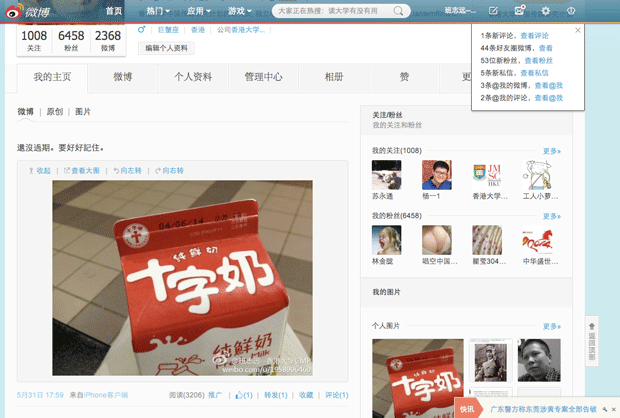
Ahead of the 4th June anniversary, Bandhurs posted a photo of his milk carton to Weibo (China’s Twitter). The expiration date was “04/06/14” and he wrote: “It’s not yet expired. We have to remember.”
“This was a very casual post, its point being to share a momentary thought with my community, a thought which for some might prompt a moment of esprit de corps, or a moment of reflection,” he tells Index.
“A lot of memes emerge, and they emerge constantly, in exactly this way. They encapsulate a thought or a feeling — often with a strong social or political dimension — that cannot be openly expressed. For example, the meme ‘My father is Li Gang’ quickly became emblematic of the injustice and inequality resulting from unchecked power. It was like a key that could open a box of thoughts no one could make very explicit.”
Just how effective are these memes? When shared instantly and abundantly across platforms like Weibo, they can be very powerful. In some instances Chinese memes have spurred a call to action, as was the case with those that knocked Beijing’s poor air quality. Until recently, the government denied the extent of the pollution. Conversation on the topic was silenced. Then photos of blue sky days and other related memes emerged. Now the government is approaching the topic with more transparency.
As for those topics which still remain off limits, memes provide an alternative form of political discourse. The China Digital Times sees caonima specifically as the “the icon of online resistance to censorship”.
Memes represent a way in which Chinese people momentarily seize control of conversations. For example, when blind activist and lawyer Chen Guangcheng was arrested, thousands of people posted photos of themselves wearing sunglasses in protest. While it might not seem like the biggest act of defiance, it’s still something in a nation where free speech and collective action are strictly controlled.
“These memes allow for more expression, a political conversation to start, for humor around a taboo subject; this is an incredibly empowering feeling. The ability to connect, talk, laugh, and touch on politics feels good,” explains Valentine.
Speaking of memes more generally, Cole Stryker, author of Epic Win for Anonymous: How 4chan’s Army Conquered the Web, tells Index:
“The power of politically-oriented memes is that they can be used in a playful way that isn’t necessarily directly confrontational to a regime. In some cases, the regime doesn’t even realize they’re being undermined. This allows activists to openly protest with impunity or even anonymity.”
At the same time, it’s important not to overstate the power of memes in China. Most vanish in the cyberspace vortex. Bandhurs’ milk carton post, for example, had more than 3,000 views, but could not be shared or commented upon, taking the sting out of it.
Memes are also predominantly harmless and politically apathetic. An office worker in Beijing, Wang Meimei, 28, said she and her friends constantly share memes. These solely relate to entertainment, not politics, because “we’re not interested in that”.
Meanwhile, 35-year-old Huang Yeping, who works in news media in Beijing, says none of the recent memes he has seen capture any form of zeitgeist.
“Is it me or have Chinese become even more subdued in terms of political expression, so much so that they haven’t been able to create anything as infectious as grass mud horse or a derivative of the tankman?” he asks, then adds:
“There has been this chill spreading across the cyber world.”
And as this indicates, taken alone memes cannot supersede collective action, nor do most have that in mind. They can spark a discussion, yes, yet remain as entertainment without the other key elements that bring about concrete action. What memes can do is allow for everyday Chinese to seize control of conversations — whether they be of a social, political or cultural nature — even if only for a few hours or days before the army of censors step in. And as Valentine says, that “feels good”.
This article was published on June 19, 2014 at indexoncensorship.org
