19 Mar 2014 | China, News
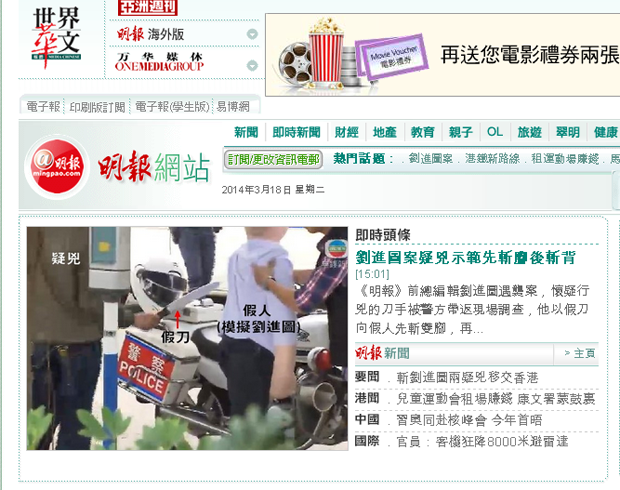
Hong Kong journalists are anxious at present – with good reason. On the morning of 26 February Kevin Lau, former chief editor of Hong Kong daily newspaper Ming Pao, was attacked as he got out of his car. Suffering stab wounds to his back and legs, Lau was rushed to hospital where he underwent emergency surgery.
Nine men have since been arrested over the attack, with police saying some are linked to organised crime. But many media workers believe differently, namely that the stabbing was provoked by Lau’s record of pushing journalistic boundaries at Ming Pao, and that it’s a message for local journalists to beware criticising Beijing.
Once a British colony, Hong Kong reverted to Chinese rule in 1997. Under the policy of “One Country, Two Systems”, Hong Kong was granted a degree of autonomy, with press freedom protected under the Basic Law.
The law isn’t a total farce. To this day, the city’s newsstands display a varied, vibrant collection of papers. In Reporters Without Borders’ World Press Freedom Index 2013 Hong Kong was ranked 58 globally, just one slot below Italy and far above China at 173.
However, beneath the surface a different story emerges. Over the past year, half a dozen violent attacks on people in media who are critical of the Hong Kong and Chinese governments have been reported, as have abrupt dismissals and resignations of several outspoken journalists.
Meanwhile, self-censorship is growing.
“It’s a creeping, insidious type of thing. If you want to keep your job, you tow the line. I work with guys who are pro press freedom, but they are still censoring constantly,” said a journalist who only agreed to talk on condition of anonymity. The man, who is a reporter at a prominent local newspaper and has been living in Hong Kong for three decades, explained how self-censorship started to emerge in the mid-90s and has become rife in recent years.
Then there are the “gatekeepers”, as he refers to them – journalists who have been educated in the Chinese school of journalism (“never question authority”) and are encouraged to run stories according to a Beijing agenda. They now get their information from Chinese media sources such as Xinhua and China Daily, as opposed to the past practice of using Reuters, AP and other international news wires.
Why has this situation emerged? Money’s a big factor. Media owners in Hong Kong used to be either local business tycoons or people in media themselves. Now they’re predominantly international businessmen with links to China, who are reliant on Chinese currency to stay afloat. According to the Committee to Protect Journalists, over 50% of Hong Kong’s media owners are closely connected to the Chinese government. Other media owners, such as the Malaysian billionaire Robert Kuok from the South China Morning Post and Malaysian Tiong Hiew-king of Ming Pao, have strong commercial interests in China.
One exception to the rule is Next Media, a profitable company that owns Apple Daily, one of Hong Kong’s most widely read newspapers – and the most openly critical of China. Next Media has survived the onslaught. But certain advertisers have withdrawn sponsorship, acting as a deterrent for smaller, less profitable papers.
Gregory Lee, an academic and writer who lived in Hong Kong on both sides of the handover, says the academic press is under attack too. The days of people publishing in Hong Kong because they couldn’t in China have ended. Lee knows of one academic who criticised China’s former leader Hu Jintao and had his entire book pulled.
Lee currently teaches Chinese studies at the University of Lyon, France. Even thousands of miles from Beijing, the Communist government’s touch is still felt.
“I’ve got Hong Kong students here who are desperate about the encroachment of mainland China on Hong Kong culture. What’s interesting is that these students were very young when the handover happened, but they still see their identity as Hong Kong.”
One thing’s for sure, Hong Kong residents will not be easily silenced. In the wake of Lau’s attack, thousands took to the streets to voice support for press freedom and to denounce the violence, and this protest was just a warm-up. Occupy Central, which is set to take place in July, should see plenty more out in public demanding rights to freedom of expression.
“Hong Kong has a golden opportunity to be a watchdog for what’s happening in the mainland, due to its proximity and links to China, and yet the press are failing in their duties,” says prominent blogger and activist Tom Grundy, who plans to attend Occupy Central. Grundy believes the protest will be “a defining moment for Hong Kong autonomy” as the government is presented with different ways to respond.
Attending Occupy Central is not just about protecting Hong Kong’s present – it’s about the future too.
“There’s a concern that when 2047 comes, Hong Kong will be absorbed by the mainland,” Grundy says of the “One Country, Two systems” agreement that will expire then.
Back in the hospital, Lau’s recovery is underway. The nerves in his legs are healing and doctors are confident he will walk again. The future of Hong Kong’s free press, on the other hand, remains in the balance.
This article was posted on 19 March 2014 at indexoncensorship.org
18 Mar 2014 | Asia and Pacific, News, Pakistan
(Image: Aleksandar Mijatovic/Shutterstock)
Pakistan’s record of abuse of its dubious blasphemy law has been criticised by a report from the US Commission on International Religious Freedom. The country currently has 14 individuals known to be on death row while 19 others are serving life sentences on charges of committing blasphemy.
Take for example the case of Aasia Bibi, accused of insulting the prophet Muhammad. The 45-year old Christian and mother of five says she was “falsely accused to settle an old score”. In jail since June 19, 2009, she has yet to have her appeal heard. Sameena Imtiaz, founder of Islamabad-based Peace Education Development Foundation (PEAD) says the commission’s findings are another “reminder of the religious intolerance that has permeated the society at large”. The hearing on March 17, before the Lahore High Court was “cancelled by order” yet again, informed her lawyer Mohammad Yasin Badar, who does not know the reason. “I got a text message from the court,” he said but surmises: “This is a very sensitive case.”
But while Bibi may be only Pakistani woman to have been sentenced to death for blasphemy, she is not alone. In November 2013, a 72-year old homeopath doctor Masood Ahmed, a British national of the minority Ahmadi sect, which has been declared non-Muslim by the constitution, was jailed for discussing Islam — a criminal offence punishable with death under Section 295-C of the Pakistan Penal Code (PPC). His conversation was filmed using a mobile phone in which he is seen reciting verses from the Quran. He has been released on bail. Then there is a mentally ill, 69-year-old British citizen, Mohammad Asghar, convicted in January this year, for sending letters proclaiming he was Prophet Mohammad. He remains in prison today.
The original blasphemy law, drawn up by the British and amended in 1986 by then-dictator General Zia-ul-Haq, puts in place a mandatory death sentence under section 295-C. Imtiaz says since the amendment more than a 1,000 cases have been registered against Ahmadis, Christians, Hindus and even Muslims.
The National Commission for Justice and Peace has also been keeping a close watch on the numbers. According to them, from 1987 to 2013, as many as 1,281 people have been charged, of which 616 are Muslims, 474 Ahmadis, 171 Christians and 20 Hindus.
Pakistan has never executed anyone under the offence but the between 1990 to 2012, several of the accused have been killed in associated vigilante violence outside the courts or in prisons.
According to a report by the Islamabad-based Center for Research and Security Studies, since 1990, extra judicial murders of 52 accused have taken place.
In its State of Human Rights in 2012 report, the independent Human Rights Commission of Pakistan states: “Abuse of the blasphemy law continues to take a heavy toll in terms of human lives and harassment of citizens.”
“The sheer number of cases registered in the past 25 years suggests the law has been widely abused,” concedes Imtiaz, adding that investigations have revealed that often the reasons for the abuse stem from personal enmity, property disputes, religious hatred.
“Decades have passed but none of the governments that followed, found the courage to repeal the discriminatory laws that have contributed significantly to intolerance, violence, bigotry, hate and injustice in the country,” says Bushra Gohar, a senior member of the Awami National Party. A legislator in the last assembly, she had submitted a bill in the assembly for the repeal of the blasphemy clauses inserted by Zia ul Haq, but it was never tabled in the assembly.
And for that reason, says Imtiaz there was an urgent need for debate to include “all segments of society on the pros and cons of the law and how it is abetting religious intolerance”.
In the meantime, she said, “an effective counter law that prohibits the abuse of the law for settling personal gains and inciting hatred” should be implemented. “The current law is not only vague but is rarely put to use due to fear of persecution and pressures,” she points out.
There have been half-hearted attempts to initiate a debate but after two high profile assassinations — of Punjab governor, Salman Taseer and minister for minorities, Shahbaz Bhatti — took place, for speaking on Bibi’s behalf and opposing the blasphemy laws, all efforts have been stalled.
“Political expediency, compromise and appeasement of a handful of religious extremists have prevented each subsequent government to initiate a meaningful debate, or even initiate pertinent legislation in the parliament to repeal or amend the discriminatory laws that continue to play havoc with the lives of women, minorities and the poor,” Gohar said.
Citing the recent torching of a temple in Larkana, in Sindh over blasphemy allegations, she says: “It shows how easy it is to incite mob violence and as in numerous similar cases in the past the root cause will not be addressed.”
According to the former legislator, strong political will is seriously lacking to review and amend or repeal the blasphemy law. “We cannot hope for justice for the victims and their families if we cannot even have an open debate on the discriminatory laws in the parliament and if the parliament, the courts and the government are threatened, coerced and silenced by a bunch of religious extremists.”
The annual report prepared by the Commission on International Religious Freedom looks at the state of religious freedom around the world.
This article was posted on March 18, 2014 at indexoncensorship.org
18 Mar 2014 | Awards, China, News
Internet censorship is rife in China. Social media sites are not exempt — there are 2,000,000 people employed in the country specifically to monitor microblogging sites. Against this backdrop, FreeWeibo works tirelessly to keep track of and publish all the censored and deleted social media messages, providing a fascinating insight into the regime’s priorities and fears.
On October 4 2013, an app version of the site was launched in the Chinese Apple app store, created in association with Radio Netherlands Worldwide. The creators fended off some initial attacks, assuming the only way the app could be truly be blocked was through blocking the entire app store. They were in for a surprise when, on November 28, Apple themselves decided to take down the app following complaints from Beijing.
The people behind FreeWeibo remain undeterred. They have launched a new type of mirror site, which they say can circumvent Chinese censorship.
Index on Censorship’s Taylor Walker interviewed FreeWeibo.
Index: How does it feel to be nominated for Index’s Digital Advocacy award and why do you think FreeWeibo was nominated?
FreeWeibo: We are totally honoured to be even thought of for this award especially given the strengths of the other projects. To be considered in that kind of company is humbling. We are delighted that we can make it onto the radar for Index on Censorship. We tend to think that a lot of people feel that fighting Chinese censorship is a lost cause. Obviously, we don’t feel that way but we get a general sense that a lot of other organizations, companies, or individuals don’t feel that it was a battle worth fighting. We very much think that not only can we fight the battle but we can win the battle.
Index: Could you describe the changing composition of FreeWeibo over the past few years?
FreeWeibo: We started as GreatFire.org in 2011- that website still exists. What we do is we track what websites and key word searches are being blocked in China. We started just covering just a few hundred websites now we have 90,000 websites in our database that are constantly being tested for censorship. We also want it to be a resource for people that want to know more about what’s happening with censorship in China. We’ve been very successful with that as well. We started FreeWeibo because we thought it was the obvious thing to do to combat censorship on Sina Weibo.
Index: How was government scrutiny following the launch of FreeWeibo?
FreeWeibo: After we launched Free Weibo it was blocked in 3 days. The government is paying close attention to what we are doing. They were paying close attention to what we were doing before FreeWeibo. But now we are working a on a new concept which we call “Collateral Freedom”. We are basically creating mirror websites that are blocked in China and hosting them on global cloud services. It’s been proven that the Chinese authorities are unable to block our mirror websites without blocking everything that’s being hosted on the cloud. We are gambling that the Chinese authorities won’t move to block everything that’s hosted in the cloud because that would create a huge disturbance in internet service in China and there would be severe economic consequences related to such a block. We are leveraging the cloud to deliver sensitive information back into China – including our own FreeWeibo website.
So far, our mirror websites have not been blocked. What we are doing now is delivering others using that same method. I don’t know how high on the radar we are for the Chinese authorities but regardless, all co-founders have close ties to China and from the time we started the project we all knew that we were getting involved in something that the Chinese authorities probably wouldn’t agree with so we took precautions right from the start to protect our identities and to basically make our involvement as secure as possible and we will continue to do that.
Index: Last year FreeWeibo teamed with Radio Netherlands Worldwide and created an app described as “unblockable.” What was your reaction to finding that Apple blocked the app?
FreeWeibo: That was actually the worst feeling. Worse than finding out that the Chinese authorities had disabled one of our test locations, for example. We expect that the Chinese government will do whatever it takes to stop us and we know that that will put pressure on foreign multinationals. But to actually know that Apple listened and obeyed the censorship authorities – it was a really low and sad moment for all of us – truly disheartening. Apple presents this totally other side to its customers and if you look at the way it markets the company it’s not the kind of karma that you’d expect from Apple.
We increasingly recognize that one of the biggest threats to our operation are large multinational companies. We’ve proved time and again that we can defeat the great firewall and we can defeat censorship in China but we need to leverage other platforms to be able to do that. If multinationals continue to concede to censorship requests from the Chinese authorities then we are going to be left with fewer options in terms of defeating censorship.
Index: How would you describe Freedom of Expression?
FreeWeibo: Freedom of expression and freedom of speech are actually written into the China’s constitution. We think that these are basic rights that Chinese citizens should enjoy – as should citizens of many other countries around the world. With the Snowden revelations, people are becoming more aware of different types of surveillance and censorship – the landscape is changing. I can say with confidence that we have a very clear path to ending censorship in China. We are also confident that we can actually bring our anti-censorship tools to other countries. This year, we are hoping to expand what we are doing with Collateral Freedom, what we are doing with GreatFire, and maybe what we are doing with FreeWeibo so that we can bring freedom of expression and freedom of speech to countries that need our help.
Nominees: Advocacy | Arts | Digital Activism | Journalism
Join us 20 March 2014 at the Barbican Centre for the Freedom of Expression Awards
This article was published on 18 March 2014 at indexoncensorship.org
18 Mar 2014 | Magazine, News, Volume 43.01 Spring 2014
[vc_row][vc_column][vc_column_text]
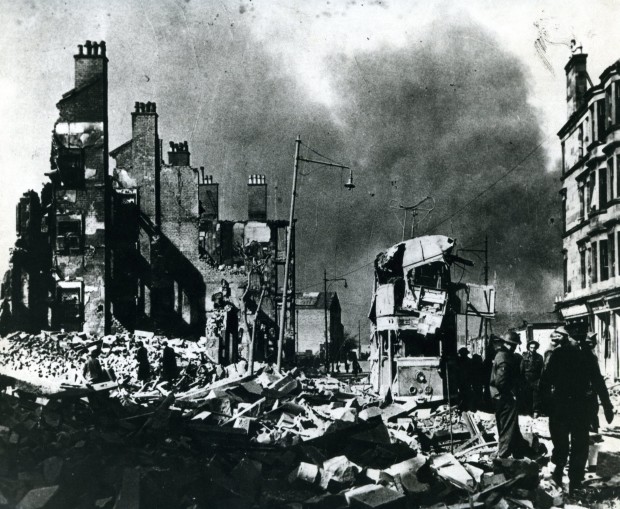
A destroyed tram is surrounded by the rubble on Dumbarton Road, Clydebank, after a WWII bomb raid
(Image: West Dunbartonshire Libraries and Cultural Services)
On a moonlit evening on Thursday 13 March 1941, just after 9pm, the first of 236 German bombers converged on Clydeside. By 9.10pm, over the western suburbs of Glasgow, over Bowling and Dalnottar and – especially – over the crowded, densely housed and productive little town of Clydebank, the bombs had begun to fall. And the next night, it happened all over again.
This was bombing of such ferocity that the explosions could be heard clearly at Bridge of Allan in Stirlingshire. The fires were of such frenzy that their glow could be clearly seen from rural Aberdeenshire and Northern Ireland.
Clydebank was all but destroyed. According to the official statistics 528 people, from one geographically small community, were killed, 617 seriously injured. Hundreds – perhaps thousands – more were superficially hurt and cut, or traumatised by blast. Of some 12,000 dwellings – including tenement blocks as well as villas and semi-detached homes – only seven were left entirely undamaged. Four thousand homes were completely destroyed, 4,500 more so severely damaged as to be uninhabitable for months.
The morning of the 14 March saw thousands of dazed survivors shambling along Dumbarton Road into Glasgow and, by the night of Saturday 15 March – as official records would eventually reveal – it was reckoned that more than 40,000 people had left the town amid utter chaos.
And, in the days immediately following the German assault, soldiers and servicemen came home on leave to Clydebank wholly innocent of what had happened. John Bowman, in March 2011, bleakly recalled – for a BBC Scotland audience – returning from his distant base in Sussex to find not only his house obliterated, but most of the street; and that his mother, two brothers and a younger sister had been killed.
There is still a place called Clydebank, and many who survived March 1941 still live there. But thousands who fled never returned. The community that had retired for the evening of Thursday 13 March 1941 was smashed beyond recovery in a single night in what, in proportion of lives lost and homes destroyed, was the worst bombing raid anywhere in Britain in the entire war. Clydebank, the historian Angus Calder bleakly noted in 1969, “had the honour of suffering the most nearly universal damage of any British town”.
But, outside Scotland, few have ever heard of the Clydebank Blitz. The Blitz, to most today, conjures up images of heroic London and battered Coventry – the first because it was, of course, the capital; and the second because the authorities deliberately exploited its ordeal for newsreel propaganda.
Of course very many towns and cities were bombed. Those particularly hard-hit included Liverpool, Hull, Southampton and Belfast. Besides, Clydebank is readily confused with the vague term “Clydeside”, used to describe the greater Glasgow area. But – beyond that – there was calculated wartime censorship by what was laughably known as the Ministry of Information.
Officials refused to allow any mention of the town’s name in subsequent newspaper reports – which only speak of the bombing of “a town in western Scotland”. No film-crews were allowed into the ruins. Neither royalty nor Prime Minister Winston Churchill sped north to visit and console. And, when one survivor, Thomas Kearns, wrote a detailed letter to family in Belfast, it was intercepted (and held) by censors. His words would not see publication till 1971.
A stark photograph, days later, of a Clydebank mass burial, was cropped before publication – on ministry orders – so that the public would not grasp just how terrible the disaster had been; sixty-seven people, or bits of them, lay in it. And the government did its best at first not to issue casualty figures at all and then to give most misleading ones.
On 18 March 1941 that the Ministry of Home Security – headed by Home Secretary Herbert Morrison – issued a foolish communiqué declaring that “about 500 persons had been killed on the raids in Clydeside”. In fact, 647 had died in Glasgow alone – quite apart from the Clydebank death-toll – and, on hearing of this fatuous announcement, a Home Guardsman in Clydebank is said bitterly to have exclaimed: “Which street?”
Bureaucrats seem to have been determined deliberately to conflate Clydebank and Glasgow fatalities, to the point where the home secretary was accused in the House of Commons of making “misleading statements”. Inevitably, feelings around Clydebank ran high.
A high official warned Tom Johnston, secretary of state for Scotland, that locals heard such official statistics with “frank incredulity” and, a year on, there was great consternation in high places when a Sunday Post anniversary piece, on 15 March 1942, lamented the “1,200 Clydebank people” who had died “as the result of the savage two-night blitz on the town”.
This article had somehow evaded censors. Clydebank Burgh Council now held a furious debate, in which all sides demanded hard, accurate numbers from the government.
But these it refused to yield for the rest of the war. Thus, to this day, many regard the official death toll, as at last made known, with profound scepticism – especially when, years and even decades after the attack, human remains were still being found in Clydebank rubble.
Such games of officialdom were not unique to the Clydebank catastrophe. As the historian Peter Lewis dryly notes, after the dreadful bombing of Manchester on 22 and 23 December 1940 The Manchester Guardian “was not allowed to name the city in its reports of the raids on ‘an inland town in north-west England’ or state that ‘a newspaper office’ hit by incendiaries was its own. Only when the Germans boasted of hitting Manchester was Manchester entitled to be told how heavy the raids and the damage were.”
Hull, the worst-bombed city in England, likewise grew inured to being described as “an east-coast town”, even as sailors came home on leave and lamented through incessant raids that they felt safer at sea. Yet the suppression of detail on Clydebank’s ordeal was determined and exceptional.
There were four evident reasons for this. The first was military. The Clyde generally was a vital workshop for ships, munitions and ordnance. Clydebank was of particular importance, notably for the great yard of John Brown’s. The authorities genuinely believed the Germans should never be told what they had actually hit, far less missed, lest they return and make good their failures.
The second was mortification. Though the imminent attack had been known for hours by the authorities, no warning of any kind had been given the people until German aircraft were practically within earshot. RAF tactics for the defence of greater Glasgow on those nights – too complex to discuss here – had been a humiliating failure. The scant anti-aircraft guns by Clydebank had run out of ammunition. Scottish Office officials had treated the town so contemptuously that Clydebank could not bury her dead even in cardboard coffins; most finally deposited in that huge grave were in bed-sheets tied with string.
Continues below
[/vc_column_text][vc_separator color=”black”][/vc_column][/vc_row][vc_row content_placement=”top”][vc_column width=”1/3″][vc_custom_heading text=”The war of the words” font_container=”tag:p|font_size:24|text_align:left” link=”url:https%3A%2F%2Fwww.indexoncensorship.org%2F2014%2F02%2Fthe-war-of-the-words%2F|||”][vc_column_text]Through a range of in-depth reporting, interviews and illustrations, the spring 2014 issue of Index on Censorship magazine explores how modern propaganda was invented and looks at poster campaigns, partisan journalism in the USA, WWII, Iraq, Afghanistan and Syria.[/vc_column_text][/vc_column][vc_column width=”1/3″][vc_single_image image=”80560″ img_size=”medium” alignment=”center” onclick=”custom_link” link=”https://www.indexoncensorship.org/2014/02/the-war-of-the-words/”][/vc_column][vc_column width=”1/3″ css=”.vc_custom_1481888488328{padding-bottom: 50px !important;}”][vc_custom_heading text=”Subscribe” font_container=”tag:p|font_size:24|text_align:left” link=”url:https%3A%2F%2Fwww.indexoncensorship.org%2Fsubscribe%2F|||”][vc_column_text]In print, online. In your mailbox, on your iPad.
Subscription options from £18 or just £1.49 in the App Store for a digital issue.
Every subscriber helps support Index on Censorship’s projects around the world.
 SUBSCRIBE NOW[/vc_column_text][/vc_column][/vc_row][vc_row][vc_column][vc_separator color=”black”][vc_custom_heading text=”Don’t lose your voice. Stay informed.” use_theme_fonts=”yes”][vc_row_inner][vc_column_inner width=”1/2″][vc_column_text]Index on Censorship is a nonprofit that campaigns for and defends free expression worldwide. We publish work by censored writers and artists, promote debate, and monitor threats to free speech. We believe that everyone should be free to express themselves without fear of harm or persecution – no matter what their views.
Join our mailing list (or follow us on Twitter or Facebook) and we’ll send you our weekly and monthly events newsletters and periodic updates about our projects defending free speech. We won’t share your personal information with anyone outside Index.[/vc_column_text][/vc_column_inner][vc_column_inner width=”1/2″][gravityform id=”20″ title=”false” description=”false” ajax=”false”][/vc_column_inner][/vc_row_inner][vc_separator color=”black”][/vc_column][/vc_row][vc_row][vc_column][vc_column_text]
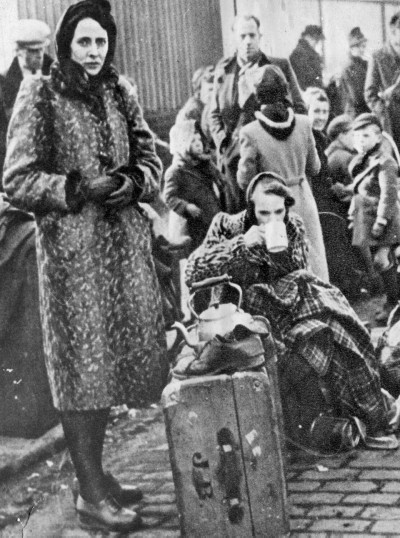
Evacuees in Whitecrook Street, Clydebank
(Image: West Dunbartonshire Libraries and Cultural Services)
A third undoubted concern was the spectre of Scottish nationalism. Tom Johnston had talked it up at every opportunity in the pursuit of London largesse, especially after a succession of witless mistakes. The BBC had ended all Scottish regional broadcasting when war began. The new BBC Home Service then persisted, for months, in the incessant playing of There’ll Always Be An England and authority at every level persisted stubbornly on using “English” as a synonym for British. In a spectacular gaffe – when a newsreel described the unambiguously Scottish RAF hero Donald Farquhar as an “English airman”, there was booing throughout Scottish cinemas.
The final factor was a baseless fear of Marxist sedition. Clydeside was an early – and, by 1941, the most organised – fortress of British socialism. She had Independent Labour Party and communist councillors. During World War I, her womenfolk had waged a determined (and successful) rent-strike against rapacious landlords. David Kirkwood – by 1941, the town’s veteran MP – had, as an earnest and vocal pacifist, been locked up in Edinburgh castle during that conflict and, in 1919, unrest was such that the Coalition government even sent troops and tanks into the streets of Glasgow.
In fact these “agitators” were a decent and remarkably conservative bunch; most, for instance, regularly attended church. But, in distant London, shattered Clydebank was viewed as a tinderbox of Bolshevism – especially as, at the time of the raids, there had been a protracted strike of apprentices in the local shipyards. (Not, in fact, greedy young lads, but time-served tradesmen still, unjustly, on apprentices’ wages.)
On all these counts, then, officialdom toiled tirelessly to block, from wider national consciousness, the effective destruction of an entire community.
It is only fair to remind ourselves – seven decades later, in a comfortable age – that Britain in March 1941 was battling for national survival – bombarded from the air, throttled in the Atlantic, close to starving and in real fear of invasion and conquest.
The desperate desire to maintain morale, deny useful information to the foe and stamp on defeatism was by no means dishonourable. And the public information films and perky propaganda posters of the struggle are maddening today less for their bossiness than for their sexism. All the same, the fatuity of wartime censorship and propaganda – much of it to mask incompetence – is remarkable.
Churchill himself intervened in two grave misjudgements. The first was in the wake of the Dunkirk disaster, when the Ministry of Information urged folk to report “defeatists” – having established it as an offence in law to spread “alarm and despondency”. Some 70 people were prosecuted after being shopped by ministry spies (cynically dubbed “Cooper’s Snoopers” after the minister of information, Duff Cooper) until Churchill ordered the nonsense to stop.
The second was after Buckingham Palace was bombed on 12 September 1940, when the king and queen only narrowly escaped death. “The Ministry of Information, with its genius for missing propaganda opportunities,” notes Lewis, “was busy suppressing news of the Palace bombing when Churchill heard of it. ‘Dolts, idiots, fools!’ he is said to have exploded. ‘Spread the news at once. Let it be broadcast everywhere. Let the people of London know that the King and Queen are sharing the perils with them…’”
Royalty was one matter; the people of Clydebank another. Whatever the motives and by whatever authority – perhaps even that of the prime minister himself – “official estimates of the damage and dead were deliberately played down”, as Meg Henderson, whose novel The Holy City is based on the experience of wartime Clydebank, put it in 1999.
“Unlike modern conflicts… there were no TV cameras to bring the horror directly into the nation’s living-rooms, but there were newsreel cameras. What Clydebank has never understood is why in Coventry and London the newsreel films were widely broadcast with proud boasts of ‘We can take it’, while in Clydebank the official view was that there had been little damage and few casualties…”
The town was never properly rebuilt; most of its March 1941 citizens never returned; and by the mid-1980s Clydebank had lost almost all her traditional industry. It’s a ragged, palpably sad place today, and with one lingering legacy from past ship-building glory – leading all Europe in asbestos-related illness and death.
This article is taken from the spring 2014 issue of Index on Censorship Magazine. Get your copy of the issue by subscribing here or downloading the iPad app.
[/vc_column_text][/vc_column][/vc_row]