28 Mar 2018 | Index in the Press
There were 1,089 verified reports of limitations to press freedom in Europe in 2017, with a majority of violations coming from official or governmental bodies, according to the Index on Censorship’s Mapping Media Freedom platform. Read the full article.
28 Mar 2018 | Press Releases
 Europejskim Centrum Wolności Prasy i Mediów (ECPMF) wraz z Międzynarodowy Instytut Prasowy (IPI) uruchamia dziś fundusz wielkości 450 000 EUR w celu wspierania transgranicznego dziennikarstwa śledczego.
http://www.ij4eu.net/
Fundusz „Investigative Journalism for Europe” (#IJ4EU) ma na celu rozwój i zacieśnianie współpracy pomiędzy dziennikarzami i pokojami prasowymi w Unii Europejskiej w zakresie ujawniania spraw w interesie publicznym i o znaczeniu transgranicznym. Środki mają wspierać prace dochodzeniowe odzwierciedlające rolę mediów, jaką jest działalność strażnicza, oraz pomagać społeczeństwu w pociąganiu do odpowiedzialności przedstawicieli władzy w związku z ich działaniami i zobowiązaniami. W ten sposób pomoc ta stanowi część starań na rzecz budowania trwałości demokracji i rządów prawa w UE.
Funduszem będzie zarządzał IPI, który tworzy globalną sieć redaktorów, dyrektorów medialnych i czołowych dziennikarzy broniących wolności prasy od 1950 r.
W 2018 r. o dotacje do maks. kwoty 50 000 EUR mogą wnioskować transgraniczne zespoły reporterów śledczych i/lub redakcje śledcze z co najmniej dwóch państw członkowskich UE na prowadzenie prac dochodzeniowych w sprawach o znaczeniu transgranicznym i ważnych z punktu widzenia interesu publicznego.
Celem proponowanych projektów musi być ujawnienie nowych informacji. Wnioski mogą także składać już istniejące zespoły dziennikarzy śledczych lub zespoły utworzone do celów realizacji projektu #IJ4EU. O fundusze mają także prawo ubiegać się osoby, które prowadzą jeszcze nieukończone prace dochodzeniowe w celu ukończenia artykułu do publikacji. Do składania wniosków zachęcamy zwłaszcza zespoły dziennikarzy lub redakcje spoza stolic lub największych miast lub z krajów, w których z dziennikarstwem śledczym wiąże się szczególne zagrożenie.
W programie zostanie uwzględnione przekazanie środków na wszystkie platformy, w tym druk, media nadawcze, media internetowe, filmy dokumentalne oraz reportaże wieloplatformowe.
Aby się zakwalifikować, autorzy muszą podjąć starania opublikowania (i udostępnienia w formie do opublikowania) proponowanych projektów w szanowanych serwisach lub platformach informacyjnych w co najmniej dwóch państwach członkowskich UE do 31 grudnia 2018 r.
Termin przesyłania wniosków upływa 3 maja 2018 r., czyli w Światowy Dzień Wolności Prasy. Wnioski należy złożyć w języku angielskim. Wnioskodawcy będą musieli przedstawić szczegółowy opis projektu, informacje na temat zespołu dziennikarzy śledczych, plan badań i publikacji, budżet i ocenę ryzyka.
Niezależna komisja wybierze projekty, które otrzymają fundusze, aby zawrzeć umowy ze wszystkimi zwycięskimi wnioskodawcami do 15 czerwca 2018 r.
Wnioski można składać na stronie internetowej funduszu. Znajdują się na niej także pełne informacje na temat kwalifikowalności, wniosków i procesu selekcji.
„Dziennikarstwo śledcze, które spełnia istotną rolę w każdej funkcjonującej demokracji, poddawane jest presji w całej UE” — powiedziała Barbara Trionfi, dyrektor wykonawcza IPI. „Przekazywanie środków finansowych na projekty o charakterze dochodzeniowym to sposób, który pomaga zagwarantować dotarcie do opinii publicznej informacji o sprawach, takich jak korupcja, przestępstwa finansowe, łamanie praw człowieka i szkody wyrządzone środowisku naturalnemu”.
Dodała: „Obecnie takie prace dochodzeniowe rzadko ograniczają się do jednego kraju, zatem niezbędna jest współpraca transgraniczna zespołów dziennikarzy w zakresie takich tematów. Jesteśmy dumni, że #IJ4EU będzie szansą na realizację takiego celu”.
For any questions, please contact:
Javier Luque
Head of Digital Media
IPI
Email: [email protected]
Tel.: +43 1 5129011
28 Mar 2018 | Awards, Fellowship 2018, News
[vc_row][vc_column][vc_video link=”https://youtu.be/eqJSvqcp968″][vc_column_text]The women behind Open Stadiums risk their lives to assert women’s rights to attend public sporting events in Iran. It’s a daring campaign which challenges the established Islamic order of Iran, and engages women in an issue many human rights activists have not in the past thought important.
Currently in Iran women face many restrictions on using public space. Swimming pools, schools, sports hall and even parks are gender segregated.
But the most potent example of their banishment from public life is that they are prohibited from going to popular sporting fixtures where men compete.
One of the successes of the Open Stadiums campaign has been to build the awareness of this as an issue.
Iran particularly enjoys competing in, and hosting international football and volleyball tournaments, and the Open Stadiums campaign has used Iran’s desire to take part in international competition to challenge the government’s ban on women attending events. In theory international sporting bodies do not allow member nations to use discriminatory practices during matches.
The campaigners face many difficulties. The organisers are worried that as their campaign becomes more successful, they will be identified and tracked. They cannot expand their campaign because they fear any foreign funds they receive will lead to then being identified and jailed, as the Iranian government continues to stifle dissent of any kind. The Iranian regime has a history of putting women’s rights activists under pressure.
Despite the difficulties and fears, 2017 has been a successful year for the Open Stadiums campaign. But the success of the group has put them increasingly in the spotlight and therefore heightened the risk for them.
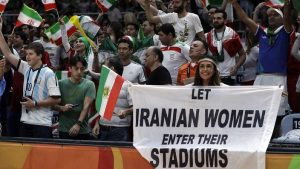 In May, the group used the slight easing of restrictions on public debate during the presidential election campaign to publish 21 demands for women and specifically pushed for women to be able to use public spaces and go to stadiums.
In September, the world’s media covered the fact women, despite having tickets, were refused entry to the football world cup qualifier between Syria and Iran in Tehran.
Two things this year have changed according to Open Stadiums. First, men and women in every match now complain about the ban on women at stadiums. They have been made to feel aware of the discrimination and it is talked about it a lot on social media. Second, MPs and people in power are beginning to talk about women’s rights to attend sports events in a way that would have been taboo before.
“I was happy down in my heart, especially when I read about the other nominees,” said Open Stadiums. “They were such great campaigns and people. I hadn’t heard of them before, and it was amazing to see how many individuals in this world are doing works not for more money but for better days for other people and society. This nomination gave me strength – yesterday when I was at risk of being arrested, I was thinking if i get arrested i know some people at least know about my passion and works i did these years.”
See the full shortlist for Index on Censorship’s Freedom of Expression Awards 2018 here.[/vc_column_text][/vc_column][/vc_row][vc_row full_width=”stretch_row_content” equal_height=”yes” el_class=”text_white” css=”.vc_custom_1490258749071{background-color: #cb3000 !important;}”][vc_column width=”1/2″][vc_custom_heading text=”Support the Index Fellowship.” font_container=”tag:p|font_size:28|text_align:center” use_theme_fonts=”yes” link=”url:https%3A%2F%2Fwww.indexoncensorship.org%2Fsupport-the-freedom-of-expression-awards%2F|||”][vc_column_text]
By donating to the Freedom of Expression Awards you help us support
individuals and groups at the forefront of tackling censorship.
Find out more
[/vc_column_text][/vc_column][vc_column width=”1/2″ css=”.vc_custom_1521479845471{background-image: url(https://www.indexoncensorship.org/wp-content/uploads/2017/05/2017-awards-fellows-1460×490-2_revised.jpg?id=90090) !important;background-position: center !important;background-repeat: no-repeat !important;background-size: cover !important;}”][/vc_column][/vc_row][vc_row][vc_column][vc_basic_grid post_type=”post” max_items=”4″ element_width=”6″ grid_id=”vc_gid:1522067393647-a5588697-4f78-2″ taxonomies=”10735″][/vc_column][/vc_row]
27 Mar 2018 | Africa, Artistic Freedom, Burkina Faso, News
[vc_row][vc_column][vc_column_text]
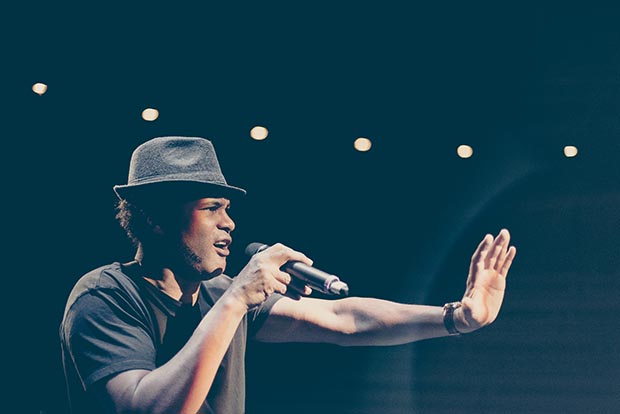
Music in Exile Fellowship Winner Serge Bambara, aka Smockey (Photo: Elina Kansikas for Index on Censorship)
On 3 March in Belfort, France, Burkinabe rapper and activist Smockey began a two-month long European tour, despite having his studio destroyed twice in recent years. The rapper, whose given name is Serge Bambara, was the inaugural Index on Censorship Music in Exile Fellow in April of the same year. Just three months after the awards, his recording studio, Studio Abazon, was wrecked in a devastating fire.
“All my music files since 2001, including my master tapes and those of my productions and clients, were lost,” Smockey told Index in September 2016. Two years on, it remains unclear how the fire began.
Smockey’s studio was also bombed in September 2015 by armed forces loyal to Burkina Faso’s former president Blaise Compaoré. This was a vengeful attack for his political activism and music critical of Compaoré’s regime.
Despite these aggressive and censorious acts, Smockey continues to record and perform, combating different forms of injustice with each track. As the founder of the grassroots political movement Le Bilai Citoyen, which helped to oust Compaoré, he often promotes the progressive ideas of Burkina Faso’s former socialist leader Thomas Sankara. The Sankarist ideology involves advocating for women’s rights, fighting corruption and imperialism, and upholding the integrity of Burkinabe people, all of which are reflected in Smockey’s lyrics. La Bilai Citoyen translates as the “the citizen’s broom,” which is “a tribute to Thomas Sankara, who organised weekly street-cleaning sessions,” Smockey told the BBC.
In March 2018 Smockey told news website Africa is a Country that Sankara’s image was that of “simplicity, modesty, and integrity … a model for anyone aspiring to manage public property”. He also noted that Sankara had the “courage and determination to build a Burkina Faso of social justice and inclusive development.”
Although the uprising of 2015 was successful in ridding Burkina Faso of an oppressive twenty-seven-year regime, Smockey is not an enthusiastic supporter of the country’s current government led by the progressive former opposition leader Roch Marc Christian Kaboré. Smockey is still a watchdog for human rights violations within his country. “The ones who were our friends before the revolution can be our enemies today,” he told Quartz Africa in July 2016. “We helped them have this power, but we are not friends because we are still sentinels.” For example, his song Tomber la Lame takes aim at widespread Female Genital Mutilation throughout Africa.
Despite multiple attempts to stop his political and artistic expression, Smockey continues to create and share his music globally. Over six weeks he will perform throughout Europe, finishing his tour in Brussels, Belgium, on 14 April.
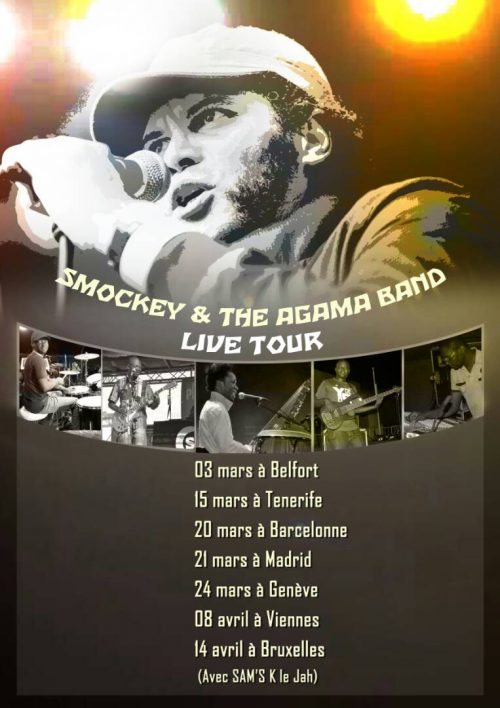
Smockey’s European Tour Dates and Locations 2018
[/vc_column_text][/vc_column][/vc_row][vc_row][vc_column][vc_basic_grid post_type=”post” max_items=”4″ element_width=”6″ grid_id=”vc_gid:1522161604778-9ae9ecbc-682f-8″ taxonomies=”8072″][/vc_column][/vc_row]
