16 Feb 2016
By Ceciel Brouwer, 16 February 2016
Ceciel Brouwer is a young academic doing a PhD at the School of Museum Studies in Leicester
In the United States, Australia and Britain a handful of art museums and galleries have come under scrutiny for displaying photographs of children.
Work by photographers such as Nan Goldin, Bill Henson and Sally Mann depicting children expressing a bodily awareness have provoked a reoccurring debate cast in two competing concerns. Voices generally sympathetic to the arts community defend the fundamental right of freedom of artistic expression and emphasise that children are able to give consent. Those calling for institutions to censor art accuse artists of perpetuating the sexualisation of children and ‘playing into the hands’ of paedophiles.
A more critical dialogue on the ethics of exhibiting photographs of young people’s bodies has been hard to find in these debates. The issues are bound up in the display of their image are addressed only during crises of controversy and too often presented as mutually exclusive, while voices of now-adult models remain profoundly absent.
Among the handful of models that have voiced their opinions in media, Sally Mann’s daughter spoke of her experiences as “teaching her the power of art” and inspiring her own career as an artist. Despite the media’s efforts, the now adult models of Bill Henson reflect on their collaboration with the artist as “empowering“. It seems that within circumstances that prioritise the needs and interests of the child, young people can experience an active engagement in art that is inspiring.
Yet not every parent or artist prioritises the best interests of the child when encouraging them to model, making this a particularly difficult ethical territory for museums to negotiate. An inherent power imbalance between parents and/or artists and young people allows some to pursue self-goals over the well-being of the child.
Adolescence is a time in which young people develop their identity, sexuality and thinking in adult-like ways, *while still remaining vulnerable and sensitive to expectations of adults* but also during which they have particular vulnerabilities and remain sensitive to expectations and coercion of adults. A young person might not see the implications of posing in certain ways as problematic until growing into adulthood. *I’d suggest making a new graph here*Consent is fluid and changeable because a person’s feelings may change according to the embodied experiences of adolescence. The meanings a photograph might evoke in other viewers might not become evident until later in life. In addition, photographs are mutable and can be read in very different ways that are temporally and culturally contingent.
In 2010, Vanity Fair published an article that exposed the emotional damage caused by Pop Art pioneer Larry Rivers on his two daughters by filming them naked during their early teens. Rivers made tapes of Emma and her older sister Gwynne on different occasions during the late 70s, “sometimes just with their breasts exposed, sometimes naked, as their father asked them questions about their bodies and budding sexuality“. Although film is inherently different from photography, it shares similarities in this context in that it is expected to show a supposed reality, the true image of a person. One of his daughters later said the film, Growing, contributed to the eating disorder and mental health problems she experienced during her adolescence and adulthood. Despite requests to have the tape destroyed, the archive’s keepers of The Larry Rivers Foundation have decided to keep the film behind closed doors in his daughter’s lifetime, but insist the collection should be kept for the sake of art.
Emma’s account embodies the idea that there is something predatory about the act of taking a photograph, as Susan Sontag asserted in On Photography. Photographs can blur the boundaries between reality and fiction and assert control over their subject, by turning a person into an object that can be possessed. River’s daughter is one of few who has attempted to gain back control over her image and ultimately failed to do so. Although the embargo on the video is partial, it does not grant her control.
Consent is negotiated and defined at the site of construction of the artwork by the relationships between the artist, parents and the autonomy of the child, but cultural institutions play a role by collecting, giving access to, exhibiting and publicising images. A museum grants the image a status inside the realm of art, but also brings work such as Larry River’s from the private into the public sphere. Outside the contemplated context of a gallery or archive, there is little space to negotiate the terms at which a photograph is used. Without any right of ownership of images of themselves, can a young person truly give lifelong informed consent for their image to be used?
No research exists that can enrich this discussion and more significantly bring to light how young people and adults reflect on their experiences. Moreover, a more open and interdisciplinary dialogue between lawyers, children rights advocates, medical ethicists, police, artists and museums is needed to equip institutions with the knowledge to encourage more informed and transparent decision-making and at the same time safeguard themselves against both censorship and self-censorship. A helpful way forward might take the shape of a more dynamic museum ethics discourse that appreciates the complexities of the context in which photographs are made and is rooted in an ethic of care towards the child on display.
Ceciel Brouwer is a young academic doing a PhD at the School of Museum Studies in Leicester. Her research explores how museums negotiate the ethical issues involved in collecting, interpreting and displaying photographs of children that express a bodily awareness. She became interested in ethics, consent and representations of young people when reflecting on the impact of her own experiences as a child participant in medical research and treatment. Her research is funded by the AHRC and Midlands3Cities.
Malaysia: Drop charges against Lena Hendry
11 Dec 2015 | Asia and Pacific, Campaigns, Malaysia, mobile, Statements
Dear Attorney General Mohamed Apandi Ali,
We write to you as organisations that are deeply concerned by the decision of the Malaysian authorities to prosecute Lena Hendry for her involvement in the screening of the award-winning human rights documentary, “No Fire Zone: The Killing Fields of Sri Lanka,” in Kuala Lumpur on July 9, 2013. The charges against her violate Malaysia’s obligations to respect the rights to freedom of opinion and expression, notably to receive and impart information. We respectfully urge you to drop the charges against Hendry. Her trial in Magistrate Court 6 in Kuala Lumpur is slated to begin on December 14, 2015.
As you know, Hendry is being charged under section 6 of the Film Censorship Act 2002, which imposes a mandatory prior censorship or licensing scheme on all films before they can be screened at any event, except films sponsored by the federal government or any state government. If convicted, she faces up to three years in prison and a fine up to RM 30,000.
The prosecution appears intended to restrict the activities of Hendry and members of the KOMAS, the human rights education and promotion organisation with which she works, by hindering their efforts to provide information and share their perspectives on human rights issues.
International human rights law and standards, such as found in article 19 of the Universal Declaration of Human Rights, states that “everyone has the right to freedom of opinion and expression; this right includes freedom to hold opinions without interference and to seek, receive, and impart information and ideas through any media and regardless of frontiers.”
Malaysia has committed to ensuring that all human rights defenders are able to carry out their activities without any hindrance or fear of reprisals from the government. In November, Malaysia voted in favor of a resolution on “Recognizing the role of human rights defenders and the need for their protection” in the 3rd Committee of the United Nations General Assembly. The resolution set out the urgent need for governments to protect human rights defenders worldwide. Article 1 of the UN Declaration on Human Rights Defenders, adopted unanimously by the UN General Assembly on December 9, 1998, states that “everyone has the right, individually and in association with others, to promote and to strive for the protection and realization of human rights and fundamental freedoms at the national and international levels.” Article 12(2) provides that the government shall “take all necessary measures to ensure the protection by the competent authorities of everyone, individually and in association with others, against any violence, threats, retaliation, de facto or de jure adverse discrimination, pressure or any other arbitrary action as a consequence of his or her legitimate exercise of his or her rights.”
In addition to dropping the charges against Hendry, we also urge you, as attorney general, to seek to repeal provisions of the Film Censorship Act 2002 that allow unnecessary and arbitrary government interference in the showing of films in Malaysia. This policy denies Malaysians the opportunity to benefit from a range of viewpoints on issues of importance to Malaysian society and that affect Malaysia’s role in the world.
Sincerely,
Brad Adams
Director, Asia Division
Human Rights Watch
Gail Davidson
Executive Director
Lawyers’ Rights Watch Canada
Jodie Ginsberg
Chief Executive
Index on Censorship
Karim Lahidji
President
International Federation for Human Rights (FIDH)
Mary Lawlor
Director
Front Line Defenders
Edgardo Legaspi
Executive Director
Southeast Asian Press Alliance (SEAPA)
Marie Manson
Program Director for Human Rights Defenders at Risk
Civil Rights Defenders
Champa Patel
Interim Director, South East Asia and Pacific Regional Office
Amnesty International
Amy Smith
Executive Director
Fortify Rights
Oliver Spencer
Head of Asia
Article 19
Gerald Staberock
Secretary General
World Organization Against Torture (OMCT)
Sam Zarifi
Regional Director for Asia and the Pacific
International Commission of Jurists
Cc:
Ahmad Zahid Hamidi, Minister of Home Affairs
Joseph Y. Yun, Ambassador of the United States of America to Malaysia
Luc Vandebon, Ambassador of the European Union to Malaysia
Victoria Treadell, British High Commissioner to Malaysia
Christophe Penot, Ambassador of France to Malaysia
Holger Michael, Ambassador of Germany to Malaysia
Rod Smith, Australian High Commissioner to Malaysia
Judith St. George Canadian High Commissioner to Malaysia
Dr John Subritzky, New Zealand High Commissioner to Malaysia
Ibrahim Sahib, Sri Lanka High Commissioner to Malaysia
Drawing pressure: Cartoons go under the hammer in support of Index on Censorship
24 Nov 2015 | News, Press Releases, United Kingdom
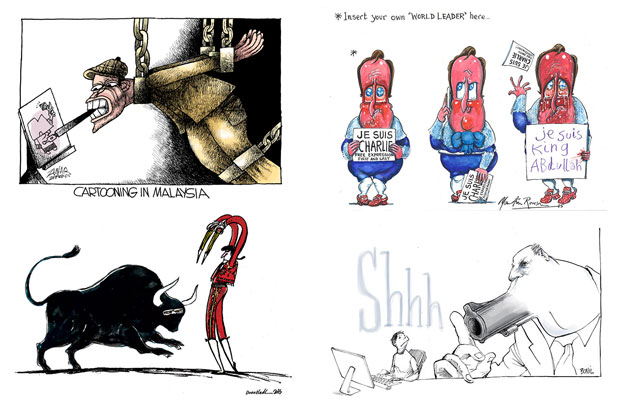
Among the cartoons available in the auction are original artworks by Zulkiflee Anwar Haque (Zunar); Martin Rowson; Xavier Bonilla (Bonil); and Doaa El Adl (clockwise from top left).
Index on Censorship is delighted to announce the auction of an incredible collection of cartoons that celebrate the power of art to challenge suppression. The auction will help fund our work supporting persecuted writers and artists worldwide.
Make a new donation to Index before the end of December to receive a limited-edition postcard set of 10 cartoons created by some of the world’s top political cartoonists
Earlier this year, Index commissioned 10 of the world’s leading cartoonists to pen a work on the theme of free expression. The cartoons are powerful tributes to the role of art, drawn by world-renowned artists from every continent: from a US Pulitzer Prize winner to a Syrian cartoonist beaten in retaliation for his work.
Beginning Tuesday, 24 November 2015, bidders will be able to enter bids for hand-drawn artwork by:
Xavier Bonilla (Bonil) – Ecuador
Regularly denounced, threatened and fined, Ecuador’s Bonil has earned the title “the pursued cartoonist” for his work. For 30 years he has critiqued, lampooned and ruffled the feathers of Ecuador’s political leaders, in the process earning a reputation as one of the wittiest and most fearless cartoonists in South America.
Kevin Kallaugher (Kal) – United States
US artist Kal is the editorial cartoonist for The Economist and The Baltimore Sun and his work has appeared in more than 100 publications worldwide including Le Monde, Der Spiegel, The International Herald Tribune, The New York Times, Time, Newsweek, and The Washington Post. He has won numerous awards, including the 2014 Grand Prix for Cartoon of the Year.
Signe Wilkinson (Signe) – United States
The first woman to win the Pulitzer Prize for Editorial Cartooning, Signe has won several other awards for her work. She comments on topical political issues and is best known for her daily cartoons in The Philadelphia Daily News.
Jean Plantureux (Plantu) – France
Plantu is the chief cartoonist for France’s Le Monde and founder of Cartooning for Peace, a global network of cartoonists. This drawing is a rare, signed copy of the world-famous cartoon Plantu drew for Le Monde the day after the attack on Charlie Hebdo.
Martin Rowson – UK
A former Cartoonist Laureate, political satirist Martin Rowson contributes cartoons to The Guardian and the Daily Mirror as well as Index on Censorship magazine. His work has earned him several awards, including the prize for the Best Humour and Satire Book of the Year at this year’s Political Book Awards.
Ali Farzat – Syria
Ali Farzat, a former Index on Censorship Freedom of Expression Award winner, came to global attention in 2011 when he was pulled from his car and beaten by Syrian security forces who broke both his hands. When Kuwaiti authorities closed the offices of his newspaper, Al-Watan, earlier this year Ferzat was forced to buy new materials and redrew this cartoon for us from scratch.
Doaa El Adl (Doaa) – Egypt
Doaa is a celebrated female artist in the Arab world – well know for her fearless political work. She has often tackled freedom of speech, human rights and women’s rights issues, wining numerous awards as well as controversy and even charges of blasphemy for her work.
Zulkiflee Anwar Haque (Zunar) – Malaysia
Zunar is an award-winning Malaysian political cartoonist who has been repeatedly targeted by authorities. Five of his cartoon books have been banned by the Malaysian government for carrying content “detrimental to public order” and thousands confiscated. He is currently facing up to 43 years in jail for mocking the government.
David Rowe – Australia
A three-time winner of the Stanley Award for Australia’s Cartoonist of the Year, David Rowe has worked for the Australian Financial Review for 22 years. Rowe’s bright and colourful watercolours are famously merciless.
Damien Glez – (Glez) – Burkina Faso
Glez’s cartoons regularly appear across three continents, including his own weekly satirical newspaper in Burkina Faso: Le Journal du Jeudi . He co-created pan-African monthly satirical Le Marabout, writes his own comic strip Divine Comedy and has won numerous awards internationally..
Bids must be placed by noon on Monday, 14 December 2015.
The auction is being hosted by Givergy.
Journalists covering refugee crisis attacked by Hungarian police
28 Sep 2015 | Europe and Central Asia, Hungary, Mapping Media Freedom, mobile, News, Serbia
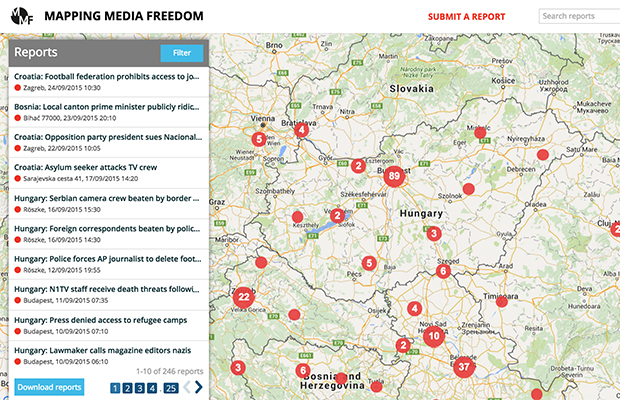
At least eight journalists were beaten and three detained as they covered a clash between refugees and the Hungarian police at the border with Serbia on 16 September.
Among those attacked were Swedish photographer Meli Petersson Ellafi, Jordan Davis, a journalist at Swiss RTS, and an entire film crew working for Radio Television of Serbia. They were covering events at the Horgoš-Röszke highway border crossing, which the Hungarian authorities had blocked the day before, leaving around 2,000 refugees stranded on the Serbian side.
On 16 September, at around 2:30 PM local time, refugees attempted to break through a gate into Hungary. While most were protesting peacefully, a small number threw stones and bottles across the fence at the Hungarian riot police. The police responded with tear gas, pepper spray and water cannons.
“At some point, the riot police retreated from the fence and the refugees managed to open the gate,” Timea Becková, who works for Slovakian newspaper Denník N, recalls. Confusion followed, with many refugees thinking the Hungarian authorities would let them in, so they walked towards the riot police on the Hungarian side. Several dozen journalists on the Serbian side followed the crowd.
At around 5:30 PM, TEK, the Hungarian anti-terror SWAT unit, equipped with sidearms, helmets and face masks, started pushing the refugees back towards Serbia.
“As I was moving backwards, I stopped for a moment to help an old man who fell and risked being trodden by riot police, which is when an officer hit me with a baton,” Becková said. She repeatedly told police in Hungarian that she is a journalist, but it made no difference.
“Suddenly the TEK guys, not the riot police, started running towards us — it was mayhem,” says Warren Richardson, an Australian photographer. Despite having two cameras, he was grabbed from behind by an officer.
“Clearly he was there to beat, not to ask questions,” Richardson told Index on Censorship, adding that he was standing on ‘no mans’ land’ between Serbia and Hungary. “From there they beat me into Hungary, then took me from the border to the police station illegally. They kidnapped me.”
“Law enforcement lost control of the situation,” Becková said. While she doesn’t hold a grudge against TEK, she says the events that followed were outrageous. She was forcefully brought back to the Hungarian side — with her hands tied tightly with a plastic wrap — where she was thrown to the ground.
She was later handed over to the regular police along with Richardson, who was kicked in the head and chest, and the Polish journalist, Jacek Tacik, who suffered a head wound. They were taken to a police station in Szeged along with a number of detained refugees.
There they were questioned on suspicion of having crossed the border illegally. In addition, Becková was accused of inciting rebellion and Tacik was told he had assaulted a policeman. However, this accusation did not emerge again during his interrogation, he told Index.
During questioning, Richardson refused to cooperate. “I stood up for myself. They were making up laws. They never took my name, personal address or fingerprints,” he said.
After interrogations that lasted up to 13 hours, the journalists were released and the charges were dropped.
In a statement, the Hungarian police denied beating the journalists. “The police — in accordance with the law — used necessary and proportional force against the members of an aggressive group that was using instruments that could cause serious harm to the police protecting the border of Hungary and the European Union. The media workers stayed at their own risk in an area where the police — after a proper warning — used coercive instruments.”
Hungarian government spokesman Zoltan Kovacs said it was a surprise to find journalists among the chaos. He said that in situations like this, the safety of journalists cannot be guaranteed, therefore they should stay away. A policeman is not in the position to judge who is a troublemaker and who represents the media, he added.
The European Federation of Journalists (EFJ) has denounced the attack. “It is incomprehensible to see an EU country like Hungary constantly violating press freedom and human rights. The European Commission and international institutions must take action against these serious violations,” EFJ President Mogens Blicher Bjerregaard said.
“It is a prerequisite for EU member states to respect the EU Charter on fundamental rights which sets out standards on media freedom and freedom of expression.”
The incident was also condemned by the Committee to Protect Journalists. “We are appalled by the police violence against journalists covering this world story,” CPJ Europe and Central Asia Program Coordinator Nina Ognianova said. “The Hungarian government must make a clear and unequivocal statement that it will not tolerate such behavior.”
Mapping Media Freedom
Click on the bubbles to view reports or double-click to zoom in on specific regions. The full site can be accessed at https://mappingmediafreedom.org/
|
This article was published on 16 September 2015 at indexoncensorship.org