10 Apr 2015 | Azerbaijan, Azerbaijan News, Europe and Central Asia, mobile, News
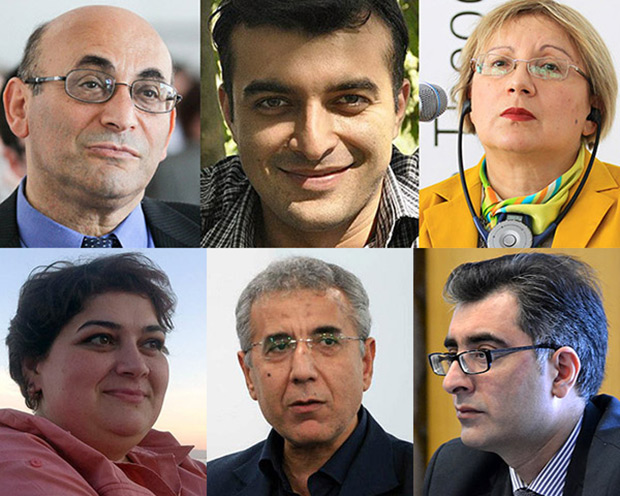
From top left: Arif Yunus, Rasul Jafarov, Leyla Yunus, Khadija Ismayilova, Intigam Aliyev and Anar Mammadli – some of the government critics jailed on trumped up charges in Azerbaijan
Social media users have hijacked the hashtag #HelloBaku to draw attention to human rights and free speech violations in Azerbaijan ahead of this summer’s inaugural European Games in the capital Baku.
Baku 2015 organisers launched the hashtag contest on 4 March 2015, as part of a promotional push ahead of the games, which start on 12 June. Social media users were invited to enter by posting a photo or video of themselves holding a sign with #HelloBaku written on it. The winner, set to be announced this week, will be awarded two tickets to the opening ceremony, as well as a night at a luxury hotel and flights.
But the campaign backfired, as a number of social media users instead used #HelloBaku to highlight Azerbaijan’s poor record on human rights. According to the latest estimates, there are over 100 political prisoners in the country. Since last summer, authorities have been engaged in an unprecedented onslaught against its most prominent critics, jailing investigative journalist Khadija Ismayilova, pro-democracy activist Rasul Jafarov, human rights lawyer Intigam Aliyev and others on trumped up charges. On 9 April, prosecutors asked for a 9-year sentence for Jafarov, who stands accused of tax evasion and malpractice, among other things.
On 30 March, the same day the contest closed, Human Rights Watch researcher Giorgi Gogia, who was set to attend the trial hearing of Aliyev and Jafarov, was blocked from entering Azerbaijan. Traveling from his native Georgia, Gogia does not require a visa to go to Azerbaijan. Despite this, his passport was taken away and he was held at the Heydar Aliyev International Airport in Baku for 31 hours without explanation, before being sent back to Tbilisi.
Azerbaijan’s authorities, led by President Ilham Aliyvev, have been accused by human rights groups of running an expensive international PR operation to whitewash rights violations, and present the country as a “modern, outward looking state“. According to the Baku European Games Operation Committee (BEGOC), the games will “showcase Azerbaijan as a vibrant and modern European nation of great achievement”.
London-based marketing firm 1000heads, whose clients include Yahoo, Procter & Gamble and Lego, worked with Baku 2015 organisers on #HelloBaku. Index contacted 1000heads to ask whether they were aware of criticisms against Azerbaijan’s human rights record before taking on the job, and their response to the hijacking of the hashtag.
“We were working with BEGOC, the Baku European Games Operation Committee, which is responsible for delivering the event for athletes from the 49 National Olympic Committees of Europe. We are no longer involved,” 1000heads CEO Mike Rowe said in an email.
This article was posted on 8 April 2015 at indexoncensorship.org
2 Feb 2015
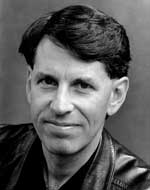
By Thomas A. Bass
Today Index on Censorship begins publishing a serialisation of Swamp of the Assassins by American academic and journalist Thomas Bass, who takes a detailed look at the Kafkaesque experience of publishing his biography of Pham Xuan An in Vietnam.
These are dark days in Vietnam, as the courts decree long prison terms for writers, journalists, bloggers, and anyone else with the temerity to criticize the country’s rulers. The brief efflorescence of Vietnamese literature that followed the collapse of the Berlin Wall in 1989—known as doi moi, or the Renovation movement—is long gone. After twenty years of black pens and prison, the censors have wiped out an entire generation of Vietnamese writers, driving them into silence or exile.
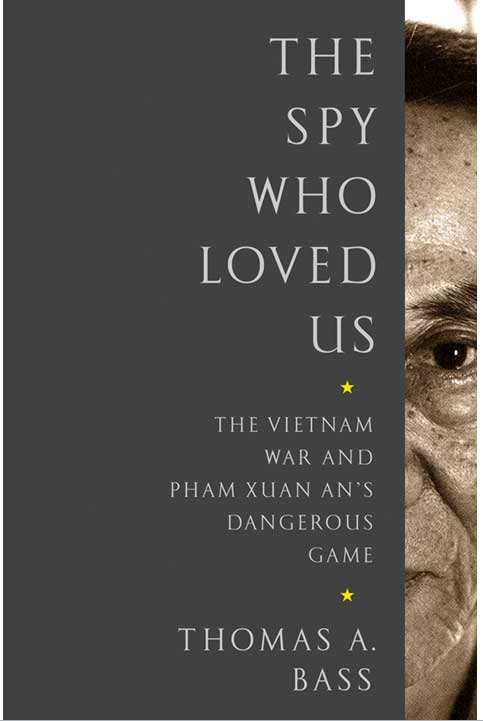
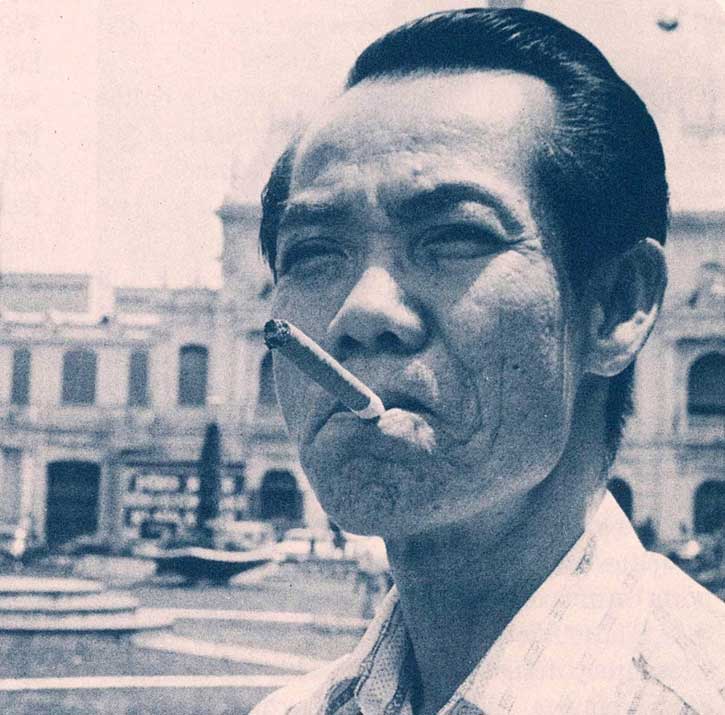
I myself have spent the last five years fighting with Vietnam’s censors, as they busied themselves cutting, rewriting, and then blocking from publication a Vietnamese translation of one of my books, The Spy Who Loved Us (2009). Based on a New Yorker article published in 2005, the book tells the story Pham Xuan An, the South Vietnamese journalist, whose remarkable effectiveness and long-lived career as a spy for the North Vietnamese communists—from the 1940s until his death in 2006—made him one of the greatest spies of the twentieth century. Trained in the U.S. as a journalist and using his profession as his cover, An worked as a correspondent for Time during the Vietnam war and served briefly as the magazine’s Saigon bureau chief. Charged with drawing battlefield maps, following troop movements, and analyzing political and military news, An leaked invaluable information to the North Vietnamese Army.
After the war, the victorious communists made An a Hero of the People’s Armed Forces and elevated him the rank of general. He is a natural subject for a biography, and, indeed, six have already been published, including another work in English by Georgia State University historian Larry Berman. Called Perfect Spy (2007), the book characterizes An as a patriot, a strategic analyst who observed the war from afar, until he happily retired to his living room, where he entertained a stream of distinguished visitors, from Morley Safer to Daniel Ellsberg.
My own account of An’s life is more troubling. I concluded that this brilliant raconteur developed a second cover as a spy. Claiming to be a friend of the West, an honest man who never told a lie (although his whole life was based on subterfuge), An had worked for Vietnamese military intelligence, not only throughout the Vietnam war, but also for thirty years after the war. At the same time, Vietnam’s northern power brokers distrusted this wise-cracking southerner who was outspoken in his attacks on the corruption and incompetence of Vietnam’s communist government. An’s rise in military rank was slow and begrudging, and he had been kept under police surveillance for years. The Vietnamese government might initially have been pleased by the prospect of publishing not one, but two, American-authored books on their “perfect spy,” but the longer the censors squinted at my version of An’s life, the more nervous they got, and the more the story had to be chopped and rewritten before it could be approved for publication.
After rejecting offers to translate my book from several publishers, including the People’s Public Security Publishing House (an official arm of Vietnam’s Ministry of Public Security) and the Ministry of Culture, Sports, and Tourism (one of the country’s largest censors), I signed a contract in July 2009 with Nha Nam, a respected publisher whose list of translated authors ranges from Jack Kerouac and Annie Proulx to Umberto Eco and Haruki Murakami. Nha Nam is an independent publisher, one of the few in Vietnam not affiliated with a ministry or other state censor. Nha Nam is occasionally fined for publishing “sensitive” books, and sometimes their titles are pulled from the shelf and pulped. Only later would I learn that Nha Nam’s status as an independent publisher does not guarantee its independence, but to their credit, the company has kept me apprised of every move made over the past five years to censor The Spy Who Loved Us.
Many authors ignore their books in translation. They delegate the sale of subsidiary rights to their agents and barely glance at the texts that arrive later in German or Chinese. I planned something different for my Vietnamese translation. I suspected it would be censored and wanted to track the process. I asked my agent to write into my contract a clause stating that the book would not be published without my prior consent and that I had to be consulted about changes made to the manuscript. Other clauses wired the book like a literary seismometer. I wanted it to record the work of the censors, to register their preoccupations and anxieties, so that by the end of the day I would know what the Vietnamese government feared and wanted to suppress.
The process of translating my book into Vietnamese began in March 2010, when I received an email saying, “I am Nguyen Viet Long of Nha Nam company, now editing the translation of The Spy Who Loved Us. I should like to correspond with you in regard to the translation.”
Long begins by asking if I know the correct diacritical marks for the name of Pham Xuan An’s grandfather. These are missing in English but important in Vietnamese, and I appreciate his attention to detail. Unfortunately, the rest of his email adopts a more aggressive tone. “You make some mistakes,” he writes, before correcting a laundry list of items. Many of these mistakes are not really mistakes, but questions of interpretation or judgment or matters of dispute in the historical record. They are the Vietnamese equivalent of inside baseball, arcane tidbits good for keeping scholars dancing on pinheads.
For example, did Jean Baptiste Ngo Dinh Diem (the first president of the Republic of Vietnam) become a provincial governor at the age of twenty-five? This depends on the day he was born, which is not an easy question to answer. People in Vietnam customarily fudge their birth dates, a practice recommended for scaring away demons, improving astrological signs, and attracting younger mates. An obscure item for an American author is apparently a big deal for the Vietnamese. If one assumes that Ngo Dinh Diem was an American puppet, a running dog for the imperialist invaders, then the last thing one wants to do is credit him with youthful accomplishment. Hence, one denies that he was the youngest governor in Vietnamese history and complicates the issue so extensively that it becomes easier simply to drop the claim.
Responding to a query from my literary agent, Long on March 15 writes, “There will be (absolutely) censorship, the book is sensitive. But please do not worry. We will keep talking to the author and will do our best to protect as much as possible the wholeness of the book.”
Long is trying to rush the book into print by April 30th—the auspicious day marking the end of the Vietnam war. After my agent reminds him that he is contractually obligated to show me the translation of the book before it can be published, Long misses the first deadline, and then he misses more deadlines, until, finally, six months later, in September 2010, I receive a copy of the galleys. The first thing I notice is an unusual number of footnotes scattered throughout the text, in a book that originally had no footnotes. I have enlisted a coterie of friends—academics, translators, an ex-CIA agent, and a former U.S. diplomat and his Vietnamese wife—to review the translation. They come back to me with sobering news. Apparently, many of the footnotes begin by saying, “The author is wrong.” Then they correct my “mistakes.”
Clearly, I have misunderstood the function of Vietnamese editors. Even before my book goes to the real censors—the chaps who control Vietnam’s publishing licenses—it has to be massaged in-house. Long will do the first whack, and the more efficiently he prunes, the more appreciated he will be by the state officials who can cap their black pens and turn to censoring more important things.
Part 2: Fighting hand-to-hand in the hedgerows of literature
This first installment of the serialisation of Swamp of the Assassins by Thomas A. Bass was posted on February 2, 2015 at indexoncensorship.org
19 Dec 2014 | India, News
The state of free speech in India remains a cause for concern judging by the rise in recorded attacks on the media and the increasing use of defamation suits — the most marked trends in 2014.
The figure for attacks on the media rose sharply with better data collection. There were at least 85 attacks this year. For the first time, since January 2014, the National Crime Records Bureau (NCRB) has begun collecting data on attacks on the media as a separate category.
Reported cases of defamation and legal notices alleging defamation totaled 21 in 2014 (till December 15). Of the eleven new cases recorded, seven were filed against media, two against college publications, and 3 against individual politicians. Two were court orders against publishers, a total of 14. Those against the media included the cases filed by Justice Swatanter Kumar and Indian captain M.S. Dhoni; politician Gurudas Kamat, and the Sahara Group.
In addition, one defamation conviction was upheld in a case filed earlier, against Vir Sanghvi when he was at the Hindustan Times.
Seven legal notices were served during the year — five to media houses, one to a marketing federation for the advertisement they ran, and one to journalist-authors. The last was sent by Mukesh Ambani-led Reliance Industries Ltd to Paranjoy Guha Thakurta and other authors of the book Gas Wars: Crony capitalism and the Ambanis. A Rs 100 crore notice was sent by industrialist Sai Rama Krishna Karuturi, Managing Director of Karuturi Global Ltd, to environmental journalist Keya Acharya. Infosys, and a former police commissioner in Pune also served legal notices on the media in the year gone by.
There was a drop in the deaths of journalists from eight in 2013 to two this year. However, a hate crime was recorded in the death of a software engineer in Pune, underlining the spike in hate speech cases. Apart from censorship across media and of books, theatre and film, there were at least 85 cases of attacks on journalists, 62 of which were from Uttar Pradesh alone.
These and other instances form part of the reported cases in the Free Speech Tracker of the Free Speech Hub till December 15, 2014. A project of the media watch site The Hoot the Free Speech Hub has been monitoring freedom of expression in India since 2010 and this is its fifth annual report. The tracker looks at a range of issues, including journalists’ deaths, attacks on journalists and on citizens, threats and arrests arising out of free speech issues, censorship, defamation, privacy, contempt, surveillance, and hate speech.
Seven defamation notices, and six legal notices were against media houses or journalists. In addition police complaints alleging defamation were also filed. The defamation cases also resulted in gag orders against the media, drawing criticism from the Editors Guild of India but to no avail. A defamation case filed by former President of the BJP, Nitin Gadkari also resulted in the arrest of Aam Aadmi Party leader Arvind Kejriwal in May, for calling the former corrupt. Kejriwal refused to furnish a bail bond and was remanded to judicial custody. The latest case, a Delhi police directive to radio stations to stop broadcasting a jingle from the Aam Aadmi Party on the grounds of defamation, only served to illustrate the extreme sensitivity of the powers that be to any criticism.
Clearly, defamation cases act as a pressure and silencing tool. Congress spokesperson and former minister Manish Tiwari faced arrest in a criminal defamation case filed by former BJP President Nitin Gadkari for alleging that the latter held a ‘benami’ flat in the Adarsh housing society. But after a summons was issued for his arrest, Tiwari submitted an unconditional apology and the case was withdrawn.
In another case, the Sahara media group filed a defamation case against Mint editor Tamal Bandopadhyay and the Kolkata High Court stayed the release of his book, Sahara: The Untold Story but a disclaimer and a settlement followed and the case was withdrawn.
Hate speech remains on the fault lines of free speech and, given the unabashed use of hate propaganda during the campaign for the 16th Lok Sabha elections, there was a sharp spike in the number of hate speech cases to 20 this year, double the 2013 figure.
The arrest of people for Facebook posts continued, despite clear guidelines issued on cases related to Section 66 (A) of the Information Technology Act in the wake of the arrest of two students from Palghar in 2012 and a pending case challenging the provisions before the Supreme Court of India. Sedition cases also cropped up; a student was arrested in Kerala for sedition for remaining seated while the national anthem was being played in a cinema.
Apart from the ignominious cave in by book publishers to the demands of Hindutva organisations, as in the case of the Wendy Doniger book The Hindus, other attacks on the media and civil society activists and violence by vigilante groups bent on imposing a regressive moral agenda, added to the potent brew for free speech violations in 2014.
Highlights
Deaths : Two journalists and a victim of a hate crime
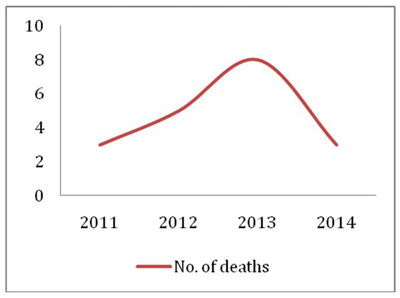
There has been a drop in the deaths of journalists from eight in 2013 to two this year. Tarun Acharya in Odisha and M.N.V. Shankar in Andhra Pradesh were brutally killed days after reporting on malpractices by local business people.
The third death, of 24-year old Mohsin Shaikh, a software engineer in Pune, was triggered by a Facebook post allegedly defamatory to 17th century Maratha ruler Shivaji and the late Shiv Sena leader Bal Thackeray. The engineer had no connection with the Facebook post but was targeted because his beard indicated his identity as a Muslim. Police arrested the founder of the Hindu Rashtra Sena, Dhananjay Desai, for a hate crime.
In 2013, eight journalists died, including Sai Reddy who was killed by Maoist groups in Chhattisgarh. In April 2014, these groups admitted that killing Reddy was a mistake. There were five deaths in 2012 and three in 2011.
Defamation cases and legal notices increase to 21
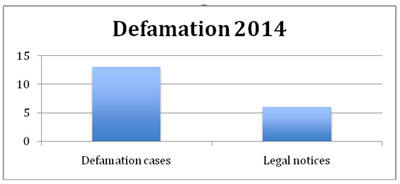
Defamation cases and legal notices threatening defamation had a chilling effect on freedom of expression with 21 instances being recorded through the year, an increase from the two cases in 2012 and seven in 2013. From politicians to business houses, lawyers, former judges and media houses, defamation notices were sent against book publishers, advertisers, other media houses and journalists.
Arrest of 13 persons, including a journalist under NSA, a student for sedition and three persons for Facebook-related content
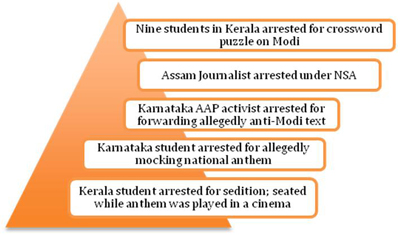
In Kerala, nine students were arrested for a crossword clue in a college magazine allegedly unfavourable to Prime Minister Narendra Modi. Other arrests included a journalist from Assam, allegedly due to links with insurgency groups and a student from Kerala on charges of sedition for remaining seated while the national anthem was being played in a cinema and three others for Facebook-related content.
Censorship: 85 instances
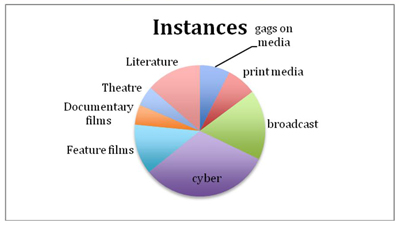
The number of instances of censorship this year fell to 86 from 99 in 2013 and 74 in 2012. Internet-related censorship fell marginally from 32 in 2013 to 27 this year. Ten of these instances were related to Facebook posts that attracted cases and triggered violence in at least three instances. There were 25 instances of censorship in print and the broadcast media, including five gag orders on media reportage and one on radio broadcasts of an advertisement.
Censorship showed an overall decrease from 99 instances last year to 85 this year. However, censorship in the broadcast media saw an increase to 14 instances, besides five instances of gags on media coverage of sensitive issues being obtained by a range of people, including former judges charged with sexual harassment and sports bodies and educational institutions.
Attacks, threats and harassment: 101 instances
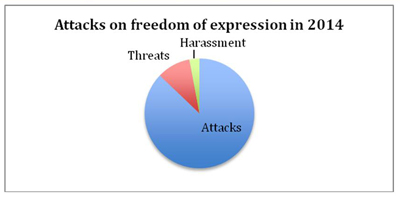
Direct physical attacks on the media and on citizens for freedom of expression issues remained high, with at least 85 cases of attacks recorded by the media alone in 2014. In addition, there were three attacks on other citizens, ten cases of threats and three of harassment.
For the first time, the National Crime Records Bureau has begun collecting data on attacks on the media as a separate category from January this year. In a written reply to a question in the Lok Sabha, the Minister of State for Information and Broadcasting Rajyavardhan Rathore said that, up to June, 62 of these cases occurred in Uttar Pradesh.
According to the Minister’s reply, up to August 8, there were six cases each in Bihar and Madhya Pradesh, with no arrests in Bihar but eight in Madhya Pradesh. Cases of attacks on the media were also registered in Andhra Pradesh, Gujarat, Assam and Meghalaya and seven people were arrested in connection with the cases in Andhra Pradesh, Gujarat, Maharashtra, and Meghalaya.
While more details are awaited on these attacks and on how many were related to professional work, the Hoot’s Free Speech Tracker has details of 18 instances of attacks and 12 instances of threats recorded this year. Of these, 15 attacks and nine threats were directed at the media, including a police assault on journalists covering news events, the sand mafia attacking an environmental journalist, separate instances of a petrol bomb and gunshots fired on the homes of journalists and reports of journalists being used as ‘human shields’ in Kashmir.
Sharp spike in hate speeches

This year saw the sharpest rise in hate speeches from two in 2012 and ten in 2013 to 22, peaking in the run-up to what was billed as the most divisive general election in India’s history. Apart from riots that broke out due to the circulation of videos or inflammatory messages, instances of hate propaganda and riots marked the increase in hate speeches in the country and, given the scheduled elections to various state assemblies, shows no signs of abating till the end of the year — witness the reports of the hate speech made by BJP Minister Sadhvi Niranjan Jyoti in December 2014.
Snapshot of the last three years
| Categories |
2014 |
2013 |
2012 |
Deaths of journalists
Death due to hate crimeTotal |
02
0103 |
08
|
05 |
Attacks on the media
Attacks on citizens
Threats
Harassment
Arrests/detentionsTotal |
85
03
10
03
04105 |
20
04
0225 |
39
|
| Censorship :
Gags on all media
Print
Electronic media
Internet
Feature films
Documentary films
Theatre
Art
Music
Literature and educational curriculum
Total |
06
06
14
26
10
04
04
–
0511
86 |
15
11
32
21
02
02
03
06
07
99 |
08
04
41
14
07
74 |
| Privacy & Surveillance |
08 |
13 |
05 |
Defamation cases
Legal notices
Court order Total |
12
07
0221 |
07 |
02 |
Hate speech
Hate propagandaCourt cases on hate speech restrictions |
20
0202 |
10 |
02 |
| Policy, regulation |
02 |
07 |
03 |
Sedition (including three withdrawals)
Contempt
Legislative privileges |
05
03 |
02
02
01 |
|
The year in review
Free speech violations in 2014 included the death of two journalists for their investigative stories on malpractices in local businesses, the killing of a young software engineer in Pune for what police termed a ‘hate crime’, an increase in defamation cases and legal notices to curb reportage of a range of issues, increasing attacks on the media and civil society activists, violence by vigilante groups and a spike in hate speech cases during various election campaigns.
While the number of deaths of journalists for their work may have fallen from the eight of the preceding year to two this year — Tarun Acharya and M.N.V. Shankar – they underline the extreme vulnerability of journalists working in small towns, particularly on unearthing crimes.
Acharya, 29, was a stringer for Kanak TV in Odisha and was killed on May 27 in Khallikote town of Ganjam district. He had done an investigative story on the alleged employment of children in a cashew processing plant owned by one S. Prusty. Shankar, 52, a senior correspondent with Andhra Prabha newspaper, was killed in Chilakaluripet town of Guntur district on May 26, a few days after his newspaper published his report on the kerosene oil mafia. While the police arrested two persons in connection with Acharya’s murder, Shankar’s killers have yet to be found.
Attacks, arrests
This year saw an increase in attacks on the media, as officially recorded by the National Crimes Bureau for the first time, an increase in threats to journalists as well as the arrests of journalists for alleged involvement with insurgency groups and the arrest of citizens for posts on social media.
Of the eight cases linked to Facebook posts, one person was arrested for a post allegedly against West Bengal Chief Minister Mamta Banerjee; an Aam Aadmi Party activist was arrested for forwarding an allegedly anti-Modi text in Karnataka; a student was arrested for allegedly mocking the national anthem in Kumta, Karnataka; and in Kerala, a student was arrested for sedition for allegedly insulting the national anthem by remaining seated while it was being played in a local theatre.
Defamation
The intimidating effect of a possible defamation suit was clearly on the rise as 2014 recorded 21 instances of defamation against individuals and the media. These included 13 cases of defamation and six legal notices, besides one court order.
In May, Aam Aadmi Party leader Arvind Kejriwal was arrested in a defamation case filed by former president of the BJP, Nitin Gadkari, for calling the latter corrupt. He refused to furnish a bail bond and was remanded to judicial custody.
Former Supreme Court judge and National Green Tribunal Chairperson Justice Swatanter Kumar filed a defamation case against two English television channels and a leading English newspaper as well as a law intern who had filed a complaint of sexual harassment against him. He also managed to get a gag order on media reportage of the case.
In another case, India cricket captain M.S. Dhoni filed a Rs 100 crore defamation case in the Madras High Court against media houses Zee Media Corporation and News Nation Network over allegations of his involvement in match-fixing.
Clearly, defamation cases serve to silence people. Congress spokesperson and former minister Manish Tiwari faced arrest in a criminal defamation case filed by former BJP President Nitin Gadkari for alleging that the latter held a ‘benami’ flat in the Adarsh housing society. But after a summons was issued for his arrest, Tiwari submitted an unconditional apology and the case was withdrawn.
In another case, the Sahara media group filed a defamation case against Mint editor Tamal Bandopadhyay and the Kolkata High Court stayed the release of his book, Sahara: The Untold Story, but a disclaimer and a settlement followed and the case was withdrawn. Given that decriminalizing defamation has been a long-standing demand of journalists’ organisations, it is ironical that a media group such as Sahara should resort to defamation notices.
It was not the only one. India TV sent a defamation notice to aggrieved employee Tanu Sharma who had alleged sexual harassment and had attempted suicide outside the company’s office. It also sent a defamation notice to media watch site Newslaundry which carried a report on the incident.
Among the other cases, Infosys sent notices of Rs 2000 crore each to three publications owned by Bennett, Coleman and Co. Ltd and The Indian Express Ltd. Other multi-crore defamation notices included separate notices sent by Mukesh Ambani’s Reliance Industries Ltd and Anil Ambani-led Reliance Natural Resources Ltd to journalist Paranjoy Guha Thakurta, author of Gas Wars: Crony Capitalism and the Ambanis. The notices were an attempt to remove the self-published book from the website promoting it.
An Inter Press Service story by environmental journalist Keya Acharya on the legal, financial, tax, labour and land problems of the Ramakrishna Karuturi-owned Karuturi Global Limited in Kenya and Ethiopia attracted a Rs 100 crore defamation notice.
Censorship
Censorship showed an overall decrease from 99 instances last year to 86 instances this year. However, censorship in the broadcast media saw an increase to 14 instances, besides five instances of gags on media coverage of sensitive issues being obtained by a range of people, including former judges charged with sexual harassment and sports bodies and educational institutions. A gag on radio jingles by Delhi police was the latest attempt at censorship.
An increase in censorship was also recorded in the arena of literature and non-fiction books, including in academia. In February 2014, Penguin, the publishers of The Hindus: An Alternative Histor, by the well-known Indologist Wendy Doniger, decided to pulp all remaining copies of the book in an out-of-court settlement with Shiksha Bachao Andolan (SBA), which had filed a civil suit against the publishers in 2011.
The organization, headed by Dinanath Batra, targeted other publishers and Orient Blackswan followed suit to withdraw ‘Communalism and Sexual Violence: Ahmedabad since 1969’ by Dr Megha Kumar. The same publisher also put under review Sekhar Bandyopadhyay’s book From Plassey to Partition: A History of Modern India.
In 2008, SBA was instrumental in filing a complaint before the Delhi High Court seeking the withdrawal of A. K. Ramanujam’s essay, Three Hundred Ramayanas: Five Examples and Three Thoughts on Translations, from Delhi University’s history syllabus. In July 2014, following the election victory of the BJP, six of Batra’s books were prescribed as compulsory reading as supplementary literature in the Gujarat state curriculum.
Hate speech
Over the last few years, hate speech and hate propaganda have tested the limits to free speech. The Free Speech Tracker has recorded two instances of hate speech in 2012 and ten in 2013. By 2014, the number of hate speech cases doubled, with an additional complaint of hate campaigning.
The death of an innocent software techie, Mohsin Sadiq Shaikh, 24, at the hands of members of a Hindu fundamentalist group, the Hindu Rashtra Sena in Pune on June 4, was a chilling reminder of the violent consequences of hate propaganda. A Facebook post with allegedly derogatory photographs of 17th century Maratha ruler Shivaji and the late Shiv Sena leader Bal Thackeray had triggered violence in Pune and a mob chanced upon Shaikh and his friend, returning home after offering namaz. Shaikh, who was identified as a Muslim by the skull cap he wore, was beaten to death. Later, seven members of the organization, including its leader, Dhananjay Desai, were arrested and charged with his murder.
Other hate speech cases were recorded throughout the year, beginning with the general election campaign and continuing to the end of the year with a lawyer from Mumbai being charged with posting allegedly inflammatory content on Facebook and BJP MP Sadhvi Niranjan Jyoti making offensive remarks on December 3.
Prominent leaders of political parties, including BJP President Amit Shah, were booked for hate speech. Other political leaders charged with hate speech included Pravin Togadia (VHP), Ramdas Kadam (Shiv Sena), Giriraj Singh, Baba Ramdev, Tapas Pal (Trinamool Congress), Azam Khan (Samajwadi Party), Pramod Mutalik (Sri Ram Sene), Imran Masood and Amaresh Mishra (Congress-I).
Contempt, privacy and surveillance
Contempt cases continued to come up and three instances were recorded, including one case that cited the archaic provision of ‘scandalising the court.
Instances of privacy also continued to figure on the Free Speech Tracker as business people and social activists cited privacy concerns to stall books and films based on their lives. In the latter category, Gulabi Gang founder Sampat Pal sought a stay on a Bollywood feature film based on her life on the grounds of privacy and copyright but settled out of court. And the Bombay High Court directed the makers of a film based on the Khairlanji massacre to apply for a fresh certificate from the Central Board of Film Certification.
Surveillance, a growing issue both globally and nationally, remained a concern as the new government reiterated its plans to go ahead with the UPA’s controversial UID scheme even as it quietly continued the roll out of the surveillance programmes of the previous regime.
For a detailed list of the instances from the Free Speech Tracker, please click here.
This article was originally posted on 16 Dec 2014 at thehoot.org and is posted here with permission.
12 Nov 2014 | Azerbaijan, Azerbaijan News, Azerbaijan Statements, Campaigns, Statements
Mr Ilham Aliyev
President of the Republic of Azerbaijan
Azerbaijan Avenue 7
1005 Baku
Republic of Azerbaijan
Fax: +994124923543 and +994124920625
Email: [email protected]
Mr President,
As the Chairmanship of the Council of Europe by the Republic of Azerbaijan draws to a close, we, the undersigned members and partners of the Human Rights House Network (HRHN) and the South Caucasus Network of Human Rights Defenders, call upon the Azerbaijani authorities, through you, Mr President, to put an end to the unprecedented repression against civil society. We call upon you to immediately and unconditionally release all civil society actors currently detained due to their engagement in human rights work and for raising critiques against Azerbaijan’s authorities, including and especially human rights defenders Leyla Yunus and her husband Arif Yunus, Rasul Jafarov, and Intigam Aliyev. Anar Mammadli and Bashir Suleymanli must also be released, as their detention is solely due to their monitoring of elections in the country, including the latest Presidential election of 9 October 2013.
This summer, one after the other, the main leaders of civil society were arrested. Many others decided to flee the country, rather than facing court hearings, of which the outcome is well known in advance. Few others have been forced into hiding in the country.
Leader of the Legal Education Society, human rights lawyer Intigam Aliyev was sentenced on 8 August 2014 to pre-trial detention for 3 months on the same charges as those held against human rights defenders Rasul Jafarov, who was arrested on 2 August 2014 for tax evasion, illegal business and abuse of authority. On similar charges, Leyla Yunus, and her husband, Arif Yunus, were arrested on 30 July and 5 August 2014 respectively. Charges of State treason are additionally held against Leyla Yunus. Furthermore, the lawyers of Leyla Yunus and Intigam Aliyev were called as witnesses against their clients and hence bared from being their defendants. Very few lawyers agree to take up politically charged cases in Azerbaijan, a country in which the Bar Association is controlled by the Ministry of Justice and has disbarred lawyers such as Intigam Aliyev himself.[1] On 6 November 2014, the lawyer of Leyla Yunus, Alaif Hasanov, was sentenced to 240 hours of community service due to his public statements about the detention conditions of his client. Leyla Yunus has indeed faced psychological and physical abuses in detention, from detainees and from prison officials.
Earlier this year, the regional civil society leader Hasan Huseynli was sentenced to 6-years imprisonment[2] and the leaders of the only independent election monitoring organisation in the country, Anar Mammadli and Bashir Suleymanli, were sentenced to respectively 5 years and 6 months and 3 years and 6 months imprisonment.
Facing investigations and charges, many other human rights defenders fled the country or are in hiding from authorities, as they know they will not enjoy a fair hearing in court.
The authorities have also targeted other respected human rights voices in the country, such as the Institute for Reporters’ Freedom and Safety (IRFS), a leading media rights NGO in the country. IRFS’ leader, Emin Huseynov, is well known and an internationally recognised human rights defender, facing similar charges as the other human rights defenders. On 5 November 2014, the 67-year old mother of human rights defender Gulnara Akhundova was summoned to the Office of the General Prosecutor. She was extensively interrogated about her daughter’s human rights activities. Following this interrogation, the Office conducted a search in the apartment registered as Gulnara Akhundova official address in Baku, which is her mother’s apartment. The few other independent voices left are also facing investigations and can be arrested at any given time.
On 10 November 2014, the blogger Mehman Huseynov, brother of Emin Huseynov and also an IRFS employee, was stopped and interrogated at the Baku Airport and later released. He was arrested in relation to an on going investigation against him, based on which he was issued a travel ban.[3] He is still not allowed to leave the country.
On 5 November 2014, the Nakhchivan City Court decided to end the investigation into Ilgar Nasibov. On 21 August 2014, Ilgar Nasibov was beaten in the office of the Democracy and NGO’s Development Resource Center in Nakhchivan. He suffered multiple fractures and injuries and to date remains in dire need of treatment. In an often-used strategy against critical voices, the police filed a lawsuit against him on charges of deliberately inflicting serious damage to health (article 127.1 of the Criminal Code of the Republic of Azerbaijan). We believe Ilgar Nasibov should be compensated for the pain he suffered and immediately provided with adequate medical support.
Politically motivated detentions of activists of the youth opposition movement NIDA must also end, as well as those of inter alia journalists Rauf Mirkadirov and Hilal Mammadov[4] and political activist Tofiq Yaqublu. On 30 October, the opposition journalist Khalid Garayev was sentenced to 25 days in detention on charges of hooliganism and disobedience to the police.
All of those human rights defenders are respected internationally and received various recognitions. Those do not protect them from the repression, just as the worrying health condition of a few does not deserve any special treatment in the eyes of the authorities. We are also extremely worried to hear that the heath conditions of Leyla Yunus and Intigam Aliyev have greatly deteriorated. We believe that the conditions of their detention have had a detrimental effect on their health, as it appears that both have still not been provided adequate health care to address their respective illnesses. Intigam Aliyev has recently complained of increasing pain and Leyla Yunus is suffering a severe diabetics.
Repression of civil society: systemic problem remaining unaddressed
Unlike claims made internationally, Azerbaijan is not “on a journey towards human rights, to which it is committed.”[5] For a few years, Azerbaijan has repeatedly and by various international mechanisms been called upon to reform its legislation to prevent any crackdown on civil society.
In 2009 already, the United Nations Human Rights Committee expressed its concern over the “extensive limitations to the right to freedom of expression of the media, the closure of independent newspapers, and the removal of licences to broadcast locally for a number of foreign radio stations. It also remains concerned at reports of a pattern of harassment and criminal libel suits or hooliganism charges against journalists.”[6] The Committee was indeed shedding light on a wave of repression against media workers in the country, which included also the banning of foreign media, such as Voice of America and the Azerbaijani coverage of the British Broadcasting Corporation.
Another wave of repression then touched upon the presence of international non-governmental organisations in Azerbaijan. In July 2009, the Azerbaijani authorities made amendments to the Azerbaijani NGO Law, which state that registration of foreign NGOs in Azerbaijan “is processed based on the agreement signed with the organisations”. It followed with the adoption of the new decree of 2011, with the aim to set criteria for concluding such agreements. Based on that legislative evolution, on 10 March 2011, authorities ordered the Human Rights House Azerbaijan (HRH Azerbaijan) to cease all activities in Azerbaijan until concluding an agreement with the authorities. In an opinion on the legislation, the European Commission for Democracy through Law (Venice Commission) comes to the conclusion that the 2009 amendments to the Azerbaijani NGO law and the 2011 decree setting new requirements for foreign NGOs overturn the efforts to meet international standards and mentioned the registration of foreign NGOs among the most problematic aspects.[7]
Instead of committing to the Venice Commission’s findings, and to the execution of so many judgements of the European Court of Human Rights on freedom of expression and association, Azerbaijan continued to adapt its legislation affecting human rights defenders and their NGOs. As the Human Rights House Foundation (HRHF) highlighted in its intervention at the United Nations Human Rights Council on 10 September 2014, several United Nations independent experts have repeatedly called for a revision of Azerbaijan’s legislation regulating the registration and funding of non-governmental organisations, declaring them as contrary to international human rights law and the standards in regard to the right to freedom of association.
The legislation became the pretext to arrest independent human rights defenders and to freeze the bank accounts of dozens of other NGOs.[8] When repeatedly questioned on Azerbaijan’s record at the Parliamentary Assembly of the Council of Europe (PACE) on 24 June 2014, you have argued, Mr President, that the country has no political prisoners, basically aiming at saying that actions are taken within national legislation by an independent judiciary. The notion of “arbitrary detention” lato sensu can however also arise from the law itself or from the particular conduct of government officials. A detention, even if it is authorized by law, may still be considered arbitrary if it is premised upon an arbitrary piece of legislation or is inherently unjust, relying for instance on discriminatory grounds. United Nations and Council of Europe mechanisms and experts have repeatedly underlined that Azerbaijani legislation violates the country’s international obligations and standards, and hence the practices of authorities in applying such law is in violation to international human rights law, to which Azerbaijan says it is committed to.
It is in the backdrop of these repressive policies that you, Mr President, accepted to reestablish a working group on political prisoners under the auspices of the Council of Europe. The composition of the group discussing the issue is of great concern, given the fact that many of those independent human rights defenders who in the past worked on the issue of political prisoners are now behind bars, especially Leyla Yunus and Rasul Jafarov, who from prison on 8 August consolidated a list of 98 people detained on politically motivated charges.
Council of Europe chairmanship and reprisal against human rights defenders
The interrogation and search that took place following Gulnara Akhundova’s participation in a hearing of PACE’s Committee of Legal Affairs is a clear example of reprisal against human rights defenders perpretrated by Azerbaijani authorities. Another case of reprisal against those participating in events of international organisations is the harassment of investigative journalist Khadija Ismayilova.[9] Most recently, she was recently arrested on charges of criminal defamation but later released. Leyla Yunus, Intigam Aliyev, Rasul Jafarov and Emin Huseynov are also well known names to the Council of Europe. They cooperate with its institutions, met the Secretary General at various occasions and provide information to the office of the Commissioner for Human Rights and to PACE rapporteurs. In June 2014, when you, Mr President, addressed PACE, Emin Huseynov, Rasul Jafarov and Intigam Aliyev together organised a side-event in Strasbourg, critical of the Azerbaijani human rights record. Previously already Azerbaijani authorities proved using reprisal against those raising human rights violations in Strasbourg: the order to HRH Azerbaijan to seize all activities followed the side-event organised at the January 2011 session of PACE by HRH Azerbaijan.
The rotating chairmanship of the Council of Europe, which Azerbaijan assumed for six months, is thought of as an occasion given to each of the Council’s 47 members to act as a role model in the implementation of European human rights law. It is a unique chance to prove a country’s commitment to the very spirit of the Council of Europe, its “devotion to the spiritual and moral values which are the common heritage of [Europe’s] peoples and the true source of individual freedom, political liberty and the rule of law, principles which form the basis of all genuine democracy” as stated in the Statute of the Council of Europe of 5 May 1949, to which Azerbaijan adhered. Instead, during the chairmanship of the Council of Europe, Azerbaijan embarked on an unprecedented repression of civil society.
Any country chairing the world’s strongest regional human rights protection mechanism has a duty to show good faith in the implementation of the its judicial mechanism; Azerbaijan has instead appealed one of the strongest judgements issued by the European Court of Human Rights on the pre-trial detention of Ilgar Mammadov, Chairman of the Republican Alternative Movement (REAL). In its judgement of 22 May 2014, the Court found that the criminal procedure against him is retaliation to critical public statements he made. In a rare move by the Court, it found a violation of Article 18 of the Convention for the Protection of Human Rights and Fundamental Freedoms, which obliges States to act in good faith and prohibits them from restricting rights for purposes other than those prescribed in the Convention. The Court’s Grand Chamber rejected Azerbaijan’s appeal, but Ilgar Mammadov remains in detention. The pre-trial detention of Ilgar Mammadov had the same justification as the one against Leyla Yunus, Arif Yunus, Rasul Jafarov and Intigam Aliyev. Recently, their pre-trial detentions were extended. Azerbaijan should instead review its policies in regard to the excessive use of pre-trial, in accordance with the Ilgar Mammadov judgement.
On 24 June 2014, you, Mr President, told PACE that “[the authorities of Azerbaijan] respect the decisions of the European Court of Human Rights.” The chairmanship of the Council of Europe by the Republic of Azerbaijan will instead remain stained with the lack of execution of the Court judgements and the mark of repression since July 2014 against Azerbaijan’s civil society.
The detention of Intigam Aliyev is a grave sign of non-cooperation with the Court. Intigam Aliyev is a prominent human rights lawyer engaged in the defense of human rights by providing legal defense, initiating strategic litigation, and training lawyers and providing human rights education. The work of Intigam Aliyev is essential in the promotion of human rights and democracy-building in Azerbaijan. He has strived for legal protection of victims of human rights violations for more than 15 years and has to date represented them in proceedings before the Court in more than 200 cases (around 40 cases are currently awaiting decision). He has succeeded in a number of cases concerning voting rights, freedom of assembly, freedom of speech and the right to a fair trial and has served as a trainer in nearly 100 training courses for judges, lawyers, journalists, and representatives of non-governmental organisations. The Committee of Ministers recently requested “detailed information on all criminal charges pending against [Intigam Aliyev],” which is indeed a sign of its dismay over this detention.[10]
As Azerbaijan’s Chairmanship of the Council of Europe draws to a close, we call upon the Azerbaijani authorities, through you, Mr President, to put an end to the unprecedented repression against civil society.
We specifically call upon you to immediately and unconditionally release all civil society actors currently detained due to their engagement in human rights activities and for raising critiques against Azerbaijan’s authorities, especially human rights defenders Leyla Yunus and her husband Arif Yunus, Rasul Jafarov and Intigam Aliyev. Anar Mammadli and Bashir Suleymanli must also be released.
We further call upon you to put an end to the harassment and attacks against human rights defenders, journalists and activists, and lift all potential charges against them, including Emin Huseynov, Mehman Huseynov and Khadija Ismayilova.
Yours sincerely,
Due to the risk of retaliation against Azerbaijani human rights defenders, we decided not to indicate the names of the Azerbaijani NGOs who worked on preparing the present letter.
Barys Zvozskau Belarusian Human Rights House in exile, Vilnius (on behalf of the following NGOs):
- Belarusian Association of Journalists
- Belarusian Helsinki Committee
- City Public Association “Centar Supolnaść”
- Human Rights Centre “Viasna”
Human Rights House Belgrade (on behalf of the following NGOs):
- Belgrade Centre for Human Rights
- Lawyers Committee for Human Rights YUCOM
- Civic Initiatives
- Helsinki Committee for Human Rights in Serbia
- Policy Centre
Human Rights House Kiev (on behalf of the following NGOs):
- Human Rights Information Centre
- Center for Civil Liberties
- Kharkiv Human Rights Protection Group
- Social Action Centre
- Ukrainian Legal Aid Foundation
Human Rights House London (on behalf of the following NGOs):
- Article 19
- Index on Censorship
- Vivarta
Human Rights House Tbilisi (on behalf of the following NGOs):
- Article 42 of the Constitution
- Caucasian Centre for Human Rights and Conflict Studies
- Georgian Centre for Psychosocial and Medical Rehabilitation of Torture Victims
- Human Rights Centre
- Union Sapari – Family without Violence
Human Rights House Oslo (on behalf of the following NGOs):
- Health and Human Rights Info
- Human Rights House Foundation
Human Rights House Voronezh (on behalf of the following NGOs):
- Charitable Foundation
- Civic Initiatives Development Centre
- Confederation of Free Labor
- For Ecological and Social Justice
- Free University
- Golos
- Interregional Trade Union of Literary Men
- Lawyers for labor rights
- Memorial
- Ms. Olga Gnezdilova
- Soldiers Mothers of Russia
- Voronezh Journalist Club
- Voronezh-Chernozemie
- Youth Human Rights Movement
Human Rights House Zagreb (on behalf of the following NGOs):
- APEO/UPIM Association for Promotion of Equal Opportunities for People with Disabilities
- B.a.B.e.
- CMS – Centre for Peace Studies
- Documenta – Centre for Dealing with the Past
- GOLJP – Civic Committee for Human Rights
- Svitanje – Association for Protection and Promotion of Mental Health
The Rafto House in Bergen, Norway (on behalf of the following NGOs):
The House of the Helsinki Foundation For Human Rights, Poland (on behalf of the following NGOs):
- Helsinki Foundation for Human Rights
About the Human Rights House Network (www.humanrightshouse.org)
The Human Rights House Network (HRHN) unites 90 human rights NGOs joining forces in 18 independent Human Rights Houses in 13 countries in Western Balkans, Eastern Europe and South Caucasus, East and Horn of Africa, and Western Europe. HRHN’s aim is to protect, empower and support human rights organisations locally and unite them in an international network of Human Rights Houses.
The Human Rights House Azerbaijan is one of the members of HRHN and served as an independent meeting place, a resource centre, and a coordinator for human rights organisations in Azerbaijan. In 2010, 6’000 human rights defenders, youth activists, independent journalists, and lawyers, used the facilities of the Human Rights House Azerbaijan, which has become a focal point for promotion and protection of human rights in Azerbaijan. The Human Rights House Azerbaijan ceased all its activities following an order of the Ministry of Justice of the Republic of Azerbaijan on 10 March 2011.
The Human Rights House Foundation (HRHF), based in Oslo (Norway) with an office in Geneva (Switzerland), is HRHN’s secretariat. HRHF is international partner of the South Caucasus Network of Human Rights Defenders and the Balkan Network of Human Rights Defenders.
HRHF has consultative status with the United Nations and HRHN has participatory status with th
[1] In 2005, Intigam Aliyev was rejected in his application for membership to the Azerbaijan Bar Association despite being completely eligible to be accepted to the Bar under the national laws. Intigam Aliyev challenged this unlawful refusal by applying to the national courts, which, however, ruled against him.
[2] We welcome the release of Hasan Huseynli following the presidential pardon of 17 October 2014 for 80 prisoners in Azerbaijan, among which were also the members of the NIDA movement, Shahin Novruzlu, Elsever Mursalli and Bakhtiyar Guliyev.
[3] Mehman Huseynov was awarded in 2013 with the Press Prize Award from Fritt Ord Foundation and the Zeit Foundation. His travel ban was issued days before he was to travel to Oslo to receive his prize. More information available at http://humanrightshouse.org/Articles/19355.html.
[4] In its opinion delivered on 27 March 2014 on the detention of Hilal Mammadov, the United Nations Working Group on Arbitrary Detention found that the charges are “based on Hilal Mammadov’s legitimate exercise of the right of freedom of expression (…) and that the violations of international law relating to the right to a fair trial are of such gravity as to give the deprivation of liberty of Hilal Mammadov an arbitrary character” (decision available in the Working Group’s report A/HRC/WGAD/2013/59). He was arrested on 21 June 2012 and sentenced to five years in prison with the accusation of “illegal selling of drugs”, “high treason”, and “incitement to national, racial, social and religious hatred and hostility”.
[5] Ambassador of the Republic of Azerbaijan to the United Kingdom Tahir Taghizadeh, in The Guardian, 6 November 2014, available at http://www.theguardian.com/world/2014/nov/06/azerbaijan-journey-towards-human-rights-committed.
[6] Concluding Observations of the United Nations Human Rights Committee to the review of the Republic of Azerbaijan, 13 August 2009, paragraph 15, UN doc. CCPR/C/AZE/CO/3.
[7] Opinion no. 636 / 2011 of 19 October 2011. More information available at http://humanrightshouse.org/Articles/17215.html.
[8] In its interim resolution CM/ResDH(2014)183 of 25 September 2014, the Committee of Ministers of the Council of Europe reiterated its concern over the arbitrary application of criminal legislation to limit freedom of expression, stating that “the present situation raises serious concerns, in particular on account of the reported recent use of different criminal laws […] against journalists, bloggers, lawyers and members of NGOs”, available at https://wcd.coe.int/ViewDoc.jsp?id=2239635&Site=CM.
[9] Most recently, harassement against Khadija Ismayilova increased, including a travel ban imposed on her. She was also excessively searched and obstructed at the airport in Baku, upon her return from a PACE session in Strasbourg, where she spoke at a side-event on 2 October 2014. More information available at http://humanrightshouse.org/Articles/20515.html.
[10] Interim resolution CM/ResDH(2014)183 of 25 September 2014, available at https://wcd.coe.int/ViewDoc.jsp?id=2239635&Site=CM.