24 Aug 2016 | mobile, News, Youth Board
Index recently appointed a new youth advisory board cohort. The eight young students and professionals, from countries including Hungary, Germany, India and the US, will hold their seats on the board until December.
Each month, board members meet online to discuss freedom of expression issues occurring around the world and complete an assignment that grows from that discussion. For their first task the board were asked to write a short bio and take a photo of themselves holding a quote that reflects their belief in free speech.
Sophia Smith-Galer 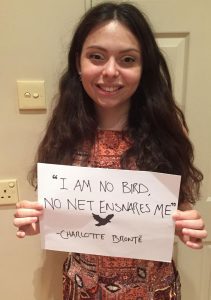
I’m half English, half Italian, and was born and raised in London. I have just graduated from Durham University with a degree in Spanish and Arabic and will be studying for a Master’s in broadcast journalism at City University next year.
I have just returned from a trip to New York after winning a multilingual world essay prize which included speaking at the United Nations’ General Assembly. I was in the group of Arabic language winners and our speeches were about tackling climate change, which is one of the UN’s sustainable development goals for 2030. Now that I am embarking on a career in journalism I’m looking forward to continue supporting these goals in my work.
Freedom of expression is particularly important to me as several countries that speak both of the languages I have dedicated years of study to continue to be plagued by tyrants and censors. I’m particularly interested addressing censorship in Latin America and the Middle East, especially with regard to the arts, as I’m also a classical singer and keen art historian.
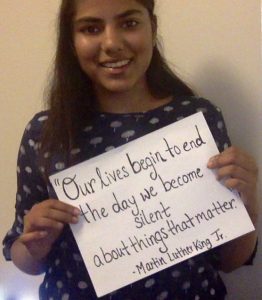
Shruti Venkatraman
Originally from Mumbai, I am currently a first year undergraduate studying law at the University of Edinburgh. As a law student, I am interested in advocacy in general, but I am particularly interested in advocating for fundamental human rights.
In today’s socio-political context, the phrase “freedom of expression” has gained importance and expanded in its meaning from it’s original intent to prevent minority persecution. Having lived in India and South Africa, I was able to grasp the importance of free speech in the context of regional history, and I learnt how human rights appeals have had local and global impacts and are inherently tied with social development. Index on Censorship’s admirable work to promote and defend freedom of expression highlights how important this cause is in our quest for social progress, justice and equality and how repression of these rights result in societal backwardness.
Niharika Pandit 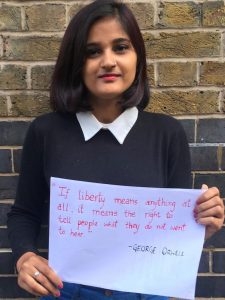
I am currently a master’s candidate at the Centre for Gender Studies at SOAS, University of London with South Asia as my focus area of gender research. I became interested in issues of censorship during my undergraduate studies in mass media with a specialisation in journalism from Bombay.
As a journalist and an active social media user in India, I was witness to numerous instances of online abuse, trolling and silencing of women politicians, journalists and activists who voiced opinions on political and social issues. As a response to the barrage of abuse in the online space, otherwise a liberating space to hear diversified opinions, I wrote a piece on Twitter trolls in India and the use of sexist abuse as a tool to muzzle women for Index on Censorship’s Young Writers’ Programme.
Within censorship, I am particularly interested in working on the intersections of social media, gender along with looking at censorship in militarised zones and its growing legitimacy in contemporary political ethos as part of my research.
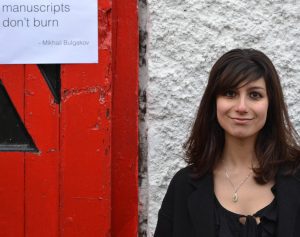
Layli Foroudi
It was studying literary works from the Soviet period during my undergraduate degree that highlighted the issue of censorship for me initially. Clearly this issue has outlived (and predates) the Soviet Union and is still of pressing concern in Russia today and globally. After graduating, I worked as a journalist on issues of freedom of expression and belief in Iran, and then in Russia at the Moscow Times. By pushing a state-sponsored version of the truth and punishing those at variance with it, these countries and others marginalise people and stifle innovation and creativity.
Freedom of expression and public debate underpin what society consists of and being denied this freedom is being denied the right to participation in society, as Hannah Arendt wrote: the polis is “the organisation of people as it arises out of acting and speaking together”. Historically, many have been denied the right to “act and speak”, based on ethnicity, gender, belief, immigration status, etc, and continue to be. I am interested in encouraging a diversity voices in the public sphere, something I have enjoyed exploring more this past year while undertaking an MPhil in race, ethnicity, and conflict at Trinity College Dublin and as a member of the youth advisory board since January.
Ian Morse 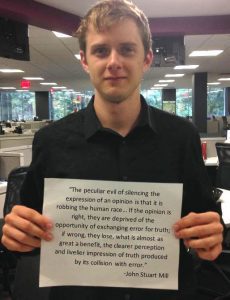
I’m a student and journalist at Lafayette College in the US, but I have studied in Germany, Turkey and the UK. I really started studying news media when I lived in Turkey 18 months ago, because even then (much more so now) journalists and bloggers had a very tough time gathering and publishing good information. Since then, I’ve been a journalist in Turkey, the UK and Greece. I study history and mathematics-economics, but almost every project I do is focused on news media.
I’ve encountered freedom of expression violations in many fashions, from student pressures against speakers to petty government retaliation to Twitter blocking. There is quite a bit of nuance that is overlooked in many cases, but that nuance is needed to understand where the line needs to be drawn. Words have a lot of power in society – but it is often difficult to get the truth out when lies are louder or gags are stronger. I hope with Index that we can find ways to fix this.
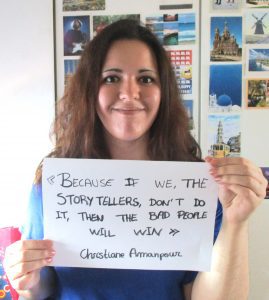
Anna Gumbau
I am a journalist living between Barcelona and Brussels. I am passionate about youth work, having volunteered for five years as member of AEGEE-Europe / European Students’ Forum, including a year as member of its international board. I have taken part in, and often led projects, run by students for other students all over Europe, on topics such as pluralism of media, election observation and media literacy. I am also involved in the field of internet governance, participating in the last two editions of the EuroDIG and joining the Youth Observatory of the Internet Society.
As a young media-maker who grew up listening to the stories of censorship in the times of the Spanish dictatorship, I believe strongly in free speech, a free press and media pluralism as essential pillars for democracy. I am fascinated by the power of words and freedom of expression to empower citizens and stand up to what they believe in. I also envision free media as a crucial element for better informed societies and, in extension, for more responsible individual citizens to participate in the public space.
Constantin Eckner 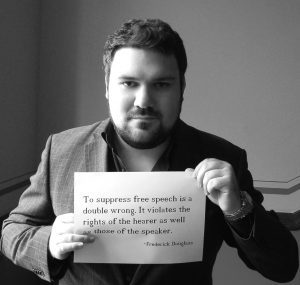
I am originally from Germany. I graduated from University of St Andrews with a master’s degree in modern history. Currently, I am a Ph.D. candidate specialising in human rights, asylum policy and the history of migration. Moreover, I have worked as a writer and journalist since I was 17 years old, covering a variety of topics over the years. Longer stays in cities like Budapest and Istanbul have raised my awareness for pressures exerted upon freedom of expression.
In a perfect world journalists, as well as every citizen, would live without fear of state censorship and potentially facing repercussions for the words they write or speak, for the pictures they draw, for the photos they shoot or for music they play.
Freedom of expression and access to information are cornerstones of an enlightened society. Unfortunately, in 2016 the world is still challenged by undemocratic regimes and powers that intend to quash people, which is an oppressive situation that has to change. It is up to us to help those who cannot raise their voice fearlessly.
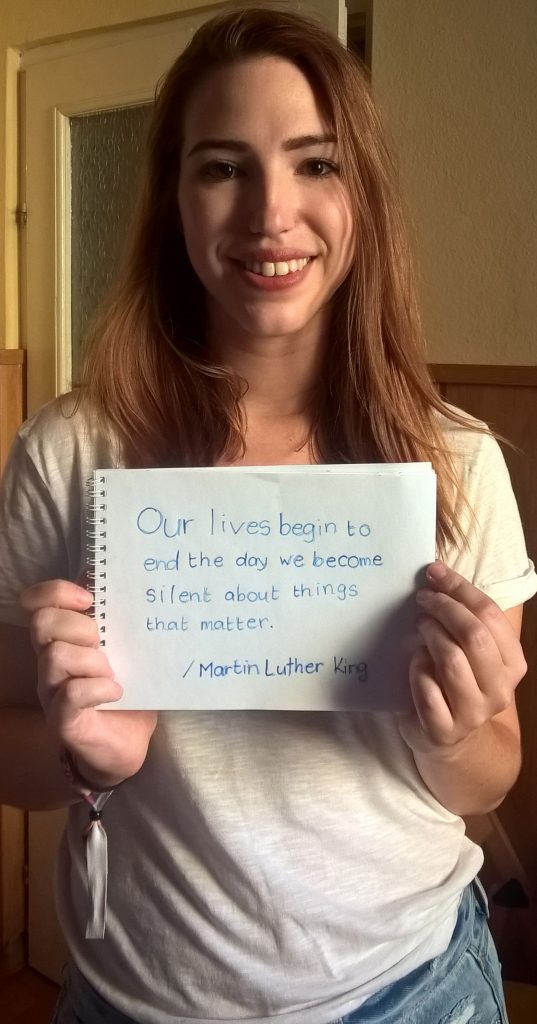 Fruzsina Katona
I was born and raised in Hungary, although I spent my pre-university years in a small town in eastern Hungary. Today I am a freelance journalist.
I always knew I wanted to be a journalist, since I was always interested in literally everything that surrounded me. The urge to publish became stronger at the age of 17, after I returned from Japan, where I spent a school year. That one year made me realise, that my home country is really far from the image I had of it. And the only way I can fight against corruption, abuses and narrow-mindedness – apart from voting – is to educate and inform the public. I took an internship at Hungary’s leading investigative journalism center, and 2015 Index on Censorship Freedom of Expression award-winner, Atlatszo.hu. I have worked for them as a freelancer ever since, and I enjoy my work pretty much.
I recently received a graduate degree in communication and media studies, and supplemented my “official” studies with training, workshops and conferences across Europe.
In the future I would like to be a post-conflict reporter or a human rights journalist, specialising in freedom of expression and the press.
10 Aug 2016 | Academic Freedom, Campaigns -- Featured, Europe and Central Asia, mobile, News, Turkey, Turkey Uncensored
The stream may be small right now, a trickle, but it is unmistakable. Turkey’s academics and secular elite are quietly and slowly making their way for the exits.
Some months ago, in the age before Turkey’s post-coup crushing of academia, a respected university lecturer told me she was seeking happiness outside Turkey. She was teaching economics at one of Istanbul’s major universities, but neither her nor her husband, who is also in the financial sector, had a desire to remain in the country any longer. They simply packed up and left for Canada.
The growing unease about the future is now accelerating among the academics and mainly secular elite in the country. This well-educated section of society is feeling the pressure more than any other, and as the instability mounts the urge to join the “brain drain” will only increase.
Some of them, particularly those academics who have been fired and those who now face judicial charges for signing a petition calling for a return to peace negotiations with the Kurdish PKK, no longer see a future for their careers. With the government further empowered by emergency rule decrees, the space for debate and unfettered learning is shrinking.
One of the petition’s signatories, the outspoken sociologist Dr Nil Mutluer, has already moved to a role at the well-respected Humboldt University in Berlin to teach in a programme devoted to scholars at risk.
You only have to look at the numbers to realise why more are likely to follow in the footsteps of those who have already left Turkey. In the days after the failed coup that struck at the country’s imperfect democracy, the government of president Recep Tayyip Erdogan swept 1,577 university deans from their posts. Academics who were travelling abroad were ordered to return to the country, while others were told they could not travel to conferences for the foreseeable future. Some foreign students have even been sent home. The pre-university educational system has been hit particularly hard: the education ministry axed 20,000 employees and 21,000 teachers working at private schools had their teaching licenses revoked.
Anyone with even the whiff of a connection to FETO — the Erdogan administration’s stalking horse for the parallel government supposedly backed by the Gulenist movement — is in the crosshairs. Journalists, professors, poets and independent thinkers who dare question the prevailing narrative dictated by the Justice and Development Party will hear a knock at the door.
It appears that the casualty of the coup will be the ability to debate, interrogate and speak about competing ideas. That’s the heart of academic freedom. The coup and the president’s reaction to it have ripped it from Turkey’s chest.
But it’s not just the academics who are starting to go. The secular elite and people of Kurdish descent that are also likely to vote with their feet.
Signs are, that those who are exposed to, or perceive, pressure, are already doing this. Scandinavian countries have noted an increase in the exodus of the Turkish citizens. Deutsche Welle’s Turkish news site reported that 1719 people sought asylum in Germany in the first half of this year. This number already equals the total of Turkish asylum seekers who registered during the whole of 2015. Not surprisingly, 1510 of applications in 2016 came from Kurds, who are under acute pressure from the government.
The secular (upper) middle class is also showing signs of moving out. The economic daily Dünya reported on Monday that the number of inquiries into purchasing homes abroad grew four-to-five times the pre-coup level. Many real estate agencies, the paper reported, are expanding their staff to meet the demand. Murat Uzun, representing Proje Beyaz firm, told Dünya:
“The demand is growing since July 15 by every day. Emergency rule has also pushed up the trend. These people are trying to buy a life abroad. Ten to twelve people visit our office every day….Many ask about the citizenship issues.”
Adnan Bozbey, of Coldwell Banker, told the paper that people were asking him: “Is Turkey becoming a Middle Eastern country?”
According to Dünya, the USA, Ireland, Portugal, Greece, Malta and Baltic countries are popular among those who want to seek life prospects elsewhere.
In short, the unrest is spreading. Unless the dust settles and the immense political maneuvering about the course Turkey is on reverses, it would be realistic to presume that a significant demographic shift will take place in the near future.
A version of this article originally appeared on Suddeutsche Zeitung. It is posted here with the permission of the author.
Turkey Uncensored is an Index on Censorship project to publish a series of articles from censored Turkish writers, artists and translators.
10 Jun 2016 | Greece, Mapping Media Freedom, mobile, News, Serbia, Spain, Turkey, Ukraine
Click on the dots for more information on the incidents.
Each week, Index on Censorship’s Mapping Media Freedom project verifies threats, violations and limitations faced by the media throughout the European Union and neighbouring countries. Here are five recent reports that give us cause for concern.
On 1 June David Jiménez, who was fired as El Mundo’s director on 25 May, filed a complaint against the paper.
Jiménez alleges that Antonio Fernández-Galiano Campos, president of El Mundo’s owner Unidad Editorial, pressured him to edit the paper to conform with the publisher’s corporate strategy.
Jiménez, who was hired as director in May 2015, claimed his right to direct editorial coverage independently was suppressed. His firing came just four days after the paper laid off 168 staffers including 38 journalists due to financial pressures.
Riot police overseeing an operation to move refugees from a camp in Idomeni, on the border near Macedonia (FYROM), only allowed public broadcaster ERT and the national Athens News Agency to cover the events.
The Greek Union of Photojournalists denounced the “flagrant violation of the freedom and pluralism of press”, during an operation to evacuate the country’s largest informal refugee camp of Idomeni. The statement stressed that journalists and photojournalists were not in danger, at least “not more than the ERT and ANA journalists”.
“If the trapped people use violence it won’t be against journalists and photojournalists, but against the police,” the organisation said in its statement.
In an interview with Greek TV, Mega Channel, a representative of the government commented that “there are always restrictions to the press during such operations”.
Journalists for the provincial radio and TV station RTV Vojvodina claim they will be replaced by new journalists who have been chosen by the Serbian Progressive Party, which has been the ruling party in the autonomous region Vojvodina since the elections in April 2016.
The entire editorial staff was told on Wednesday 18 May 2016 that they no longer need to come to work, and that other journalists would take over their jobs. They have not been fired.
Editor-in-chief of TV channel 1, Mirjana Jovic, and general director Srdjan Mihajlovic had earlier resigned. Both are believed to have left the station under “political pressure”. Programme director Slobodan Arezina has also been dismissed, B92 reported.
In response, around forty journalists and editors have sent an open letter in which they express their worries about “sudden personnel changes that have not been clearly explained”. They are demanding a public explanation from the management “about why there has been such a sudden shift without explanation and whether this is a political decision”.
A court in the city of Mersin sentenced journalist Arzu Yildiz to 20 months in jail and deprived of legal guardianship over her children for footage she published in May 2015.
The footage was from a court hearing where four prosecutors were on trial for ordering a search of trucks belonging to Turkey’s MIT intelligence agency as they traveled to Syria in 2014, Reuters reported. President Erdogan accused those who covered the story as plotting against his government along with enemies to undermine Turkey and to embarrass the country.
The lawyer said the decision to strip parental rights was an act of revenge. “There are many cases in which the court does not execute this article of the penal code. They didn’t have to do it”.
Ukrainian president Petro Poroshenko signed a decree to impose personal sanctions against 17 Russian media executives for broadcasting propaganda, the Unian information agency reported.
According to Human Rights Watch, among the 17 are Konstantin Ernst, general director of Channel One, Russia’s main state-owned television channel, and Margarita Simonyan, chief editor of Russia’s international television network RT (formerly Russia Today) and the Rossiya Segodnya news agency. Journalists on the list also include Vladislav Fronin, chief editor of the official government newspaper Rossiyskaya Gazeta, and Vitali Leibin, editor at Russkiy Reporter magazine. Russia either owns — at least partially — or exerts significant control over the media outlets listed in the presidential decree, HRW said.
According to the decree the 17 individuals “create real and potential threat to national interests, national security, sovereignty, and territorial integrity of Ukraine; facilitate terrorist activity and violate citizens’ rights and freedoms; contribute to the occupation of territories, and obstruct full realization of rights and freedoms by Ukrainian citizens.”
The decree bars the 17 from entering Ukraine through December 31 2017.
24 May 2016 | Azerbaijan, Azerbaijan News, Belarus, Belgium, Bosnia, Croatia, Europe and Central Asia, France, Germany, Greece, Index Reports, Macedonia, Mapping Media Freedom, mobile, News, Poland, Serbia, Spain, Turkey, Ukraine
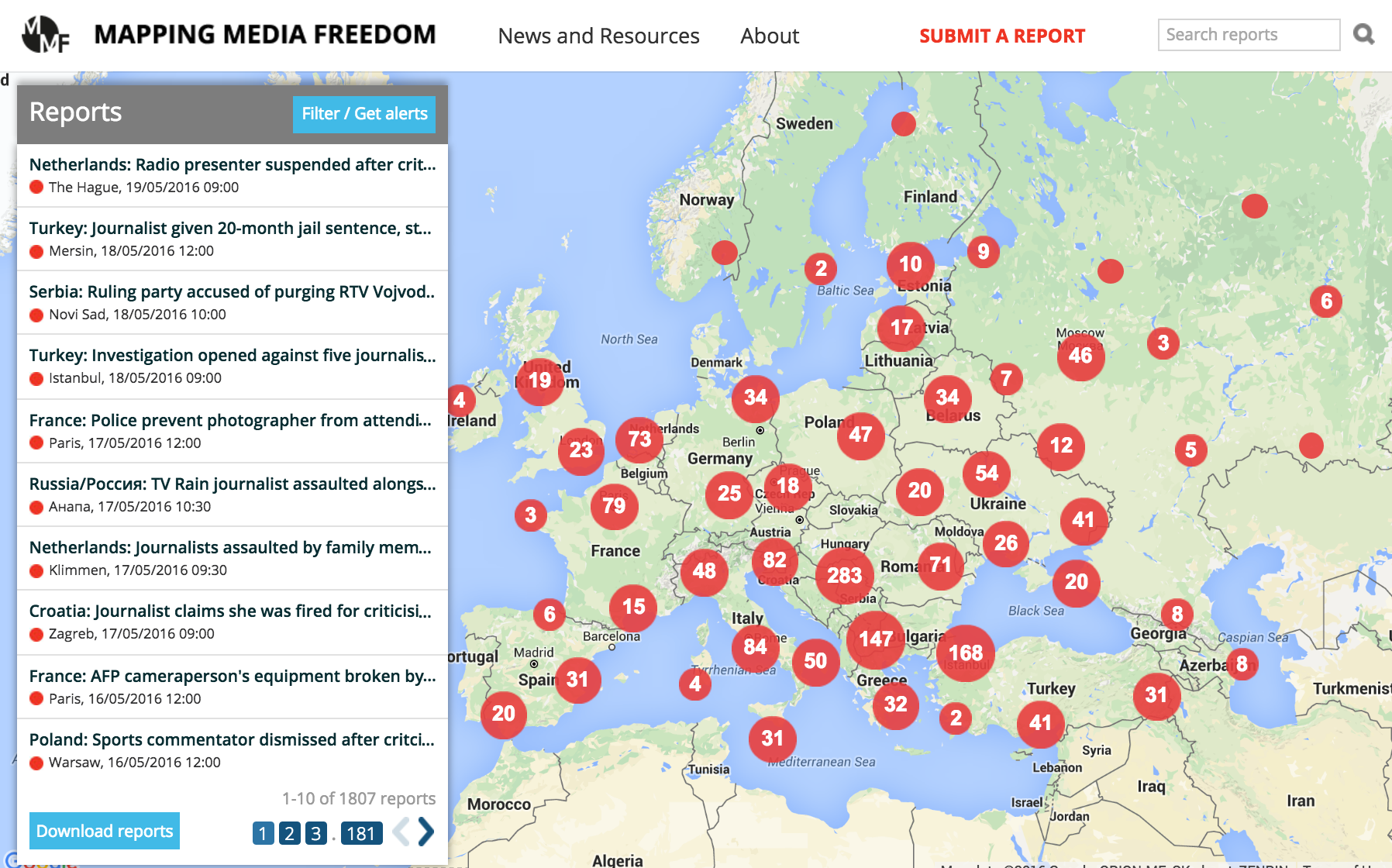
Mapping Media Freedom launched to the public on 24 May 2014 to monitor media censorship and press freedom violations throughout Europe. Two years on, the platform has verified over 1,800 media violations.
“The data the platform has collected over the last two years confirms that the state of press freedom across Europe is deplorable,” said Hannah Machlin, project officer for Mapping Media Freedom. “Media violations are occurring regularly in countries with strong democratic institutions and protective laws for journalists. Legislation limiting the press, violence across the continent and authoritarian governments are also fuelling this rapid and worrying decline. We hope that institutions and leaders take note of this information and take action swiftly.”
To mark the anniversary, we asked our correspondents to pick a key violation that stood out to them as an example of the wider picture in their region.
Russia / 113 verified reports
Several journalists and human rights activists attacked in Ingushetia
“The brutal attack on a minibus carrying six journalists and several human rights activists near the border between Ingushetia and Chechnya on the 9 March 2016 demonstrates the dangers faced by media professionals working in Russia’s North Caucasus. No suspects have been established so far. This case stands out due to its extreme violence but also supports a common trend: the reluctance of the local authorities to ensure that the journalists’ rights are respected.” – Ekaterina Buchneva
Italy / 190 verified reports
97 journalists accused of breaking the law in mafia investigation
“This was a very relevant investigation, with no precedent, that took place in October, a few weeks away from the start of the trial known as Mafia Capitale, which concerns the scandal that involved the government of the city of Rome. It is a collective intimidation because it involved 97 journalists, who were denounced for violating the secret on the ongoing investigations. It is a really serious form of intimidation because it was activated within the field of law and thus is not punishable.” – Rossella Ricchiuti
Turkey / 57 verified reports
Zaman newspaper seized by authorities
“These attacks and actions taken by the government against independent media in Turkey attest to the shrinking space of independent media overall. In addition, it illustrates the shifting power dynamic within the ruling government in Turkey where once upon a time friends, are turned into enemies by the regime. As the paper wrote itself, Turkey is headed through its ‘darkest and gloomiest days in terms of freedom of the press.'” – MMF’s Turkey correspondent
Azerbaijan/ 5 verified reports
Writer banned from leaving country
“Aylisl’s 12-hour interrogation at the airport and later charges of hooliganism were just as absurd as the claim that a 79-year-old man, suffering from a heart condition and other health issues would attack an airport employee to such an extent that it would cause hemorrhage. I chose this example to illustrate the absurdity of charges brought against individuals in Azerbaijan but also the extent to which the regime is ready to go in order to muzzle those voices who different.” – MMF’s Azerbaijan correspondent
Macedonia / 59 verified reports
Deputy Prime Minister attacks journalist
“This incident best demonstrates the division in society as a whole and among journalists as a professional guild. This is a clear example of how politicians and elites look upon and treat the journalist that are critical towards their policies and question their authority.” – Ilcho Cvetanoski
Bosnia / 56 verified reports
Police raid Klix.ba offices
“This was the most serious incident over the last two years in Bosnia regarding the state’s misuse of institutions to gag free media and suppress investigative journalism. In this specific incident, the state used its mechanisms to breach media freedoms and send a chilling message to all other media.” – Ilcho Cvetanoski
Croatia / 64 verified reports
Journalist threatened by disbanded far-right military group
“After the centre-right government in Croatia came to power in late 2015, media freedom in the country rapidly deteriorated. Since then around 70 media workers in the public broadcaster were replaced or removed from their posts. This particular case of the prominent editor-in-chief of the weekly newspaper Novosti receiving a threatening letter from anonymous disbanded military organisation demonstrates the polarisation in the society and its affect on media freedom.” – Ilcho Cvetanoski
Greece / 34 verified reports
Golden Dawn members assault journalists covering demonstration
“This was the second attack against journalists by Golden Dawn members within one month. With more than 50,000 asylum seekers and migrants trapped in Greece, the tension between members of the far-right group and anti-fascist organisations is rising.” – Christina Vasilaki
Poland / 35 verified reports
Over 100 journalists lose jobs at public broadcasters
“This report highlights the extent of the ongoing political cleansing of the public media since the new media law was passed in early January.” – Martha Otwinowski
Germany / 74 verified reports
Journalist stops blogging after threats from right-wing extremists
“The MMF platform lists numerous incidents where German journalists have been threatened or physically assaulted by right-wing extremists over the last two years. This incident stands out as a case of severe intimidation that resulted in silencing the journalist altogether.” – Martha Otwinowski
Belgium / 19 verified reports
Press asked to respect lockdown during anti-terrorism raids
“On 22 November 2015, the Belgian authorities asked the press to refrain from reporting while a big anti-terrorist raid was taking place in Brussels. While understandable, this media lock-down raised questions for press freedom and underlined the difficulties of reporting on terror attacks and anti-terror operations.” – Valeria Costa-Kostritsky
Luxembourg / 2 verified reports
Investigative journalist on trial for revealing Luxleaks scandal
“This Luxleaks-related case is the only violation we have become aware in Luxembourg over the period (which is not to say that no other cases occurred). Along with two whistleblowers, a journalist was prosecuted by PricewaterhouseCoopers and accused of manipulating a whistleblower into leaking documents. This is a good example of the threat the notion of trade secrets can represent to journalism.” – Valeria Costa-Kostritsky
Ukraine / 127 verified reports
Website leaks personal information of more than 4,000 journalists
“This incident shows how fragile the media freedom and personal data of journalists are in armed conflict. Even after a great international scandal, the site continues to break the legislation and publishes new lists. It has been operating for two years already and those involved in its activities go unpunished. It seems that the post-Maidan Ukraine has simply ‘no political will’ for this.” – Tetiana Pechonchyk
Crimea / 18 verified reports
Journalists’ homes searched, criminal case filed
“This report shows the everyday life of independent journalists working on the peninsula. Only a few critical voices are still remaining in Crimea while the majority of independent journalists were forced to leave the profession or to leave Crimea and continue their work on the mainland Ukraine.” – Tetiana Pechonchyk
Spain / 49 verified reports
Journalist fined for publishing photos of arrest
“The latest issue for the Spanish media is the Public Security Law, introduced in June 2015, which among other things limits space for reporters. The law prohibits the publication of photo and video material where police officers may be identified, unless official state permission is obtained. This was the first case of a journalist being fined by the new law.” – Miho Dobrasin
Belarus / 47 verified reports
Journalist beaten by police, detained and fined for filming police attacks
“The story has ended in impunity: a criminal case was not even filed against the police officers who had beaten the journalist.” – Volha Siakhovich
Latvia / 12 verified reports
Latvia and Lithuania ban Russian-language TV channels
“This was the beginning of a disturbing tendency to react with rather futile gestures against Russian television channels. The bans are not so much against the media, as telling the audience that the authorities, not the public, will decide what Latvian viewers may or may not see or hear.” – Juris Kaža
Serbia / 110 verified reports
Investigative journalists victim of smear campaign
“You have to be very brave to launch a new investigative journalism portal in Serbia and expose corruption and organised crime involving government officials. That is why the launch of KRIK in early 2015 has been so important for media freedom, but at the same time so dangerous for its journalists. Smear campaigns like this by pro-government tabloid Informer are a relatively new but common method in the Balkans to scare journalists off.” – Mitra Nazar