29 Apr 2025 | Middle East and North Africa, News, Palestine, Volume 54.01 Spring 2025
This article first appeared in Volume 54, Issue 1 of our print edition of Index on Censorship, titled The forgotten patients: Lost voices in the global healthcare system, published on 11 April 2025. Read more about the issue here.
Most children say their first word between the ages of 12 and 18 months. But Fatehy, a Palestinian boy living in Jabalia City in Gaza, is four years old and is still barely talking.
When he does speak, he says the same words over and over again – “scared”, “bomb” and “fighters”. While he used to say words such as “mumma” and “bubba”, his language progression has reversed, and now he is mostly silent.
He has been displaced roughly 15 times and experienced several close family deaths, including those of his mother and sister. At one point, he was discovered on a pile of bodies and was presumed dead. He was rescued purely by luck when a family member saw that he was still gently breathing.
His cousin, Nejam, is three years old. His speech is also very limited, and is mostly reserved for the names of tanks, drones and rockets. He has been pulled from rubble several times.
Neither child has access to school, nursery or social activities with friends. Medical treatment is severely limited, and they have been unable to access any of the few speech therapists available. Food scarcity also means they have been unable to learn basic vocabulary about ingredients or meals.
Dalloul Neder, a 33-year-old Palestinian man living in the UK since 2017, is their uncle.
“The only thing they’ve been listening to is the bombing,” he told Index. “That’s why they are traumatised.
“They miss their families, grandparents, mums and family gatherings around the table. They realise something is not right but they can’t express their pain.”
Psychological trauma is extremely common for children living in warzones. This can cause mental health issues such as depression, anxiety and panic attacks, but also communication problems, such as losing the ability to speak partially or fully, or developing a stammer. For younger children such as Fatehy and Nejam, war trauma can impact cognitive development, causing language delays and making it hard to learn to speak in the first place.
In December, the Gaza-based psychosocial support organisation Community Training Centre for Crisis Management published a report based on interviews it had conducted with more than 500 children, parents and caregivers. Nearly all the children interviewed (96%) said they felt that death was “imminent” and 77% of them avoided talking about traumatic events. Many showed signs of withdrawal and severe anxiety. Roughly half the caregivers said children exhibited signs of introversion, with some reporting that they spent a lot of time alone and did not like to interact with others.
Katrin Glatz Brubakk is a child psychotherapist who has just returned to Norway from Gaza, where she was working as a mental health activities manager with Médecins Sans Frontières in Nasser Hospital, Khan Younis. Her team offers mental health support to adults and children, but mainly to children dealing with burns and orthopaedic injuries, mostly from bomb attacks.
She told Index that children tended to present with “acute trauma responses”, while the long-term impacts on their psychological wellbeing were yet to be seen.
In her work, she typically sees two types of responses – either restlessness and being hard to calm down, or becoming uncommunicative and withdrawn. She believes the latter is significantly harder to spot and therefore under-reported.
“We have to take into account that it’s easier to detect the acting-out kids, and it’s easier to overlook the withdrawn kids or just think they’re a bit shy or quiet,” she said.
She commonly saw children experiencing extreme panic attacks due to flashbacks, where any small thing – such as a door closing or their parent leaving a room – could trigger them. She noted they would often let out “intense screams”.
But some children have become so withdrawn they do not scream or cry at all. Some have even fallen into “resignation syndrome”, a reduced state of consciousness where they can stop walking, talking and eating entirely.
Brubakk recalled one “extreme case” of a five-year-old boy who was the victim of a bomb attack and witnessed his father die. He fell completely silent and did not want to see anybody, and also hardly ate.
“When children experience severe or multiple trauma, it’s as if the body goes into an overload state,” she said. “In order to protect themselves from more negative experiences and stress, they totally withdraw from the world.”
Living in a warzone can also mean that children’s “neural development totally stops”, she said, as they lose the opportunity to play, learn new skills, learn language and understand social rules. “The body and mind use all their energy to protect the child from more harm,” she said. “That doesn’t affect the child only there and then, it will have long-term consequences.”
This is made worse by a lack of “societal structures”, such as schools. “[These offer a] social arena, where they can feel success – there’s no normality, there’s no predictability.”
Therapy can be used to encourage children to speak again, particularly with creative methods such as play and drawing therapy. Brubakk explained how through “playful activities” and “small steps”, her team were able to encourage children to communicate.
Recently, she managed this through the creation of a makeshift dolls house. A young girl had been burnt in a bomb attack. Her two brothers had been killed and her two sisters injured, with one of them in a critical state. It was uncertain whether her sister would survive.
The girl wasn’t able to speak about her experiences until Brubakk helped her create a dolls house using an old box, some colouring pens and tape, plus two small dolls the girl had kept from her home. She named the dolls after herself and her sister, and was able to start expressing her grief and fears, as well as her hopes for the future.
“So through a very different type of communication, she was able to express how worried she was about her sister, but also process some of the experiences she had,” said Brubakk.
A report published by the non-profit Gaza Community Mental Health Programme (GCMHP) includes success stories of children who have benefited from creative communication. Alaa, a 12-year-old boy who sustained facial injuries after a bombardment and then later experienced forced evacuation by Israeli forces from Al-Shifa hospital, developed recurring nightmares, verbal violence, memory loss and an aversion to talking about his injuries. A treatment plan of drawing therapy and written narrations of the events helped him to become more sociable, and now he visits other injured children to share his story with them and listen to theirs.
Sarah, meanwhile, is a 13-year-old girl who developed post-traumatic stress disorder and traumatic mutism after having an operation on her leg following a shell attack. She didn’t speak for three months and would use only signals or write on pieces of paper. The GCMHP worked with her on a gradual psychotherapy plan, including drawing and play therapy. After three weeks, she started saying a few words, and she was eventually able to start discussing her trauma with therapists.
Trauma-related speech issues are complex problems that can be diagnosed as both mental health issues and communication disorders, so they often benefit from intervention from both psychotherapists and speech and language therapists.
Alongside developing speech issues due to war, living in a warzone can worsen speech problems in children with pre-existing conditions. For example, those with developmental disabilities such as autism may already have selective mutism (talking only in certain settings or circumstances), and this can become more pronounced.
Then there is behaviour that can become “entrenched” due to their environments, Ryann Sowden told Index. Sowden is a UK-based health researcher and speech and language therapist who has previously worked with bilingual children, including refugees who developed selective mutism in warzones.
“Sometimes, [in warzones,] it’s not always safe to talk,” she said. “One family I worked with had to be quiet to keep safe. So, I can imagine things like that become more entrenched, as it’s a way of coping with seeing some really horrific things.”
She described a “two-pronged” effect, with war trauma causing or exacerbating speech issues, and a lack of healthcare services meaning that early intervention for those with existing communication disorders or very young children can’t happen.
There is an understandable need to focus on survival rather than rehabilitation in warzones, she said, and a lot of allied health professionals, such as occupational therapists, physiotherapists and psychotherapists, are diverted to emergency services.
This was echoed by Julie Marshall, emerita professor of communication disability at Manchester Metropolitan University and formerly a speech and language therapist working with refugees in Rwanda. Her academic research has noted a lack of speech and language therapists in low and middle-income countries (LMICs) in general.
“In many LMICs, communication professionals are rare, resulting in reliance on community members or a community-based rehabilitation workforce underprepared to work with people with communication disorders,” she wrote in a co-authored paper in British Medical Journal Global Health.
For children who already have speech or language difficulties, losing family members who are attuned to their other methods of communication, such as gestures or pointing, can make the issue worse.
“If you are non-verbal, you may well have a family member who understands an awful lot of what we would call ‘non-intentional communication’,” said Marshall. “If you lose the person who knows you and reads you really well, that’s huge.”
In warzones, Marshall and Sowden both believe that speech and language therapy is more likely to be incorporated alongside medical disciplines dealing with physical injury, such as head or neck trauma or dysphagia (an inability to swallow correctly). This belief was mirrored by the work of Brubakk, whose mental health team at Nasser Hospital worked mostly with patients who had been seen in the burns and orthopaedics departments.
One of the most valuable things that can be done is to train communities in simple ways to help children who may be living with a speech or language difficulty, Marshall believes, shifting away from treating a single individual to trying to change the general environment.
“There are lots of attitudes around communication disabilities that could be changed,” she said. For example, it is often misjudged that children with muteness may not want to talk, and they are subsequently ignored rather than patiently and gently interacted with.
Despite a lack of healthcare provision, there are some professionals on the ground in Gaza. In 2024, the UN interviewed Amina al-Dahdouh, a speech and language therapist working in a tent west of Al-Zawaida. She said that for every 10 children she saw, six suffered from speech problems such as stammering. In a video report, al-Dahdouh held a mirror up to children’s faces as she tried to teach them basic Arabic vocabulary and show them how to formulate the sounds in their mouths.
But the destruction of medical facilities such as hospitals and a lack of equipment have made it difficult for professionals to do their jobs. Mohammed el-Hayek is a 36-year-old Palestinian speech and language therapist based in Gaza City who previously worked with Syrian child refugees in Turkey.
“Currently, there are no clinics or centres to treat children, and there are many cases that I cannot treat because of the war, destruction and lack of necessary tools – the most important of which is soundproof rooms,” he told Index. “Before the war, I used to treat children in their homes.”
Soundproof rooms can be used by speech and language therapists to create more private, quiet and controlled spaces that reduce distracting external noises including triggering sounds such as gunfire or bombs.
The most common issue he has encountered is stammering, which he says becomes harder to tackle the longer it is left untreated.
“Children are never supported in terms of speech and language,” he added. “[It is] considered ‘not essential’ but it is the most important thing so that the child can communicate with all their family and friends and not cause [them] psychological problems.”
For many of these children, the road to recovery will be long. Mona el-Farra, a doctor and director of Gaza projects for the Middle East Children’s Alliance, told Index that the “accumulation of trauma” caused by multiple bombardments meant that even those receiving psychological support were offered little respite to heal.
One glimmer of hope is that cultural barriers around trauma appear to be lifting, which has encouraged people to stop self-censoring around their own mental health.
“There is no stigma now [around mental health],” said el-Farra. “The culture used to be like this, but not anymore. You can see that 99% of the population has been subjected to trauma. [People] have started to express themselves and not deny it.”
At the time of publishing, the ceasefire between Israel and Hamas had broken down and bombardment had restarted. When a permanent ceasefire is finally established and healthcare provision in Gaza can be rebuilt, there will need to be a concerted effort to support children with their psychological and social rehabilitation as well as their physical health. Hopefully then they can start to come to terms with their experiences and tell their stories – otherwise, they could be lost forever.
23 Apr 2025 | Israel, Middle East and North Africa, News, Palestine
For more than 40 years, the Palestinian-run Educational Bookshop in occupied East Jerusalem has provided both locals and tourists with access to a wealth of books, magazines and cultural events, establishing itself as a cultural hub within the historic city. Now, its very existence is under threat.
On 9 February 2025, undercover Israeli police stormed the bookshop and its Arabic-language counterpart next door.
“It was a Sunday afternoon. I was having a good time with my daughter who’s 10 years old,” Mahmoud Muna, co-owner of the bookshop, told Index on Censorship.
The officers started pulling books from the shelves and examining the covers.
“Any cover that had a flag, map, words, keywords like ‘Palestine’, ‘Nakba’ or ‘Gaza’ was deemed suspicious,” said Mahmoud. “Then they Google translate[d] the cover or the blurb or the back page, and they start[ed] creating two piles on the floor, one for the books that they didn’t want to take and another pile for the books that they wanted to take. [This was] completely irrespective of the books and what they mean to us.”
The police put around 300 confiscated books into bin bags, then took Muna and his nephew Ahmad Muna into custody on charges that their books were causing “public disorder”.
“They took us to the police station where we were detained the first night and then taken to court the second night… we were released after 48 hours, myself and my nephew, who was manning the Arabic branch. [We were put] on bail: five days’ house arrest and 20 days away from the bookshop.”
Most of the confiscated books were returned. On 11 March 2025, the police raided the bookshop again, taking 50 books and arresting Mahmoud’s 61-year-old brother and co-owner, Imad Muna. Imad was released a few hours later. The police confiscated books by Banksy, Ilan Pappé and Noam Chomsky, among others.
“They came again and they replayed the whole scenario again. It was just that we were a bit more ready legally. It happened during the morning hours and it was my brother who was in the shop. So we were able to act very quickly and [he was released] before the night,” Mahmoud said.
The Educational Bookshop was founded in 1984 by Mahmoud’s father, Ahmad Muna, a Jerusalem-born teacher. The bookshop has remained a family business ever since.
“For 40 years, we’ve been in operation, trying to serve our community, trying to contribute to social, political, cultural change in a city that is torn between political upheavals. And we believe that books and conversation around books can be an important carrier, if you like, for the conversation. It can open up a space for conversation,” Mahmoud said.
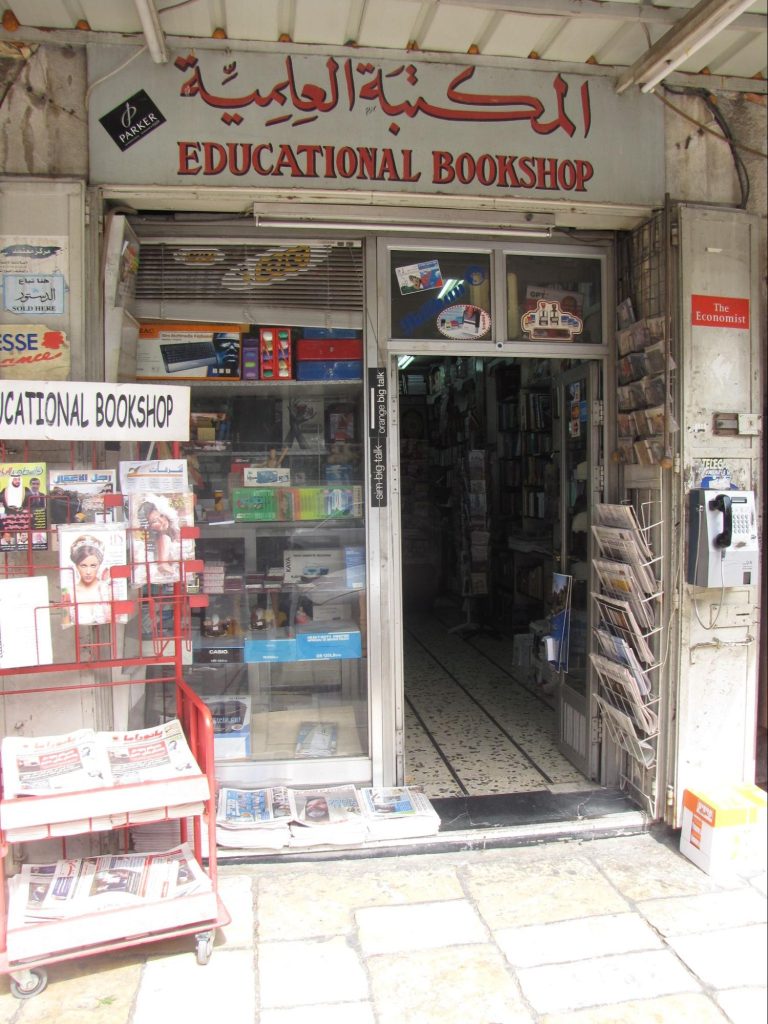
Photo by Mahmoud Muna
These raids are not isolated incidents; they form part of a wider campaign by the Israeli government to crack down on free expression, which has been intensified by the emergence of the far-right within Prime Minister Benjamin Netanyahu’s government and worsened still by Hamas’s incursion on 7 October 2023 and the war in Gaza that has followed.
Recently, authorities have also begun censoring Israeli films critical of the government, as well as events and festivals that discuss Gaza, Palestinians or the 1948 Nakba. The government has started using a revived British Mandate-era law from 1917, which allows the Culture and Sport Ministry to review films before they are screened.
“I think the political climate has really changed. Maybe the war is part of that, but it is not the reason. There is a policy of oppression towards cultural institutions. If you look at theatre, music schools, youth clubs, women’s associations for the last five, six, seven years even before the war, they have been suffering,” Mahmoud said.
Mahmoud says that he and his family have no intention of giving into the authorities’ intimidation tactics.
“We are determined, we’re not gonna give up. It makes me angry, but it also makes me believe even stronger in the power of books and words and literature. And it also opens my eyes even further to the importance of our work in our society.”
Above all, he calls on the international community to speak out against the erosion of democratic values unfolding in Israel and Palestine today.
“If we really believe in what we say, and we really want progressive liberal societies and freedom of expression in Turkey or China or Russia, then we also need to demand them in places like Jerusalem as well.”
11 Apr 2025 | Americas, Asia and Pacific, Israel, Middle East and North Africa, News, Pakistan, United States
In the age of online information, it can feel harder than ever to stay informed. As we get bombarded with news from all angles, important stories can easily pass us by. To help you cut through the noise, every Friday Index will publish a weekly news roundup of some of the key stories covering censorship and free expression from the past seven days. This week, we look at targeted families of activists in two parts of the world and how the US president is punishing those who defy him.
Activists under pressure: Human rights defenders in Balochistan face new threats
On 5 April, the father of Baloch human rights defender Sabiha Baloch was arrested by Pakistani authorities, and his whereabouts are currently unknown. This has been widely considered as an attempt to silence Sabiha Baloch, who advocates for the rights of Baloch people, in particular against the killings, enforced disappearances and arbitrary arrests that have been happening for years.
There are reports that authorities refuse to release Baloch’s father until she surrenders herself, and raids are being carried out in an attempt to arrest her. This is not the first attempt to silence her. Other family members have previously been abducted and held in detention for several months.
Two days later on 7 April, another Baloch human rights defender, Gulzadi Baloch, was arrested. It is believed that her arrest was particularly violent, and that she was beaten and dragged out onto the street. Both women are members of the Baloch Yakjehti Committee, which advocates for human rights for Baloch people. Its founder, Mahrang Baloch, was arrested on 22 March along with 17 other protesters, after they staged a sit-in to demand the release of members of their group. During the crackdown, at least three protesters were reportedly killed.
Toeing the line: Trump gets to work silencing critics
US President Donald Trump has made several attempts to silence or punish his critics this week. On 9 April, he signed an executive order placing restrictions on the law firm Susman Godfrey, including limiting attorneys from accessing government buildings and revoking security clearances. The firm represented Dominion Voting System in their defamation lawsuit against Fox, accusing the media company of lying about a plot to steal the election and claiming Dominion was involved. It ended with Dominion getting a $797.5m settlement in April 2023. This week’s move comes after Trump took similar measures to target five more law firms, connected with his political rivals.
The next day, Trump took aim at former homeland security officials, Miles Taylor and Chris Krebs, who both served in Trump’s first administration and both publicly spoke out against Trump’s election fraud narrative.
Taylor turned whistleblower in 2018, anonymously speaking out in a New York Times article and after quitting writing a book, before eventually revealing his identity. Trump has accused him of leaking classified information. Krebs, whose job it was to prevent foreign interference in elections, corrected rumours about voter fraud in the 2020 election, and was subsequently fired by Trump. Trump has ordered the Department of Justice to investigate the two men, and revoke their security clearances.
Attorney and former congresswoman Liz Cheney described the move as “Stalinesque”. As he signed the executive orders, Trump took the opportunity to repeat lies about a stolen election.
Not safe to report: Journalists killed as Israeli airstrike hits media tent
On Monday, an Israeli airstrike hit a tent in southern Gaza used by media workers, killing several journalists and injuring others. The journalists killed were Hilma al-Faqawi and Ahmed Mansour, who worked for Palestine Today, wth Mansour dying later following severe burns. Yousef al-Khozindar, who was working with NBC to provide support in Gaza, was also killed.
Reuters say they have verified one video, which shows people trying to douse the flames of the tent in the Nasser Hospital compound. The Committee to Protect Journalists and the National Union of Journalists have denounced Israel’s strike on the journalists’ tent.
The Israel Defense Forces wrote on X: “The IDF and ISA struck the Hamas terrorist Hassan Abdel Fattah Mohammed Aslih in the Khan Yunis area overnight” … “Asilh [sic], who operates under the guise of a journalist and owns a press company, is a terrorist operative in Hamas’ Khan Yunis Brigade.”
The deaths add to the growing number of journalists and media workers who have been killed in the conflict since 7 October 2023, which the International Federation of Journalists place at over 170. The journalists killed are Lebanese, Syrian, Israeli and overwhelmingly Palestinian. Journalists are protected under International Humanitarian law. This is vital not only for the safety of individuals, but so that accurate information can be broadcast locally and internationally.
Whistleblowing triumphs: Apple settles unfair labour charges
Whistleblower Ashley Gjøvik came out on top on 10 April, when Apple agreed to settle labour rights charges after she claimed their practices were illegal, including barring staff from discussing working hours, conditions and wages, and speaking to the press.
Gjøvik was a senior engineering programme manager at the tech giant, when she raised her concerns about toxic waste under her office. She was fired after engaging in activities that should be protected under labour rights laws. She was let go after supposedly violating the staff confidentiality agreement.
In a memorandum, Gjøvik highlighted that there is still plenty to be concerned about. She wrote: “The settlement’s policy revisions, while significant—do not address several categories of retaliation and coercive behavior that remain unremedied or unexamined, including: surveillance, email interception, and device monitoring in relation to protected activities; threats or internal referrals aimed at chilling protected disclosures; and retaliation based on public statements regarding working conditions.”
Circles of influence: Hong Kong family taken in for questioning
On Thursday, the Hong Kong national security police targeted the family of Frances Hui, a staff member at the Committee for Freedom in Hong Kong (CFHK) Foundation, and a US resident.
Hui’s parents were taken in for questioning, even though Hui cut ties with them when she left for the USA in 2020. She now fights for democracy and freedom in Hong Kong, from abroad. This week’s move comes shortly after the USA placed sanctions on six Chinese and Hong Kong officials who have enforced repressive national security policies in Hong Kong.
In December 2023, Hong Kong police put out an arrest warrant for Hui, and placed a HK$1 million bounty on her head.
The CFHK Foundation said: “By placing a bounty on her and other U.S-based Hong Kong activists, the Hong Kong authorities are encouraging people to kidnap them on U.S. soil in return for a reward.”
4 Apr 2025 | Africa, Asia and Pacific, Burma, Europe and Central Asia, Germany, Middle East and North Africa, News, Sudan, Uganda, United Kingdom
In the age of online information, it can feel harder than ever to stay informed. As we get bombarded with news from all angles, important stories can easily pass us by. To help you cut through the noise, every Friday Index will publish a weekly news roundup of some of the key stories covering censorship and free expression from the past seven days. This week, we look at how Myanmar’s devastating earthquake is being exploited for political repression, and the destruction of a national museum.
Natural disaster: Myanmar blocks aid and access to earthquake-affected regions
On 28 March, a 7.7 magnitude earthquake struck near the city of Mandalay in central Myanmar, causing immense destruction and claiming thousands of lives. It is the most powerful earthquake to hit the country for over a century, and Min Aung Hlaing, the leader of Myanmar’s military junta, has reportedly exploited the disaster as a weapon against his enemies. Myanmar has been engaged in a deadly civil war for more than four years since the military took power via an armed coup in 2021. It is estimated that the military controls just 21% of the nation, including the key cities, with the rest in the hands of armed resistance forces. In the aftermath of the natural disaster, the junta has been accused of blocking aid to regions of the country that have been severely affected and which are under control of resistance groups, leveraging checkpoints to block humanitarian workers and crucial medicine from reaching those who need it most. Furthermore, foreign journalists are allegedly being blocked from entering the country to report on the catastrophe amid reports that the junta has continued to conduct airstrikes on affected regions. Native journalists already face immense free speech restrictions in Myanmar, with many sent to prison or forced into exile for reporting on the atrocities committed by the junta. With little reporting on the ground, Myanmar’s response to one of the worst disasters in its history is shrouded in darkness.
Cultural destruction: The looting of Sudan National Museum
Since 15 April 2023, Sudan has been embroiled in a devastating conflict between the Sudanese Armed Forces (SAF) and the Rapid Support Forces (RSF). According to the United Nations (UN), more than 11 million people have been internally displaced, and tens of thousands have been killed, with the RSF being accused of genocide in the Darfur region of the country. But the damage goes beyond the human cost of war, striking at the heart of Sudan’s cultural heritage. After the SAF recaptured Sudan’s capital Khartoum from RSF control last month, Sudan’s national museum was almost completely ransacked by fleeing RSF paramilitaries. Display cabinets were shattered, artefacts looted, and precious gold and stones were also taken. It was estimated that the museum held approximately 100,000 artefacts of immense historical value, dating back to the Nubian Kingdom, the Kushite empire and Christian and Islamic eras, including some of the oldest mummies in the world – now, all that remains are the largest statues that proved too cumbersome to steal. With these priceless items likely smuggled out of Sudan to be sold abroad, this will have a permanent, devastating impact on both the cultural wealth of the country and its ability to record its history.
Following the USA’s footsteps: EU citizens face deportation from Berlin for pro-Palestine protests
The detention and threat of deportation of pro-Palestine activists on Visas or green cards under the Donald Trump administration has been widely reported on in recent weeks, with the arrest of Mahmoud Khalil sparking uproar and raising many questions over the right to protest in the USA. This may have set a precedent for how western countries respond to people publicly displaying criticism of Israel’s military actions in Gaza. Germany, in particular, appears to have been increasingly prioritising crackdowns on pro-Palestine protests. Immigration authorities in Berlin have ordered three EU citizens and one American to leave the country by 21 April or face deportation following their participation in a university sit-in at Berlin’s Free University protesting Israel’s military campaign in Gaza. The four individuals have been accused of antisemitism and supporting terrorism, and of constituting a threat to public safety. However, lawyer Alexander Gorski, who is representing the protesters, said that despite concerns from Berlin’s immigration office over the legality of removing EU citizens, the country’s Department for Interior and Sport overruled these objections and went through with the order. The four protesters, none of whom hold any existing criminal convictions, have appealed the decision.
Protest crackdown: Metropolitan Police raids Quaker meeting house to arrest activists
Following the trend of protest crackdowns in democratic nations, London’s Metropolitan (Met) Police broke new ground on 27 March by raiding a Quaker meeting house in Westminster to arrest six women involved in a meeting with activist group Youth Demand, on suspicion of conspiracy to cause a public nuisance. Youth Demand is a group that organises for climate causes and in solidarity with those affected by the war in Gaza. According to reporting by The Guardian journalist George Monbiot, one woman arrested wasn’t an activist but was a student journalist covering the meeting; she was detained for 16 hours, with no contact permitted with her family or friends. A spokesperson for Quakers in Britain said that this is the first time “in living memory” that anyone has been arrested at a Quaker Meeting House, which is the Quakers’ place of worship. This led to Quaker members holding a silent protest outside New Scotland Yard on 3 April. These arrests mark a chilling continuation of the UK police’s trend to silence protesters, as Index has previously covered.
Oil over people: Thousands displaced in Uganda following oil pipeline construction
Uganda’s burgeoning oil industry is reported to be of huge fiscal benefit to the nation, strengthening economic growth and opening up thousands of jobs for locals, with 14 oil fields and a heated oil pipeline under construction with investments to the tune of $15 billion. However, this oil rush comes at a cost – both through contributing to the climate crisis, and uprooting the lives of thousands. A report by Kampala-based non-profit Haki Defenders Foundation and the University of Sheffield released on 1 April revealed that planned resettlement for those displaced by the oil pipeline was inadequate, with overcrowded resettlement camps and lack of access to basic infrastructure such as water and medical care. Monetary compensation was also so low that those who received it could not afford to relocate anywhere else. This injustice has also stepped into the terrain of free speech violations; it has been reported that those who have protested peacefully against these new projects have faced violent crackdowns from security forces over the past few years, with 11 protesters being imprisoned in Kampala in February.
