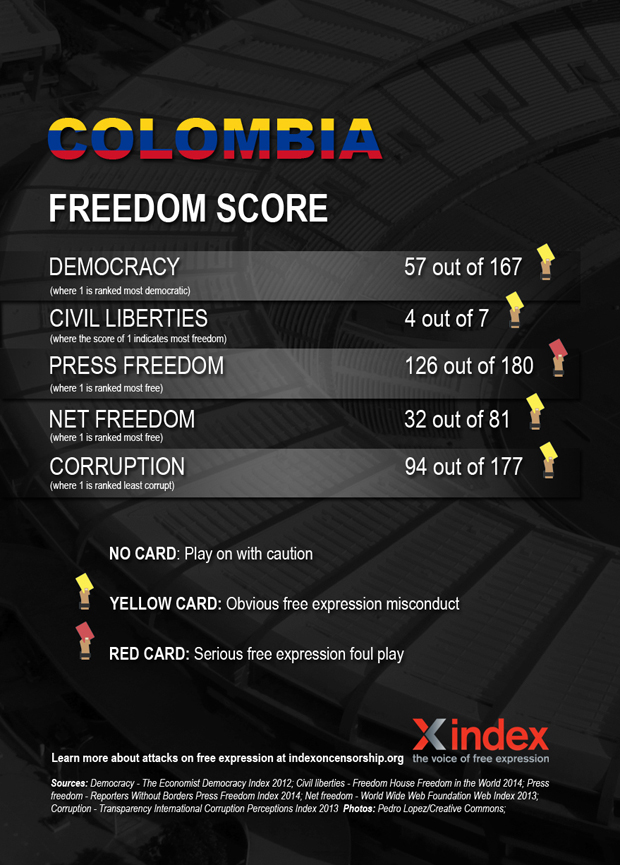
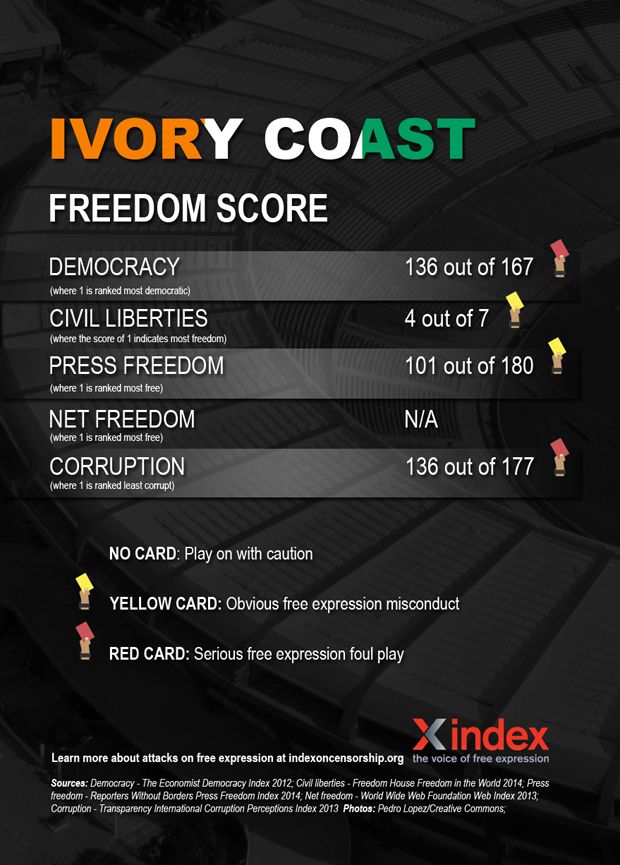
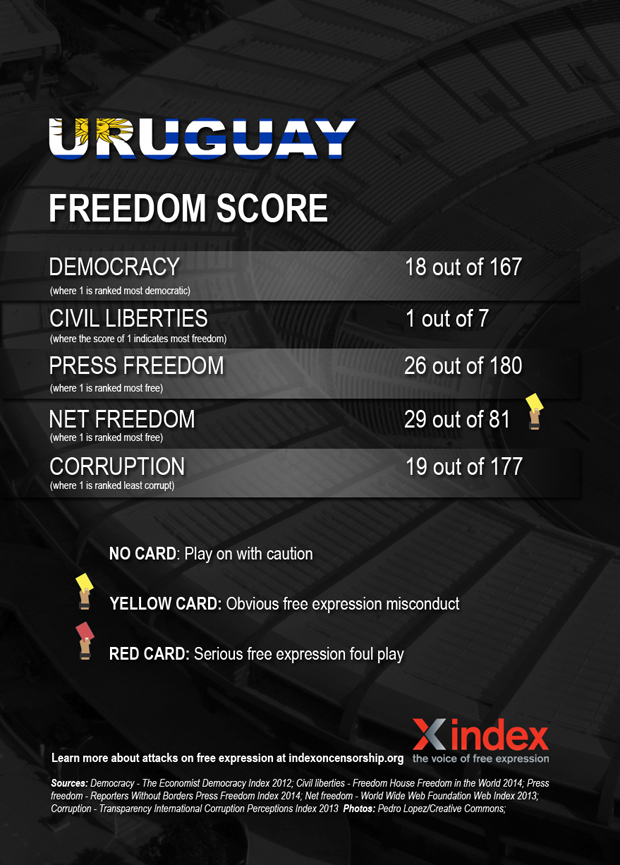
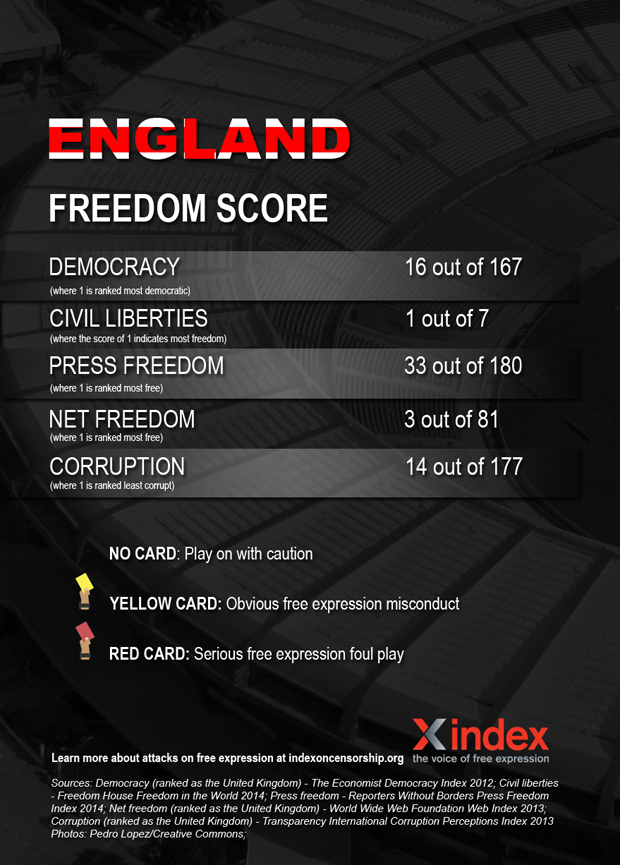
World Cup 2014: What’s the score on freedom of expression?
GROUP A
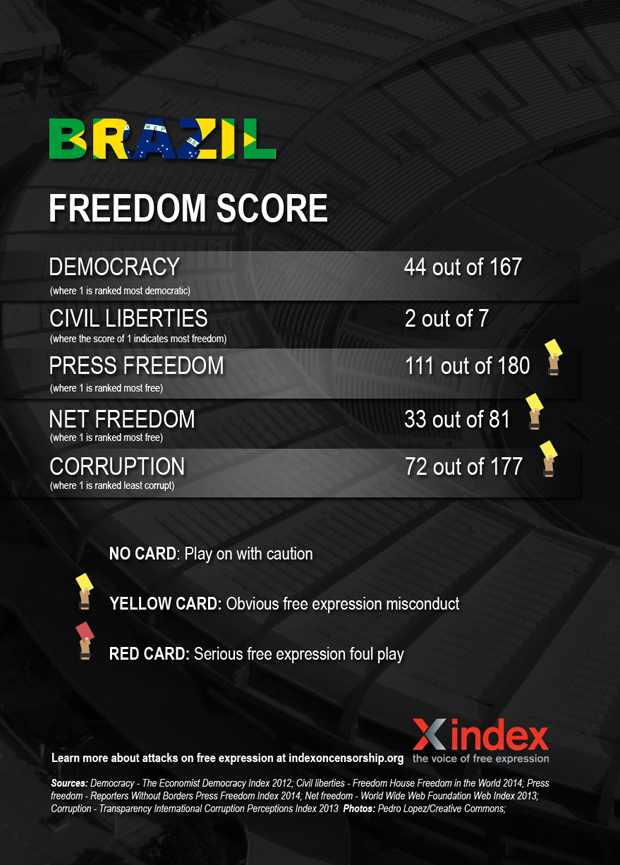
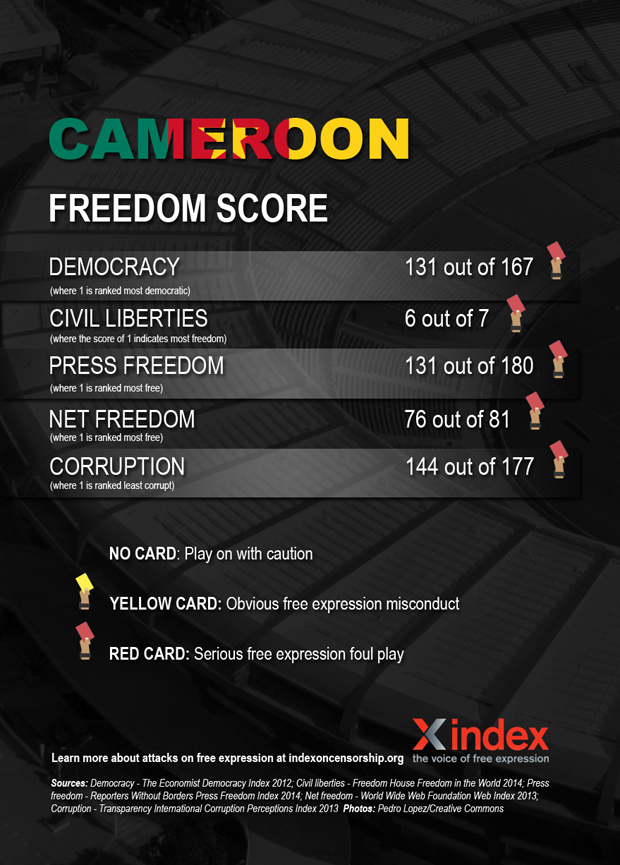
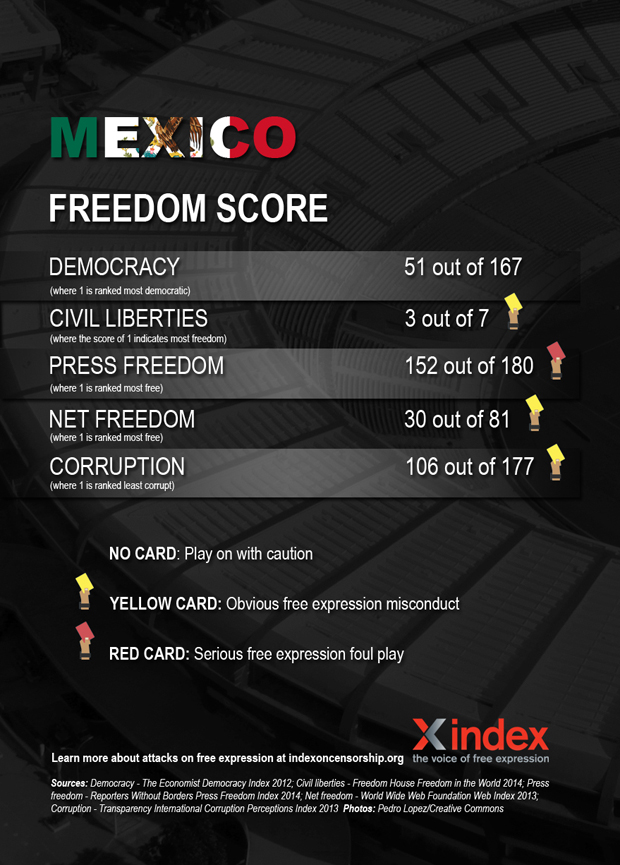
GROUP B
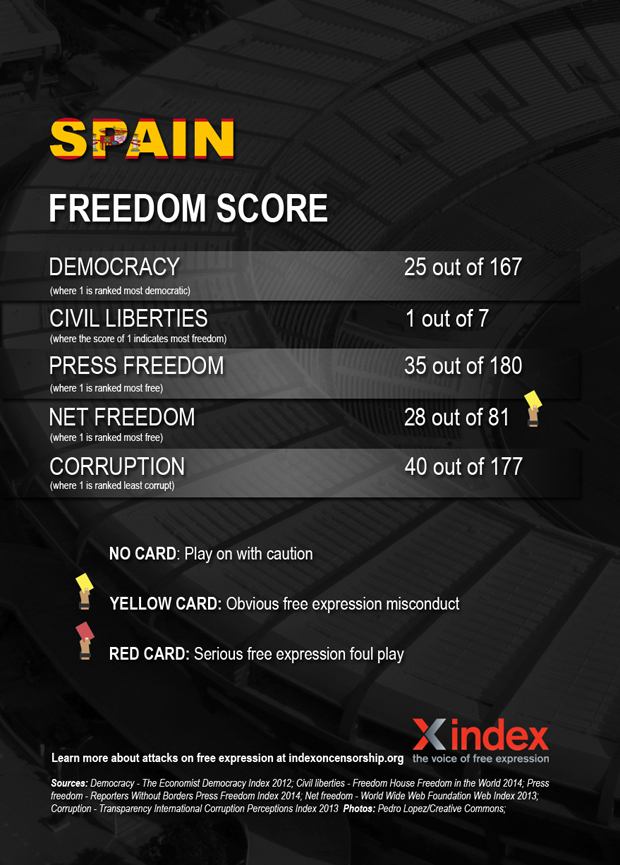

GROUP C
GROUP D
GROUP E
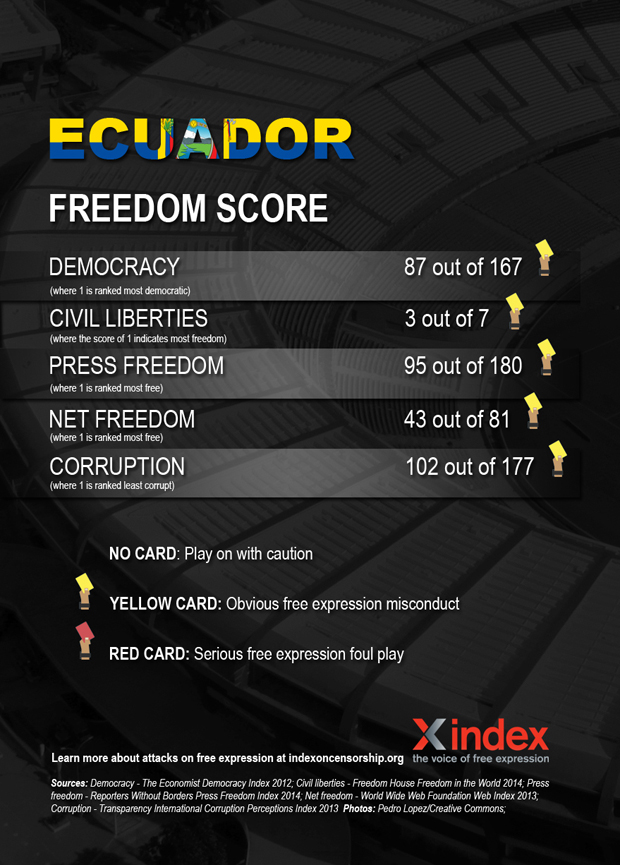
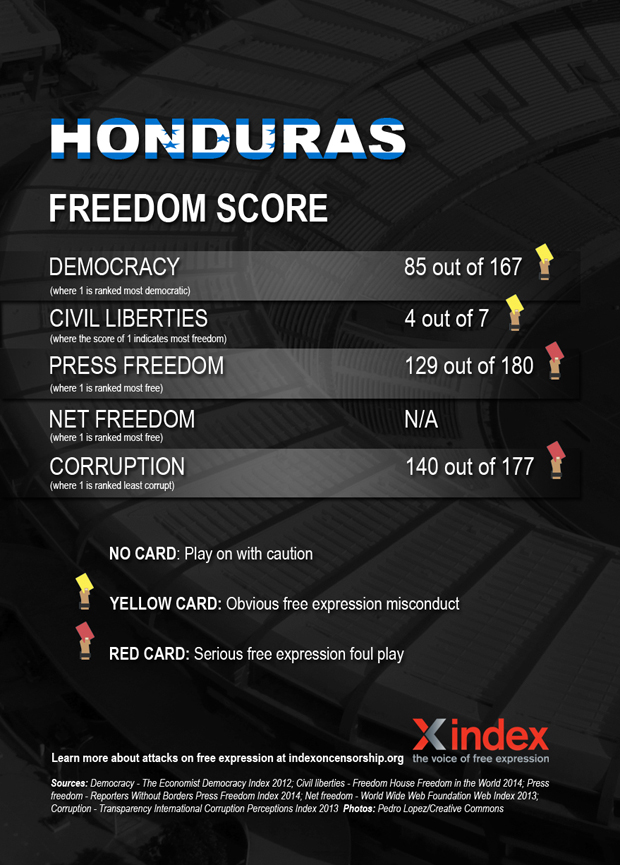
GROUP F
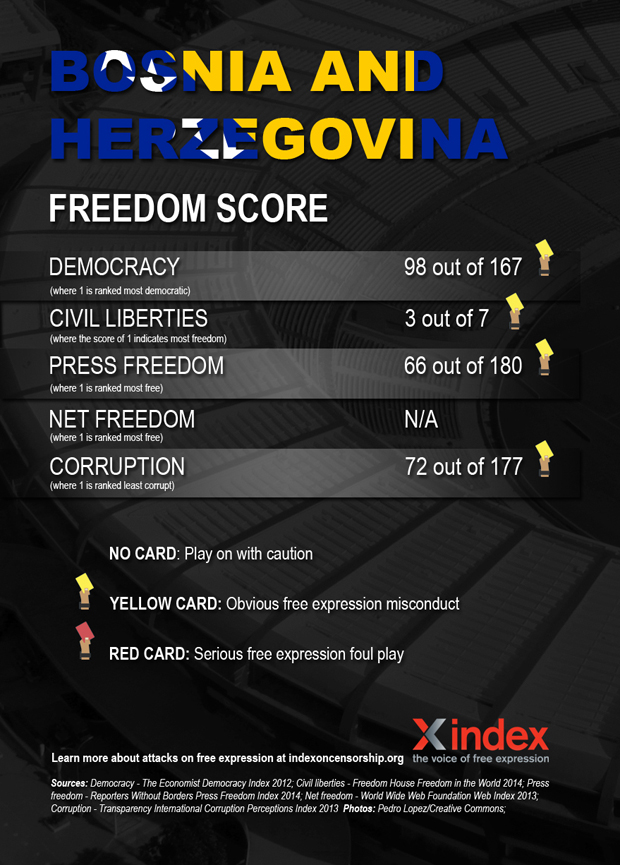
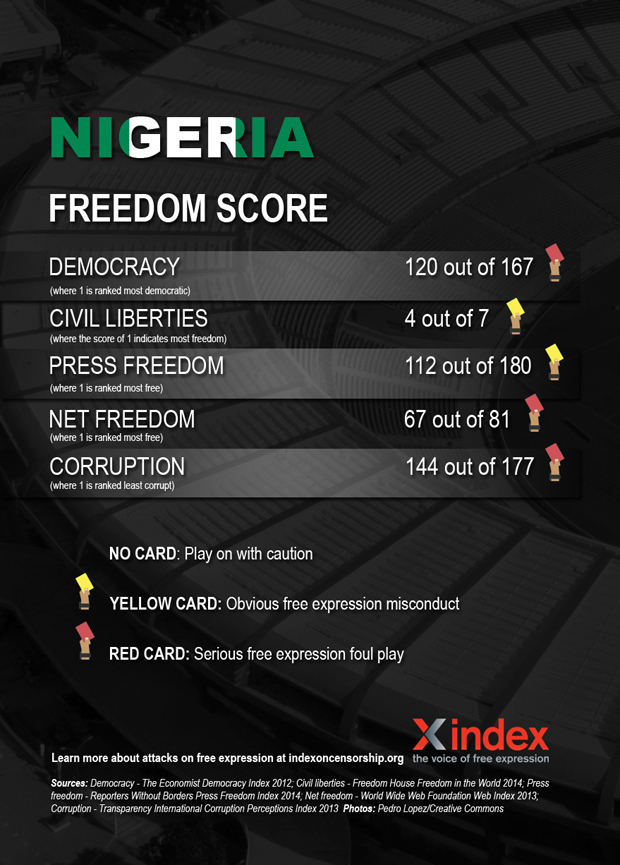
GROUP G
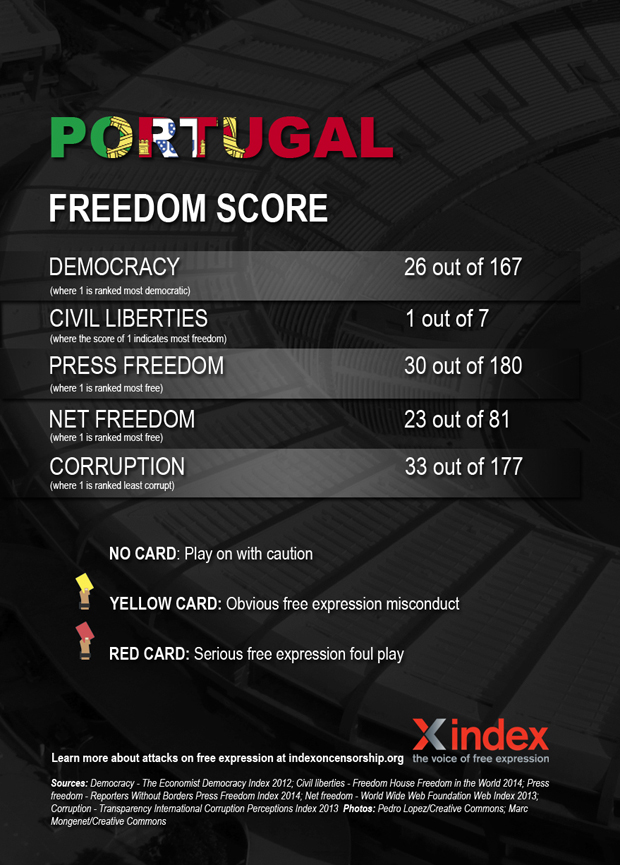
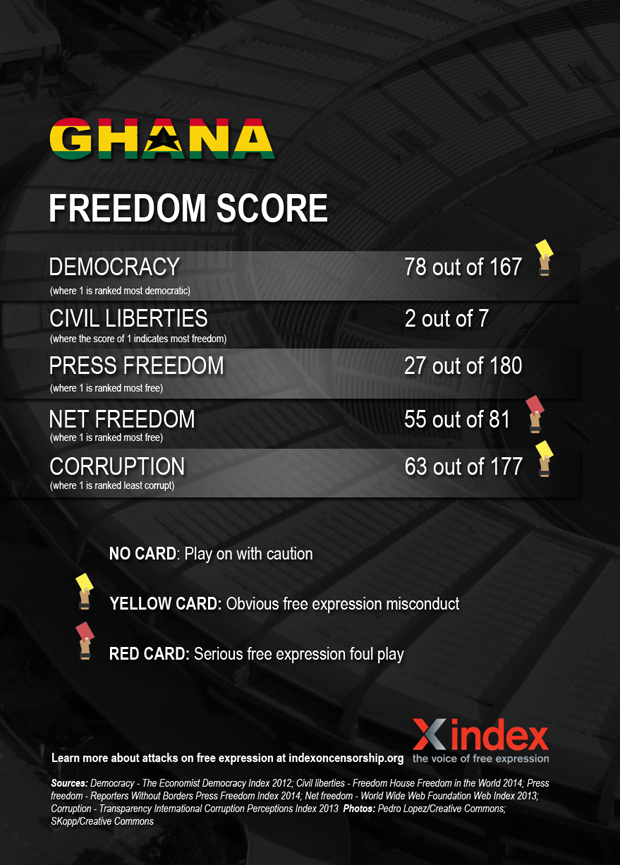
GROUP H
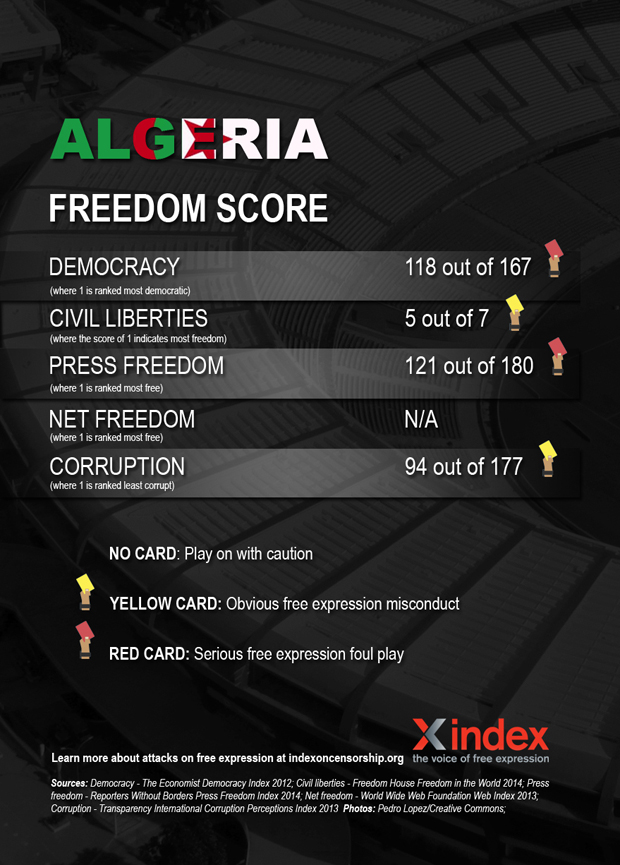
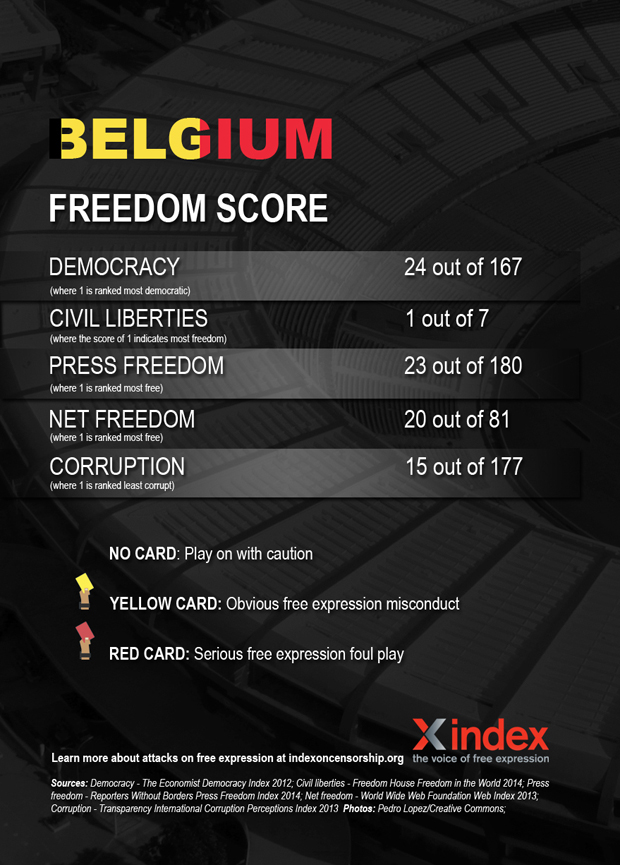
This article was published on June 18, 2014 at indexoncensorship.org

This article was published on June 18, 2014 at indexoncensorship.org
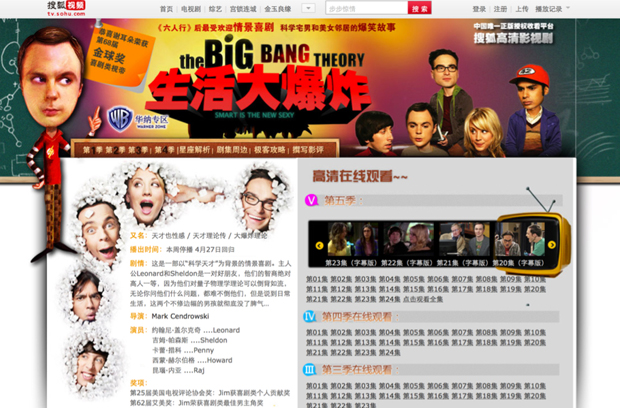
Chinese fans of American TV have been dealt a serious blow after some of their favorite shows were removed from the country’s main video streaming websites. On Saturday, The Big Bang Theory, The Good Wife, NCIS and The Practice all disappeared from the sites of Sohu TV, iQiyi and Youku. Immediately after, fans took to online forums to voice their disapproval. Netizens lashed out at the government, referring to China as “West North Korea,” a phrase that was quickly blocked from online searches.
No one knows exactly why the government has ordered the shows offline. Others, such as House of Cards and Breaking Bad, both of which have gained huge followings in China and present darker material, remain unscathed. Speculating in the state-controlled newspaper Global Times, leading film critic Tan Fei argued that “the machetes the monitoring departments waved to the U.S. dramas are not only aimed at protecting teenagers’ physical and mental health but, on a deeper level, are aimed at protecting our weak domestic film industry.”
Of Fei’s last point, it’s worth noting that until recently, the main video providers have been free to broadcast shows without the hurdle of obtaining official approval. China’s TV stations, by contrast, are heavily restricted when it comes to content. Poorly acted soap operas and over-the-top dramas about corrupt emperors and the Sino-Japanese War are the mainstay of these channels. As a result, viewers have fled to the more free and entertaining realms of online TV.
In order to lure people back, state-owned television channels have started to broadcast some of the same shows as Chinese streaming platforms, albeit censored versions. China’s national TV broadcaster CCTV will soon air The Big Bang Theory and has recently introduced a dubbed version of Game of Thrones to its paid channel.
Li Bingwen, who has worked for Chinese state media and is now at a western publication, watches a range of popular US shows, including the ones that have been removed. For Li, who tells Index that Chinese TV shows make him “doze off”, the latest government move is “cynical.”
“Forcing video web sites like Youku.com to remove The Big Bang Theory from their play lists is the most cynical act by Chinese censors ever. Banning speech for ideological reasons is evil but understandable. Taking a show off the site of a private company just so a state-owned broadcaster can air it is the new height of hypocrisy.”
Commerce doesn’t explain the move entirely though. The development comes as the government is tightening control of all areas online, particular the areas that attract the most attention, which these shows do.
“There’s been a tendency for the government to treat different forms of communication differently when it comes to censorship, being most restrictive about the media that reach the broadest spectrum of people,” explained Jeffrey Wasserstrom, a prominent academic and author of China in the 21st Century: What Everyone Needs To Know.
“The internet was seen for a time as having less broad a reach than film and television, so you were given more latitude for what you said online as opposed to in a television show. Now, of course, streaming content and growing numbers of people who go online regularly blurs that distinction,” he added.
While people of all ages within China watch these shows, it is the youth who tune in the most, and are therefore the most affected. On top of making up the biggest proportion of online users, the under-30 demographic are particularly drawn to the themes of the shows, and disillusioned by those themes presented on Chinese TV. For example, the story of science geeks trying to find their way in the world post graduation, as is illustrated in The Big Bang Theory, resonates with millions of young Chinese. With the job market in China becoming fiercely competitive and living costs soaring across major cities, graduates are now finding their dreams scuppered, much like the characters of this show.
Today’s Chinese youth also see US and UK shows as windows to foreign cultures, and more importantly, as exercises in English. For many of these people then, who might be politically apathetic, or at least profess to be so, the recent attack will be a first direct taste of censorship.
“Moves like this, which limit access to works of western popular culture, are particularly significant for Chinese youth,” Wasserstrom said.
“When people in China go online, as when people in other places do this, they often do so in search not of news but of entertainment and other kinds of non-political things, such as information about restaurants. Being suddenly unable to access a favorite television show is both annoying and a reminder of the prevalence of the government’s ability to exert control over many different aspects of life, when it wants to.”
The battle is not over yet. In the wake of the ban, people have started exploring alternative methods to access the shows. Committed viewers like Li can still gain access to the programmes. Li is boycotting CCTV and says he will explore unsanctioned methods to access the shows.
“If you are really serious, you can find them, maybe on someone’s virtual hard drive that they make accessible to everyone. A friend for example goes to a place to download tons of shows shortly after they air in the US. He is very discreet about that place and he is helping me now.”
Less tech savvy fans will have to await the airing of The Big Bang Theory on Chinese TV and hope it’s not too sanitised. Wang Meimei, another fervent Big Bang fan who Index spoke to, says she’s not holding her breath. She’ll tune in anyway.
“I want to see how much they will ruin a good drama,” explains the 26-year-old curtly.
This article was published on May 2, 2014 at indexoncensorship.org
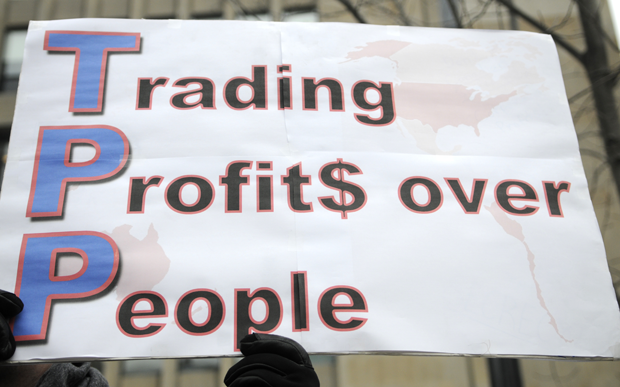
A sign saying “trading profits over people” during a rally to protest the proposed TPP trade agreement and NAFTA Agreement on January 31, 2014 in Toronto, Canada. (Photo: Shutterstock)
As President Barack Obama returns from Asia trade talks today, freedom of speech campaigners plan to deliver nearly three million signatures to the White House, gathered over recent weeks on the Stop The Secrecy website.
Freedom of expression campaigners have warned that the Transpacific Partnership trade agreement, which Obama has been negotiating with a dozen Asian governments, will have wide-reaching censorship implications.
With secret negotiations reportedly at a critical stage, campaigners have mounted a global plan to draw the attention to the role that internet providers would play in preventing the free flow of information.
The draft chapter of the Trans-Pacific Partnership Agreement on Intellectual Property— in its current leaked version mandates signatory governments to provide legal incentives for Internet Service Providers (ISPs) to privately enforce copyright protection rules.
The TPP wants service providers to undertake the financial and administrative burdens of becoming copyright cops, serving what the Electronic Frontier Foundation call “a copyright maximalist agenda”.
The agreement also proposes wide-reaching alterations to the controversial topic of copyright laws, including laws that require ISPs to terminate their users’ Internet access on repeat allegations of copyright infringement, requirements to filter all internet communications for potentially copyright-infringing material, ISP obligations to block access to websites that allegedly infringe or facilitate copyright infringement, efforts to force intermediaries to disclose the identities of their customers to IP rights holders on an allegation of copyright infringement.
While this might be good news for music, film and TV companies – who have seen profits fall off the back of websites such as the Pirate Bay, but a spokesperson for Electronic Frontier Foundation warned the result could be a “cautious and conservative” internet afraid to run into draconian enforcement policies laid out under the new TPP rules.
“Private ISP enforcement of copyright poses a serious threat to free speech on the internet, because it makes offering open platforms for user-generated content economically untenable,” argue EFF.
“For example, on an ad-supported site, the costs of reviewing each post will generally exceed the pennies of revenue one might get from ads. Even obvious fair uses could become too risky to host.”
EFF also warned that ISPs take-down “ask questions later” approach to copyright infringements could give corporations too much power to remove time-sensitive user-generated content, for example a supporting video for an election campaign.
“Expression is often time-sensitive: reacting to recent news or promoting a candidate for election. Online takedown requirements open the door to abuse, allowing the claim of copyright to trump the judicial system, and get immediate removal, before the merits are assessed.”
TPP, which is currently being negotiated between the United States and a dozen major markets in Asia, It is a key plank in Obama’s much feted “pivot to Asia” and could affect up to 60% of American exports and 40% of world trade.
The US-led treaty has proposed criminal sanctions on copyright infringement and – according to EFF – could force internet service providers to monitor and censor content more aggressively, and even block entire websites wholesale if requested by rights holders.
Backed by a number of groups including Avaaz, Reddit, Electronic Frontier Foundation and Open Media International, the anti-TPP coalition is also employing guerrila marketing techniques. These include projecting campaign slogans onto key government buildings in Washington, in an attempt to draw wider attention to the secretive talks, as well as a digital banner that can be easily installed on any website.
The trade negotiations have controversially gone on largely behind closed doors – and while talks are believed to have stalled between Japan and the United States in the latest round – many countries, including Vietnam and Australia, are vociferous advocates.
WikiLeaks’ Julian Assange, who master-minded the release of a rare leaked chapter of the agreement in November, is adamant the deal’s worst aspects lie in its approach to intellectual property.
Speaking when the documents were first published on the Wikileaks website, he observed: “If instituted, the TPP’s IP regime would trample over individual rights and free expression, as well as ride roughshod over the intellectual and creative commons”
He added “If you read, write, publish, think, listen, dance, sing or invent, the TPP has you in its crosshairs.”
OpenMedia’s Executive Director Steve Anderson, told Index “If the TPP’s censorship plan goes through, it will force ISPs to act as “Internet Police” monitoring our internet use, censoring content, and removing whole websites.”
OpenMedia, although based in Canada, has led the charge in co-ordinating the campaign to shed light on censorship aspects of the deal.
“A deal this extreme would never pass with the whole world watching – that’s why U.S. lobbyists and bureaucrats are using these closed-door meetings to try to ram it through. Our projection will shine a light on this secretive and extreme agreement, sending decision-makers a clear message that we expect to take part in decisions that affect our daily lives.”
This article was originally published on April 30, 2014 at indexoncensorship.org
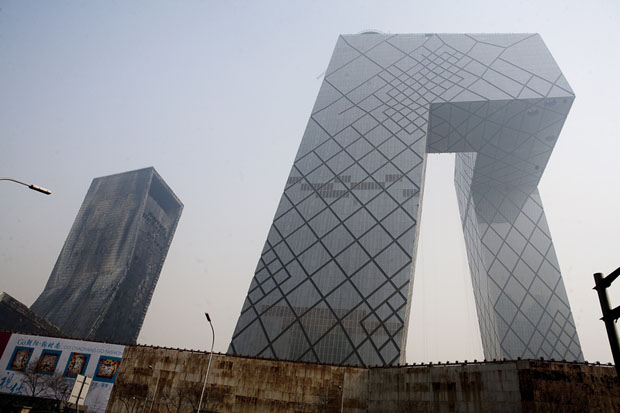
China’s state broadcaster CCTV fired a journalist for criticising its practise of airing live criminal “confessions” (Image: Matthew Niederhauser/Demotix)
In November 2013, Wang Qinglei, a TV producer at the state-broadcaster CCTV, left his office for the last time. “Long-time co-workers lamented with me, ‘Over all these years, there have been editors, reporters, producers, and directors who have been suspended because of stories, but you are the first producer who has been fired for speaking your true feelings! What is wrong with CCTV these days?'” he later wrote.
“In the space of a year, we get upwards of a thousand propaganda orders,” Wang had controversially vented on an internet forum prior to his dismissal. “We should ask ourselves: How many of these orders were issued in the national interest, and how many were issued to serve the political and economic interests of some individual, group or leader?”
His comments sparked alarm amongst the authorities. They had just passed laws forbidding citizens from exploiting the media to spread unfounded rumours and libellous claims, a strategy which most suspected was more covert censorship than genuine concern.
The open letter that he posted online, which CCTV would subsequently fire him over, focused on a new practice of airing live criminal “confessions.” State-owned CCTV had been broadcasting dramatised admissions by petty criminals for years, in an attempt to win new viewers, but in recent months, a string of high-profile political suspects had also been made to confess to crimes on air. The suspects are often filmed handcuffed and wearing jump suits. The footage is designed to be humiliating. The practice is ongoing.
Chinese-American Charles Xue, a social media celebrity and successful venture capitalist, had been amongst the first victims of the tactic, just two months previously. He “confessed” to having been “in a negative mood” while tweeting criticisms of the government, admitting that his thoughts were “a neglect of the social mainstream.” Separately, the authorities had arrested him for consorting with prostitutes, charges which some say are fabricated.
As Wang put it, when decrying the TV confessions in his open letter to CCTV executives: “We abused the public institution of media to wantonly bombard an individual indiscretion. Journalistic integrity and professionalism were nowhere to be found.”
The ironies of the circumstances surrounding Xue’s confession were either unintended or highly cynical. While the Chinese authorities are still having trouble taming the internet, the government remains in control of print and TV media.
Footage of Xue’s confession, for example, was widely discussed by Chinese TV and print outlets, whose freedom of expression is heavily limited by state involvement. Meanwhile, Xue’s online media presence was rapidly disappearing. Mentions of previous campaigns on microblogging site Weibo were removed. Wang’s open letter to CCTV, the one which had got him sacked, was also removed. Directives issued from the Ministry of Information detailed how links to any of the content would result in arrests.
Wang, and other critics of the policy, argued the on-air confessions, forced on high-profile enemies of the state such as Xue, were an unfair skip round a proper judicial process. Human rights lawyers and even some Communist Party officials have condemned the practice. The confessions sit alongside new legislation that forbids what the government call online “rumour mongering,” and allows anyone who retweets an “unfounded rumour” to be arrested. Thousands have now been arrested, including several high profile “social media celebrities.”
State newspapers say the new laws to control “rumour mongering” are necessary: “The Internet has grown into an easily accessible platform for the Chinese public, an increase in crimes such as defamation and blackmail has occurred online over the past few years.”
Indeed, authorities were quick to link Charles Xue’s arrest with those of Qin Zhihui and Yang Xiuyu – two so-called “black PR” professionals. Xue had allegedly invested in their controversial public relations outfit.
“Black PR” is a rapidly growing sector in China – which polishes the online reputation of celebrity and corporate clients – while spreading malicious rumours about their enemies. Rumours started by Qin and Yang were often fabricated, sometimes falsely accusing CEOs of infidelity, or involvements with prostitutes and causing a significant scandal when they effectively destroyed the Chinese Red Cross’ reputation, over made up allegations of sexual impropriety amongst senior officials at the organisation. The pair employed a 15,000 strong portfolio of online personalities to help spread their rumours – known as a “water army.”
Yet industrial smearing from the pair had gone unchecked for years — the government simply wasn’t interested in the malicious rumours Qin and Yang routinely disseminated. In fact, it was only when Qin and Yang’ decided to attack a senior Communist Party official, Lei Feng, that new “rumour mongering” legislation was suddenly used to arrest the pair. They now face long jail sentences.
Charles Xue, who was accused of backing the pair financially when he was arrested, has long been of interest to the party apparatus. As a young man, his father was imprisoned by Mao Zedong, and Xue was forcibly exiled to the countryside, put to work in attempt to reduce the threat he, and other academics, supposedly posed to communism. His outlook since the effective imprisonment has been increasingly international – as a young man he quickly learned English, did some translation work of American texts for publication in China, and travelled to Stanford to study.
In recent years, Xue has amassed not only vast wealth through his various business enterprises, but also several million followers on social media. He leverages this considerable audience for awareness campaigns around issues such as clean water, kidnapping and human rights. He also speaks passionately about the potential for Weibo to affect change.
The irony of the state abusing their control of TV and print to control those who “abuse” the media online has also been noted by local Chinese observers. Government bodies “spreading falsehoods” have come in for focussed criticism. Activists simply ask “why are men like Charles Xue being arrested, when the authorities regularly spread false rumours themselves?”
For example, an article about the Beijing police in a state-run newspaper, which reported on a supposed new crackdown on prostitution, was quickly identified as a fake. The article was in fact a repeat of an identical piece published several years earlier, which had simply been reprinted with a new date at the top.
Critics also called out newspaper Xinhua, when they mistakenly announced that Istanbul had been awarded the 2020 Olympic Games, instead of Japan. The authorities, who effectively operate Xinhua, were extremely embarrassed by the editorial hiccup. Yet no arrests at Xinhua have yet been made, over this Olympic-sized mistake.
International media has been suggesting Weibo is being”neutered” as a result of the new anti-rumours crackdown – with people too scared to use it. But newer analysis of online conversations since the legislation has been passed has revealed something strange. Record numbers of Chinese netizens are now politically active, in particular chatting about the relatively obscure political ideology “constitutionalism.” Constitutionalism is a reformist movement that advocates tying the Communist Party to a constitutional framework. In Weibo terms, the volume of conversations is enormous: there are currently twice as many microblogs referring to “constitutionalism” as were being made around the time of the Jade Rabbit moon landing. The Chinese foray into space held the previous record for most microblogs on a single topic, the analysis showed.
But on balance, the laws are chilling. The arrest net the “anti-rumours campaign” has thrown is big, with thousands already in custody. In politically troublesome Inner Mongolia, the state has made fifty arrests. And the firing of Wang Qinlei at CCTV will shake employees at state-owned media outlets, but also “social media celebrities” who are contemplating effecting social change online. The sacking starkly shows how the Communist Party stands behind CCTV as a broadcaster: endorsing public confessions to made-up crimes, as an agent of the state. Criticism of these public confessions will not be tolerated — instead it will be destroyed. And consider the “victim” of the confession, Charles Xue. Trumped up prostitution charges were probably difficult to explain to his wife. His kids won’t remember fondly, watching their dad on TV, confessing to being an enemy of the state. Nor the bullying that goes on in the school yard afterwards. The gossip and rumours behind his family’s back. “Saving face” is an all-important concept in China: public humiliation is the antithesis of that. Televised confessions, an unsettling and bizarre spectacle, are making even the most influential scared to speak out.
This article was posted on 21 February 2014 at indexoncensorship.org