Each week, Index on Censorship’s Mapping Media Freedom project verifies threats, violations and limitations faced by the media throughout the European Union and neighbouring countries. Here are five recent reports that give us cause for concern.
5 August, 2016 – Twelve journalists were arrested on terror charges following a court order, independent press agency Bianet reported.
According to Bianet: “The court on duty has ruled to arrest Alaattin Güner, Şeref Yılmaz, Ahmet Metin Sekizkardeş, Faruk Akkan, Mehmet Özdemir, Fevzi Yazıcı, Zafer Özsoy, Cuma Kaya and Hakan Taşdelen on charges of “being a member of an armed terrorist organisation” and Mümtazer Türköne, columnist of the now closed Zaman Daily on charges of “serving the purposes of FETÖ (Fethullahist Terrorist Organisation)” and Hüseyin Turan and Murat Avcıoğlu on charges of “aiding a [terrorist] organization as non-member”.
Warrants for the detainment of all 13 Zaman newspaper journalists were issued on 27 July 2016 by Turkish authorities.
4 August, 2016 – Monica Gubernat, a member and chairperson of the National Audiovisual Council of Romania, cut off the live transmission of a council debate, news agency Mediafax reported.
An ordinance says that all meetings of the council must be broadcasted live on its website.
The institution has recently purchased equipment to broadcast debates, which was set to go live on 4 August, 2016. A member of the council, Valentin Jucan, even issued a press statement about the live broadcast.
The chairperson, Monica Gubernat was opposed to it, saying that she was not informed about the broadcast, and asked for a written notification about the transmission.
ActiveWatch and the Centre for Independent Journalism announced they would inform the supervisory bodies of the National Audiovisual Council of Romania and the culture committees of the Parliament about the “abusive behavior of a member of the council” and asked for increased transparency within this institution.
The National Audiovisual Council of Romania is the only regulator of the audiovisual sector in Romania. Their job is to ensure that Romania’s TV channels and radio stations operate in an environment of free speech, responsibility and competitiveness. In practice, the council’s activity is often criticised for its lack of transparency and their politicised rulings.
2 August, 2016 – British blogger Graham Phillips and freelance journalist Billy Six, forcibly entered the offices of non-profit investigative journalism outlet Correctiv, filmed without permission and accused staff of spreading lies, the outlet reported on its Facebook page on Wednesday 3 August.
According to Correctiv’s statement, Phillips had been seeking to confront Marcus Bensmann, the author of a Correctiv article which claimed that Russian officers had shot down the passenger airplane crossing over Ukraine in July 2014.
Phillips maintains the Ukrainian military is responsible for the crash.
2 August, 2016 – Police officers prevented freelance journalist Dzmitry Karenka from filming near the Central Election Commission office located in the Belarusian Government House in Minsk, the Belarusian Association of Journalists reported.
The journalist reported intended to film a video on the last day when candidates for the House of Representatives, Belarusian lower chamber, could register.
At 6am he was approached by police officers who told him that administrative buildings in Belarus can be filmed “only for the news” and asked him to show his press credentials which he didn’t have as he is a freelance journalist.
Karenka told the Belarusian Association of Journalists that he spoke with the police for over an hour before he was released and advised not to film administrative buildings.
Index has released a special collection of apartheid-era articles from the Index on Censorship magazine archives to celebrate Nelson Mandela day 2016. Holly Raiborn has selected the collection, tracing the breadth of writing during the apartheid era from authors both in the country and in exile. The articles selected trace the history of this period in South Africa’s history. Significant South African writers, including Nadine Gordimer, Don Mattera, Pieter-Dirk Uys and Desmond Tutu, discuss the impacts this era of oppression had on themselves, their peers and their country. The collection will now form a reading list available to students who are researching the apartheid years, and will be available via Sage Publishing in university libraries.
Before 1948 “apartheid” was just a word in Afrikaans with a simple meaning: separateness. However, over the course of the next 50 years, the word “apartheid” would take on a new level of significance. The connotation of the word grew darker with every dissident banned, prisoner tortured, child left uneducated and home destroyed. Apartheid is no longer just a word; it carries the history of brutality, censorship and maltreatment of South Africans. For a limited period, Index and Sage are making the collection free to non-subscribers. For those who want to study the history of censorship further, Index on Censorship magazine’s archives are held at the Bishopsgate Institute in London and are free to visit.
Nadine Gordimer, Apartheid and “The Primary Homeland”
1972; vol. 1, 3-4: pp. 25-29
An address regarding the 1972 plans of the South African government to abolish the right of appeal against decisions brought by the State Publications Control Board, effectively ridding writers of a means to combat the rulings of government-appointed censors. The censorship in South Africa at this time caused a breakdown in communication between “the sections of a people carved up into categories of colour and language.”
An extensive report on the state of the “free” press in South Africa prepared for the United Nations’ Unit on Apartheid in November 1972. Ginwala posits that apartheid attempts to segregate freedom and this attempt “extinguishes freedom itself”.
A personal narrative reflecting the experiences of Robert Royston as a black poet in South Africa during a period of popularity for black poetry amongst white readers. Royston describes a disconnect between the language he speaks and the language understood by the government and white citizens, although they technically share the same tongue.
An article by a New York Sunday Times staff writer arguing that the proposed cultural boycott would ultimately negatively affect black South Africans more than white South Africans who were merely irritated. Slater feared black South Africans suffer from feelings of isolation from the outside world because of the cultural boycott.
A discussion regarding the often contradictory aspects of the South African “free” press in which newspapers censor themselves. Strict laws preventing communism, sabotage and terrorism were often twisted to prevent the publications of black viewpoints.
In the UK in the 1970s, news about South Africa was contributed by the white minority while black South Africans were not interviewed by major European news outlets about events predominantly affecting their community such as the Soweto riots. This article discusses the clear racial bias, blaming it for the misinformation and misconceptions in Europe about apartheid-era South Africa.
A report regarding the glaring health violations within the overwhelmingly black South African mental hospitals that were largely ignored due to racial factors and censorship brought about with the 1959 Prisons Act. This act made reporting “false information” on prisons or prisoners punishable with jail time or fines which led to prison and mental patient camp, conditions being largely neglected in the media.
An article about a significant yet short-lived South African journal, Bandwagon, whose purpose was to unite individuals banned under the Suppression of Communism Act. The act featured strictly enforced limits on social life and essentially made any meetings, social or otherwise, illegal for a banned person; therefore, the impact and importance of this publication should not be understated.
Hachten discusses the new found power of being a black journalist (the literacy rate of black South Africans had recently surpassed whites) and the growing hazards of the profession in the late 1970s. Journalists were arrested for reporting the events of the Soweto riots and faced constant police and legislative pressure on top of fines and censorship imposed by the white-controlled newspapers they had no choice but to work for.
An address from a banned poet who pointed out the cruelty of white South African society so that they may never claim ignorance to the atrocities. He questions why his words are deemed so dangerous that he is not allowed to attend social gatherings like birthdays and funerals
Gordimer hypothesised that the successful appeal of her novel’s banning, and that of many novels by other white writers, was due to the fact that she is white. She argued that South Africa would never be rid of censorship until it was rid of apartheid.
Woods wrote about the shift from editors of South African newspapers facing fines for disobeying censorship statutes to jail time in the late 1970s and explained that this shift signalled that dissent and bold writing was permitted in white politics but would not be permitted from black perspectives. He argued that the reason the government did not censor the press entirely was because they enjoyed the façade of a “free press” and there was no reason for them to need full censorship.
Tomaseli explained that censorship was often as financially driven as it is culturally. He wrote that censorship interferes at three stages, namely during: finance, distribution and through state censorship law. Tomaseli expands on the circumstances that led to many different films being banned or harshly edited.
Mzamane claimed that the Bantu Education Act of 1956 was clearly a ploy to create compliant Africans within a society increasingly controlled by Afrikaners. Bantu schools were essentially vocational training for servitude to whites and textbooks were blatant indoctrination, he argued.
A clever take on the South African censor. Hope addresses the reasons and methodology of the South African censor with tongue and cheek commentary as he reviews the Publications Appeal Board: Digest of Decisions. This collection is comprised of the totality of decisions made by the South African Publications Appeal Board.
Sepamla writes about the struggles of continuing to write under such strict scrutiny by censors after the banning of his latest novel, A Ride on the Whirlwind. He speaks of the disenchantment experienced by any writer that has faced censorship and specifically black South African writers who faced this treatment all too often.
Music was divided along race and class lines. Music was banned under the Publications Act if it was found to be unsafe to the state, harmful to the relationship between members of any sections of society, blasphemous, or obscene Songs with even symbolic mention of freedom or revolution were banned.
Reverend Pityana wrote of the paradox that Christianity teaches that all are equal under god but the church in South Africa still degraded and segregated. He writes that The Bible teaches that all are created in God’s image and the plight of the Jews and other marginalised groups within the Bible give hope, guidance and reassurance to those suffering under apartheid.
Tlali, a black female South African novelist, addresses the added difficulties of being black and a woman in Afrikaner-controlled society. She speaks both from personal experience and about the struggles of her peers.
An honest first-hand account of the Soweto riots by a 20-year-old unemployed black South African. Rantete wrote a sympathetic eyewitness report of the September riot and the first reaction of the South African authorities to confiscate and ban it.
The white South African novelist on the intimidation tactics and stalking committed by the security police after his controversial novel, Cry, The Beloved Country, was published. He notes that he suspects his treatment would have been even worse had he been black.
Former editor of the Cape Times, who was awarded the International Federation of Newspaper Publishers’ Golden Pen of Freedom in 1986, Heard was dismissed from his position after his interview with banned leader of the African National Congress Oliver Tambo. Heard speaks about 16 years of editing under apartheid and the circumstances surrounding his dismissal in August 1987.
‘The importance of international pressure in giving a measure of protection to the South African press cannot be overestimated’ wrote the co-editor of the Johannesburg Weekly Mail in this assessment of Botha’s policy towards the alternative press. Harber offered a compelling plea for protection of the South African alternative press by the international media.
An extensive review of restrictions in South Africa at that time including the Defence Act, Police Act, Prisons Act, Internal Security Act and the Publications Act. The writers offer suggestions for the safety and protection of journalists in the future.
Rive discusses the racial factors that have contributed to his writing style and the works of any black writer in South Africa. He emphasises the hypocrisy of the society he lives in which will criticise black writers as simplistic but not allow quality education and where the books of black writers sitting in libraries that they are not allowed to enter.
Albie Sachs was asked by Index on Censorship to look ahead to constitutional reform that was not foreseeable at that point and how to enshrine freedom of expression in a post-apartheid South Africa. Four months later came the unbanning of the ANC on 2 February, the release of Nelson Mandela on 11 February and his reunion with Oliver Tambo in Sweden on 12 March, all of which promised real change. These are extracts from the conversation about a future South Africa. He offers suggestions for the then-looming transition from apartheid to democracy.
In May 1986 Oliver Tambo, president of the African National Congress, was interviewed by Andrew Graham. The ANC president discussed the beginning of the end for apartheid and traces the lineage of the racism that fuelled the apartheid for nearly 50 years. Tambo optimistically plans for a new reign of government made up of representation that actually reflects the populous.
On 11 July 1979, Nadine Gordimer’s novel Burger’s Daughter was banned by the South African directorate of publications on the grounds – among others – that the book was a threat to state security. After an international outcry the director of publications appealed against the decision of his own censorship committee to the publications’ appeal board. In this article, Nadine Gordimer reflects on these events, and on the new censorship policy they heralded. Gordimer reflects on censorship under previous administrations and what she expects from President FW de Klerk’s reign as president.
A reflection on how far South Africa had come and still had to go by this frequently banned author. Using the Descartes method, Gordimer considers the role reversal that has occurred in post-apartheid South Africa as her once banned colleagues ascend to political power.
An Index interview with Archbishop Desmond Tutu, Tutu discusses the urgency of healing the past before South Africa can truly move on to a brighter future. This brighter future was to be achieved with the aid of the Truth Commission. He argued that only honesty, compassion and forgiveness would lead to national unity in South Africa, even if that means prosecuting former ANC members. He stresses that the commission’s goal is reparations and not compensation.
Famed satirist Pieter-Dirk Uys questioned if information about the atrocities of the apartheid could actually be uncovered by the Truth Commission. Uys asked how the country could heal when so many willing participants in the apartheid already seemed eager to forget or to forge their own accounts of history to avoid blame. His pessimistic view contrasted with that of Archbishop Desmond Tutu’s.
All articles from Index on Censorship magazine, from 1972 to 2016, are available via Sage in most university libraries. More information about subscribing to the magazine in print or digitally here.
[vc_row][vc_column][vc_custom_heading text=”Index on Censorship has dedicated its milestone 250th issue to exploring the increasing threats to reporters worldwide. Its special report, Truth in Danger, Danger in Truth: Journalists Under Fire and Under Pressure, is out now.”][vc_row_inner][vc_column_inner width=”1/2″][vc_column_text]
Highlights include Lindsey Hilsum, writing about her friend and colleague, the murdered war reporter Marie Colvin, and asking whether journalists should still be covering war zones. Stephen Grey looks at the difficulties of protecting sources in an era of mass surveillance. Valeria Costa-Kostritsky shows how Europe’s journalists are being silenced by accusations that their work threatens national security.
Kaya Genç interviews Turkey’s threatened investigative journalists, and Steven Borowiec lifts the lid on the cosy relationships inside Japan’s press clubs. Plus, the inside track on what it is really like to be a local reporter in Syria and Eritrea. Also in this issue: the late Swedish crime writer Henning Mankell explores colonialism in Africa in an exclusive play extract; Jemimah Steinfeld interviews China’s most famous political cartoonist; Irene Caselli writes about the controversies and censorship of Latin America’s soap operas; and Norwegian musician Moddi tells how hate mail sparked an album of music that had been silenced.
The 250th cover is by Ben Jennings. Plus there are cartoons and illustrations by Martin Rowson, Brian John Spencer, Sam Darlow and Chinese cartoonist Rebel Pepper.
You can order your copy here, or take out a digital subscription via Exact Editions. Copies are also available at the BFI, the Serpentine Gallery, MagCulture, (London), News from Nowhere (Liverpool), Home (Manchester) and on Amazon. Each magazine sale helps Index on Censorship continue its fight for free expression worldwide.
Index on Censorship magazine was started in 1972 and remains the only global magazine dedicated to free expression. It has produced 250 issues, with contributors including Samuel Beckett, Gabriel García Marquéz, Nadine Gordimer, Arthur Miller, Salman Rushdie, Margaret Atwood, and many more.
[/vc_column_text][/vc_column][/vc_row][vc_row][vc_column][vc_custom_heading text=”SPECIAL REPORT: DANGER IN TRUTH, TRUTH IN DANGER” css=”.vc_custom_1483444455583{margin-right: 0px !important;margin-left: 0px !important;border-bottom-width: 1px !important;padding-top: 15px !important;padding-bottom: 15px !important;border-bottom-color: #455560 !important;border-bottom-style: solid !important;}”][vc_column_text]
Journalists under fire and under pressure
Editorial: Risky business – Rachael Jolley on why journalists around the world face increasing threats
Behind the lines – Lindsey Hilsum asks if reporters should still be heading into war zones
We are journalists, not terrorists – Valeria Costa-Kostritsky looks at how reporters around Europe are being silenced by accusations that their work threatens national security
Code of silence – Cristina Marconi shows how Italy’s press treads carefully between threats from the mafia and defamation laws from fascist times
Facing the front line – Laura Silvia Battaglia gives the inside track on safety training for Iraqi journalists
Giving up on the graft and the grind – Jean-Paul Marthoz says journalists are failing to cover difficult stories
Risking reputations – Fred Searle on how young UK writers fear “churnalism” will cost their jobs
Inside Syria’s war – Hazza Al-Adnan shows the extreme dangers faced by local reporters
Living in fear for reporting on terror – Ismail Einashe interviews a Kenyan journalist who has gone into hiding
The life of a state journalist in Eritrea – Abraham T. Zere on what it’s really like to work at a highly censored government newspaper
Smothering South African reporting – Carien Du Plessis asks if racism accusations and Twitter mobs are being used to stop truthful coverage at election time
Writing with a bodyguard – Catalina Lobo-Guerrero explores Colombia’s state protection unit, which has supported journalists in danger for 16 years
Taliban warning ramps up risk to Kabul’s reporters – Caroline Lees recalls safer days working in Afghanistan and looks at journalists’ challenges today
Writers of wrongs – Steven Borowiec lifts the lid on cosy relationships inside Japan’s press clubs
The Arab Spring snaps back – Rohan Jayasekera assesses the state of the media after the revolution
Shooting the messengers – Duncan Tucker reports on the women investigating sex-trafficking in Mexico
Is your secret safe with me? – Stephen Grey looks at the difficulties of protecting sources in an age of mass surveillance
Stripsearch cartoon – Martin Rowson depicts a fat-cat politician quashing questions
Scoops and troops – Kaya Genç interviews Turkey’s struggling investigative reporters
A world away from Wallander – An exclusive extract of a play by late Swedish crime writer Henning Mankell
“I’m not prepared to give up my words” – Norman Manea introduces Matei Visniec, a surreal Romanian play where rats rule and humans are forced to relinquish language
Posting into the future – An extract from Oleh Shynkarenko’s futuristic new novel, inspired by Facebook updates during Ukraine’s Maidan Square protests
The lost art of letters – Vicky Baker looks at the power of written correspondence and asks if email can ever be the same
[/vc_column_text][/vc_column][/vc_row][vc_row][vc_column][vc_custom_heading text=”SUBSCRIBE” css=”.vc_custom_1481736449684{margin-right: 0px !important;margin-left: 0px !important;border-bottom-width: 1px !important;padding-bottom: 15px !important;border-bottom-color: #455560 !important;border-bottom-style: solid !important;}”][vc_column_text]Index on Censorship magazine was started in 1972 and remains the only global magazine dedicated to free expression. Past contributors include Samuel Beckett, Gabriel García Marquéz, Nadine Gordimer, Arthur Miller, Salman Rushdie, Margaret Atwood, and many more.[/vc_column_text][vc_row_inner][vc_column_inner width=”1/2″][vc_single_image image=”76572″ img_size=”full”][/vc_column_inner][vc_column_inner width=”1/2″][vc_column_text]In print or online. Order a print edition here or take out a digital subscription via Exact Editions.
Copies are also available at the BFI, the Serpentine Gallery, MagCulture, (London), News from Nowhere (Liverpool), Home (Manchester), Calton Books (Glasgow) and on Amazon. Each magazine sale helps Index on Censorship continue its fight for free expression worldwide.
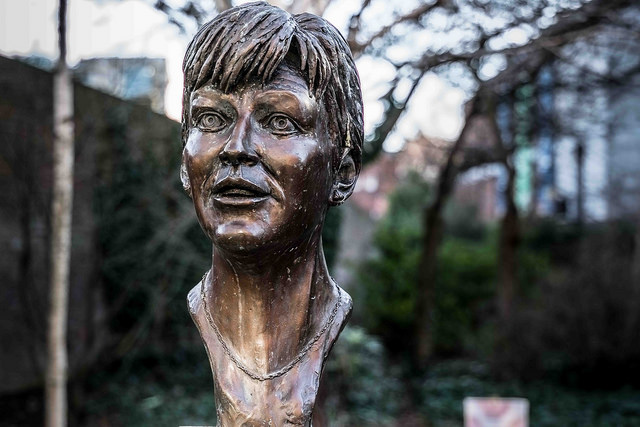
Monument to Veronica Guerin in Dublin Castle gardens. Credit: William Murphy / Flickr
This weekend marks 20 years since the murder of Irish award-winning crime and investigative journalist Veronica Guerin. On 26 June 1996, two masked men on a motorbike pulled up alongside her car at traffic lights on the outskirts of Dublin, opened fire and killed her instantly. Three men were subsequently convicted for their involvement in the murder.
Guerin, who had been working as a freelance journalist for Ireland’s Sunday Independent, made a name for herself investigating and exposing the crimes of senior members of Dublin’s criminal underworld. But such a reputation can be a dangerous thing for an investigative reporter to have. Guerin was subject to a number of attacks and threats, including against the life of her young son Cathal. In 1995 she was shot in her home but survived. Refusing to yield, she continued her work.
“Veronica was a late entrant to journalism; she trained and worked initially in accountancy so she had an instinct for business and understood money,” says Séamus Dooley, Irish Secretary, National Union of Journalists. “That was very useful in studying records and following the money.”
Her death prompted a wave of public anger culminating in the establishment of the Criminal Assets Bureau, followed by more than 150 arrests and a major hunt for organised criminal gangs. “The idea of a designated bureau with sweeping powers to target those with suspicious wealth was a direct response to her murder and caused havoc among those heading criminal gangs,” says Dooley.
Guerin’s death was described by then-Taoiseach John Bruton as a “an attack on democracy”. Unfortunately, this sentiment was echoed earlier this year when current Taoiseach Enda Kenny said: “Journalists and media organisations will not be intimidated by such threats, which have no place in a democratic society.”
The threats he was referring to were made in February 2016 by criminal gangs in Dublin against a number of crime journalists in the city who were reporting on a gangland feud that saw two audacious murders in the space of four days. Police informed Independent News and Media, which owns the Irish Independent newspaper, that the safety of two reporters — a man and a woman — was at risk.
Jimmy Guerin, the brother of Veronica, said at the time: “Successive governments have let down the memory of Veronica … by failing to provide the resources required to beat the gangs.”
So are we back to the way things were two decades ago?
“The situation has been simmering beneath the surface for a while, but the turf wars between the Kinahan and the Hutch families, along with the nature of the violence, is new,” says Dooley. “Gerry Hutch is someone Veronica would have covered in her time, so there is a direct connection with what came before.”
“However, there was this perception that Dublin was a city on lockdown following the killings and journalists are operating under fear,” adds Dooley. “This isn’t bandit country, and there aren’t large numbers of journalists fearful for their lives.”
This shouldn’t mean complacency, adds Dooley, who states that the NUJ has supported a number of journalists at risk in Ireland in recent years.
“One of the problems is that Dublin is a small city, so, naturally, the number of people covering crime is very small,” says Dooley. “Veronica was very well-known to the people she was writing about and so are today’s reporters.”
With crime reporting being such a small part of the market, there is great pressure to deliver stories quicker, which brings problems in itself.
“Today’s journalists are expected to take more risks, and freelancers — as Veronica was — take even greater risks than those in staff jobs,” says Dooley. “While I understand that there is also the commercial element of selling newspapers in order to survive, sensationalising crime coverage in such a high profile way and being overly provocative in the process of selling comes at a price.”
His murder remains an isolated case, but recent years have seen a spate of attacks and threats against journalists in the country. In 2014, Irish News reporter Allison Morris was called a “Fenian bastard” and a “Fenian cunt” as she left court by a gang who threatened to cut her throat.
These are not isolated incidents in either the north or south of Ireland.
If we are to learn anything from the death of Veronica Guerin all these years later, says Dooley, it is that “there needs to be greater recognition of the rights of journalists.”