(2) CRIMINALISATION OF ONLINE SPEECH AND SOCIAL MEDIA
The criminalisation of online speech in India is of concern as the authorities have prosecuted legitimate political comment online and personal views expressed on social media. New free speech opportunities offered by social media usage in India have been diminished after the introduction of provision 66A of the IT Act and the arrest of a number of Indian citizens for posting harmless content.[20] This chapter looks at how Section 66A constitutes a significant impediment to freedom of expression and will demonstrate the need to reform the law.
In 2011, Communications Minister Kapil Sibal asked Google, Facebook and Yahoo! to design a mechanism that would pre-filter inflammatory and religiously offensive content.[21] This request was not just, as noted at the time, technologically impossible, it was also a clear assault on free speech. The request demonstrated that even if Section 66A were reformed, further work would still be needed to prevent politically motivated crackdowns on social media usage.
Section 66A of the IT Act is both overly broad and also carries a disproportionate punishment. The section punishes the sending of “any information that is grossly offensive or has menacing character” or any information meant to cause annoyance, inconvenience, obstruction, insult, enmity, hatred or ill will, among other potential grievances. The provision carries a penalty of up to three years imprisonment and a fine.
IT (Amendment) Act 2008
66A: Any person who sends, by means of a computer resource or a communication device, —
(a) any information that is grossly offensive or has a menacing character; or
(b) any information which he knows to be false, but for the purpose of causing annoyance, inconvenience, danger, obstruction, insult, injury, criminal intimidation, enmity, hatred or ill will, persistently by making use of such computer resource or a communication device; or
(c) any electronic mail or electronic mail message for the purpose of causing annoyance or inconvenience or to deceive or to mislead the addressee or recipient about the origin of such messages, shall be punishable with imprisonment for a term which may extend to three years and with fine.
Much of the 2008 law historically stems from the 1935 UK Post Office (Amendment) Act, which related to telephone calls and telegraph messages. Rather than update the law to remove this dated provisions, the Indian government decided to extend them to new technologies.
Of particular concern is that there have been a number of arrests made under Section 66A for political criticism on Facebook, Twitter and even via private email. This is a worrying trend that may indicate an intolerance towards public interest speech about politicians that ought to be protected. Criminal and civil cases have also been brought against dozens of internet companies for failing to remove content deemed by some to be defamatory or religiously offensive.[22] Indians new to social media are learning to navigate the red lines of free speech or face prosecution. This degree of censorship is unwelcome in a functioning democracy.
For example, two women were arrested in 2012 for their use of Facebook, one for criticising disruptions in Mumbai during a politician’s funeral and the other for “liking” her friend’s comment (see case study). The two women were arrested under Section 66A and their arrest soon sparked public outrage, with the Times of India newspaper denouncing “a clear case of abuse of authority” by the police.[23]
Case study: Facebook arrests
On Sunday 18 November 2012, a 21-year-old Mumbai woman, Shaheen Dhada, shared her views on Facebook on the shutdown of the city as Shiv Sena chief Bal Thackeray’s funeral was being held. Her friend Renu Srinivasan “liked” her post. At 10.30 am the following day, they were both arrested and were ordered by a court to serve 14 days in jail. Hours later, they were eventually allowed out on bail after paying two bonds of Rs. 15,000 (£145) each.
Dhada had posted, “Respect is earned, not given and definitely not forced. Today Mumbai shuts down due to fear and not due to respect”. A local Shiv Sena leader filed a police complaint and Dhada and Srinivasan were booked under Section 295 A of the Indian Penal Code (IPC) for “deliberate and malicious acts, intended to outrage religious feelings or any class by insulting its religion or religious beliefs.” Subsequently they were also charged under Section 505 (2) of the IPC for making “statements creating or promoting enmity, hatred or ill-will between classes”, and the police added Section 66A of the IT Act to the list of charges.
After a significant public outcry, charges were finally dropped. Other recent examples include a 19-year-old, Sunil Vishwakarma, who was detained for a derogatory Facebook post against a politician.[24] “We have received a complaint that he posted some objectionable comments against Raj Thackeray”, said an officer at Palghar police station. The police did not charge the teenager. He was questioned and later taken to a special cyber-crime cell before being released. In October 2012, Ravi Srinivasan, a 46-year-old businessman in the southern Indian city of Pondicherry, was arrested for a tweet criticising Karti Chidambaram, the son of Indian Finance Minister P Chadambaram. He was later released on bail.
Popular outrage over the police’s misuse of Section 66A led the Minister for Information and Communication Technology, Kapil Sibal, to issue a guidance to states on how to implement the controversial section of the IT Act.[25] However, there remain ongoing issues relating to political interference in law enforcement itself and to the vague wording of the law itself, with the use of the terms “annoyance” and “inconvenience” overly broad, giving the authorities a wide scope to criminalise comment and opinion.[26]
Despite top-down resistance to change, there is a push for reform of the law. Beyond the guidelines issued in late 2012 to prevent misuse of Section 66A, a revision of the law itself is still needed to prevent warrantless arrests and prosecutions. Civil society and political pressure to reform the law have recently increased. In 2012, cartoonist Aseem Trivedi and journalist Alok Dixit founded Save Your Voice, a movement against internet censorship in India that opposed the IT Act and demands democratic rules for the governance of internet.[27] The Minister for Information and Communication Technology has acknowledged there is an issue over the interpretation of 66A: “It’s very difficult to interpret the act on the ground. If you give this power to a sub-inspector of police, it is more than likely to be misused”.[28] Yet, he has defended the controversial law and resisted change, justifying his decision by saying that there was “no rampant misuse”.[29]
In January 2013, Rajeev Chandrasekhar, member of the upper house of the Indian Parliament, filed a petition to the Indian Supreme Court challenging Section 66A and the Information Technology [Intermediaries Guidelines] Rules for being “arbitrary and uncanalized, […] and in violation of the rights available to citizens under Articles 14, 19 and 21 of the Constitution.” Five other petitions related to the IT Act are currently under review by the Supreme Court. The Supreme Court has directed that pleadings will be listed before the Court in the first week of January 2014. This is a welcome step but the Supreme Court must deal with these cases as a matter of urgency and even in the case of success for the petitions, these decisions will require political will to be implemented.
The criminalisation of online speech and social media usage is a serious threat to freedom of expression in the country. The use of “offence” to silence political criticism online jeopardises free speech as a fundamental right necessary for public debate in a democracy. It is clear that there is the need and the public will to reform the law. The arrests and prosecution of citizens for innocuous messages has tarnished India’s image as the world’s largest democracy. While the 2014 General Elections offer a window of opportunity for change, the Indian authorities must undertake reform of the IT Act and end resistance to change.
[20] BBC News, ‘Outrage at India arrests over Facebook post’ (20 November 2012), http://www.bbc.co.uk/news/world-asia-india-20405193 accessed on 5 September 2013.
[21] The Hindu, ‘Sibal warns social websites over objectionable content’ (6 December 2011), http://www.thehindu.com/news/national/sibal-warns-social-websites-over-objectionable-content/article2690084.ece accessed on 5 September 2013.
[22] Freedom House, ‘Freedom on the Net 2012: India’, http://www.freedomhouse.org/report/freedom-net/2012/india accessed on 9 September 2013.
[23] Times of India, ‘Shame: 2 girls arrested for harmless online comment’ (20 November 2012), http://articles.timesofindia.indiatimes.com/2012-11-20/mumbai/35227016_1_police-station-shiv-sainiks-police-action accessed on 5 September 2013.
[24] Indian Express, ‘Now Palghar police detain 19-year-old for Facebook post on Raj Thackeray’ (28 November 2012), http://www.indianexpress.com/news/now-palghar-police-detain-19yrold-for-facebook-post-on-raj-thackeray/1037462/ accessed on 5 September 2013.
[25] New guidelines require that no less than a police officer of a rank of Deputy Commissioner of Police will be allowed to permit registration of a case under provisions of the Information Technology Act.
[26] Some provisions in Section 66A were purportedly drafted to prevent spam – messages typically sent in bulk and unsolicited.
[27] Save Your Voice, a movement against web censorship, http://www.saveyourvoice.in/p/about.html
[29] Nikhil Pahwa, Medianama, News and Analysis of Digital Media in India, ‘Sibal defends IT Act Section 66A in Parliament: Notes’, http://www.medianama.com/2012/12/223-sibal-defends-it-act-section-66a-in-parliament-notes/ accessed on 18 November 2013.
It is an astonishing fact that Zimbabwe, after 20 years of a rule that has starved libraries and schools of books, is full of people who yearn for books, who see them as a key to a better life, and whose attitude is similar to that of people in Europe and the USA up to 50 years ago who read because they agreed with Carlyle’s dictum ‘the real education is a good library’ — and aspired to be educated.
There are libraries and libraries. Some I am involved with would not be recognised as such in more fortunate parts of the world. A certain trust sends boxes of books out to villages which might seem to the illinformed no more than clusters of poor thatched mud huts, but in them may be retired teachers, teachers on holiday, people with three or four years of education who yearn for better. These villages may have no electricity, telephone, running water, but they beg for books from every visitor. Perhaps a hut may be set aside for books, with a couple of shelves in it, or shelves or a trestle may be put under a tree. In a bush village far from any big town, or even a little one, such a trestle with 40 books on it has transformed the life of the area. Instantly study groups appeared, literacy classes — people who can read teaching those who can’t — civic classes and groups of aspirant writers.
A letter from there reads: ‘People cannot live without water. Books are our water and we drink from this spring.’
An enterprising council official in Bulawayo sends out books by donkey car — ‘our travelling library’ — to places where ordinary transport cannot go, because there are no roads, or roads that succumb to dust or mud.
A friend of mine, known to be involved with organisations that supply books, was approached .by two youths in a bush village near Lake Kariba who said, ‘We have built a library, now please give us the books.’
The library was a shelf in a little lean-to of grass and poles, but the books would never succumb to white ants or the book-devouring fish-moth, because they would always be out on loan.
A survey was made in the villages and it turned out that what these book-starved people yearn for are romances, detective stories, poetry, adventures, biography, novels of all kinds, short stories.
Exactly what a survey in this country would reveal — that is, among people who still read.
One problem is that these people do not know what is available that they might like if they tried. The Mayor of Casterbridge was a school set book one year and was read by the adults, and so people ask for books by Hardy.
The most popular book everywhere is George Orwell’s Animal Farm. Another that has queues waiting for it is World Tales by Idries Shah, and it is not only the tales themselves, but the scholarly footnotes attached to them which people enjoy. They say of a story, perhaps from the Sudan or the USA, ‘But we have a story just like that.’
One problem is that people, hearing of this book hunger, at once offer to donate their cast-off books. These are not always suitable. Donations would be better. Book Aid International, based in London, sends books out to book-starved countries.
This article was originally published in Index on Censorship magazine, March 1999.
We all like to think of ourselves as free – free to think, free to feel, free to speak our mind. But are we? Can we say what we want on social media? Do we have a right to offend each other?
TRIPWIRES offers a thought provoking workshop; an opportunity to engage with these incendiary issues in an enjoyable and accessible way.
Practically exploring what free speech means, three young facilitators will open the floor with a workshop before delivering an interactive show developed in collaboration with award-winning, censored Lebanese director Lucien Bourjeily.
TRIPWIRES FACILITATORS:
Emma Dennis-Edwards
Emma is an actress and workshop facilitator, writer and director.
Theatre work includes Clean (The Traverse Theatre), Upper Cut (TARA Theatre) Crash (North Wall Arts Centre/ Arcola Theatre), Talent (Soho Theatre), Millennium (The Vineyard Theatre, New York), A New World Order (Barbican/Hydrocracker Theatre) . Television and Film includes Trap for Cinderella (Forthcoming Productions) BBC Ident Over the Rainbow (Red Bee Media), The Naked Poet (Triple Threat Media).
As a workshop facilitator Emma has worked for The National Youth Theatre, Apples and Snakes and Hoxton Hall.
Emma was selected for the Oval House Theatre and English Pen writers group and her debut plays Spice and Dreams of a Scholar were produced by Oval House Theatre’s 33% Festival earlier this year.
What does freedom of expression mean to you?
Freedom of Expression is a right and not a privilege, however I believe that this right comes with great responsibility and it is important to me that I use my voice to aid the freedom of expression of others and also use my skills as an artist to tell stories of those individuals and communities who do not have the freedom to have their voices head.
Lance Kirby
After completing a Performing Arts: Acting course at Westminster Kingsway College in 2008, Lance has pursued a career as a performer, project coordinator and workshop facilitator in the UK and abroad. In 2010 Lance embarked on a 6 months leadership-training course ‘Tripwires’ combining theatre, acting, writing and movement to create an open space for young people to explore freedom of expression, censorship and offence. Since then Lance has supported and led workshops for arts organisations including: Project Phakama UK, Index on Censorship, English PEN, Apples and Snakes, Urban Development, Immediate Theatre and Al Kasaba, Yes Theatre and Karama Children’s centre (In Palestine).
What does freedom of expression mean to you?
Freedom of expression is to protect the human race from the human race.
Hussina Raja
I studied Criminology and Law while always having a keen interest in Performing Arts. I work as an actress and founded the organisation FREE2B and henceforth, decided to live the life of a struggling creative in hope of gaining invaluable life experience. I came into contact with Index on Censorship via the TRIPWIRES Arts training and leadership programme, a joint collaboration between Index and Project Phakama UK. It is an innovative programme which engaged me into the Social Arts scene through exploration and gave me a sense of direction, a platform for expression and inspiration.
What does freedom of expression mean to you?
Freedom of Expression is a concept I still find very difficult to pin down. I find it vast and inconsistent, varying according to the context. For me it’s an opportunity to freely speak and do as I please, experiment and investigate boundaries without being censored by others. Freedom to express in theory is an individual right for everyone and a responsibility, one that must be reinforced among the human race. However, practically I find it can be exhausting. As a young British woman I still find it hard to express myself without the back lash from communities and conflict with my culture and traditions, leaving me confused and living in a society that promotes Human Rights and protects your Civil Liberties and yet still leaves me struggling to find a voice and stance that won’t cause offence.
In late October blogger Dinh Nhat Uy became the first activist sentenced in Vietnam for his Facebook posts, or, more specifically “abusing democratic freedoms” via Facebook (the much-used Article 258 of the legal code). Uy received a 15 month suspended sentence and in that regard he is luckier than the legion of bloggers, writers and activists who have been sent to prison or rehabilitation centres by the government in recent years.
But it is not just bloggers and activists who fall under the government’s watchful eye. Cultural activities from web comics to concerts are also monitored, for sex as much as sedition.
On October 4 General Vo Nguyen Giap passed away at age 102. Two weeks later during the weekend of the war hero’s funeral, most television channels shut down as a mark of respect. The odd BBC report is blocked, sex – but not violence – is cut from many overseas films shown domestically and subtitles often substitute perceived offensive language with more innocuous words. That television, along with nightlife and karaoke, was essentially cancelled shows just how much the old general was revered, and how the government still controls much of the means of communication in Vietnam. Those TV stations which did keep broadcasting showed old revolutionary films.
Bloggers are regularly jailed for pointing out state failings. Journalists face myriad restrictions from the state-owned press. Protesters and those handing out leaflets or organising strikes are also jailed. Facebook, now accessible, was quietly blocked for years and there are still sites one needs a workaround to access. Transparency International, Reporters Without Borders, Human Rights Watch, even Barack Obama, all decry Vietnam’s lack of freedom of speech.
But did you know, you can’t write about blow jobs in women’s magazines? Art, music, pop stars, books, comics, web comics, blogs, foreign news, lifestyle magazines, television subtitles, newspaper articles, research, the findings of market research, unflattering film footage, photographs, song lyrics, religious events, religious books, tour guides’ scripts: all are censored and watched closely by authorities.
Sometimes it’s nothing more than the relevant ministry fining a singer a piddling amount for revealing outfits during a performance as it is “not in keeping with Vietnamese fine traditions”. This is duly reported by papers and websites on slow news days and invariably gives the singer in question more publicity.
This process is piecemeal, contradictory and opaque. Are many rules unclear and often not enforced to keep people on their toes? Or is it simply the uncoordinated and sometimes inept efforts Vietnamese bureaucrats are known for country-wide? It is hard to say.
Once, artists had to submit sketches of their proposed paintings not only before they were given paint. These days things are less draconian but more uncertain. Galleries still need approval before exhibitions are allowed to go ahead; sometimes galleries simply won’t have an official exhibition party. As one art insider said, “there is no one rule.”
September 2009’s Decision 97 doesn’t limit expression but research, to 317 pre-approved topics. One of its most immediate effects was to force the disbanding of the well-respected Institute for Development Studies, which did so of its own volition in protest. Its 16-person membership was made up of Party members and well-known intellectuals, not rabble rousers.
All books in Vietnamese must be, in theory and usually in practice, subject to vetting. Even the Quran when translated into Vietnamese and published locally had to be examined first, according to several ethnic Cham, who are adherents of Islam. There has even been the odd raid on foreign book stores, such as in 2012, to confiscate Lonely Planet Vietnam guidebooks which had maps of the South China Sea which, given the ongoing flare ups with China over disputed island territories, is very firmly referred to as the East Sea in Vietnam.
Randy Slocum runs a bookshop in a tourist town in central Vietnam. He recalled trying to import books when he first opened seven years ago. “When I imported my 3,000 books, they confiscated 450 titles for being ‘depraved and reactionary’. Mostly Harlequin romance novels if you can believe it. But they are also interested in religion, anything about the American War, things about revolution. But they refuse to give you a list of what is banned and they refuse to give reasons why certain books are taken.” It is worth noting that Slocum was at the mercy of the provincial authority, not a draconian arm of Hanoi’s Ministry of Tourism, Sport and Culture, which is largely responsible for much cultural oversight.
The only time cultural censorship reached much of an international audience was when Bob Dylan played Ho Chi Minh City in 2011. He, as he has so often, neglected to play ‘Blowin’ in the Wind’. Both Human Rights Watch and American columnist Maureen Dowd pilloried him for giving in to censorship from communist authorities. However sources close to the show’s organisers said 100 songs, including Blowin’ in the Wind, had been approved. In any case, Dylan’s allegory and circumspection might have made his meanings hard to catch for censors whose first language is not English.
One organiser said, “You have to understand, what the authorities are looking for is actually just profanity and overtly sexual lyrics. It is a moral thing rather than a political one.”
Whilst serious news journalists can face arrest for reporting on corruption, even lifestyle or expat magazines have to tread carefully.
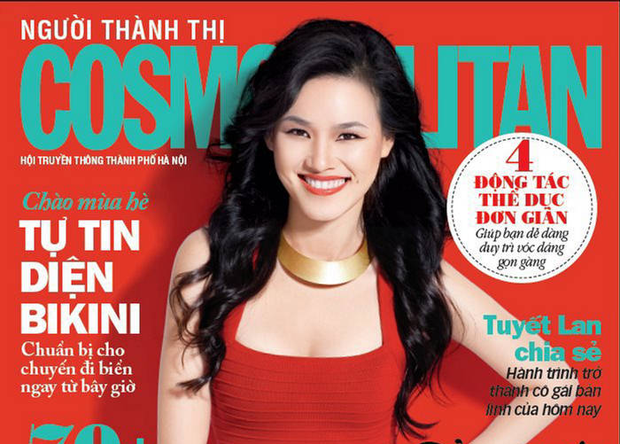
The first issue of Cosmopolitan, which began its Vietnamese-language issue with a local publishing company a few years ago, had a handy guide of the effects of alcohol on one’s orgasm, illustrated by graphics of the ratio of wine glasses to fireworks (two or three drinks is the perfect amount; they start to sputter to nothing after that). The headline mentioned “love” (in those knowing quote marks), not sex.
More generally in this area of publishing words like “him”, “triangle” or, in English, “Mr Happy” (in an article on blow job technique) are employed. Even when the correct, medical terms are employed for the varied body parts censors still apparently refuse, saying it’s “too sensitive”.
“We try to be different many times but the government won’t let us. You cannot write this, it not go with traditional (sic),” an unnamed editor explained. She said the internet was different, plenty of people wrote about sex.
These magazines, by and large, appeal to the educated middle classes. These are the same people, it has long been supposed by optimistic liberals worldwide, who will be behind either a revolution or a gradual ease in political restrictions in any repressive regime. A rising and educated middle class is also a hope of the government as Vietnam tries to move into a middle income country status. Yet they’re not allowed to see a tattoo or a wine bottle in a magazine. The exception is SOME men’s magazines with barely dressed models, which are not uncommon.
Even magazines in English are wary. Vietnamese censors may miss the nuance in a bar review noting the number of friendly young women eager for your company, but a feature on issues sex workers face is problematic enough for editors to avoid.
Content which “abuses democratic freedoms” (Article 258) is never clearly defined but in practice can be anything that criticises the government. Content which “sabotages national fine custom and tradition” or is “not in keeping with Vietnamese tradition” can be anything from a pop star’s stupid hairstyle to art that is covertly critical of the government or ruling elites, but given more leeway here people often actually end up more confused and sometimes even more conservative as a result.

 Emma is an actress and workshop facilitator, writer and director.