OVD-Info is an independent human rights media project documenting political persecution in Russia. With the help of a hotline, they collect information about detentions at public rallies and other cases of political pressure, publish news and coordinate legal assistance to detainees.
The organisation was set up in 2011 to document arrests during the widespread anti-fraud protests. Initially, groups of journalists and specialists collected and published information about the arrests on social media. As the organisation grew and became more structured they eventually set up a website. The organisation has now evolved to offer legal guidance and support to people arrested at peaceful protests in Russia.
Over the last year, censorship has increased in Russia with many media sites blocked. In September 2021, OVD-Info was labelled as a ‘foreign agent’ by Russian authorities. This means that the organisation must add a disclaimer to any work they publish: “THIS NEWS MEDIA/MATERIAL WAS CREATED AND/OR DISSEMINATED BY A FOREIGN MASS MEDIA PERFORMING THE FUNCTIONS OF A FOREIGN AGENT AND/OR A RUSSIAN LEGAL ENTITY PERFORMING THE FUNCTIONS OF A FOREIGN AGENT.” Their website was later blocked by Russian authorities because they claimed that news about detained people glorified terrorism and extremism.
During the ongoing war in Ukraine and associated anti-war protests in Russia, OVD-Info’s work is more important than ever. Within the first 10 days of the war, OVD-Info registered more than 13,000 arrests at anti-war protests in Russia. In March 2022, Marina Ovsyannikova interrupted the Russian state Channel One while holding a sign saying “Stop the war. No to war.” Following her on-screen protest, OVD-Info released a pre-recorded video by Ovsyannikova where she explained her motivations.
Despite a highly unpredictable situation and persistent censorship, OVD-Info continue to support detained and persecuted protesters in Russia.
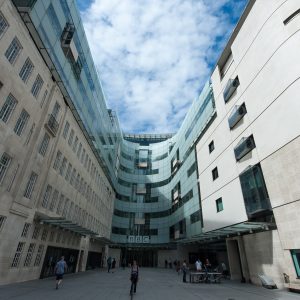
BBC Broadcasting House. Photo: Peter Hastings, CC BY-NC-ND 2.0
This week I had planned to write about the importance of public service broadcasting. To focus on and celebrate 100 years of the world’s oldest national broadcaster, the BBC. I wanted to talk about my favourite programmes and highlight their successes and importantly their failures – because we should always have an honest appraisal of even those entities which we rely upon. But there is a bigger issue at play – in a world of disinformation and misinformation, where conspiracy feels like it’s becoming the norm we have never needed independent and publicly funded news outlets more.
Call me biased but the BBC is the best in the world and needs to be cherished and protected. Its journalists have been on the frontline of every new story for a century. They have documented every joy and every horror, without fear or favour. Because of them we have historical evidence of war crimes, of the Holocaust, of protests, of the rise and fall of governments in every corner of the world and of course the moments of global jubilation and joy.
I, for one, will always defend the institution of the BBC – it’s central to my daily life and I trust their output. I make no apologies for loving the BBC – but it’s not just the institution – it’s the promise of independent journalism, of being able to hold the powerful to account and of documenting events for posterity.
This week we have seen the value of public service journalism. In Manchester the BBC documented a democracy protester being dragged into the Chinese consulate by CCP officials. He was beaten. His story is now known and the subject of a diplomatic incident because the BBC covered the news. Bob Chen will have justice, or at least be protected because his story was told by independent journalists.
Contrast that with events in Russia. Protest is banned. Independent journalism all but crushed. Dissidents are arrested every day. Challenge is not tolerated. Their leaders never questioned.
I am so lucky to live in a democracy. To be blessed with a free press. To be able to hold my politicians to account.
Public broadcasting is integral to that – so Happy Centenary BBC – we’re lucky to have you.
It shouldn’t have taken a murder. Surely it didn’t need a car bomb in a quiet Maltese town. Daphne Caruana Galizia did not need to die for Europe and the rest of the world to take notice of media freedom’s precarious foundations. But to our shame, it did.
Five years ago today, Daphne was murdered by a car bomb that exploded when she was moments from her front door. But the car bomb was only the mechanism by which she was silenced. Daphne was murdered by the opaque but powerful forces that first encourage, before demanding and eventually forcing silence. But she was never rendered mute, even now.
In the years that have followed, Europe has wrestled both with her legacy – what her investigations revealed – as well as the legacy of her killing – what her murder revealed. In the aftermath of similar killings in Northern Ireland (Lyra McKee), Slovakia (JánKuciak and Martina Kušnírová), Greece (Giorgos Karaivaz) and the Netherlands (Peter R. de Vries), as well as increased attention on the use of strategic lawsuits against public participation (SLAPPs), Europe has been forced to address an uncomfortable reality: journalists are at risk all across the continent. And so, by extension, is European democracy.
This is the dark light that bathes Europe, a light emanating from the brutal collapse of the rule of law but also a light that can illuminate what is broken. In the five years that have passed since her death, Daphne’s family have had to fight for every inch to demand both justice for Daphne and accountability for Malta. Whether this was to demand a public inquiry, pressing for progress in the criminal investigation, and putting SLAPPs on the European agenda, the rage, sadness and fury has fuelled a reckoning that has helped bring forward a proposed European Commission directive on SLAPPs, a Europe-wide coalition of organisations fighting to upend this form of lawfare, as well as similar movements at a national level.
In the UK, spurred on by Russia’s unlawful invasion of Ukraine, the UK Government announced in July 2022 an anti-SLAPP mechanism that could limit how UK courts are abused to silence critical speech. As we wait to see what happens – especially after the change in Prime Minister and her cabinet – we hope we are at the threshold of something significant. It is important to remember that a number of the libel threats against Daphne were deployed with the aid of London-based legal expertise – SLAPPs cannot be confined within national borders.
But we must return to Malta to remind ourselves of the pitfalls. Recently announced reforms aimed at protecting journalism, including much-vaunted anti-SLAPP protections, have had to be hurriedly frozen by the Prime Minister after being widely derided as inadequate, both in terms of content, falling far short of the proposed EC Directive, and process. The Institute of Maltese Journalists (IGM) had threatened to step away from the Committee of Experts unless “meaningful” consultation takes place. This was echoed by both the International and European Federations of Journalists (IFJ and EFJ) who have joined the call for the legislation to be withdrawn, as reported in Maltese outlet, NewsBook: “no proposal on media legislative reform should be submitted to the parliament without a transparent public consultation. This is all the more crucial in a country where a state holds some form of responsibility for the killing of a journalist.” While appearing to be fuelled by a desire to be the first EU nation to bring forward national legislation responding to SLAPPs, a grimy sense of competitive haste has seemingly triumphed over a commitment to genuine and meaningful protections.
Today, vigils remembering Daphne’s legacy – her life, her writing, and her commitment to the public’s right to know – are taking place across Europe, in London, Valletta, Brussels and Edinburgh to name a few. But wherever we are, we must ensure that by remembering Daphne’s life, we are reminded of our commitment to protect journalists against vexatious legal threats, physical attacks and every act that isolates, demonises or targets them.
Progress is slow and halting and will not proceed from one point to the next without obstruction – Malta’s current reform process is testament to that – however, the greatest way we can honour Daphne is by moving with purpose to ensure what happened to her cannot happen to another journalist. The dark light has illuminated what needs to change and the urgency with which it must change. It should not have taken the murder of a journalist for this to happen and we must not forget the darkness that sparked this push for greater protections, a darkness that robbed a family of the private space in which to mourn, but we must follow where the light leads. For in Daphne’s words, “There are crooks everywhere you look. The situation is desperate.
I went on my first political demo when I was a baby – joining the march against pit closures. For four decades I have been on demos to save jobs; on pickets to support striking workers and; on marches against racism and political extremism. I have participated in political stunts at elections and vigils to mark horrendous and heartbreaking events. Each has been newsworthy to some extent, each was meant to be a mark of solidarity with a community or a group whose voice needed to be amplified in order to be heard. Each was a statement of my personal values and a commitment to make our society a little better.
But none of these acts of democratic participation required me to be brave. Not really. I never once considered if my political views could, on that day, cost me my life. Although in hindsight some of them made me very vulnerable. But I never thought about it seriously because I am so incredibly lucky to live in a democracy, to have basic human rights which protect my right to be heard, to protest, to assemble. To speak truth to power. My biggest threats came from individuals who wished me harm – not a government or a police force or a judiciary.
I am lucky. I know I am. And I am so grateful for it.
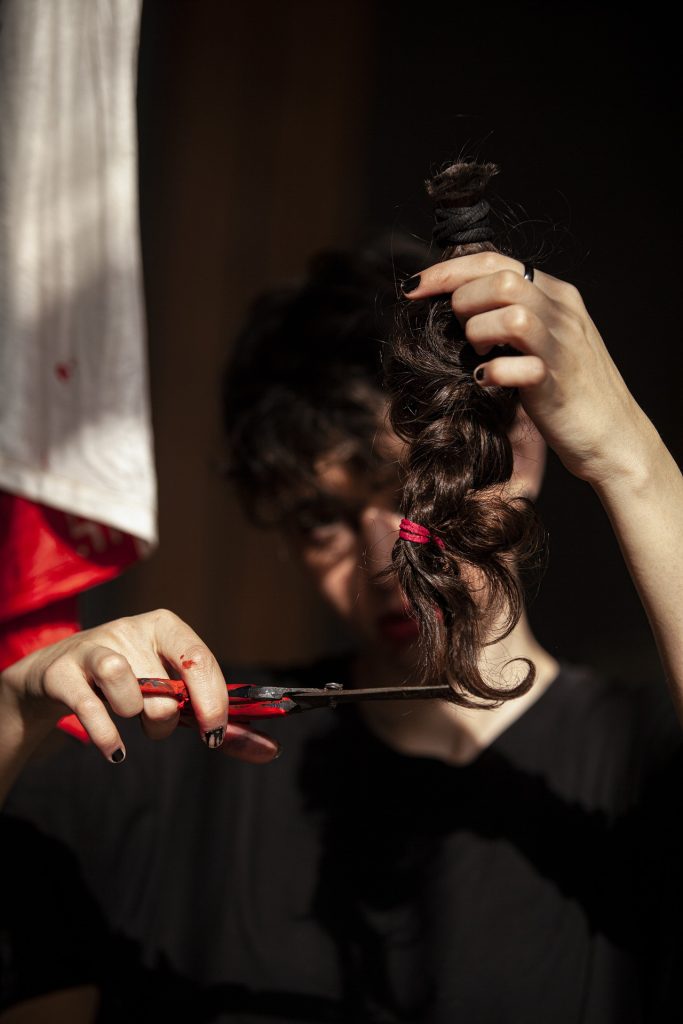
Which is why it is so important that people like me, like you, use their voices to promote those who are brave, those who risk everything by walking down the street without a head scarf, those who stage a sit in outside the Kremlin against an unjust war, those who unveil a banner exposing the tyrant that governs them. These people are brave beyond words. They use the only things available to them – usually their bodies – to challenge an unacceptable status quo. And by doing so they build a movement. They move the dial just a little and they place untold pressure on the tyrants and dictators who strive to silence them.
We have a duty to support them, to tell their stories and to amplify their voices. Because otherwise nothing changes.
The tyrants win if we let these acts of protest pass without notice. If we let global news move on and forget the faces of those who have paid the ultimate sacrifice to demand their access to the universal values that we hold so dear and so easily take for granted. We have an obligation to support the Iranian women in their demands for equality. We have a duty to tell the stories of those Russian dissidents who push back against Putin’s illegal invasion. We have a responsibility to ensure that the democracy campaigners imprisoned in Hong Kong are remembered. Not just today but every day.
We have to be, today and always, a Voice for the Persecuted.