6 May 2022 | Hungary, Opinion, Poland, Ruth's blog, United Kingdom, United States
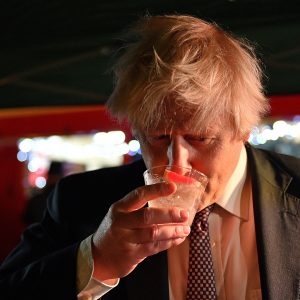
Prime Minister Boris Johnson samples an Isle of Harris gin. Photo: Justin Tallis/PA Wire/PA Images
This week was election week in the UK and, as a former parliamentarian, you’d expect me to be writing about the joy of being able to express ourselves at the ballot box and the vital importance of democratic values when they seem so under attack at the moment in too many places to mention.
I love elections, I love the debate, I love speaking to people on their doorsteps and there is nothing like a successful election count for your party. I cherish the fact that I am lucky enough to live in a democracy, that typically my human rights are protected because my fellow citizens also believe that democracy is something to be protected. But voting is a means to an end – it allows us all to hold our politicians to account and to ensure that our core values are reflected in our government. This only works if you believe that your democratically elected government is going to stick to the rules and it’s that that I have been reflecting on for the last couple of weeks.
There are some conversations that keep coming back to you. That spark debate and lead you to question the status quo. Last month, I had a series of meetings where there was a recurring theme that did just that.
International norms and the rule of law, which underpin both our democratic states and our world order, are only relevant if state actors recognise them and that culturally we all acknowledge their necessity.
The moral authority of democratic countries is dependent on how they choose to apply the rule of law – both domestically and internationally. On whether they are prepared to defend core democratic values, even when inconvenient, on a national and international stage. It’s the application of these norms and rules which empower democratic states to challenge others when they break them. And the recurring message from my meetings was that there was no longer an acceptance that democratic states were prepared to uphold the rule of law – if it didn’t suit them. And therefore, we are losing our moral authority to intervene when others break the law.
Poland is being fined one million euros a day by the European Court of Justice for undermining its domestic judiciary. Rather than comply with the ruling, Poland has been happy to let the fine mount up – a proportion of its EU finding withheld to pay for it.
The European Commission is also cutting funding to Hungary for eroding legal standards in the EU.
The British Prime Minister has been fined for breaching his own Covid-19 regulations and, pre-pandemic, was found to have unlawfully suspended Parliament.
In the US we saw incitement by leading politicians to undermine a smooth transition of power after the last presidential election.
This would be dangerous at any time, but right now when Russia and China are both attempting to leverage their power and influence, invade and threaten their neighbours we have never needed to uphold our international norms more.
The leaders of our democratic nation states speak with a level of moral authority on a global stage because their voice is our voice, because they are seen to uphold our core values – and they can therefore challenge other world leaders when they cross the line. If our current global order is to survive it’s therefore imperative that our leaders uphold the law – whether it suits them or not.
The rule of law is the basis of the campaigns that Index runs. Our work is framed by Article 10 of the European Convention on Human Rights – that everyone has the right to freedom of expression. We demand that national states uphold the values espoused by the Universal Declaration of Human Rights. If our leaders aren’t upholding these values, then it’s not just their voices that are weakened but ours too.
My fear is that when international norms aren’t followed – when our leaders opt in and opt out of laws and norms they don’t like – then repressive regimes thrive and their citizens are the ones that suffer.
So, this is really a plea to all of us who are lucky enough to live in democratic societies – hold your leaders to account and make sure that they comply with the law – so that we all have the moral authority to hold the tyrants’ feet to the fire.
29 Apr 2022 | China, Media Freedom, News, Russia, Ukraine
Physical attacks on journalists have increased dramatically over the past year, according to the latest annual report from the Council of Europe Platform on media freedom in Europe.
The platform, of which Index on Censorship is a partner, reports on serious threats to the safety of journalists and media freedom in Europe in order to reinforce the Council of Europe’s response to the threats and member states’ accountability.
The new report, Defending Press Freedom in Times of Tension and Conflict, reveals that the number of cases involving the safety and physical integrity of journalists has jumped by 51% year-on-year, with 82 cases reported to the platform.
Many of the attacks on journalists have taken place during public protests.
“Violence against journalists during street protests is fed by a wave of media bashing and an avalanche of hate speech on social networks – very often prompted by political figures – which directly target journalists, questioning their independence and legitimacy and therefore making them more vulnerable to physical aggression,” the report says.
Overall, the number of alerts in all categories published by the CoE platform has sky-rocketed to 280 in 2021, up from around 200 in 2020 and more than double the level reported in 2016. Of the 280 alerts, 110 related to the harassment and intimidation of journalists.
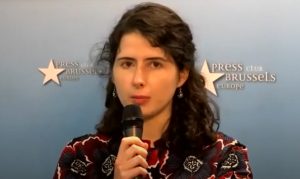
Index’s policy and campaigns manager Jessica Ní Mhainín
Speaking at the launch of the report, Index’s policy and campaigns manager Jessica Ní Mhainín highlighted cases of impunity in CoE’s report.
“Impunity for crimes against journalists refer to failure of states to identify, prosecute and punish anyone including the assailants and masterminds involved in committing a crime against a journalist,” she said. “Cultures of impunity contribute to self-censorship by making journalists more vulnerable to pressures out of fear of reprisals or harm.”
Some 35 cases of impunity have been registered on the platform since 2015 and two new impunity cases – those of Turkish journalist Uğur Mumcu, murdered in 1993, and Turkish-Cypriot journalist Kutlu Adalı, murdered in Cyprus in 1996 – were added to the impunity category during the year.
“In 2021, we welcomed the Slovak Supreme Court’s decision to overturn the not-guilty verdicts of the suspected masterminds of the 2018 murder of journalist Ján Kuciak and his fiancée Martina Kušnírová. The case will be heard in the Specialized Criminal Court later this year,” said Ní Mhainín.
Last year also saw the publication of a 438 page-report from the public inquiry into the assassination of investigative journalist Daphne Caruana Galizia, which concluded that the state of Malta “must bear responsibility for the assassination because it created an atmosphere of impunity”.
“We once again call on the Maltese authorities and the Commission of Experts to implement the recommendations of the Public Inquiry,” said Ní Mhainín.
Russia, Turkey and Ukraine account for 60% of all the cases relating to impunity on the platform. Last October marked the 15th anniversary of Russian journalist Anna Politkovskaya’s murder.
Ní Mhainín said, “The masterminds of her murder are still at large, sending the incredibly dangerous message that killing a journalist is a low-risk crime.”
Yet impunity is not restricted to these countries.
A BBC Spotlight investigation has uncovered serious concerns over the police investigation and the failure to prosecute those behind the murder of Irish journalist Martin O’Hagan, who was killed in September 2001 for his reporting on paramilitary activities in Northern Ireland. The concerns raised in the programme, which aired on 2 March 2022, came in the wake of several Police Ombudsman reports that uncovered collusive behaviour between the police and loyalists in Northern Ireland. According to the BBC’s investigation, police did not act on important information – including individual names – that were handed over to them within 48 hours of the murder. The journalist’s family are now taking legal action against the Police Service of Northern Ireland (PSNI) and the Ministry of Defence.
“Press freedom is the canary in the coal mine – it is a key indicator of the clear and worrying degree of democratic backsliding that is taking place across Europe,” said Ní Mhainín. “That’s why we once again call on Council of Europe member states to ensure that the highest priority is given to conducting thorough and transparent investigations into all crimes against journalists and we remind member states of the 2016 Recommendation of the Committee of Ministers which requires states ‘adopt appropriate criminal law provisions to prevent impunity’”
27 Apr 2022 | News, United States
On 25 April, Twitter announced that it has entered into a definitive agreement to be acquired by an entity wholly owned by tech entrepreneur Elon Musk in a transaction valued at approximately US$44 billion. He had previously announced that he had amassed a 9% stake in the social media platform.
Ooh, that’s a lot of money.
Elon Musk is not short of a few dollars. He made $175 million from selling his stake in PayPal when it was sold to eBay. He was an early investor in electric vehicle manufacturer Tesla, of which he is now CEO, and he founded rocket company SpaceX. His net worth is estimated at US$264.4 billion, making him the richest person in the world.
Why has he bought Twitter?
Musk is one of Twitter’s biggest users, with 86.2 million followers. He has hinted that he might want to buy it for several years. That said, he has had a love-hate relationship with the platform. In 2018, he suggested on Twitter that he had enough funding to take Tesla private but was subsequently fined $20 million as it had affected the market in Tesla shares, something frowned upon by the US Securities and Exchange Commission.
Why is everyone talking about free speech?
Elon Musk clearly wants Twitter to reconsider its approach to free speech. In the press release on the acquisition, Musk’s only statement was: “Free speech is the bedrock of a functioning democracy, and Twitter is the digital town square where matters vital to the future of humanity are debated. I also want to make Twitter better than ever by enhancing the product with new features, making the algorithms open source to increase trust, defeating the spam bots, and authenticating all humans.”
What does Elon Musk think free speech is?
Elon Musk describes himself as a “free speech absolutist”, posting that he would not remove access to Russian news sources through his satellite internet company Starlink “except at gunpoint”.
Clarifying his position on Tuesday evening, Musk tweeted, “By “free speech”, I simply mean that which matches the law. I am against censorship that goes far beyond the law. If people want less free speech, they will ask government to pass laws to that effect. Therefore, going beyond the law is contrary to the will of the people.”
What about the freedom to criticise him and his companies?
He clearly does not want everyone to have free speech, most notably disgruntled Tesla employees and whistleblowers.
Isn’t Twitter quite hot on free expression anyway?
Twitter says in its policy on freedom of expression that “defending and respecting the user’s voice is one of our core values” and that this commitment is based on the the United States Bill of Rights and the European Convention on Human Rights, as well as being informed by a number of additional sources including the members of its Trust and Safety Council, relationships with advocates and activists around the globe, and by works such as United Nations Principles on Business and Human Rights.
In its policy on hateful conduct, Twitter says, “Free expression is a human right – we believe that everyone has a voice, and the right to use it. Our role is to serve the public conversation, which requires representation of a diverse range of perspectives.
We recognize that if people experience abuse on Twitter, it can jeopardize their ability to express themselves… For this reason, we prohibit behavior that targets individuals or groups with abuse based on their perceived membership in a protected category.”
What’s this he’s saying about authenticating humans? Sounds a bit weird.
It seems clear that while Musk is keen to allow “lawful” free speech, he is less keen on the ability for people to remain anonymous on the platform.
In its transparency report, Twitter says that “anonymous and pseudonymous speech is important to Twitter”.
Anonymity is particularly valuable for dissidents and for others who fear attack if they reveal their true identity.
Some of the world’s most authoritarian regimes want social media users to have to identify themselves. That should raise a red flag.
Will Musk’s acquisition see Twitter veer to the right?
Musk has been hard to pin down on his political views, with most seeing him as a social libertarian.
One of the criticisms often aimed at Twitter is that it and its staff are too woke.
However, Twitter’s own research shows that mainstream right-wing parties benefit at least as much, and often substantially more, from algorithmic personalisation as their left-wing counterparts.
It also found that content from US media outlets with a strong right-leaning bias are amplified marginally more than content from left-leaning sources.
The million-dollar question: Will Musk ask Twitter to reinstate Donald Trump’s Twitter account?
On 8 January 2021, Twitter announced that it would permanently ban former President Donald Trump from Twitter “due to the risk of further incitement of violence” following the storming of the US Capitol by his supporters.
Musk might try as part of his commitment to free speech to allow Trump back on but Trump himself says he won’t rejoin even though his own Truth Social platform appears to be struggling to make an impact.
And finally, will Musk’s acquisition give China greater influence over Twitter?
Musk’s fellow rocket-loving gazillionaire Jeff Bezos jumped on Twitter to ask whether Musk’s acquisition of Twitter would give the Chinese government “a bit of leverage over the town square?”.
The Amazon founder asked the question in response to another tweet by New York Times reporter Mike Forysthe that pointed out that China was Tesla’s second biggest market after the USA in 2021 and that Chinese battery makers are major suppliers for Tesla’s electric vehicles.
Bezos answered his own question, saying “probably not” and that a “more likely outcome…is complexity in China for Tesla, rather than censorship at Twitter”.
Thousands of Twitter users helpfully pointed out to Bezos that people could ask the same question of him following his acquisition of the Washington Post in 2013. User Sankrant Sanu wrote: “How much leverage does China have over Washington Post given the percentage of goods sold on Amazon that are dependent on that country for supply?
22 Apr 2022 | Afghanistan, China, France, Israel, Opinion, Palestine, Russia, Ruth's blog, Ukraine, United States
I regularly start my weekly blog with the exclamation “there is just too much news!” Too much horror and heartbreak and this week the assertion is all too true.
Russia has invaded a sovereign country and daily we are seeing evidence of war crimes on the continent of Europe; China is arresting yet more democracy activists on the flimsiest of excuses; there have been bombings targeting schools in Afghanistan; a neo-fascist is, yet again, in the final run-off in the French Presidential elections; there are riots in Sweden against the far-right with dozens hurt; people are starving in Shanghai under Covid-19 restrictions; there is active conflict again in Jerusalem, with over 150 Palestinians hurt in clashes after a series of terror attacks targeting Israelis in recent weeks; another video of a black man being fatally shot by the police has emerged in the US – Patrick Lyoya was killed, while being held on the ground, defenceless, on 14 April and riots have followed in Michigan.
Our team at Index is working on every one of these news stories. We work with people on the ground, and we commission dissidents and writers, in country, to give us a first-hand account. In the twenty-first century we can speak to people in every corner of the globe, as events are happening, because of the internet and the social media platforms which afford us all a level of protection because of end-to-end encryption. We work with people on the ground who would be arrested, tortured, or even killed because they want to share their experiences with the world. They want the world to know what is happening to them and to their communities. They are on the frontline in the perpetual fight for our democratic right to freedom of expression. They are vulnerable because of who they are and what they want to share with us, whether that’s their writings, their opinions or their art.
They are brave and inspirational and determined to stand up for what is right. For as long as they want to tell their stories there is a moral onus for us to listen to them.
Which brings me to the current proposals to regulate our online lives currently being progressed in the European Union and in the United Kingdom. In Europe, today (Friday) the final negotiations on the substance of the Digital Services Act are underway and, in the UK, the Online Safety Bill began its parliamentary journey on Tuesday. Index is working actively with partners to try and mitigate the worst aspects of both pieces of legislation and we were in Brussels this week to make the case for additional protections for freedom of speech. Our overriding goal is to make sure that our access to those brave dissidents is protected and that our rights to discuss the detail of these horrors are protected. To make sure that while legislators are trying to ‘protect’ us online they don’t end up inadvertently silencing us.
Index advocates for free expression within the protections afforded to us by the European Convention on Human Rights. There is no right not be offended. There is no right not to see things online, or in real life, that will upset you. Of course, we all want to protect each other from seeing the worst aspects of human life – that’s an admirable aspiration but it isn’t the grounds for making new law. In fact, it’s the exact opposite – legally we have protected freedom of expression, it’s a fundamental right. I have written before about our concerns regarding online regulation and in the coming months I’ll be writing extensively on it – but we start with the basic principle – what is legal to say should be legal to type. And that should be the case whatever any new legislation seeks to amend.