2 Sep 2016 | Albania, Azerbaijan, Azerbaijan News, Europe and Central Asia, Kosovo, Mapping Media Freedom, News, Russia, Turkey
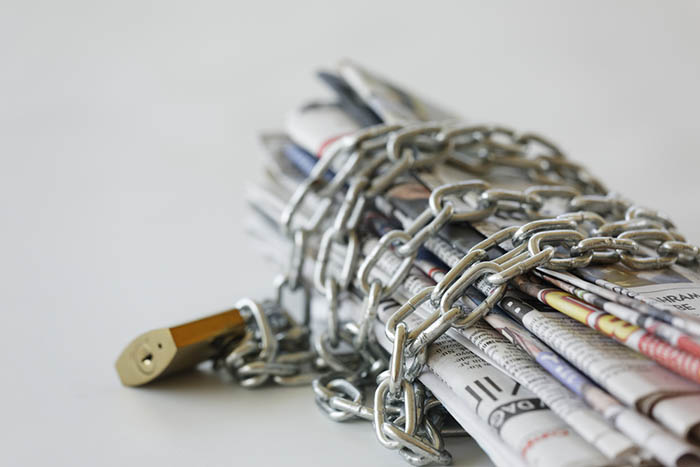 Each week, Index on Censorship’s Mapping Media Freedom project verifies threats, violations and limitations faced by the media throughout the European Union and neighbouring countries. Here are five recent reports that give us cause for concern.
30 August 2016 – The home of veteran journalist and Index contributor Yavuz Baydar was raided by the police, the journalist reported via Twitter.
The raid came shortly after detention warrants were issued for 35 people including 27 journalists. As of 30 August, of the 27 journalists sought nine have been detained in Turkey while 18 other journalists are reportedly abroad.
Also read by Baydar: Turkey: Losing the rule of law
28 August 2016 – At around 10pm an unidentified individual threw a hand grenade at the house of Mentor Shala, the director of Kosovo’s public broadcaster RTK.
Shala and his family were inside at the time. No casualties were reported but according to the RTK director the explosion was strong and that it had shocked the whole neighbourhood.
Kosovo’s police are investigating the case, which is the second attack on national broadcaster RTK within a week. On 22 August 2016 an explosive device was thrown at the broadcaster’s headquarters.
President Hashim Thaci has condemned the attack. “Criminal attacks against media executives and their families threaten the privacy and freedom of speech, and at the same time seriously damage the image of Kosovo,” he told RTK.
Both attacks were claimed by a group called Rugovasit, which said in a written statement to RTK that the attack was “only a warning”.
Rugovasit blames RTK journalist Mentor Shala for only reporting the government’s perspective. “If he does not resign from RTK, his life is in danger,” they said.
27 August 2016 – Journalist and founder of news agency Novy Region, Alexander Shchetinin, was found dead in his apartment in Kiev.
The National Police confirmed in a statement that “a man with a gunshot wound to the head was discovered on the balcony”. He reportedly died between 8-9.30pm.
Police found cartridges, a gun and a letter at the scene. “The doors to the apartment were closed, the interior looks intact,” police reported.
“Until all the facts are established, until the examination and forensic examination is complete, we are investigating it as a murder,” said Kiev police chief Andrey Kryschenko. “The main lines of enquiry are suicide and connections with his professional activities.”
The Russian-born journalist had lived in the Ukrainian capital since 2005. He was often critical of the Russian government. In 2014, he refused Russian citizenship, later joined the National Union of Journalists of Ukraine.
20 August 2016 – Faeces was poured onto the prominent Russian journalist Yulia Latynina, who works for independent newspaper Novaya Gazeta and hosts a programme called Kod Dostupa at radio station Echo of Moscow.
According to Latynina, the incident took place close to the radio’s office at Novy Arbat in central Moscow. An unidentified individual in a motorcycle helmet perpetrated the attack, while his accomplice was waiting for him at a motorcycle nearby. The unidentified individuals fled the scene.
Latynina told Echo of Moscow that it was the 14th or the 15th time she has been attacked. She believes the assailants had been following her for a long time as they seemed to know her daily commute and where she parks her car.
Latynina also believes the incident is connected to her Novaya Gazeta investigations into billionaire Evgeny Prigozhin, who is close to Russian President Vladimir Putin. According to Latynina’s investigations, Prigozhin has orchestrated mass trolling on opposition activists in Saint Petersburg.
22 August 2016 – A prosecutor has asked for a three-month prison sentence for Faig Amirli, the director of the newspaper Azadliq, Radio Free Europe’s Azerbaijan Service.
Amirli’s lawyer declared that his client is being charged for spreading national and religious hatred, along with promoting religious sects and disturbing public order by performing religious activities.
Amirli was detained by a group of unidentified individuals on 20 August. At the time, his whereabouts were unknown while his house was searched by the representatives of Grave Crimes Unit.
Police claim they found literature related to Fethullah Gülen, the alleged orchestrator of the attempted coup in Turkey, in Amirli’s car.
His arrest is considered part of a new crackdown in Azerbaijan ahead of the September’s constitutional referendum.
Also read: Azadliq: “We are working under the dual threat of government harassment and financial insecurity”
24 Aug 2016 | mobile, News, Youth Board
Index recently appointed a new youth advisory board cohort. The eight young students and professionals, from countries including Hungary, Germany, India and the US, will hold their seats on the board until December.
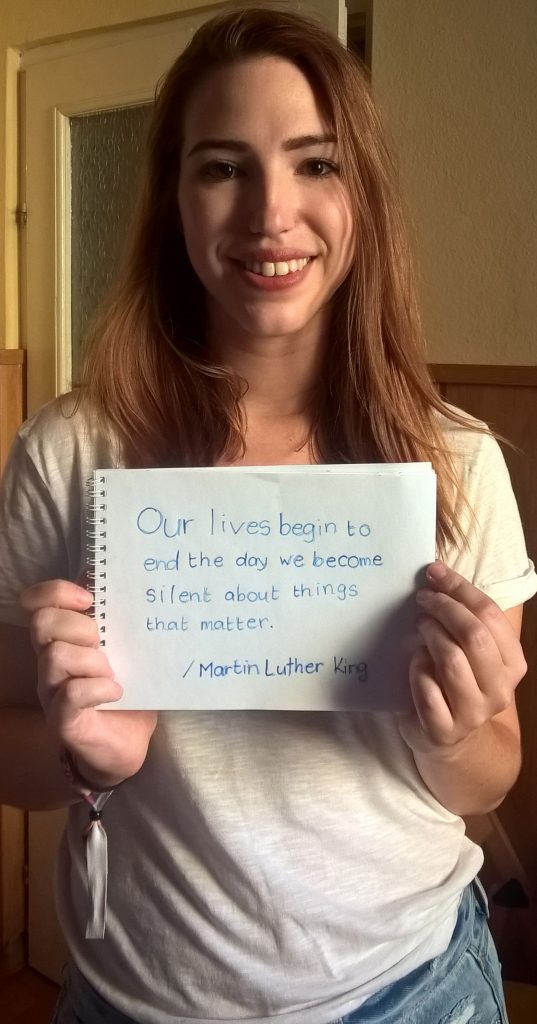
Each month, board members meet online to discuss freedom of expression issues occurring around the world and complete an assignment that grows from that discussion. For their first task the board were asked to write a short bio and take a photo of themselves holding a quote that reflects their belief in free speech.
Sophia Smith-Galer 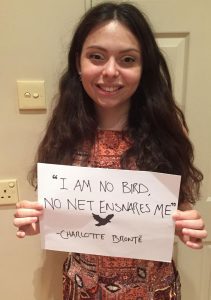
I’m half English, half Italian, and was born and raised in London. I have just graduated from Durham University with a degree in Spanish and Arabic and will be studying for a Master’s in broadcast journalism at City University next year.
I have just returned from a trip to New York after winning a multilingual world essay prize which included speaking at the United Nations’ General Assembly. I was in the group of Arabic language winners and our speeches were about tackling climate change, which is one of the UN’s sustainable development goals for 2030. Now that I am embarking on a career in journalism I’m looking forward to continue supporting these goals in my work.
Freedom of expression is particularly important to me as several countries that speak both of the languages I have dedicated years of study to continue to be plagued by tyrants and censors. I’m particularly interested addressing censorship in Latin America and the Middle East, especially with regard to the arts, as I’m also a classical singer and keen art historian.
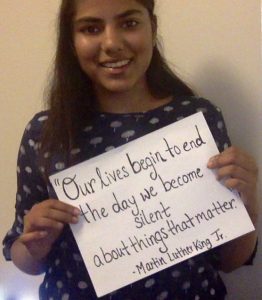
Shruti Venkatraman
Originally from Mumbai, I am currently a first year undergraduate studying law at the University of Edinburgh. As a law student, I am interested in advocacy in general, but I am particularly interested in advocating for fundamental human rights.
In today’s socio-political context, the phrase “freedom of expression” has gained importance and expanded in its meaning from it’s original intent to prevent minority persecution. Having lived in India and South Africa, I was able to grasp the importance of free speech in the context of regional history, and I learnt how human rights appeals have had local and global impacts and are inherently tied with social development. Index on Censorship’s admirable work to promote and defend freedom of expression highlights how important this cause is in our quest for social progress, justice and equality and how repression of these rights result in societal backwardness.
Niharika Pandit 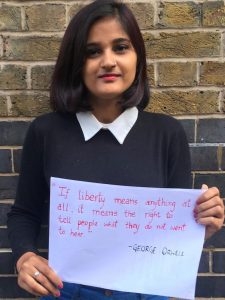
I am currently a master’s candidate at the Centre for Gender Studies at SOAS, University of London with South Asia as my focus area of gender research. I became interested in issues of censorship during my undergraduate studies in mass media with a specialisation in journalism from Bombay.
As a journalist and an active social media user in India, I was witness to numerous instances of online abuse, trolling and silencing of women politicians, journalists and activists who voiced opinions on political and social issues. As a response to the barrage of abuse in the online space, otherwise a liberating space to hear diversified opinions, I wrote a piece on Twitter trolls in India and the use of sexist abuse as a tool to muzzle women for Index on Censorship’s Young Writers’ Programme.
Within censorship, I am particularly interested in working on the intersections of social media, gender along with looking at censorship in militarised zones and its growing legitimacy in contemporary political ethos as part of my research.
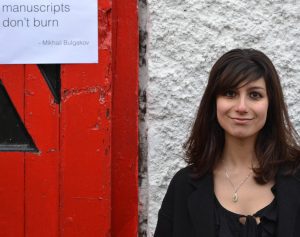
Layli Foroudi
It was studying literary works from the Soviet period during my undergraduate degree that highlighted the issue of censorship for me initially. Clearly this issue has outlived (and predates) the Soviet Union and is still of pressing concern in Russia today and globally. After graduating, I worked as a journalist on issues of freedom of expression and belief in Iran, and then in Russia at the Moscow Times. By pushing a state-sponsored version of the truth and punishing those at variance with it, these countries and others marginalise people and stifle innovation and creativity.
Freedom of expression and public debate underpin what society consists of and being denied this freedom is being denied the right to participation in society, as Hannah Arendt wrote: the polis is “the organisation of people as it arises out of acting and speaking together”. Historically, many have been denied the right to “act and speak”, based on ethnicity, gender, belief, immigration status, etc, and continue to be. I am interested in encouraging a diversity voices in the public sphere, something I have enjoyed exploring more this past year while undertaking an MPhil in race, ethnicity, and conflict at Trinity College Dublin and as a member of the youth advisory board since January.
Ian Morse 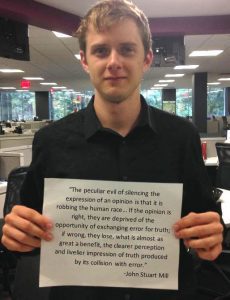
I’m a student and journalist at Lafayette College in the US, but I have studied in Germany, Turkey and the UK. I really started studying news media when I lived in Turkey 18 months ago, because even then (much more so now) journalists and bloggers had a very tough time gathering and publishing good information. Since then, I’ve been a journalist in Turkey, the UK and Greece. I study history and mathematics-economics, but almost every project I do is focused on news media.
I’ve encountered freedom of expression violations in many fashions, from student pressures against speakers to petty government retaliation to Twitter blocking. There is quite a bit of nuance that is overlooked in many cases, but that nuance is needed to understand where the line needs to be drawn. Words have a lot of power in society – but it is often difficult to get the truth out when lies are louder or gags are stronger. I hope with Index that we can find ways to fix this.
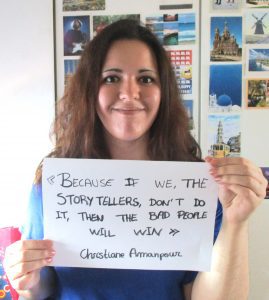
Anna Gumbau
I am a journalist living between Barcelona and Brussels. I am passionate about youth work, having volunteered for five years as member of AEGEE-Europe / European Students’ Forum, including a year as member of its international board. I have taken part in, and often led projects, run by students for other students all over Europe, on topics such as pluralism of media, election observation and media literacy. I am also involved in the field of internet governance, participating in the last two editions of the EuroDIG and joining the Youth Observatory of the Internet Society.
As a young media-maker who grew up listening to the stories of censorship in the times of the Spanish dictatorship, I believe strongly in free speech, a free press and media pluralism as essential pillars for democracy. I am fascinated by the power of words and freedom of expression to empower citizens and stand up to what they believe in. I also envision free media as a crucial element for better informed societies and, in extension, for more responsible individual citizens to participate in the public space.
Constantin Eckner 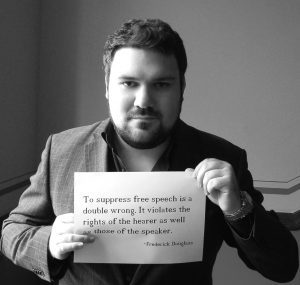
I am originally from Germany. I graduated from University of St Andrews with a master’s degree in modern history. Currently, I am a Ph.D. candidate specialising in human rights, asylum policy and the history of migration. Moreover, I have worked as a writer and journalist since I was 17 years old, covering a variety of topics over the years. Longer stays in cities like Budapest and Istanbul have raised my awareness for pressures exerted upon freedom of expression.
In a perfect world journalists, as well as every citizen, would live without fear of state censorship and potentially facing repercussions for the words they write or speak, for the pictures they draw, for the photos they shoot or for music they play.
Freedom of expression and access to information are cornerstones of an enlightened society. Unfortunately, in 2016 the world is still challenged by undemocratic regimes and powers that intend to quash people, which is an oppressive situation that has to change. It is up to us to help those who cannot raise their voice fearlessly.
 Fruzsina Katona
I was born and raised in Hungary, although I spent my pre-university years in a small town in eastern Hungary. Today I am a freelance journalist.
I always knew I wanted to be a journalist, since I was always interested in literally everything that surrounded me. The urge to publish became stronger at the age of 17, after I returned from Japan, where I spent a school year. That one year made me realise, that my home country is really far from the image I had of it. And the only way I can fight against corruption, abuses and narrow-mindedness – apart from voting – is to educate and inform the public. I took an internship at Hungary’s leading investigative journalism center, and 2015 Index on Censorship Freedom of Expression award-winner, Atlatszo.hu. I have worked for them as a freelancer ever since, and I enjoy my work pretty much.
I recently received a graduate degree in communication and media studies, and supplemented my “official” studies with training, workshops and conferences across Europe.
In the future I would like to be a post-conflict reporter or a human rights journalist, specialising in freedom of expression and the press.
19 Aug 2016 | Azerbaijan, Azerbaijan News, Mapping Media Freedom, mobile, News, Russia, Serbia, Turkey
 Each week, Index on Censorship’s Mapping Media Freedom project verifies threats, violations and limitations faced by the media throughout the European Union and neighbouring countries. Here are five recent reports that give us cause for concern.
16 August, 2016 – IMC TV reporter Gulfem Karatas and cameraman Gokhan Cetin were assaulted and detained while covering the police raid on the daily Ozgur Gundem. Footage of the attack was shared via IMC TV Twitter account, showing police grabbing the camera and physically assaulting the reporter, who is heard screaming in the footage.
Karatas and Cetin were detained along with journalists Günay Aslan, Reyhan Hacıoğlu, Ender Öndeş, Doğan Güzel, Ersin Çaksu, Kemal Bozkurt, Sinan Balık, Önder Elaldı, Davut Uçar, Zana Kaya, Fırat Yeşilçınar and Mesut Karnak.
In an official statement IMC TV said: “During the live broadcast, the police prevented Gulfem Karatas and Gokhan Cetin from reporting and detained them violently along with at least 21 Ozgur Gundem employees. We condemn this unacceptable treatment to our colleagues who were on duty and ask for their immediate release.”
16 August, 2016 – Journalist Vladimir Zivanovic and photographer Boris Mirko, who work for the daily Serbian Telegraph were threatened and insulted while reporting on the illegal construction of an aqua park in the capital Belgrade.
The journalists were in an area of the city where former professional football player Nikola Mijailovic is building the controversial aqua park. Mijailovic approached the journalists and shouted a series of insults about them and their families. He reportedly told them that they should be put in a gas chamber together.
Mijailovic also reportedly tried to bribe them. The journalists have reported the threats to the police and Serbia’s Independent Association of Journalists has condemned the incident.
15 August, 2016 – A court in Baku ruled to uphold a travel ban against investigative reporter Khadija Ismayilova. “Binagadi Court told me because I have no husband, kids or property, I might not be able to return if I leave the country,” Ismayilova said following the hearing in Baku.
Ismayilova was released from prison on 25 May on a suspended three-and-a-half-year sentence.
Also read: Azerbaijan’s long assault on media freedom
16 August, 2016 – The eighth administrative court in Istanbul ordered the closure of the newspaper Ozgur Gundem on the grounds of “producing terrorist propaganda”.
The court order described the closure as “temporary” although no duration appears to be specified in the text of the decision.
Later that day, Ozgur Gundem’s offices were raided by the police.
According to P24, the 23 members of staff were taken into custody. They are: Editor-in-Chief Zana Kaya, journalists Zana Kaya, Günay Aksoy, Kemal Bozkurt, Reyhan Hacıoğlu, Önder Elaldı, Ender Önder, Sinan Balık, Fırat Yeşilçınar, İnan Kızılkaya, Özgür Paksoy (DİHA news agency) , Zeki Erden, Elif Aydoğmuş, Bilir Kaya, Ersin Çaksu, Mesut Kaynar (DİHA), Sevdiye Gürbüz, Amine Demirkıran, Baryram Balcı, Burcu Özkaya, Yılmaz Bozkurt (member of the press office of the Istanbu Medical Chamber), Gülfem Karataş (İMC), Gökhan Çetin (İMC) and Hüseyin Gündüz (Doğu Publishing House).
Also read: Turkey’s continuing crackdown on the press must end
11 August, 2016 – Dmitri Remisov, the Rostov-on-Don regional correspondent for Rosbalt news agency, told the agency that he was repeatedly assaulted by police officers while being questioned at the regional Center for Counteracting Extremism.
According to Remisov, he was asked to come to the CCE to answer questions related to a criminal case “on the preparation of a terrorist act” in Rostov, a city in south-west Russia.
He reported that two police officers asked him whether he knew certain individuals, where most of the people he was asked about were opposition activists.
“Then they asked me if I knew a certain Smyshlayev. I said that I didn’t remember such a person,” Remizov said.“One officer started saying I did know this person in 2009, after which he struck my head three times. Afterwards, he began threatening me, saying he could prosecute me under the criminal law or could have some Nazis punish me.”
After he was questioned another policeman threatened him with physical punishment, saying “we will meet [with you] once again”.
The Rosbalt correspondent received medical care after the questioning. He also filed a complaint against police officers, Rosbalt reported.
12 Aug 2016 | Belarus, Germany, Mapping Media Freedom, mobile, Netherlands, News, Romania, Turkey
Each week, Index on Censorship’s Mapping Media Freedom project verifies threats, violations and limitations faced by the media throughout the European Union and neighbouring countries. Here are five recent reports that give us cause for concern.
5 August, 2016 – Twelve journalists were arrested on terror charges following a court order, independent press agency Bianet reported.
According to Bianet: “The court on duty has ruled to arrest Alaattin Güner, Şeref Yılmaz, Ahmet Metin Sekizkardeş, Faruk Akkan, Mehmet Özdemir, Fevzi Yazıcı, Zafer Özsoy, Cuma Kaya and Hakan Taşdelen on charges of “being a member of an armed terrorist organisation” and Mümtazer Türköne, columnist of the now closed Zaman Daily on charges of “serving the purposes of FETÖ (Fethullahist Terrorist Organisation)” and Hüseyin Turan and Murat Avcıoğlu on charges of “aiding a [terrorist] organization as non-member”.
Warrants for the detainment of all 13 Zaman newspaper journalists were issued on 27 July 2016 by Turkish authorities.
Also read: 200 Turkish journalists blacklisted from parliament
4 August, 2016 – Monica Gubernat, a member and chairperson of the National Audiovisual Council of Romania, cut off the live transmission of a council debate, news agency Mediafax reported.
An ordinance says that all meetings of the council must be broadcasted live on its website.
The institution has recently purchased equipment to broadcast debates, which was set to go live on 4 August, 2016. A member of the council, Valentin Jucan, even issued a press statement about the live broadcast.
The chairperson, Monica Gubernat was opposed to it, saying that she was not informed about the broadcast, and asked for a written notification about the transmission.
ActiveWatch and the Centre for Independent Journalism announced they would inform the supervisory bodies of the National Audiovisual Council of Romania and the culture committees of the Parliament about the “abusive behavior of a member of the council” and asked for increased transparency within this institution.
The National Audiovisual Council of Romania is the only regulator of the audiovisual sector in Romania. Their job is to ensure that Romania’s TV channels and radio stations operate in an environment of free speech, responsibility and competitiveness. In practice, the council’s activity is often criticised for its lack of transparency and their politicised rulings.
2 August, 2016 – British blogger Graham Phillips and freelance journalist Billy Six, forcibly entered the offices of non-profit investigative journalism outlet Correctiv, filmed without permission and accused staff of spreading lies, the outlet reported on its Facebook page on Wednesday 3 August.
According to Correctiv’s statement, Phillips had been seeking to confront Marcus Bensmann, the author of a Correctiv article which claimed that Russian officers had shot down the passenger airplane crossing over Ukraine in July 2014.
Phillips maintains the Ukrainian military is responsible for the crash.
2 August, 2016 – Police officers prevented freelance journalist Dzmitry Karenka from filming near the Central Election Commission office located in the Belarusian Government House in Minsk, the Belarusian Association of Journalists reported.
The journalist reported intended to film a video on the last day when candidates for the House of Representatives, Belarusian lower chamber, could register.
At 6am he was approached by police officers who told him that administrative buildings in Belarus can be filmed “only for the news” and asked him to show his press credentials which he didn’t have as he is a freelance journalist.
Karenka told the Belarusian Association of Journalists that he spoke with the police for over an hour before he was released and advised not to film administrative buildings.
Also read: Belarus: Government uses accreditation to silence independent press
1 August, 2016 – The website of the Dutch edition of Turkish newspaper Zaman Today was hit by a DDoS attack, broadcaster RTL Nieuws reported.
The website, known to be critical of the Erdogan government, was offline for about an hour.
An Erdogan supporter reportedly announced an attack on the website earlier via Facebook. Zaman Today said it will be pressing charges against him.
Also read: Turkey’s media crackdown has reached the Netherlands
