24 May 2016 | Azerbaijan, Azerbaijan News, Belarus, Belgium, Bosnia, Croatia, Europe and Central Asia, France, Germany, Greece, Index Reports, Macedonia, Mapping Media Freedom, mobile, News, Poland, Serbia, Spain, Turkey, Ukraine
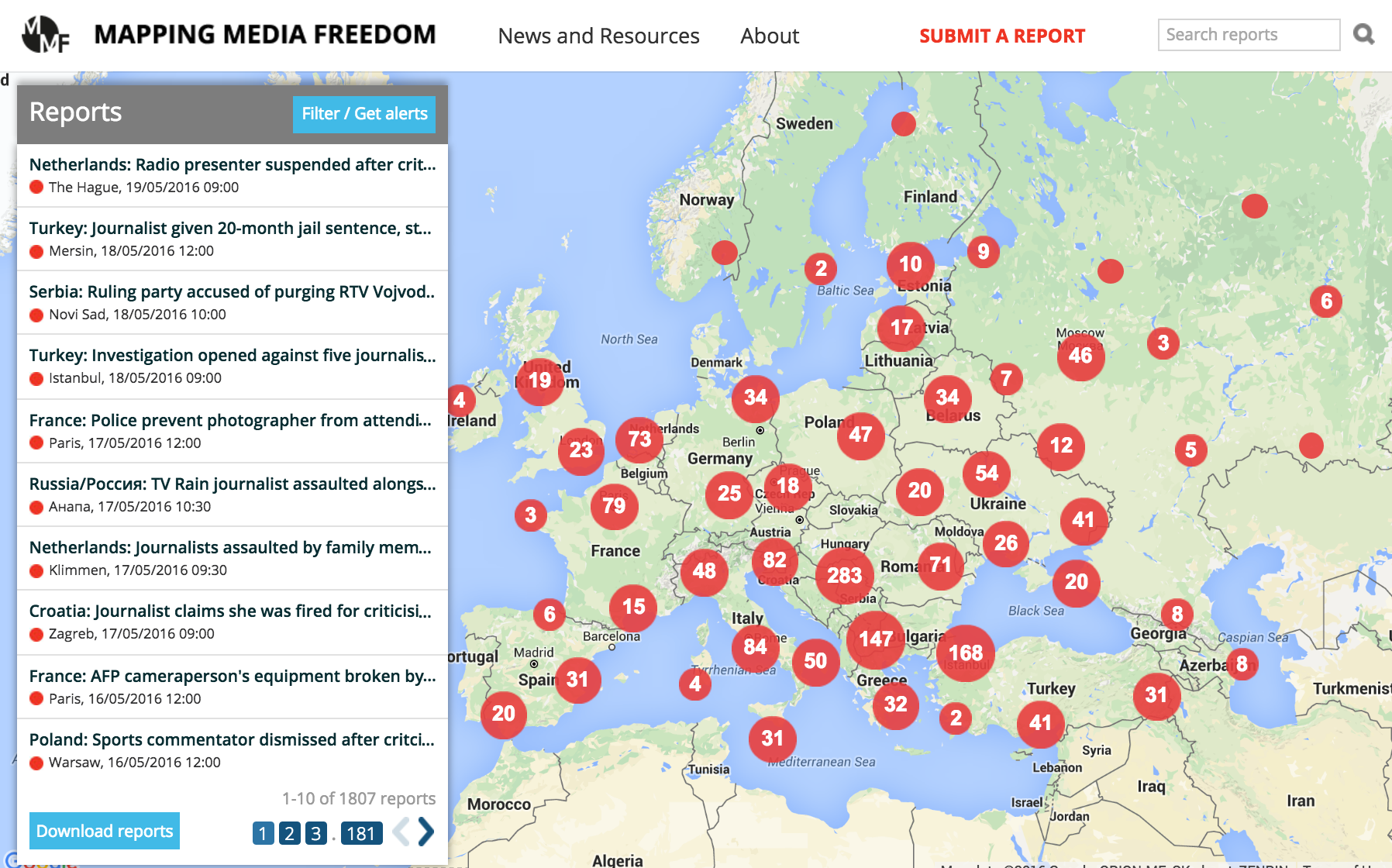
Mapping Media Freedom launched to the public on 24 May 2014 to monitor media censorship and press freedom violations throughout Europe. Two years on, the platform has verified over 1,800 media violations.
“The data the platform has collected over the last two years confirms that the state of press freedom across Europe is deplorable,” said Hannah Machlin, project officer for Mapping Media Freedom. “Media violations are occurring regularly in countries with strong democratic institutions and protective laws for journalists. Legislation limiting the press, violence across the continent and authoritarian governments are also fuelling this rapid and worrying decline. We hope that institutions and leaders take note of this information and take action swiftly.”
To mark the anniversary, we asked our correspondents to pick a key violation that stood out to them as an example of the wider picture in their region.
Russia / 113 verified reports
Several journalists and human rights activists attacked in Ingushetia
“The brutal attack on a minibus carrying six journalists and several human rights activists near the border between Ingushetia and Chechnya on the 9 March 2016 demonstrates the dangers faced by media professionals working in Russia’s North Caucasus. No suspects have been established so far. This case stands out due to its extreme violence but also supports a common trend: the reluctance of the local authorities to ensure that the journalists’ rights are respected.” – Ekaterina Buchneva
Italy / 190 verified reports
97 journalists accused of breaking the law in mafia investigation
“This was a very relevant investigation, with no precedent, that took place in October, a few weeks away from the start of the trial known as Mafia Capitale, which concerns the scandal that involved the government of the city of Rome. It is a collective intimidation because it involved 97 journalists, who were denounced for violating the secret on the ongoing investigations. It is a really serious form of intimidation because it was activated within the field of law and thus is not punishable.” – Rossella Ricchiuti
Turkey / 57 verified reports
Zaman newspaper seized by authorities
“These attacks and actions taken by the government against independent media in Turkey attest to the shrinking space of independent media overall. In addition, it illustrates the shifting power dynamic within the ruling government in Turkey where once upon a time friends, are turned into enemies by the regime. As the paper wrote itself, Turkey is headed through its ‘darkest and gloomiest days in terms of freedom of the press.'” – MMF’s Turkey correspondent
Azerbaijan/ 5 verified reports
Writer banned from leaving country
“Aylisl’s 12-hour interrogation at the airport and later charges of hooliganism were just as absurd as the claim that a 79-year-old man, suffering from a heart condition and other health issues would attack an airport employee to such an extent that it would cause hemorrhage. I chose this example to illustrate the absurdity of charges brought against individuals in Azerbaijan but also the extent to which the regime is ready to go in order to muzzle those voices who different.” – MMF’s Azerbaijan correspondent
Macedonia / 59 verified reports
Deputy Prime Minister attacks journalist
“This incident best demonstrates the division in society as a whole and among journalists as a professional guild. This is a clear example of how politicians and elites look upon and treat the journalist that are critical towards their policies and question their authority.” – Ilcho Cvetanoski
Bosnia / 56 verified reports
Police raid Klix.ba offices
“This was the most serious incident over the last two years in Bosnia regarding the state’s misuse of institutions to gag free media and suppress investigative journalism. In this specific incident, the state used its mechanisms to breach media freedoms and send a chilling message to all other media.” – Ilcho Cvetanoski
Croatia / 64 verified reports
Journalist threatened by disbanded far-right military group
“After the centre-right government in Croatia came to power in late 2015, media freedom in the country rapidly deteriorated. Since then around 70 media workers in the public broadcaster were replaced or removed from their posts. This particular case of the prominent editor-in-chief of the weekly newspaper Novosti receiving a threatening letter from anonymous disbanded military organisation demonstrates the polarisation in the society and its affect on media freedom.” – Ilcho Cvetanoski
Greece / 34 verified reports
Golden Dawn members assault journalists covering demonstration
“This was the second attack against journalists by Golden Dawn members within one month. With more than 50,000 asylum seekers and migrants trapped in Greece, the tension between members of the far-right group and anti-fascist organisations is rising.” – Christina Vasilaki
Poland / 35 verified reports
Over 100 journalists lose jobs at public broadcasters
“This report highlights the extent of the ongoing political cleansing of the public media since the new media law was passed in early January.” – Martha Otwinowski
Germany / 74 verified reports
Journalist stops blogging after threats from right-wing extremists
“The MMF platform lists numerous incidents where German journalists have been threatened or physically assaulted by right-wing extremists over the last two years. This incident stands out as a case of severe intimidation that resulted in silencing the journalist altogether.” – Martha Otwinowski
Belgium / 19 verified reports
Press asked to respect lockdown during anti-terrorism raids
“On 22 November 2015, the Belgian authorities asked the press to refrain from reporting while a big anti-terrorist raid was taking place in Brussels. While understandable, this media lock-down raised questions for press freedom and underlined the difficulties of reporting on terror attacks and anti-terror operations.” – Valeria Costa-Kostritsky
Luxembourg / 2 verified reports
Investigative journalist on trial for revealing Luxleaks scandal
“This Luxleaks-related case is the only violation we have become aware in Luxembourg over the period (which is not to say that no other cases occurred). Along with two whistleblowers, a journalist was prosecuted by PricewaterhouseCoopers and accused of manipulating a whistleblower into leaking documents. This is a good example of the threat the notion of trade secrets can represent to journalism.” – Valeria Costa-Kostritsky
Ukraine / 127 verified reports
Website leaks personal information of more than 4,000 journalists
“This incident shows how fragile the media freedom and personal data of journalists are in armed conflict. Even after a great international scandal, the site continues to break the legislation and publishes new lists. It has been operating for two years already and those involved in its activities go unpunished. It seems that the post-Maidan Ukraine has simply ‘no political will’ for this.” – Tetiana Pechonchyk
Crimea / 18 verified reports
Journalists’ homes searched, criminal case filed
“This report shows the everyday life of independent journalists working on the peninsula. Only a few critical voices are still remaining in Crimea while the majority of independent journalists were forced to leave the profession or to leave Crimea and continue their work on the mainland Ukraine.” – Tetiana Pechonchyk
Spain / 49 verified reports
Journalist fined for publishing photos of arrest
“The latest issue for the Spanish media is the Public Security Law, introduced in June 2015, which among other things limits space for reporters. The law prohibits the publication of photo and video material where police officers may be identified, unless official state permission is obtained. This was the first case of a journalist being fined by the new law.” – Miho Dobrasin
Belarus / 47 verified reports
Journalist beaten by police, detained and fined for filming police attacks
“The story has ended in impunity: a criminal case was not even filed against the police officers who had beaten the journalist.” – Volha Siakhovich
Latvia / 12 verified reports
Latvia and Lithuania ban Russian-language TV channels
“This was the beginning of a disturbing tendency to react with rather futile gestures against Russian television channels. The bans are not so much against the media, as telling the audience that the authorities, not the public, will decide what Latvian viewers may or may not see or hear.” – Juris Kaža
Serbia / 110 verified reports
Investigative journalists victim of smear campaign
“You have to be very brave to launch a new investigative journalism portal in Serbia and expose corruption and organised crime involving government officials. That is why the launch of KRIK in early 2015 has been so important for media freedom, but at the same time so dangerous for its journalists. Smear campaigns like this by pro-government tabloid Informer are a relatively new but common method in the Balkans to scare journalists off.” – Mitra Nazar
24 May 2016 | About Index, Azerbaijan News, Campaigns, Campaigns -- Featured, Europe and Central Asia, Mapping Media Freedom, mobile
Journalists have been murdered and burned in effigy. Reporters have been publicly discredited by government officials, prosecuted for under anti-terrorism laws and excluded from public meetings on the refugee crisis. We’ve even recorded journalists being menaced with mechanical diggers.
Mapping Media Freedom launched to the public on 24 May 2014 to monitor media censorship and press freedom violations throughout Europe. Two years on, the platform has verified over 1,800 incidents, ranging from insults and cyberbullying to physical assaults and assassination.
“The original impetus behind the project was to uncover everyday attacks on press freedom in Europe. The database has given Index, its partners and policy makers a highly unnerving look at the ways journalists are barred, attacked or even murdered simply for doing their jobs,” Hannah Machlin, project officer for Mapping Media Freedom, said.
The project has been granted renewed funding by the European Commission.
“The strength of Mapping Media Freedom is that it provides an ongoing narrative about the state of press freedom in the European region. It is gratifying that the European Commission values its contribution to the project by renewing its funding for a third year,” Melody Patry, senior advocacy officer, Index on Censorship said.
Over the period of coverage, Mapping Media Freedom has released periodic reports on the verified incidents. In the first quarter of 2016, the project received a total of 301 violations of press freedom to the database, a 30% rise over the fourth quarter of 2015. Earlier reports documented similar trends: February 2016, October 2015, May 2015 and December 2014.
The platform — a joint undertaking with the European Federation of Journalists and Reporters Without Borders and partially funded by the European Commission — covers 40 countries, including all EU member states, plus Albania, Belarus, Bosnia, Iceland, Kosovo, Macedonia, Montenegro, Norway, Russia, Serbia, Turkey, Ukraine and Azerbaijan. In September 2015 the platform expanded to monitor Russia, Ukraine and Belarus and in February 2016 into Azerbaijan. Since launching in May 2014, the map has recorded over 1,800 violations of media freedom, as 17 May 2016. Each report is fact checked with local sources before becoming publicly available on the interactive map.
Mapping Media Freedom works in conjunction with the Council of Europe’s platform about the safety and protection of journalists, provides resources for researchers and information for journalists. It is also affiliated with European Youth Press, Media Legal Defence Initiative, Human Rights House Kiev, Ossigeno per L’Informazione, Osservatorio Balconi e Caucaso and the European Centre for Press and Media Freedom.
18 May 2016 | About Index, Campaigns, Campaigns -- Featured, Counter Terrorism, Statements, United Kingdom
The government’s planned Counter-Extremism and Safeguarding Bill must be carefully crafted to avoid damaging freedom of expression.
“The government’s move to counter extremism must not end up silencing us all,” said Jodie Ginsberg, Chief Executive of Index on Censorship. “We should resist any attempts to make it a crime for people of faith to talk publicly about their beliefs, for political parties to voice unpopular views, and for venues from universities to village halls to host anyone whose opinions challenge the status quo. We urge the government to use its consultation to ensure this does not happen.”

The government’s plans to tackle extremism through a “new civil order regime” and other measures must not undermine the very values it aims to defend, free expression organisations said on Wednesday.
Index on Censorship, English PEN, the National Secular Society, the Christian Institute, ARTICLE 19, Big Brother Watch, Manifesto Club and the Peter Tatchell Foundation welcomed plans to consult on the matter, following their demands earlier this year.
The proposals for a new law, outlined in the Queen’s Speech, are more ambiguous than earlier proposals made by this government, but nevertheless leave open broad measures to police a wide swathe of speech and should be resisted, the groups said.
The new legislation will include giving law enforcement agencies new powers to protect vulnerable people – including children – “from those who seek to brainwash them with extremism propaganda so we build a stronger society around our shared liberal values of tolerance and respect”, according to the background notes accompanying the Queen’s Speech.
More specifically, the government proposals are to legislate:
· Stronger powers to disrupt extremists and protect the public.
· Powers to intervene in intensive unregulated education settings which teach hate and drive communities apart.
· A new civil order regime to restrict extremist activity, following consultation.
· Closing loopholes so that Ofcom can continue to protect consumers who watch internet-streamed television content from outside the EU on Freeview.
The new proposals should avoid creating an environment that could make it even harder for people of all faiths and ideologies to express their beliefs and opinions, the groups said. Current legislation already prohibits incitement to violence and terrorism, and a compelling case for broadening them further through civil measures has not been made.
“The government’s move to counter extremism must not end up silencing us all,” said Jodie Ginsberg, Chief Executive of Index on Censorship. “We should resist any attempts to make it a crime for people of faith to talk publicly about their beliefs, for political parties to voice unpopular views, and for venues from universities to village halls to host anyone whose opinions challenge the status quo. We urge the government to use its consultation to ensure this does not happen.”
The groups said plans to introduce new laws in this area presented three main risks:
1. Definitions
It is still not clear how new legislation would deal with the problem of defining “extremism” in a way that would not threaten free speech.
The government has previously defined extremism broadly as “the vocal or active opposition to fundamental British values, including democracy, the rule of law, individual liberty and the mutual respect and tolerance of different faiths and beliefs”. The continued lack of a clear definition risks outlawing any political expression that does not reflect mainstream or popular views.
Britain already has a host of laws to tackle the incitement of terrorist acts, as well as racial and religious hatred. The government has previously been criticised for the broad definitions of “terrorism” in existing legislation, and the definition of ”extremism” in the Prevent Strategy. The proposed bill must not introduce new vague terminology and widen the net even further.
“The government’s approach to extremism is unfocused. Unless we can make them see sense, the range of people who could find themselves labelled ‘extremist’ by their own government is about to get a whole lot wider,” said Simon Calvert of the Christian Institute.
2. Nature of new civil orders
The government is ambiguous on whether they are still considering “extremism disruption orders” or “banning orders” within the package of civil measures. Though the promised consultation is welcome, these draconian measures are clearly not off the table.
Baroness Manningham-Buller, former head of MI5, has said previously that extremists need to be exposed, challenged and countered. The proposed measures would have the opposite effect and should not find their way into the new civil order regime.
“Extremism banning orders could mean political activists – or any other activists deemed to be ‘anti-democratic’ – such as environmental activists – could be outlawed in future, thereby undermining democracy itself,” said Jo Glanville, Director of English PEN.
Extremist disruption orders (EDO), suggested under earlier plans for the bill, could have a similar chilling effect on free expression and democracy. Under original plans for EDOs, the police would be able to apply to the high court for an order to restrict the “harmful activities” of an “extremist” individual. The definition of “harmful” could include a risk of public disorder, a risk of harassment, alarm or distress, or the ill-defined “threat to the functioning of democracy”.
Keith Porteous Wood, Executive Director of the National Secular Society, said: “The prosecution thresholds for EDOs – as originally envisaged – are worryingly low – civil, not criminal – yet the consequences of granting of such an order, even if not broken, are likely to be very serious, e.g. rendering the recipient unemployable. Few faced with such a threat are likely to have the resources to mount any defence as proceedings will be at the High Court.”
“No convincing case has been made for the necessity of new measures to restrict free speech. Existing measures are already deterring individuals and groups from engaging in open debate on important issues. The plans re-announced today, though watered down, do not sufficiently address criticism the government has received; they not only threaten to further chill legitimate speech, but may also fuel divisive ideologies and make us less safe,” said Thomas Hughes, Executive Director of ARTICLE 19.
3. International implications
Governments across the world – such as Russia, Turkey and Egypt – are increasingly using national security laws to censor free expression, including in the media. The government’s moves are likely to legitimise and embolden these efforts, setting a counter-productive example.
UN and regional human rights experts have jointly raised concerns regarding the potential impact of broadly defined initiatives to counter violent extremism on the free expression of minority and dissenting views. They have called for responses to violent extremism to be evidence based, and to respect international human rights law on freedom of expression and non-discrimination.
Conclusion
We call on the government to consult widely with all stakeholders, including civil society and minority groups, to ensure that a bill intended to tackle extremism does not undermine one of the values at the heart of democracy: that of free speech for all.
For more information or to arrange interviews, please contact:
– Melody Patry, head of advocacy, Index on Censorship.
[email protected]; 0207 963 7262
– Robert Sharp, head of communications, English PEN
[email protected]; 020 7324 2535
18 May 2016 | Bosnia, Europe and Central Asia, Mapping Media Freedom, mobile, News, Russia, Turkey, United Kingdom
Each week, Index on Censorship’s Mapping Media Freedom project verifies threats, violations and limitations faced by the media throughout the European Union and neighbouring countries. Here are five recent reports that give us cause for concern.
The Russian state media regulator Roskomnadzor began blocking Krym Realii, the Сrimean edition of Radio Free Europe / Radio Liberty on Saturday 14 May.
A representative of Roskomnadzor confirmed that the regulator had blocked a page, which contains an interview with a leader of the Tatar Mejlis, at the request of the general prosecutor office. “Currently, Roskomnadzor is implementing measures for blocking and closing this website,” criminal prosecutor Natalia Poklonskaya told Interfax.
Krym Realii was established following the annexation of Crimea to Russia. Materials on the site are published in Russian, Ukrainian and Crimean Tatar languages.
Several editors at RBC media holding lost their jobs on 13 May following a meeting between top management with journalists. They include RBC editor-in-chief Elizaveta Osetinskaya, editor-in-chief of the RBC business newspaper Maksim Solyus, and RBC deputy chief editor Roman Badanin.
In a press release, RBC underlined that the dismissals were finalised as a mutual agreement of both parties, but sources from TV-Dozhd and Reuters claim managers have bowed to political pressure from the Kremlin.
The pressure against RBC began following investigations that have reportedly “irked the Kremlin“, including one on the assets of Vladimir Putin’s alleged daughter, Ekaterina Tikhonova.
Petar Panjkota, a journalist for the Croatian commercial national broadcaster RTL, was physically assaulted after he had finished a segment from the Bosnian town Banja Luka on 14 May.
Panjkota was reporting on parallel rallies in Banja Luka, the administrative centre of Bosnia’s Serb-dominated of Republika Srpska. He was reporting on protests organised by the ruling and opposition parties of the Bosnian Serbs. When he went off air, Panjkota was punched in the head by an unidentified individual, leaving bruises.
RTL strongly condemned the attack, calling it another attack on media freedom. No information has surfaced on the identity of the assailant.
On 12 May, the long-awaited white paper on the future of the BBC was unveiled. The BBC Trust is to be abolished and replaced by a new governing board including ministerial appointees. The board will be comprised of 12 to 14 members: the chair, deputy chair and members for each of the four nations of the UK will be appointed by the government and the remaining seats will be appointed by the BBC.
“It is vital that this appointments process is clear, transparent and free from government interference to ensure that the body governing the BBC does not become simply a mouthpiece for the government,” Jodie Ginsberg, CEO of Index on Censorship, said.
“Independence from government is essential for the BBC and these proposals don’t quite offer that,” Richard Sambrook, director of the Centre for Journalism at Cardiff School of Journalism, Media and Cultural Studies and former BBC journalist, told Index on Censorship. “There is no reason the board can’t be appointed by an arms length, independent panel. Currently the plans are too close to a state broadcasting model.”
Two reporters working for Dicle News Agency (DİHA) reporters were detained in the eastern city of Van on 12 May. Nedim Türfent and Şermin Soydan were allegedly detained within the scope of an on-going investigation and taken to the anti-terror branch in the central Edremit district of Van.
Both were detained separately. According to Bestanews website, Nedim Türfent was detained when his car was stopped by state forces at the entrance of Van. Şermin Soydan was detained on her way to cover news in the city of Van.
