17 May 2016 | Azerbaijan, Azerbaijan Statements, Campaigns, Campaigns -- Featured, Europe and Central Asia, mobile, Statements
London, 17 May 2016: The Formula One Group leadership should urge the Azerbaijani government to release unjustly imprisoned activists and journalists ahead of the European Grand Prix in Azerbaijan, said the Sport for Rights coalition today.
Azerbaijan will host its first Formula One European Grand Prix race on 17-19 June 2016 in the capital, Baku. The Azerbaijani government has sought to host a number of high-profile sports and other events in recent years, including the inaugural European Games in 2015, while cracking down on human rights activists and critical journalists, as event organisers stayed silent.
“Formula One leadership has a crucial opportunity to press the Azerbaijani government to make concrete steps to improve its human rights record ahead of the Baku Grand Prix”, said Jane Buchanan, associate director for Europe and Central Asia, at Human Rights Watch. “If it remains silent, Formula One risks condoning the government’s efforts to benefit from the prestige of international events, while silencing domestic critics, without consequences”.
Sport for Rights is a coalition of international human rights groups working to draw attention to the dramatic human rights situation in Azerbaijan. The coalition campaigns for the protection of human rights in Azerbaijan and calls on international sporting organisations to press for better human rights safeguards in countries hosting major sporting events.
In recent years, the government of Azerbaijan has undertaken a systematic crackdown on journalists, media outlets, and independent activists. The authorities have arrested or imprisoned dozens on politically motivated charges, including Azerbaijan’s best-known investigative journalist, Khadija Ismayilova, and opposition politician Ilgar Mammadov. The government has also forced numerous independent groups critical of the government to cease operations.
The Formula One Group has explicitly acknowledged its human rights responsibilities, in a policy that states it is “committed to respecting internationally recognised human rights in its operations globally”.
In a letter to Bernard Ecclestone, Chief Executive of Formula One Group, the groups urge Formula One to speak out publicly against the Azerbaijan government’s crackdown on critics and call for the release of those wrongly imprisoned.
“It’s commendable that Formula One group recognises its human rights responsibilities, but the policy has little meaning unless the leadership insists on respect for fundamental human rights protections in the countries that host the Grand Prix” said Rebecca Vincent, coordinator of the Sport for Rights campaign. “If the Azerbaijani government wants the reputational boost of being a global sporting host, it must also recognise its obligations to allow independent media and activists to speak freely, even if it doesn’t always like the message”.
The Azerbaijani government has taken some positive steps in 2016, including releasing at least 16 activists and journalists imprisoned on politically motivated charges. However, many outstanding, extremely serious concerns remain, and the government continues to harass and detain critics, the Sport for Rights coalition said.
In the letter to Formula One Chief Bernie Ecclestone, the coalition called the Formula One Group to take a number of essential steps, including calling on the Azerbaijani authorities to:
- Unconditionally release unjustly imprisoned journalists and activists, including Ismayilova and Mammadov, as well as journalist Seymur Hezi and blogger Ilkin Rustemzade;
- Quash the convictions of all recently released activists and journalists and stop additional prosecutions of independent journalists and activists;
- Cease unjust interference with the operation of independent organisations;
- Ensure journalists attending the Baku Grand Prix can operate without interference while covering a range of topics.
The coalition noted that during the 2015 European Games in Baku, the government prevented numerous leading international journalists from covering the Games, without any penalty or consequences from the Games’ organisers.
“Formula One Group has a chance to support the critical voices remaining in Azerbaijan and ensure the Grand Prix doesn’t repeat the human rights failures of the European Games”, said Emin Huseynov, director of the Institute for Reporters’ Freedom and Safety. “By using its unique position, the Formula One group can ensure that the legacy of the Grand Prix in Azerbaijan is not greater repression”.
For more Human Rights Watch reporting on Azerbaijan, please visit:
https://admin.hrw.org/europe/central-asia/azerbaijan
For more information on Sport for Rights, please visit:
https://www.facebook.com/sport4rights/
For more information, please contact:
For Human Rights Watch, in New York, Jane Buchanan (English, Russian): +1-646-644-4847, or [email protected]. Twitter: @JaneMBuchanan
For Human Rights Watch, in Tbilisi, Giorgi Gogia (English, Georgian, Russian): +995-577-42-12-35 (mobile); or [email protected]. Twitter: @Giorgi_Gogia
For Sport for Rights, in London, Rebecca Vincent (English, Azerbaijani): +44 (0)7583 137751 (mobile); or [email protected]. Twitter: @rebecca_vincent
For the Institute for Reporters’ Freedom and Safety, in Geneva, Emin Huseynov (English, Azerbaijani, Russian): +41 (0) 788788428 (mobile); or [email protected]. Twitter: @EminAzerbaijan
Bernard Ecclestone
Chief Executive
Formula One Group
6 Princes Gate
Knightsbridge
London SW7 1QJ
17 May 2016
Dear Mr Ecclestone,
We, the undersigned members of the Sport for Rights coalition, are writing to you in advance of the Baku European Grand Prix in June to provide details on Azerbaijan’s deeply troubling human rights record and steps that we believe Formula One Group can take to ensure its compliance with its human rights responsibilities.
Sport for Rights is a coalition of international non-governmental organisations working together to promote human rights in Azerbaijan. As Azerbaijan hosts and bids to host international sporting events, with the media spotlight, prestige, and reputational boost that those events can bring to a host country, we are consistently calling on international sporting organisations and others to take meaningful action consistent with their human rights responsibilities as well as use the opportunity of sporting events to press for better human rights protections.
In the run-up to the European Grand Prix in Baku, the Azerbaijani authorities have continued with their human rights crackdown to silence critical voices. We urge you to use the European Grand Prix as an opportunity to speak out against the crackdown and call for the release of jailed journalists and activists.
Formula One Group’s Responsibilities
Formula One Group states that it “is committed to respecting internationally recognised human rights in its operations globally”. The policy also states that Formula One Group will take steps to “understand and monitor through our due diligence processes the potential human rights impacts of our activities”, “identify and assess, by conducting due diligence where appropriate, any actual or potential adverse human rights impacts with which we may be involved”, “consider practical responses to any issues raised as a result of our due diligence”, and “engage in meaningful consultation with relevant stakeholders in relation to any issues raised as a result of our due diligence”. Sport for Rights welcomes this explicit acknowledgement and statement of Formula One Group’s human rights responsibilities.
As you will be aware the United Nations Guiding Principles on Business and Human Rights (Ruggie Principles) and the Organisation for Economic Cooperation and Development (OECD) Guidelines for Multinational Enterprises, issued in 2011 both provide that entities such as Formula One Group bear responsibilities to carry out effective human rights due diligence, to avoid contributing to adverse human rights impacts and to address any that arise.
Grave Human Rights Situation in Azerbaijan
As you may also be aware, in recent years, the government of Azerbaijan has undertaken a dramatic crackdown on journalists, media outlets and civil society leaders and independent organisations. Specifically the authorities have:
- Arrested or imprisoned dozens of human rights defenders, journalists, bloggers, youth activists, politicians and others on politically motivated charges, prompting others to flee the country or go into hiding.
- Frozen the bank accounts and sealed the offices of NGO leaders targeted in the crackdown, forcing these NGOs to stop operations function.
- Launched a spurious, overbroad, two-year criminal investigation implicating foreign donors and dozens of their grantees, forcing the donors to stop their crucial support to independent civil society.
- Adopted legislative amendments and regulations on non-governmental organisations that severely and groundlessly interfere with organisations’ ability to operate, including by restricting access to international funding.
Recently, the authorities have taken some positive, but limited steps. In March 2016, the authorities pardoned or conditionally released at least 16 human rights defenders, activists, and journalists imprisoned on politically motivated charges. In April 2016, the government also finally allowed leading activist, Leyla Yunus, and her husband, Arif Yunus, to travel abroad for medical treatment. The Yunuses had earlier been released on suspended sentences from prison, where their fragile health conditions had deteriorated precipitously since their arrests on politically motivated charges in 2014, charges levied in retaliation for their activism.
However, many outstanding, extremely serious concerns remain, and the crackdown on independent voices has not ended.
The criminal records of the recently released activists have not been expunged and some continue to face restrictions, including travel bans and frozen bank accounts. Other prominent activists and journalists arrested on politically motivated charges remain behind bars. They include:
- Khadija Ismayilova, Azerbaijan’s best known investigative journalist;
- Ilgar Mammadov, opposition REAL movement leader, whose release has been ordered five times by the Council of Europe Committee of Ministers, in order to implement the May 2014 European Court of Human Rights ruling on his case;
- Seymur Hezi, journalist with the opposition daily “Azadliq”;
- Ilkin Rustemzade, blogger and youth activist
On 30 March 2016, authorities detained 79-year-old writer Akram Aylisli at the Baku airport for 12 hours, questioned him, and prevented him from travelling. Authorities later charged him with violently resisting authorities, and he faces up to three years’ imprisonment if convicted.
On 20 April 2016, the Azerbaijani authorities opened a criminal investigation against Meydan TV, a leading independent online broadcast news outlet, only able to operate out of Germany, with correspondents and other staff based in Azerbaijan. The Azerbaijani prosecutor’s office named 15 journalists in the investigation, at least seven of whom remain in the country under travel bans, and face the threat of politically motivated trials and imprisonment.
In addition, the Azerbaijani government has not committed to amending the restrictive legislation regulating NGOs and NGO funding. In December 2015, the Ministry of Justice adopted new regulations granting the ministry nearly uninhibited powers to conduct inspections at non-governmental organisations.
Role of Formula One Group
In light of this deeply troubling human rights situation, we encourage you to use your prominent role within Formula One racing to guarantee a positive legacy from the European Grand Prix in Baku and ensure that the race is not stained by severe violations of press freedom and human rights.
Specifically, in advance of the opening of the Grand Prix in Baku on 17 June 2016, we urge you to:
- Publicly and privately call for the unconditional release of imprisoned journalists and activists, including Khadija Ismayilova, Ilgar Mammadov, Seymur Hezi, Ilkin Rustemzade and others unjustly imprisoned. Such a call would be particularly meaningful from you personally, as the recognised global leader of Formula One racing;
- Call on the authorities to quash the convictions of all freed activists, drop the political prosecutions of independent media outlets, organisations, and individuals, unfreeze civil society organisations’ bank accounts, and allow civil society to function without undue legislative or other restrictions on funding or other activities;
- Urge the authorities to refrain from repression and any further politically motivated arrests and prosecutions of independent journalists and activists;
- Insist that the authorities guarantee that all international and Azerbaijani journalists and bloggers can operate without interference in advance of and during the European Grand Prix in Baku while covering a range of topics. During the 2015 European Games in Baku, the government interfered with the entry of several leading international journalists, including those accredited to cover the games, without penalty or consequences, sending a very troubling signal that such actions are acceptable for hosts of international sporting events.
In addition, we would welcome more information on and strongly encourage Formula One Group to publicly disclose the responsible parties, timeline, terms, specific actions, indicators, and outcomes of its due diligence procedure undertaken in relation to the European Grand Prix in Baku, including information on consultation with stakeholders, in line with the UN Guiding Principles on Business and Human Rights requirements and their call for transparency as an essential element of meaningful due diligence.
Finally, representatives from the Sports for Rights coalition would welcome the opportunity to meet you in the coming weeks to discuss these issues in more detail.
Sincerely,
Rebecca Vincent, Coordinator, Sport for Rights campaign
Katie Morris, Head of Europe and Central Asia Programme, ARTICLE 19
Alice Klein, President, Canadian Journalists for Free Expression
Robert Hårdh, Executive Director, Civil Rights Defenders
Nina Ognianova, Europe and Central Asia Program Coordinator, Committee to Protect
Journalists
Maran Turner, Executive Director, Freedom Now
Mary Lawlor, Executive Director, Front Line Defenders
Danuta Przywara, President of the Board, Helsinki Foundation for Human Rights
Hugh Williamson, Director, Europe and Central Asia Division, Human Rights Watch
Melody Patry, Senior Advocacy Officer, Index on Censorship
Emin Huseynov, Director, Institute for Reporters’ Freedom and Safety
Jesper Højberg, Executive Director, International Media Support
Brigitte Dufour, Director, International Partnership for Human Rights
Petra Havlikova, Project Coordinator of the Women’s Rights Are Human Rights
Programme, NESEHNUTI
Pepijn Gerrits, Executive Director, Netherlands Helsinki Committee
Berit Lindeman, Senior Advisor, Norwegian Helsinki Committee
Karin Karlekar, Director, Free Expression Programs, PEN America
Ann Harrison, Programme Director, Writers in Prison Committee, PEN International
Emma Hughes, Strategy Director, Platform
Ivana Skalova, Head of the East European Program, People in Need
Aleksandra Antonowicz-Cyglicka, Head of Programme, Action for the Global
South, Polish Green Network
Łukasz Biernacki, Managing Director, You Aid Foundation
13 May 2016 | Digital Freedom, Mapping Media Freedom, mobile, News, Ukraine
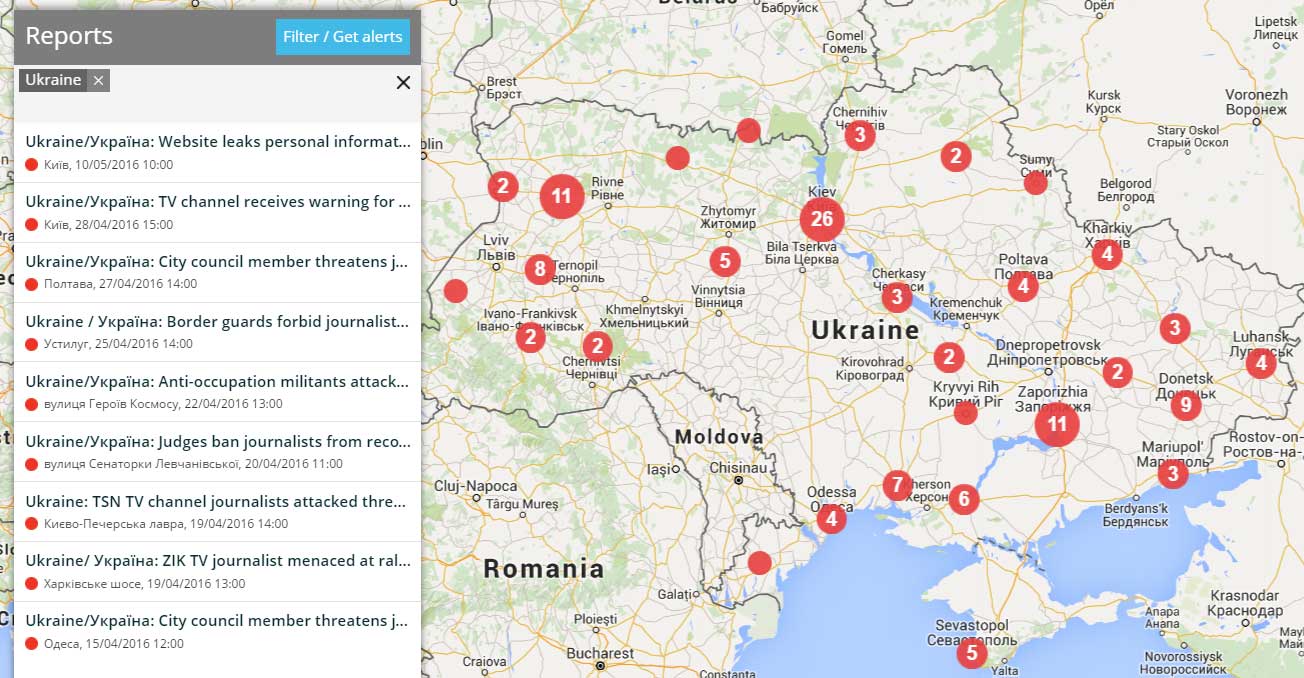
Ukraine is again at the center of an international scandal. On 10 May Ukrainian website Myrotvorets, which publishes personal data of alleged separatists, made public information about the journalists who have been accredited in the so-called Donetsk People’s Republic (DPR) — the part of Donbas area beyond Ukraine’s government control.
The website, which announced on Friday 13 May that it was shutting down, leaked personal data of more than 4,000 journalists, including those working for BBC, Reuters, AFP, The Independent, Ceska televize, CNN, Bloomberg, Aljazeera, AP, Liberation, ITAR-TASS and other media.
The site published the names of the journalists, the media outlets they work for, country of origin, cell phones, email and dates of stay in the DPR.
Myrotvorets, or Peacemaker, received the data from Ukrainian hackers who had attacked DPR sites. After the data was illegally disclosed, the hackers declared a boycott and suspended their activities.
The website also accuses the journalists of co-operating with “militants of the terrorist organisation” and claims that “journalists with Russian names work for many non-Russian media (CNN? BBC? AFP?).”
Myrotvorets has long been raising concerns and criticism of Ukrainian human rights activists. Launched in the spring of 2014, it publishes the personal data of people its writers see as supporting separatism in Ukraine.
In particular, it had published the personal data of former Ukrainian lawmaker Oleh Kalashnikov and journalist Oles Buzyna. Both were murdered near their apartments shortly after the release of their information.
Breaking legislation on personal data protection and the presumption of innocence, the site has been operating for two years without any prosecution for its activities.
In April 2015, the Ukrainian parliament’s Commissioner for Human Rights Valeria Lutkovska demanded that the security service and the interior ministry block the website and prosecute those behind it. Instead, she received only threats in response.
As a result, Anton Herashchenko, the MP from the People’s Front faction and the advisor to the Ukrainian Interior Minister, who previously announced his involvement in the creation of Myrotvorets, threatened Lutkovska with dismissal. He said that operation of the website was “extremely important for the national security of Ukraine and the one, who does not understand this or attempts to hinder its operation, is either a puppet in the wrong hands or works against the national security” and the information is collected “exclusively from such open sources as social networks, blogs, online directories, news feeds”.
Lutkovska’s office of ombudsman told Mapping Media Freedom that the police launched a criminal case last year, but there are no tangible results yet and the website continues its work. The sites servers are located outside Ukraine.
In the wake of the publication of journalists’ information, Lutkovska again appealed to the interior ministry and security service aksing for the site to be blocked.
Journalists, whose personal data was published, have already received threats. Ukrainian freelance journalist Roman Stepanovych has published a threat he received via e-mail.
Stepanovych, who currently works mainly for Vice News, told Mapping Media Freedom: “I filmed in Donbas like a stringer for different news agencies like NBC, DW, Reuters and sometimes worked as a fixer for Die Ziet, CCTV, Aftenposten and many more. I am a native of Donetsk, but have always worked for the western media.“
Stepanovych, who is working outside Ukraine, said that he was considering asking police to investigate the threats when he returns to the country.
On May 11, journalists working for Ukrainian and foreign media issued a joint statement with Ukrainian and international media organisations demanding that Myrotvorets immediately take down the personal data of journalists, who had been accredited in the DPR:
“The Ukrainian and foreign journalists, who risked their lives to cover the events impartially and told what was happening in the occupied territories in Ukrainian and international media, were exposed to attack. In particular, it is thanks to their work we found out about the Vostok battalion, crimes of militant known as Motorola and other militants, supply of Russian weapons and many other important facts. These journalists gave information for a qualitative investigation into downing of MH17 flight in the summer of 2014, and their materials about senior officials of the occupied territories formed the basis of many investigative and analytical articles. We especially emphasise that accreditation does not mean and has never meant cooperation of journalists with any party to the conflict. Accreditation is a form of protection and safety of journalists.”
According to the Ukrainian and international media organisations, nearly 80 journalists were taken captive in 2014, many of whom suffered torture. Accreditation is the only, although minor, mechanism for protection of journalists from torture or captivity.
Lutkovska and the journalists also appealed to Ukrainian authorities asking for a launch of criminal proceedings. On the same day, the address of the European Union’s ambassador to the Ukraine, Jan Tombinski, was released. Tombinski said that publication of the journalists’ leaked personal data violated the best international practices and Ukrainian legislation. He urged Ukrainian authorities “to help ensure that this content is no longer published“.
In response, Anton Herashchenko posted on his Facebook page: “Currently, Ukraine has no lawful methods to block harmful content and has no principles of defining which content is illegal and harmful and which is not. Ukraine has also no technical possibility to block any content on the internet.”
On May 11, the Kyiv prosecutor’s office opened criminal proceeding under Article 171 of the Criminal Code of Ukraine (Preclusion of legal professional activities of journalists).
6 May 2016 | Belarus, Europe and Central Asia, Macedonia, Mapping Media Freedom, News, Russia, Turkey, Ukraine
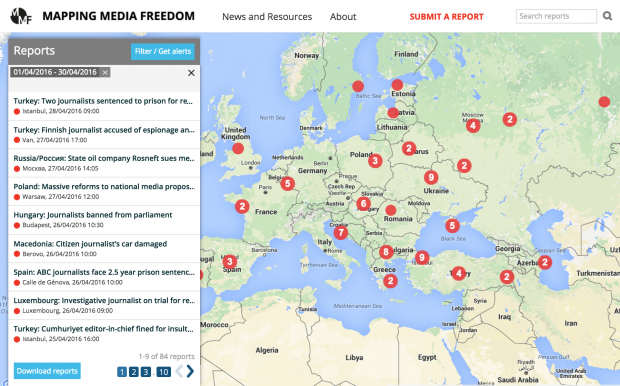
April 2016 was the busiest month for Index on Censorship’s Mapping Media Freedom since the project began in May 2014, with a total of 87 violations against the media recorded. While MMF records violations from over 40 countries, the majority (55%) of last month’s violations came from just five countries.
These hotspots for attacks on the media will come as no surprise to anyone following the project in recent months.
Turkey continues to be the worst offender
With 16 violations recorded within its borders in April, Turkey is again the location with the most offences.
One of the most worrying occurrences last month was on 28 April when journalists Ceyda Karan and Hikment Chetinkaya, who work for Turkish daily Cumhuriyet, were sentenced to two years in prison for publishing the cover of Charlie Hebdo magazine featuring an image of prophet Muhammad. The pair were convicted of inciting “hatred and enmity”.
In another instance, on 30 April, Hamza Aktan, news director of private Istanbul-based IMC TV, was arrested by anti-terror police. Aktan was escorted to the police station where he was interrogated for 12 hours and then released. The editor is being accused of spreading propaganda for a terrorist organisation and trying to build public opinion abroad against interests of Turkey for four public tweets.
UPDATE: Government-seized Zaman and Cihan forced to close
Index on Censorship’s latest quarterly report includes a case study on an Istanbul court appointing a group of trustees to take over the management of Zaman newspaper. Since the report, it has been announced that Zaman and Cihan News Agency, also government-seized,
are to be permanently closed on 15 May. The decision comes the day after the European Commission recommendation of granting Turkey visa-free travel to the EU.
Russia: Big business throws its weight around
As the Panama Papers showed in April, investigative journalism is essential if misconduct and abuse by big business are to come to light. This makes a recent trend in Russia all the more worrying.
A total of 12 reports were filed in Russia last month, three of which related to journalists investigating business. On 12 April, when covering truckers protesting against the “illegal” actions of Omega, journalist Anton Siliverstov’s phone was stolen by Evgeni Rutkovski the director of the transport company. When he asked Rutkovski to comment on the protest, Siliverstov was forced from the office. The journalist said he would record the incident on his phone, at which point Rutkovski snatched the journalist’s device, refused to give it back and called security. Siliverstov hasn’t seen the phone since.
Two days later, reporter Igor Dovidovich was assaulted by the head of Gaz-Service, a gas company he was investigating. His TV crew was also attacked by the firm’s employees.
The month ened with state oil company Rosneft filing a judicial complaint against BiznessPress for an article which, the firm said, is “false and represents baseless fantasies of journalists or their so-called sources”.
Ukraine: TV journalists in the firing line
Ukraine continues to be unsafe for many media workers, with nine reports submitted to the project in April. Violations included five cases of intimidation, two attacks to property and several physical assaults. On 1 April, unidentified assailants set a local TV studio on fire with molotov cocktails. Studio equipment and furniture were destroyed. No one was injured.
Three days later, claims emerged that journalists working for TV channel 1+1 were under surveillance, have received death threats and have been assaulted. Later in the month, journalists from the station were attacked on 19 and 20 April.
Belarus: Journalism as a crime
Journalism is not a crime, but you’d be excused for thinking otherwise when observing recent events in Belarus. Seven reports were filed for Belarus last month, including two criminal charges resulting in fines, three arrests, and one journalist interrogated for doing his job.
On 15 April, freelance journalists were fined approximately €330 each for contributing to Polish TV channel. Kastus Zhukousky and Larysa Schyrakova were found guilty of illegal production and distribution of media products and for contributing to a foreign media outlet without accreditation.
Zhukouski has been fined seven times this year alone.
Macedonia: Anti-government protests turn sour
Six reports were submitted from Macedonia during April. The most worrying instances involved attacks to property (2) and a physical assault, leading to an injury.
April saw a wave of anti-government protests with thousands marching, mainly peacefully, through the capital city of Skopje. On 13 April four photographers and one journalist were injured by police during the anti-government demonstration. Two TV journalists were also injured by demonstrators on the day. On 14 April the offices of the Slobodna Makedonija radio station were pelted with stones by some anti-government demonstrators, causing the windows to break and other material damages.
Mapping Media Freedom Quarterly Report
Index on Censorship has released its report for the first quarter of 2016 covering 1 January and 31 March 2016. During this time: Four journalists were killed; 43 incidents of physical assault were confirmed; and there were 87 verified reports of intimidation, which includes psychological abuse, sexual harassment, trolling/cyberbullying and defamation. Media professionals were detained in 27 incidents; 37 criminal charges and civil lawsuits were filed; and media professionals were blocked from covering a story in 62 verified incidents.
“Conflict in Turkey and eastern Ukraine along with the misuse of a broad range of legislation — from limiting public broadcasters to prosecuting journalists as terrorists — have had a negative effect on press freedom across the continent,” Hannah Machlin, Mapping Media Freedom project officer, said.
28 Apr 2016 | Academic Freedom, Academic Freedom Reports, Campaigns -- Featured, mobile, News, United Kingdom
Academic freedom has been the subject of many debates in recent months. With speakers regularly being no-platformed, and increasing violations of safe space, universities and student unions across the UK have faced harsh criticism.
This growing trend of banning speakers from debates rather than confronting their views head on has led to calls for reforms in university policies in protecting academic freedom and so-called “safe space”.
When human rights activist and ex-Muslim Maryam Namazie was invited by the Atheist, Secularist and Humanist Society (ASH) to speak at Goldsmiths University in December 2015 she faced heckles and interruptions from students who opposed her views.
Throughout Namazie’s talk about blasphemy and apostasy members of Goldsmiths University’s Islamic Society (ISOC) caused a disruption by laughing, shouting out and even switching off her presentation, leading to some students being removed by security.
Namazie spoke to Index about the importance of academic freedom, stating: “Universities have always been hotbeds of dissent and progressive politics. They are places where anything can and should be discussed and debated – where deeply held sensibilities and beliefs can be reviewed, opposed and challenged.
“If you can’t express yourself on a university campus, doing so off-campus is usually even harder. Where academic freedom is restricted, it is a measure of the limits of free speech in society at large.”
Speaking about the Goldsmiths incident, Namazie refuses to be intimidated. She believes those pushing the Islamist narrative want to prevent a counter-narrative on university campuses and therefore it is more important for her to go and speak on any campus she is invited to and to push to be allowed where she is denied access.
“My family fled the Islamic regime of Iran in order to live freer lives. Therefore, it’s especially important for me to speak up, particularly given how many face imprisonment or lose their lives in doing so. I feel I have an added responsibility to speak for those who cannot,” she told Index.
In September 2015 Namazie was invited to speak at Warwick University by the Warwick Atheists, Secularists and Humanists’ Society, but her invitation was withdrawn by the University’s Student Union, who claimed her views would “incite hatred on campus”.
Other activists including Germaine Greer and Julie Bindel have also been silenced on campuses for their controversial views.
Namazie believes no-platforming is having a chilling effect on students’ academic freedom. She told Index: “These policies equate speech with real harm and violence though clearly there is a huge distinction between speech and action. Criticising Islam and Islamism, for example, is not the same as attacking Muslims. Nonetheless, I have been accused of ‘inciting violence’ or ‘inciting discrimination’ against Muslims.”
Human rights activist Peter Tatchell was involved in a dispute in February after National Union of Students’ LGBT representative Fran Cowling, declined to attend an event at the Canterbury Christ Church University at which Tatchell was giving a keynote address and participating on a panel.
He told Index: “Academic freedom is a crucial element of a free and open society. The right to explore, research, articulate, debate and contest ideas — even disagreeable ones — is a democratic hallmark.
“Imposing restrictions is the slippery slope to authoritarianism. As well as diminishing the realm of knowledge and understanding, it reinforces conformism and the status quo; putting a break on dissent and innovation.”
Right2Debate are a student-led movement who are campaigning for an end to censoring and no-platforming in universities by calling for student unions to reform their policies contesting rather than removing divisive and extremist narratives.
The movement, which has 100 student activists across 12 different UK universities and a further 3000 signatures of support, are aiming to have their four-point policy implemented by student unions across the UK. The policy’s outcomes include debate taking place over censorship, uncontested platforms for extremist speakers and transparency in the way the student unions conduct external speaker policy and challenging extremist/divisive narratives.
Haydar Zaki, Quilliam’s Outreach Right2Debate programme coordinator, told Index: “We are in this hostile environment to free speech because of the fruitless terms that have been employed at universities which include safe spaces and duty of care. In reality, these terms are completely open to interpretation, and have led to the chaos we see today whereby speakers are banned (or initially banned) at one university, but then freely allowed in others.
“What student unions and universities need to do is actually start implementing policies that are transparent and uniform — emphasising academic rights and the right to challenge over censorship.”
Bigoted ideas in society need challenging. To do so students require an academic environment that is willing to have open and civil discussions on all types of ideas, including those that could be deemed offensive, believes Benjamin David, an editor at Right2Debate.
Academic freedom is also essential for developing as a society, he told Index: “Academic freedom is important for a variety of reasons, none so pressing than the instrumental value that it has in making advancements in science, law or politics. Such advancements necessitate that the free discussion of opinion is available.”
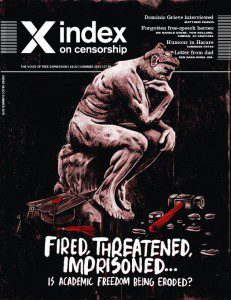
The summer 2015 issue of Index on Censorship magazine which focuses on academic freedom. Subscribe here to get your copy.
Professor Chris Frost, former head of journalism at Liverpool John Moores University, agrees. Frost believes academic freedom is important for new ideas to be explored. He told Index: “Academic freedom is critical as it allows academics to investigate matters that may be generally considered socially unacceptable simply because there has been no previous investigation. We cannot expand knowledge and understanding if we don’t challenge socially accepted concepts and seek proof to support our theories. Preventing academic research leads to a stifled society and one that will eventually destroy itself through its own limitations.”
Academic freedom is a regular topic for debate for the Index on Censorship Youth Advisory Board, a group of young professionals who meet up for monthly online meetings to discuss current free speech issues. The board spoke to Index about why academic freedom is important to them.
Board member, freelance journalist and race, ethnicity and conflict Masters student, Layli Foroudi, told Index: “Academic freedom is important to me because the purpose of research and study should be to investigate reality, to seek to shed light on some aspect of life, or “truth” — and most importantly, to challenge other people’s truth claims. If there is no academic freedom then there will only be a narrow view of reality that is being purported and left unchallenged.”
Mark Crawford, a postgraduate student specialising in Russian and post-Soviet politics at University College London and current board member, added: “As a historian, it always seemed to me that academic freedom was the closest anyone can really get to ideas breaking down monopolies of power -– hard, scientific investigation can cut through the emotions around nationalism or religion, and afterwards you’re left with truths that however inconvenient are always extremely necessary for new and better narratives to be built.”
This article was updated on 3 May 2016. Corrects to clarify the nature of the dispute over Peter Tatchell’s appearance at Canterbury Christ Church University.
Josie Timms is editorial assistant at Index on Censorship and the first Liverpool John Moores University/Tim Hetherington fellow.
Related:
Why is freedom of speech important?
Worst countries for restrictions on religious freedom
