14 May 2014 | Digital Freedom, News, United States
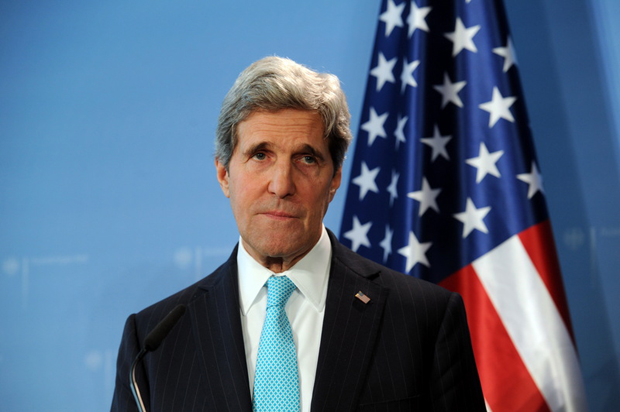
US Secretary of State John Kerry (Photo: AAP Images via Demotix)
The US Secretary of State John Kerry’s speech before the fourth annual Freedom Online Coalition conference has all the makings of anti-censorship agitprop. “The places where we face some of the greatest security challenges today are also the places where governments set up firewalls against the basic freedoms online.”
Indeed, like his predecessor, Hillary Clinton, he has taken to banging the drum of internet freedom as if it is a transforming given of modern life. On January 21, 2010, Clinton made the remark at America’s “interactive museum of news” otherwise called Newseum, that “information freedom supports the peace and security that provide a foundation for global progress.”
As the Belarussian writer and researcher Evgeny Morozov put so eloquently in The Net Delusion, such sentiments promote two delusionary sentiments, the first being cyber-utopianism itself, and the second, being that all problems of the modern world must somehow be tied to matters of the internet.
The philanthropist and high-tech investor Esther Dyson exemplifies both streaks. Writing in 1997, she claimed in Release 2.0 that, “The Net offers us a chance to take charge of our own lives and to redefine our role as citizens of local communities and of a global society.” It provides opportunities of self-governance and autonomy, “to work with fellow citizens to design rules we want to live by.”
The obvious point lacking in Dyson’s analysis is that behind every utopia is a dystopia waiting to happen. All governments, whatever their creed, have been guilty of the same vice.
Freedom provides its own vicious subversions – the open use of Twitter and social media sites invariably allows for infiltration, trolling and forms of cyber counter-insurgency. The simple suggestion that authoritarianism is somehow an enemy of Internet freedom is naïve in so far as it suggests a total misunderstanding as to what such regimes can, in fact, do. All states, autocratic or otherwise, have made it their business to stifle Internet freedoms. They just disagree on how best to do it.
Sounding much like the former Soviet minister of culture, Andrei Zhdanov, Kerry claimed that, “Today, we’ve learned that walls can be made of ones and zeros and the deprivation of access even to those ones and zeros, and that wall can be just as powerful in keeping us apart in a world that is so incredibly interconnected.” This is somewhat ironic – Kerry himself is obsessed by the behaviour of authoritarian regimes and those who would police internet content, ignoring exactly what might be happening at home.
So many myths have been bound up with the Internet, it has become almost mandatory for Kerry to fall into the rather unreflective pose of technology as freedom. Zeros and Ones do nothing to liberate a people, let alone facilitate revolution and institutional change. This is another form of dastard cyber-utopianism – extolling a system of freedom that is merely the straw man of liberty.
Kerry and his colleagues, in truth, are all about regulation and the velvet glove of policing. They decry efforts to control the net in Venezuela, Russia and China, the traditional bogeymen of cyber-freedoms, but prove happy with puritanical measures that police inappropriate content or regulate traffic via private enterprise.
The recent move by the US Federal Communications Commission (FCC) to initiate what it terms a “net neutrality” plan is even more indicative of the scope of control being exerted by the powers that be. Initiated by its chairman, Tom Wheeler, the proposal came about in response to failed efforts by his predecessor, Julius Genachowski, to defend net neutrality.
More than 100 technology companies, including Facebook Inc, Google Inc, and Amazon.com Inc, have expressed concerns about the proposal that regulates the way Internet providers manage traffic. They have urged the FCC to “take the necessary steps to ensure that the Internet remains an open platform for speech and commerce.”
The cardinal warning here is that any suggestion that finds home with the label “open” is bound to be only slightly ajar, if not closed altogether. The Wheeler plan, which purports to be an “open Internet” idea, imports commercial reasonableness into the management of the web. In other words, companies responsible for content would be able to purchase greater speeds on the Internet from broadband providers, within the bounds of commercial prudence.
The consequence of such a superficially liberal plan is that the Internet will be carved up, a case of managing traffic on the “fast lanes” via such companies as Verizon Communications or Comcast Corp, leaving others to languish in their use. The green light to discriminatory deals is being suggested. Even one FCC commissioner, Jessica Rosenworcel, felt that, “Rushing headlong into a rulemaking next week fails to respect the public response to his [Wheeler’s] proposal.”
An internal revolt in the FCC may well be on the cards. But what is an even more striking note is that internet freedom will be dealt a blow, not only by the orthodox authoritarians, but by closet regulators with their fingers on the switch.
Brian Merchant, writing for Motherboard is certainly right to note the fallacious binary embraced by Kerry: “Democracies with private internet service providers, good. Autocrats who block Twitter, or say that the CIA invented the internet, bad.”
This article was posted on May 14, 2014 at indexoncensorship.org
9 May 2014 | Azerbaijan, Azerbaijan News, Bahrain, China, News, Oman, Saudi Arabia, Thailand, United Arab Emirates, United Kingdom
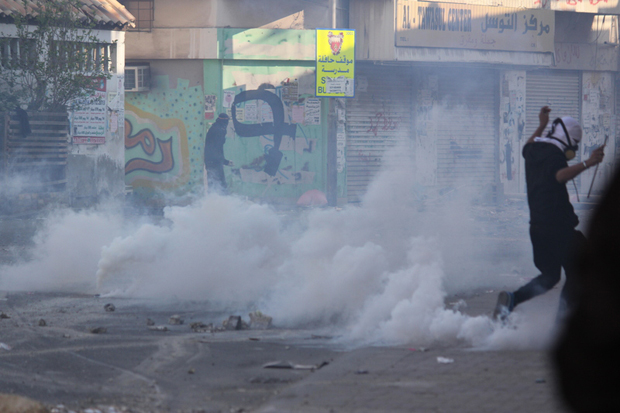
Made in Britain? Physicians for Human Rights (PHR) called for the immediate suspension of the use of excessive, indiscriminate and systematic use of tear gas against civilian protesters and densely populated Shia neighbourhoods in Bahrain (Image: Iman Redha/Demotix)
The Arab Spring has not stopped Britain from helping crush free expression and freedom of assembly by selling crowd control gear to authoritarian states including Saudi Arabia and Bahrain.
Analysis of newly-published data on export licences approved by the UK government have revealed ministers backed over £4 million of tear gas, crowd control ammunition and CS hand grenade sales over the last two years to Saudi Arabia – one of the most repressive states in the world.
The British government also allowed crowd control ammunition to be sold to Malaysia and Oman, as well as tear gas to Hong Kong and Thailand.
It gave the green light to anti-riot and ballistic shields to four authoritarian regimes listed by the Economist Democratic Index: the United Arab Emirates, Bahrain and Azerbaijan, as well as Saudi Arabia.
Its only refusal for an export licence in 2013 for equipment which could be used to suppress internal dissent was for an order of CS hand grenades and ‘tear gas/irritant ammunition’ to Turkey.
A lack of transparency across the secretive arms sector makes it difficult to establish which companies are providing the arms – or how the country in question intends to use them.
But the Geneva Convention forbids the military use of all gas weapons, meaning the UK government would have assumed the tear gas was for use against civilian protesters.
Brief explanatory notes included in the export licences data suggest all those mentioned above are primarily for use against domestic populations.
The notes typically state the licence is granted “for armed forces end use” or “for testing and evaluation by a government / military end user”.
The only exception is the note for a sizeable order of anti-protest equipment for Brazil, which makes clear the export licence is granted for “armed forces end users not involved in crowd control / public security”.
Further evidence has emerged that Britain’s leading arms firm, BAE, has signed a £360 million contract with an unnamed Middle Eastern country for the upgrade of armoured personnel carriers whose primary use is against protesters.
Industry insiders believe the improvements are being made in Saudi Arabia to a stockpile of the vehicles left in the country by the United States military.
BAE’s chairman Sir Roger Carr said contractual commitments prevented him from commenting at the defence giant’s annual general meeting in Farnborough yesterday.
He faced heckling and hissing from vocal critics in the audience who had infiltrated the two-hour question-and-answer session, but insisted BAE was “helping to preserve world peace” and that the company “are not undermining the broader international rules” of the arms trade.
Speaking afterwards, however, a member of BAE’s board suggested the “natural place for these decisions is with government” rather than the company.
“I’m not abrogating our moral responsibility,” he said, “but it’s right that the burden of these difficult decisions is on the government because, in the UK at least, this is an elected democracy.”
Britain’s parliament, at least, has proved reluctant to provide a critical voice on the UK’s arms trade.
Opponents had alleged Saudi Arabian troops which intervened to crush the Arab Spring in Bahrain had received British military training. A recent report from MPs accepted the Foreign Office’s rejection of British complicity, with ministers arguing none of the training had taken place “in a repressive way”.
The Commons’ foreign affairs committee did, however, call on the government to “adhere strictly to its existing policy to ensure that defence equipment sold by UK firms are not used for human rights abuses or internal repression”.
Its request for the government to provide further evidence that it is doing so in practice did not meet with a positive response.
Officials said the risk that export licence criteria might be broken is “factored into” the original decision to grant the licence.
The Foreign Office stated: “There are rigorous pre-licence checks and, for open licences, compliance audits at the exporters’ premises in the UK. We will continue to scrutinise carefully all arms sales to Saudi Arabia.”
Many believe the current export licence regime is not fit for purpose, however. In 2013 the UK approved military licences to a total of 31 authoritarian regimes including Russia, China, Qatar and Kuwait.
“BAE couldn’t sell the weapons they do to these countries without the support of the UK government,” Andrew Smith of the Campaign Against The Arms Trade said.
“The UK government can stop any of these exports at any time but is choosing not to because it’s putting arms company profits ahead of human rights.”
He suggested the government’s decision to exclude Bahrain from its list of ‘countries of concern’ on human rights was “politically motivated”.
And he warned arms sales went beyond small-scale arms and ammunition to include much bigger purchases like fighter jets.
“The reason the Saudis buy from Britain is not just because Britain is willing to sell arms,” Smith added, “but also because it comes with political support and the endorsement and silence of the British government.”
This article was posted on May 9, 2014 at indexoncensorship.org
8 May 2014 | Europe and Central Asia, News

Eurovision contestant Teo, in the music video for this year’s Belarusian entry Cheesecake (Image: Yury Dobrov/YouTube)
If you want a Eurovision of the future, imagine a faux-dubstep bassline dropping on a human falsetto, forever. That was how it felt watching YouTube footage of this year’s entrants in the continent’s greatest song-and-dance-spectacle.
The Eurovision Song Contest, born of the same hope for the future and fear of the past as the European Union, is approaching its 50th year. And strangely, it’s doing quite well. In spite of fears that the competition would end up as an annual carve up between former Soviet states, recent years have in fact seen a fairly equal spread of winners throughout the member states of the European Broadcasting Union (who do not actually have to be in Europe; a fact often missed by anti-Zionists who somehow see a conspiracy in the fact that Israel is a regular entrant in the competition is that channels in countries such as Libya, Jordan and Morocco are also members of the EBU, and technically could enter if they wish. Morocco did, in 1980). Since 2000, the spread of winners between Western Europe, the former Soviet states, and the Balkans and Turkey have been pretty much even.
While some of the geopolitics will always be with us — Turkey and Azerbaijan united in their hatred of Armenia, Cyprus and Greece douze-pointsing each other at every opportunity — the once-derided contest has in fact functioned as a genuine competition. Year in, year out, the best song in the competition tends to win, while the laziest entrants, not taking the event seriously as a songwriting competition (yes, we’re looking at you, Britain), tend to fall behind and then complain that Europe doesn’t “get” pop music.
The best songs and singers triumph, by and large. But Eurovision still does have a political edge.
Take Tuesday’s semi-final in Copenhagen. Russia’s entry, Shine, performed by the Tolmachevy Sisters and described by Popbitch as sounding like “almost every Eurovision song you’ve ever imagined” contained some unintentionally ominous lines:
Living on the edge / closer to the crime / cross the line a step at a time
Add an “a” to the end of that “crime”, and you’ve got the Kremlin’s current foreign policy neatly summed up in a single stanza.
I am not suggesting that the Tolmachevys were sent out to justify Putin’s expansionism. Nonetheless, the Copenhagen crowd were keen that Russia should know what the world thought of its foreign policy and domestic human rights record: as it was announced that Russia had made Saturday’s grand final, the arena erupted in jeering. The dedicated Eurovision fan is clearly not just a poppet living in a fantasy world of camp. They are engaged with the world, and particularly the regressive policies of countries such as Russia, Azerbaijan and Belarus, perhaps more so than your average European.
When Sweden’s Loreen won the competition in Baku, capital of Azerbaijan, in 2012, she pledged to meet the country’s human rights activists. That same year, BBC commentator “Doctor Eurovision” (he actually is a doctor of Eurovision) made explicit references to Belarus’s disgraceful dictatorship, rather than simply giggle at the funny eastern Europeans.
This raises an interesting question about how we engage with dubious regimes.
Before the Baku Eurovision in 2012, there was some discussion over whether democratic countries should boycott the competition, sending a message to Aliyev’s regime.
“No,” Azerbaijani civil rights activists told Index on Censorship. “Let the world come and see Azerbaijan.” They felt that for most of the world, most of the time, they are citizens of a far away country of whom we know nothing. They wanted to take their chance while the world was looking. I think they got it right. As discussed last week, Azerbaijan is engaged in a massive international PR campaign, but to most people in the world since that Eurovision and the attention it raised for the country’s opposition, it has not been able to entirely disguise its atrocious record on free speech and other rights.
On Friday, the International Ice Hockey Federation’s world championship will open in Belarus. Though there was some discussion of boycotting that event, it has died down. Nonetheless, journalists from Europe and North America will be covering the event, and fans will travel too.
Belarus’s macho dictator Alexander Lukashenko is a keen ice hockey fan, and will be aiming to sweep up the glory of hosting a major international sporting event, not long after the country hosted the world track cycling championships in 2013.
Ice hockey fans and sports journalists are generally not the type of people who go in for Eurovision. But maybe they should try to take a leaf out of the Song Contest supporters book. Have a look at the country around them, learn a little about the politics, and spread the word about the side the dictators don’t want us to see.
Autocrats try to use these international competitions to control the world’s view of them. We should beat them at their own games.
This article was posted on May 8, 2014 at indexoncensorship.org
8 May 2014 | Belarus, News
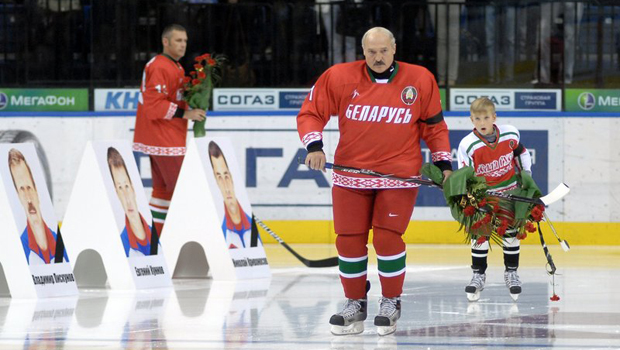
(Photo: Ivan Uralsky / Demotix)
Authorities in Belarus have been targeting human rights activists ahead of this weekend’s start of the International Ice Hockey Federation’s world championship in Minsk.
At least 17 political and civic activists were detained between 26 April and 6 May to prevent the organising of protests during the championship, which begins on 9 May. Another five are either in detention or being sought for questioning by police. All have been accused of minor hooliganism and sentenced to administrative detention of up to 25 days.
Such “preventive arrests” are common in Belarus. One of the activists, Pavel Vinahradau, who is known for his numerous detentions, opted to leave Minsk until the end of the championship. He had previously been summoned by the police: “They made it clear that either I go to Berezino (a small town 100 km outside Minsk) till 3 June, or I go to Akrestsina (a detention centre in Minsk). I choose Berezino,” Vinahradau wrote on Facebook.
A website called Totalitizator asks its visitors make predictions about which activists will be detained next, for how many days and on what charges. For people who follow political news in Belarus it is not difficult to make a choice.
Potential foreign “troublemakers” are also being kept away from the tournament. On Wednesday, Martin Uggla, a human rights activist from Sweden, was denied entry to Belarus when he was detained at Minsk-2 National Airport. According to temporary visa-free travel requirements, hockey supporters with valid game tickets do not require visa. Despite the fact Martin had one, border guards told him he was being prohibited from entering the country.
Belarus’ president Alexander Lukashenko is known for his love for hockey – and his unfulfilled desire of a real international profile. Consistent tensions with the Western democracies and an unwillingness to ease his authoritarian grip has deprived Lukashenko’s international relations of impact. Fifty-six of the president’s last 100 international visits were to Russia and Kazakhstan, though he has travelled to Turkmenistan, Venezuela, China and Cuba, as well.
The ice hockey championship in Minsk is set to become Lukashenko’s marquee performance on the world stage. That is why the government is rounding up activist voices. Lukashenko wants to present a calm, hospitable and prosperous country led by a wise and caring leader. The picturesque façade cannot hide the problems afflicting Belarus: An unsustainable economy hooked on huge Russian subsidies and a dismal human rights record.
Belarus remains the only country in Europe that still imposes the death penalty. On 18 April, 23-year-old Pavel Sialiun was, according to reports, executed. Sialiun’s case is still under review by the UN Human Rights Committee.
Nine political prisoners are still in jail in Belarus, including well-known human rights defender Ales Bialiatski, and former presidential candidate Mikalay Statkevich. A recent report by FIDH says they are in a critical situation. Many dissidents suffer regular restrictions to “their means of support, quality of food and medical assistance”, including being deprived of meetings with relatives and subject to limits on correspondence.
“Politically motivated persecution of civil society representatives and of the opposition is a general trend, and the limitations on political and civil rights of Belarusian citizens are pervading, both in national legislation and in practice,” says another statement by 12 human rights groups that represent the ice hockey championship participating countries.
But people who raise these issues are not welcome in Minsk these days. Even foreign journalists who are accredited for the championship are obliged to receive a separate accreditation at the Belarusian Foreign Ministry if they wish to cover issues other than hockey while in Belarus.
But many in the country fear the real issues to cover will appear after the championship is over on 25 May.
“Putin invaded the Crimea four days after the Sochi Olympics. Let’s see if Lukashenko will be that quick with another clampdown on civil society. But I am sure he will settle all accounts with us after the championship,” a leader of one Belarusian NGOs told Index in Minsk last week.
Next year, the country will vote in the presidential election. So there is more ice to come in Belarus after international hockey is gone.
An earlier version of this article specifically stated that both Ales Bialiatski and Mikalay Statkevich have been deprived of meetings with relatives and subject to limits on correspondence. While this may have been true in the past, we have not been able to confirm that this is currently happening to the pair.
This article was posted on May 8, 2014 at indexoncensorship.org
