2 May 2014 | News
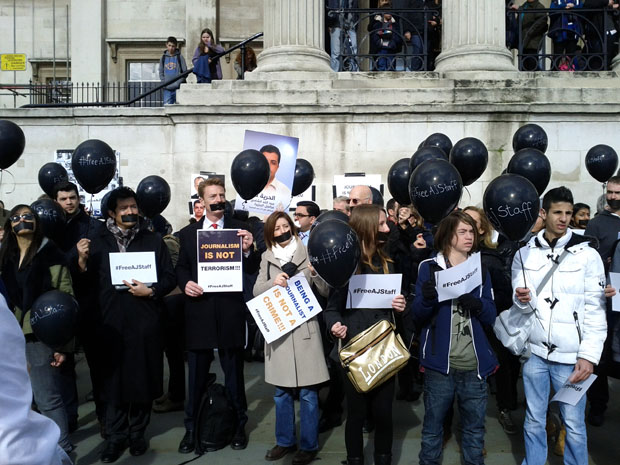
A London protest calling for the release of jailed Al Jazeera journalists in Egypt (Image: Index on Censorship)
Press freedom is at a decade low. Considering just a handful of the events of the past year — from Russian crackdowns on independent media and imprisoned journalists in Egypt, to press in Ukraine being attacked with impunity and government reactions to reporting on mass surveillance in the UK — it is not surprising that Freedom House have come to this conclusion in the latest edition of their annual press freedom report. This serves as a stark reminder that press freedom is a right we need to work continuously and tirelessly to promote, uphold and protect — both to ensure the safety of journalists and to safeguard our collective right to information and ability to hold those in power to account. On the eve of World Press Freedom day, we look back at some of the threats faced by the world’s press in the last 12 months.
1) Journalism is not terrorism…
National security has been used as an excuse to crack down on the press this year. “Freedom of information is too often sacrificed to an overly broad and abusive interpretation of national security needs, marking a disturbing retreat from democratic practices,” say Reporters Without Borders (RSF) in their recently released 2014 Press Freedom Index.
Journalists have faced terrorism and national security-related accusations in places known for their somewhat chequered relationship with press freedom, including Ethiopia and Egypt. However, the US and the UK, which have long prided themselves on respecting and protecting civil liberties, have also come under criticism for using such tactics — especially in connection to the ongoing revelations of government-sponsored mass surveillance.
American authorities have gone after former NSA contractor and whistleblower Edward Snowden, tapped the phones of Associated Press staff, and demanded that journalists, like James Risen, reveal their sources. British authorities, meanwhile, detained David Miranda under the country’s Terrorism Act. Miranda is the partner of Glenn Greenwald, the journalist who broke the mass surveillance story. Authorities also raided the offices of the Guardian — a paper heavily involved in reporting in the Snowden leaks.
2) …but governments still like putting journalists in prison
The Al Jazeera journalists detained in Egypt on terrorism-related charges was one of the biggest stories on attacks on press freedom this year. However, Mohamed Fahmy, Baher Mohamed, Peter Greste and their colleagues are far from the only journalists who will spend World Press Freedom Day behind bars. The latest prison census from the Committee to Protect Journalists (CPJ) put the number of journalists in jail for doing their job at 211 — their second highest figure on record.
In Bahrain, award-winning photographer Ahmed Humaidan was sentenced in March to ten years in prison. In Uzebekistan, Muhammad Bekjanov, editor of opposition paper Erk, is serving a 19-year sentence — which was increased from 15 in 2012, just as he was due to be released. In Turkey, after waiting seven years, Fusün Erdoğan, former general manager of radio station Özgür Radyo, was last November sentenced to life in jail. Just last Friday, Ethiopian authorities arrested prominent political journalist Tesfalem Waldyes and six bloggers and activists.
3) New media is under attack…
As more journalism is being conducted online, blogs, social and other new media are increasingly being targeted in the suppression of press freedom. Almost half of the world’s jailed journalists work for online outlets, according to the CPJ. China — with its massive censorship apparatus — has continued censoring microblogging site Sina Weibo, while also turning its attention to relative newcomer WeChat. In March, it closed down several popular accounts, including that of investigative journalist Luo Changping.
Meanwhile, Turkish Prime Minister Recep Tayyip Erdoğan has publicly all but declared war on social media, at one point calling it the “worst menace to society”. Twitter played a big role in last summer’s Gezi Park protests, used by journalists and other protesters alike. Only days ago, Turkish journalist Önder Aytaç was jailed, essentially, because of the letter “k” in a Tweet.
Meanwhile Russia has seen a big crackdown on online news outlets, while legislation recently passed in the Duma is targeting blogs and social media.
4) …and independent media continues to struggle
Only one in seven people in the world live in countries with free press. In many parts of the world, mainstream media is either under tight control by the government itself or headed up media moguls with links to those in power, with dissenting voices within news organisation often being pushed out. Brazil, for instance, has been labelled “the country of 30 Berlusconis” because regional media is “weakened by their subordination to the centres of power in the country’s individual states”. At the start of the year, RIA Novosti — known for on occasion challenging Russian authorities — was liquidated and replaced by the more Kremlin-friendly Rossiya Segodnya (Russia Today), while in Montenegro, has seen efforts by the government to cut funding to critical media. This is not even mentioning countries like North Korea and Uzbekistan, languishing near the bottom of press freedom ratings, where independent journalism is all but non-existent.
5) Attacks on journalists often go unpunished
A staggering fact about the attacks on journalists around the world, is how many happen with impunity. Since 1992, 600 journalists have been killed. Most of the perpetrators of those crimes have not been brought to justice. Attacks can be orchestrated by authorities or by non-state actors, but the lack of adequate responses by those in power “fuels the cycle of violence against news providers,” says RSF. In Mexico, a country notorious for violence against the press, three journalists were murdered in 2013. By last October, the state public prosecutor’s office had yet to announce any progress in the cases of Daniel Martínez Bazaldúa, Mario Ricardo Chávez Jorge and Alberto López Bello, or disclose whether they are linked to their work. Pakistan is also an increasingly dangerous place to work as a journalist. Twenty seven of the 28 journalists killed in the past 11 years in connection with their work have been killed with impunity. Syria, with its ongoing, devastating war, is the deadliest place in the world to be a journalist, while some of the attacks on press during the conflict in Ukraine, have also taken place without perpetrators being held accountable. That attacks in the country appear to be accelerating, CPJ say is “a direct result of the impunity with which previous attacks have taken place”.
This article was published on May 2, 2014 at indexoncensorship.org
1 May 2014 | Brazil, Digital Freedom, News, Russia, United States
“ICANN’s mission is stewardship and operational stability, not the defence of its existence or the preservation of the status quo.”
Stuart Lynn, ICANN President, Feb 2002
There has been much debate this month among internet circles about the future of the Internet Corporation for Assigned Names and Numbers (ICANN). Much of this was discussed at the NETmundial meeting in Sao Paolo, a suitable venue given Brazil’s desire to throw its weight behind reforming such bodies as ICANN. Reforms are on the cards, but no one seems to be clear what exactly these will do to the way the internet is used. Sentiments of doom and gloom mix with utopian forecasts of freedom.
The NETmundial Multistakeolder Statement doesn’t reveal much, other than paying lip service to various principles (freedom of expression and association, privacy) and charting the roughest of roadmaps for future directions on Internet governance. Aspiration, be it in terms of transparency, accountability and collaboration, is key.
ICANN was incorporated in California on September 18, 1998. Its creation was heralded as a loosening of the grip by US authorities on the operational side of the Internet, tasking a company to take over administrative duties. ICANN plays a leading role in dealing with the distribution of IP addresses and the management of the Domain Name System (DNS).
As far back as February 2002, the organisation’s president, Stuart Lynn, saw the need for reforms of the body. Reforms had to “replace ICANN’s unstable institutional foundations with an effective public-private ownership, rooted in the private sector but with the active backing and participation of national governments.” Tensions of management are fundamental – keeping an eye on “high-level elements of the Internet’s naming and address allocation systems” while avoiding intrusions that would stifle “creativity and innovation”. That tension has never been resolved.
On Mar 14, the National Telecommunications and Information Administration (NTIA), based in the US Department of Commerce, announced that its grip on ICANN would be loosened. “The timing is right to start the transition process,” claimed Assistant Secretary of Commerce for Communications and Information, Lawrence E. Strickling. “We look forward to ICANN convening stakeholders across the global Internet community to craft an appropriate transition plan.”
John M. Eger, Director of the Creative Economy Initiative at San Diego State University, was enthusiastic. “The US Government’s decision to end oversight of [ICANN] represents an opportunity for US leadership creating global ‘e-government’ systems to solve international law enforcement and terrorism problems, develop global education and environmental initiatives, and in turn, start using the Internet as a platform for advancing a new foreign-policy agenda.”
Eger’s overview is counter-intuitive – to shape internet governance, to seize the day, as it were, in such areas, one has to liberalise such bodies as ICANN and lessen the grip. Technology can be better managed and directed if the big holders release the creation. The Internet can become both a tool of open governance if the Obama administration embraces a “multistakeholder model”. “Letting go of ICANN gives the US momentum to more aggressively breathe life into the thousand[sic] of applications, which more truly internationalise its usefulness to nations, and to the world community.”
Eger’s observations are problematic on one direct level. US leadership in such areas has tended towards bullying and cajoling negotiating partners in accepting a supposedly universal premise in implementing its own specific policies. Nothing demonstrates that more acutely than the current secret Trans-Pacific Partnership Agreement talks. Ostensibly geared to accelerate trade liberalisation, the leaked chapters of the document suggest that Washington is keen to impress strict, even draconian intellectual property provisions on potential signatories. What can’t be done through Congress can be smuggled in via international treaty.
The suggested relinquishing of control by the US Department of Commerce has not been deemed a wise gesture on the part of such individuals as Sweden’s minister for foreign affairs, Carl Bildt. In relinquishing such control, internet governance would be altered, allowing other states to throw their hats in the ring. Bildt is convinced that widening such involvement on ICANN is not “the way to go.”
Bildt’s concern is paternalistic. Opening such doors will let in rather unsavoury characters keen on over-regulation. “Net freedom is as fundamental as freedom of information and freedom of speech in our societies.” Despite extolling such virtues, he has proven rather enthusiastic about dousing the flames over the NSA revelations of blanket surveillance, arguing that the Swedish FRA is, in fact, a defender of online freedoms. Visions of governance tend to vary.
Bildt also chairs the Chatham House and Centre for International Governance and Innovation Inquiry, created to examine the Snowden legacy and state censorship of the Internet. In a statement in January, the inquiry partners emphasised that “a number of authoritarian states are waging a campaign to exert greater state control over critical internet resources.” They are far from the only ones.
The short of it is that governments are compulsive meddlers. As attractive as the rhetoric of liberty and freedom might be, intrusive governance is still regarded as acceptable. The Brazilian Minister of Communications, Paulo Bernardo, considers virtual crimes and cybersecurity as vital areas of government policy. He did concede that “protocol standards and domain names registration can be perfectly controlled by the technical community.”
The language of Nikolai Nikiforov, Russian representative at NETmundial, proved more muscular. “Being subject to international laws, states act as grantors of rights and freedoms for citizens, play a role in the economy, security and stability of internet infrastructure, and undertaken measures to prevent, detect and deter illegal actions in the global network.”
Governments, it seems, just can’t let go.
This article was posted on May 1, 2014 at indexoncensorship.org
30 Apr 2014 | About Index, Azerbaijan Letters, Campaigns, Statements
Minister Usubov Ramil Idris oglu
Minister of Internal Affairs of the Republic of Azerbaijan
Azerbaijan Avenue 7
1005 Baku
Republic of Azerbaijan
Email: [email protected]
Prosecutor General Zakir Bakir oglu Garalov
Nigar Rafibayli street 7
1001 Baku
Republic of Azerbaijan
Email: [email protected]
Mr Minister, Mr Prosecutor General,
We, the undersigned members and partners of the Human Rights House Network (HRHN) and the South Caucasus Network of Human Rights Defenders, express our deep concern over the persecution and hindrance of free movement of human rights defender Leyla Yunus and her husband Arif Yunus. We call upon you to put an end to the attacks, detention and harassment of human rights defenders and to take steps in order to foster a safe environment for human rights defenders, in line with Azerbaijan’s international obligations and commitments, including as a member of the Council of Europe.
On 28 April 2014 Leyla Yunus and her husband, the historian Arif Yunus, were prevented from leaving the country at Baku’s airport. She then was detained and interrogated by the police regarding the case of the arrested journalist Rauf Mirkadirov and questioned about the relation between the journalist and the Institute for Peace and Democracy. She was released only in the after-noon on 29 April 2014. Searches were conducted in the office of the Institute for Peace and Democracy, and continued in the private home of Leyla Yunus until the night of 29 April 2014. According to Leila Yunus, she was humiliated during the search by the officers. The official grounds on which Leyla Yunus and Arif Yunus were prevented from leaving the country and detained are unclear, as well as the grounds on which the searches are being carried out.
Leader of the Institute for Peace and Democracy, Leyla Yunus is a well-known Azerbaijani human rights defender. Her NGO is a member of the South Caucasus Network of Human Rights Defenders and has from the very start in 1995 worked on the issue to release political prisoners and to establish rule of law in Azerbaijan. Leyla Yunus has within several projects worked to establish dialogue between civil society actors in the South Caucasus. She is a Chevalier of the National Order of the Legion of Honour, as a tribute for her longstanding work promoting human rights.
We are worried that the persecution is related to her outspoken criticism in the past few days against the detention of Rauf Mirgadirov, the investigative journalist of the leading Russian-language newspaper Zerkalo (Mirror), who is now facing charges of treason for his efforts in the peace building process of the Nagorno-Karabakh conflict. Rauf Mirkadirov participated in the numerous joint projects between the Institute for Peace and Democracy and Armenian NGOs.
Under Azerbaijan’s commitments within the Organisation for Security and Cooperation’s Misnk Group, we strongly believe that public diplomacy and cooperation between civil society in the South Caucasus contributes to efforts aiming at finding a peaceful solution to the Nagorno-Karabakh conflict.
As the Commissioner for Human Rights of the Council of Europe Nils Muižnieks stated on his Facebook page, “this is an additional example showing the extent of intimidation and repression of critical voices in Azerbaijan, a problem which I have repeatedly highlighted […] and asked the Azerbaijani authorities to address.”[1]Azerbaijan should indeed guarantee the right to freedom of expression of all human rights defenders and critical voices, in line with its obligations as a member of the Council of Europe.
Furthermore, authorities should prevent the use of unreliable evidence and unwarranted investigations against human rights defenders, as laid out in the United Nations Human Rights Council resolution 22/6 of 21 March 2013.
We are extremely worried to see that human rights defenders, including journalists and bloggers, are persecuted, attacked and detained due to their work. In addition to Leyla Yunus, the Chairperson of the Election Monitoring and Democracy Studies Centre (EMDS) Anar Mammadli, the Executive Director of EMDS Bashir Suleymanli and Elnur Mammadov, president of the Volunteers of International Cooperation, are facing court trials[2].
Ahead of the Chairmanship of the Council of Europe by the Republic of Azerbaijan, we call upon you to put an end to the crackdown of the civil society and to take steps in order to foster a safe environment for human rights defenders.
We further call upon you to report to the Council of Europe on your plans to investigate the acts of the State agents, which prevented Leyla Yunus and Arif Yunus from leaving the country and later detained them and to end all persecutions against them and other human rights defenders.
Sincerely,
Human Rights House Azerbaijan (on behalf of the following NGOs):
- Azerbaijan Lawyers Association
- Institute for Reporters’ Safety and Freedom
- Legal Education Society
- Media Rights Institute
- Women Association for Rational Development
Belarusian Human Rights House in exile, Vilnius (on behalf of the following NGOs):
- Belarusian PEN Centre
- Belarus Watch
- City Public Association “Centar Supolnaść”
- Human Rights Centre “Viasna”
Human Rights House Belgrade (on behalf of the following NGOs):
- Belgrade Centre for Human Rights
- Lawyers Committee for Human Rights YUCOM
- Civic Initiatives
- Helsinki Committee for Human Rights in Serbia
- Policy Centre
Human Rights House Kiev (on behalf of the following NGOs):
- Association of Ukrainian Human Rights Monitors on Law-Enforcement
- Human Rights Information Centre
- Center for Civil Liberties
- Kharkiv Human Rights Protection Group
Free Word Centre London (on behalf of the following NGOs):
- Index on Censorship
- Vivarta
Human Rights House Sarajevo (on behalf of the following NGOs):
- Helsinki Committee for human Rights in Bosnia and Herzegovina
Human Rights House Tbilisi (on behalf of the following NGOs):
- Georgian Centre for Psychosocial and Medical Rehabilitation of Torture Victims – GCRT
- Caucasian Center for Human Rights and Conflict Studies
- Human Rights Centre
- Union Sapari
- Article 42 of the Constitution
- Media Institute
Human Rights House Oslo (on behalf of the following NGOs):
- Health and Human Rights Info
- Human Rights House Foundation
- FIAN Norway
Human Rights House Voronezh (on behalf of the following NGOs):
- Charitable Foundation
- Civic Initiatives Development Centre
- Confederation of Free Labor
- For Ecological and Social Justice
- Free University
- Golos
- Interregional Trade Union of Literary Men
- Lawyers for labor rights
- Memorial
- Ms. Olga Gnezdilova
- Soldiers Mothers of Russia
- Voronezh Journalist Club
- Voronezh-Chernozemie
- Youth Human Rights Movement
Human Rights House Yerevan (on behalf of the following NGOs):
- Armenian Helsinki Association
- Helsinki Citizens’ Assembly-Vanadzor
- Journalists’ Club “Asparez”
- Democracy Today
Human Rights House Zagreb (on behalf of the following NGOs):
- APEO/UPIM Association for Promotion of Equal Opportunities for People with Disabilities
- B.a.B.e.
- CMS – Centre for Peace Studies
- Documenta – Centre for Dealing with the Past
- GOLJP – Civic Committee for Human Rights
- Svitanje – Association for Protection and Promotion of Mental Health
Rafto Foundation, Norway
Helsinki Foundation for Human Rights, Poland
Public Union of Democracy Human Rights Resource Centre, Azerbaijan
Legal Protection and Awareness Society, Azerbaijan
Copies have been sent to:
- Ministry of Justice of the Republic of Azerbaijan
- Presidency of the French Republic
- Ministry of Foreign Affairs of the French Republic
- Office of the Commissioner for Human Rights of the Council of Europe
- Private Office of the Secretary General of the Council of Europe
- Chairman of the Committee of Ministers of the Council of Europe
- Delegation of the Council of Europe in Azerbaijan
- UN Special Rapporteur on human rights defenders
- Office for Democratic Institutions and Human Rights of the Organisation for Security and Cooperation in Europe (OSCE ODIHR)
- Delegation of the European Union in Azerbaijan
- Subcommittee on Human Rights of the European Parliament
- Diplomatic community in Baku, Brussels, Geneva and Strasbourg
- Various ministries of foreign affairs and parliamentary committees on foreign affairs
About the Human Rights House Network (www.humanrightshouse.org)
The Human Rights House Network (HRHN) unites 90 human rights NGOs joining forces in 18 independent Human Rights Houses in 13 countries in Western Balkans, Eastern Europe and South Caucasus, East and Horn of Africa, and Western Europe. HRHN’s aim is to protect, empower and support human rights organisations locally and unite them in an international network of Human Rights Houses.
The Human Rights House Azerbaijan is one of the members of HRHN and served as an independent meeting place, a resource centre, and a coordinator for human rights organisations in Azerbaijan. In 2010, 6’000 human rights defenders, youth activists, independent journalists, and lawyers, used the facilities of the Human Rights House Azerbaijan, which has become a focal point for promotion and protection of human rights in Azerbaijan. The Human Rights House Azerbaijan has been closed after the Ministry of Justice of the Republic of Azerbaijan ordered all activities to be been ceased on 10 March 2011.
The Human Rights House Foundation (HRHF), based in Oslo (Norway) with an office in Geneva (Switzerland), is HRHN’s secretariat. HRHF is international partner of the South Caucasus Network of Human Rights Defenders and the Balkan Network of Human Rights Defenders.
HRHF has consultative status with the United Nations and HRHN has participatory status with the Council of Europe.
[1]Statement available at https://www.facebook.com/HumanRightsHouseNetwork/posts/10152035306640965.
[2]Further information on those cases available at http://humanrightshouse.org/Articles/20033.html.
30 Apr 2014 | Brazil, Digital Freedom, News, United States
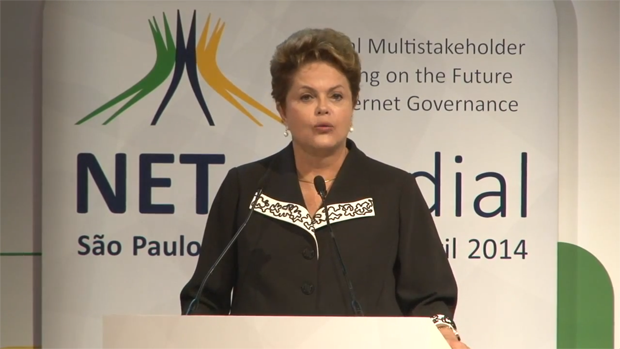
Brazilian President Dilma Rouseff spoke at the opening of NETmundial.
“In 2013, the revelations about the comprehensive mechanisms for spying and monitoring communications provoked outrage and disgust in broad sectors of the Brazilian and the world’s public opinion. Brazilian citizens, companies, embassies and even the President of the Republic had their communications intercepted. Such facts are unacceptable. They undermine the very nature of the Internet: open, pluralistic and free”.
With these words, President Dilma Rousseff opened the NETmundial – Global Multistakeholder Meeting on the Future of Internet Governance, held in São Paulo on April 23 and 24.
Organized by the Brazilian Internet Steering Committee (CGI.br) and /1Net, the unprecedented gathering brought together 1,229 participants from 97 countries. The meeting included representatives of governments, the private sector, civil society, the technical community and academics. Among those present were the Under Secretary-General of the United Nations, Wu Hongbo; the President of ICANN (Internet Corporation for Assigned Names and Numbers), Fadi Chehade; the “father” of the Web, Tim Berners-Lee, and the co-author of TCP/IP and vice-president of Google, Vint Cerfol. The creator of WikiLeaks, Julian Assange, attended the event via Skype.
The words of the president of Brazil seemed to indicate the tone of the meeting: “This reunion responds to a global desire for change in the current situation, with the systematic strengthening of freedom of expression on the internet and the protection of basic human rights, such as the right to privacy”.
In the audience, activists wore masks with the face of Edward Snowden, whose leaks were a catalyst for NETmundial. They protested against the Article 15 of the Marco Civil–signed into law by Rousseff at the event’s opening ceremony–which orders the retention of users’ browsing data. Some demanded that Brazil offer asylum to Snowden.
The main objective of NETmundial was to begin to formulate a system of international internet governance that will come into effect in September 2015, when the United States steps away from the coordination of ICANN, which administers and manages the names and domains used on the internet.
NetMundial was born thanks U.S. spying that targeted the Brazilian government. Rousseff personally stitched together the event after her speech at the UN General Assembly last year that strongly condemned the NSA spying.
After the meeting, a statement of principles was approved. However, the document does not clearly state any principle governing the massive data espionage or violation of privacy. The term “neutrality” appears only in the list of topics to be discussed in the future. The mass surveillance is identified only as a discrediting factor of the net: “Mass and arbitrary surveillance weakens the trust and the confidence in the internet and in the ecosystem of internet governance”, says the document. The collection and use of personal data “should be subject to international human rights law”. And nothing more. Without incrimination, without any preventive or corrective measure, the question remained open. The postponement of the discussion about net neutrality was advocated by the U.S. private sector.
The final document raised much criticism from civil society, which had their expectations disappointed. With a weak text, the Charter of Principles was more like a set of corporate standards, with little affirmative language, full of marketing buzzwords. Its statements are soft. The governments’ voices, especially the U.S.’s, sounded much stronger. Civil society condemned the lack of explicit rules for the “net neutrality” – the term, by the way, was not even mentioned. Another criticized point was the inclusion of protection and copyright of intellectual property, which meets to the interests of lobbyists from business environment and is contrary to the recommendations of collaborative and free creation.
“The document ended up not reflecting the greatness of the debate that happened here. We missed the chance to produce a substantial document to the discussion of the internet governance”, said Laura Tresca, from the NGO Article 19. “The positive balance is in the process, which was interesting: we experienced the idea of the multistakeholder model in practice; but the final document was too weak.”
EFF published a text that defined the outcome of the meeting as “disappointing”.
The multistakeholder model was criticized by activists as “oppressive, determined by political and market interests”. People like Jérémie Zimmermann (La Quadrature Du Net, which defends the rights and freedom of citizens on the web) and Jacob Appelbaum (developer and security researcher) said that the principles of NetMundial were “empty of content and devoid of real power”. These activists argue that governments have an obligation to ensure the rights of users and that the internet is a common, free and geared to citizens’ good.
It would be very difficult to have unanimity with so many sectors present. Russia, Cuba and India disagreed with the Charter of Principles. Brazil’s minister of communications, Paulo Bernardo, missed a more forceful condemnation of espionage. “For obvious reasons, the United States was uncomfortable with it”, said Bernardo. He recognized that the document is not perfect, but evaluates that it means a victory for the future of governance. The idea now is to enhance the text in other debates, such as the Internet Governance Forum (IGF), that will be held next September in Turkey and in Brazil in 2015.
NETmundial was a historic step putting Brazil in the frontline for internet use in the world, even with the disagreements and a questionable model. Nevertheless, it lacked the courage to allow the voice of the people to sound louder than economic interests. To push the most important issues into the future for further discussions was a mistake – both strategic and purposeful. In this sense, they have bitten more than they could chew.
A previous version of this article referred to Wu Hungbo as the Secretary-General of the United Nations. His correct title is Under Secretary-General of the United Nations. This has now been corrected.
This article was published on April 30, 2014 at indexoncensorship.org
