18 Dec 2014 | Magazine, News, Volume 43.04 Winter 2014
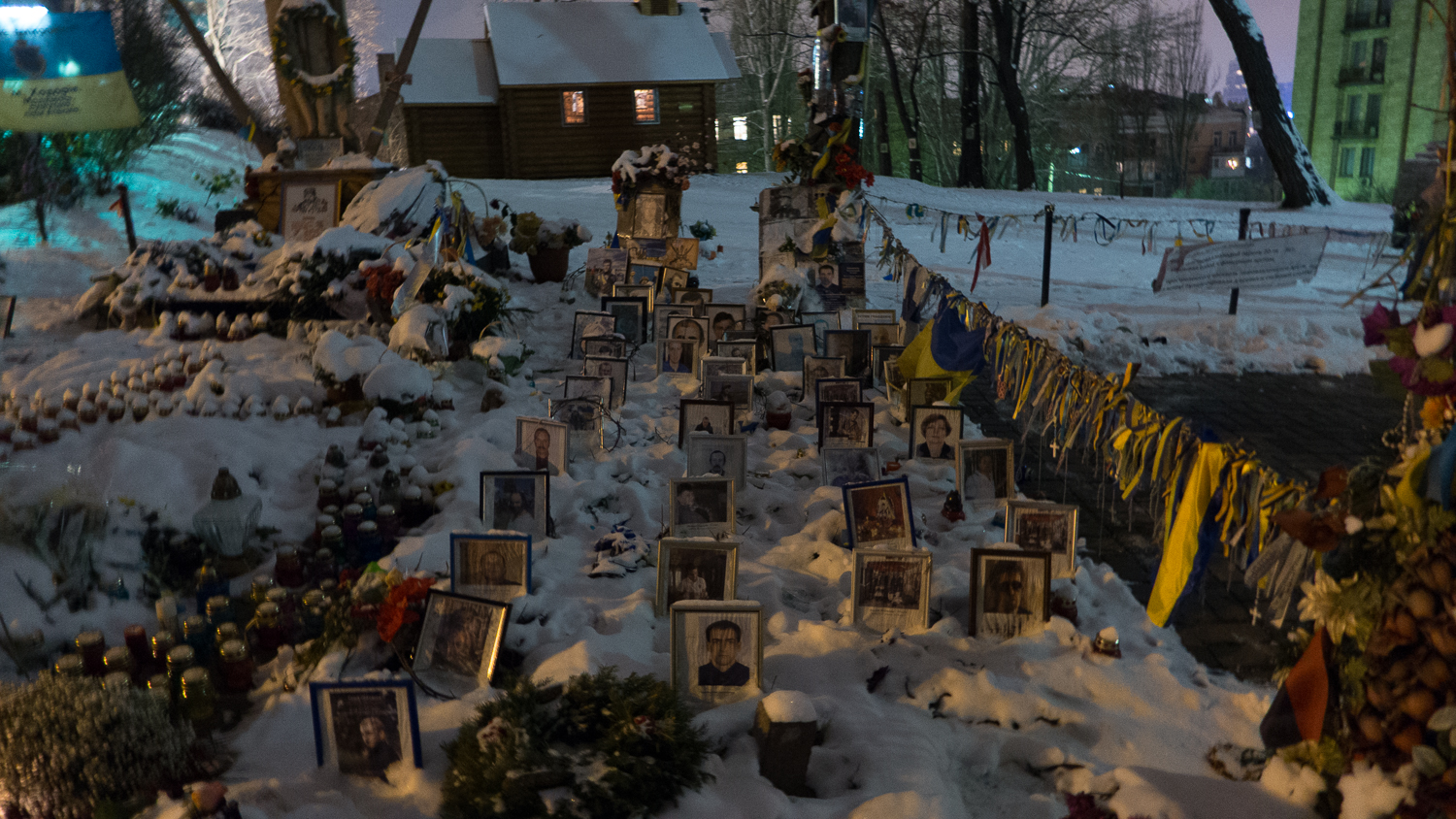
A makeshift shrine remembers the Ukrainians killed during protests on Maidan Nezalezhnosti. (Photo: Sean Gallagher / Index on Censorship)
“There is no civil war in Ukraine. It is a war between Russia and Ukraine, and it is inspired by heavy Russian propaganda,” says Volodymyr Parasyuk as we sit in a café on the main square of the regional capital Lviv in western Ukraine.
This year Parasyuk became a national hero in his country. Some say he changed history when he made a passionate speech on Maidan Nezalezhnosti in Kiev on 21 February 2014, after the police killed about 100 protesters. Parasyuk, head of a sotnia, a unit of 100 men, and part of the protesters’ defence force, demanded President Yanukovich resign and said otherwise protesters would launch an armed attack. The next day the head of state fled the country, and there was a new government formed in Ukraine.
Parasyuk knows what he is saying about war. He joined a voluntary battalion of Ukrainian forces and fought separatists in the east of his country during the summer and autumn. He was wounded and spent a couple of days in detention, but managed to escape.
“This is direct aggression by the Kremlin against my country. This war is completely directed from Russia. We do not have internal reasons to fight each other, the conflict is provoked by lies and propaganda that come from the east,” says Parasyuk.
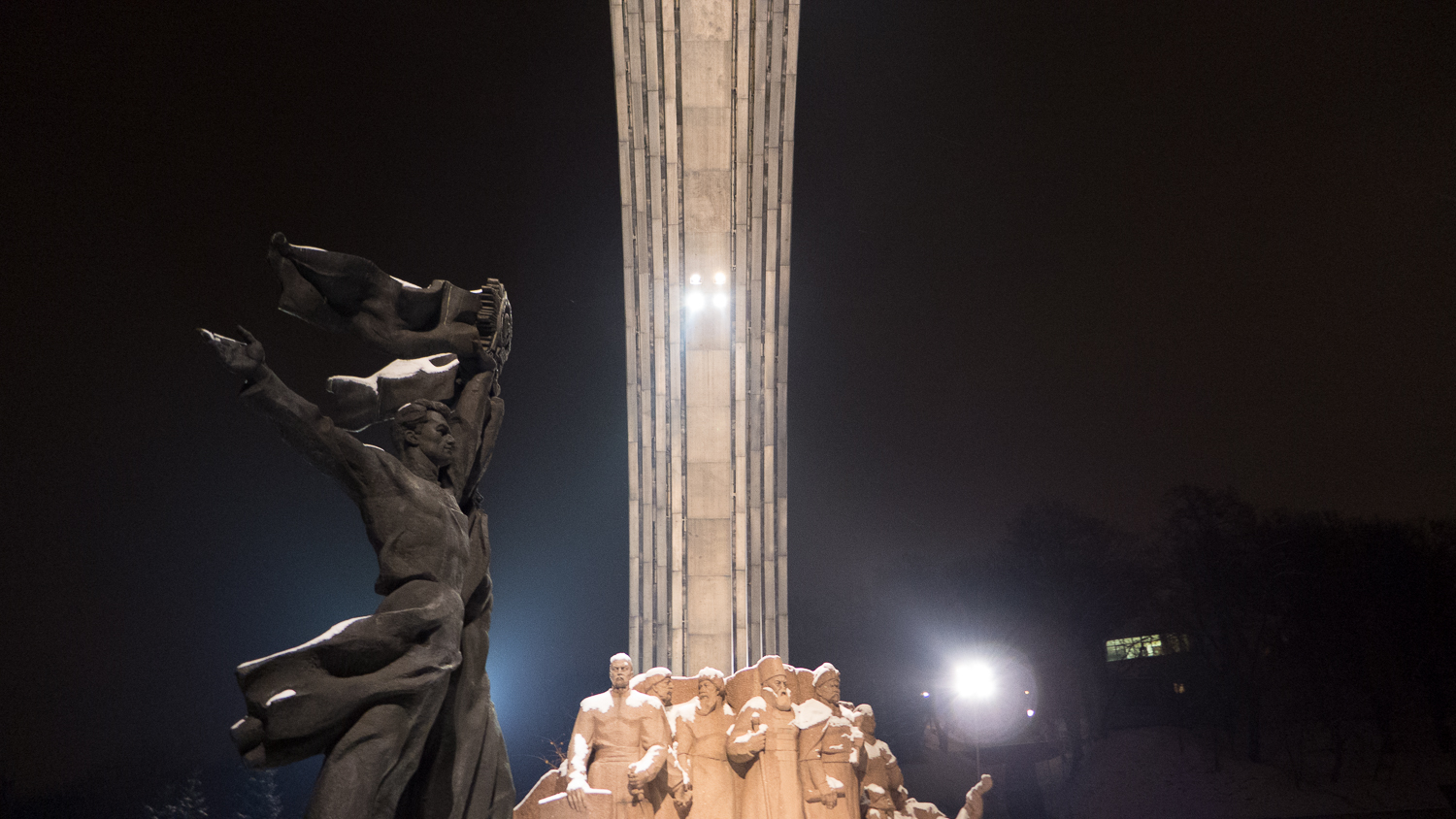
Statues near Maidan Nezalezhnosti celebrate the friendship between Russia and the Ukraine. (Photo: Sean Gallagher / Index on Censorship)
To read the full article, subscribe to Index on Censorship magazine or download the app, get 25% off print orders until 31 Dec 2014.
This excerpt was posted on 18 December 2014 at indexoncensorship.org
17 Nov 2014 | Awards, News, Russia
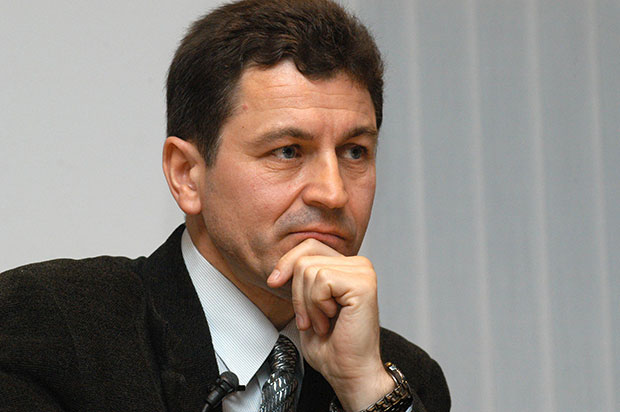
Former naval officer and journalist Grigory Pasko risked everything to uncover environmental degradation committed by the Russian Navy. (Photo: robertamsterdam.com)
In the 1990s, Grigory Pasko, a former naval officer and journalist, reported that Russia’s navy was dumping nuclear waste in the Sea of Japan (East Sea). After a series of articles exposing the environmental crimes, Russian federal security service agents arrested him in 1997, on charges of espionage and abuse of his official power. He was tried several times and eventually sentenced in December 2001 to four years of imprisonment for espionage. He was finally released in January 2003.
Pasko is one of many journalists who has been targeted by the Russian government. He says that freedom of speech and media in the country today, is not that different from when he was named International Whistleblower of the Year at the Index on Censorship Freedom of Expression Awards 13 years ago.
“It is just the same blatant rule by the security services, the same totalitarianism and lack of democratic institutions,” Pasko told Index in an email exchange.
Investigative journalists, in particular, are scarce in the current Russian environment, though the 1990 Law on the Mass Media [1991] states that journalists are allowed to carry on investigations. Article 29 of the Russian Constitution bans censorship altogether. However, under Vladimir Putin’s administration, Pasko said that press freedom and new, economically independent media have disappeared in favor of blatant propaganda.
Nominations for the 2015 Index on Censorship Freedom of Expression Awards close on 20 Nov.
Who will you nominate? A journalist? A digital activist? A campaigning organisation? An artist? Or all four?
“Investigative journalism barely exists as a genre in Russia,” Pasko said. “Journalists in our country are killed and put in prison.”
In March 2011, Pasko and his colleagues, Galina Sidorova and Igor Korolkov, established the Foundation for Investigative Journalism as a way to help professional and citizen journalists alike, as well as to create open discussion and respect for the law. It maintains “zero tolerance towards corruption in all forms”.
“Our goal is to help those who pursue this form of journalism,” Pasko said. “So far we have held schools in investigative journalism for journalists and bloggers in many towns throughout Russia. Unfortunately, funds from our sponsors limit us to holding only three such schools a year.”
Pasko said the foundation aims to teach journalists “to be free. To obey the law. To help the democratic development of journalism in Russia. To know how to use the rights they have been given by the constitution and the law. Not to be afraid.”
In a bleak time for journalists and a free media, Pasko said there is always hope for a brighter, freer future.
“The Russian public will feel a need for the truth, just as it has a need to drink fresh not stagnant water,” Pasko said. “Then society will have a need for independent free journalists. Our task and our goal meanwhile are not to let them disappear and keep the genre of investigative journalism alive.”
This article was posted on 17 Nov 2014 at indexoncensorship.org
3 Nov 2014 | Latvia, News, Religion and Culture, Russia, United Kingdom
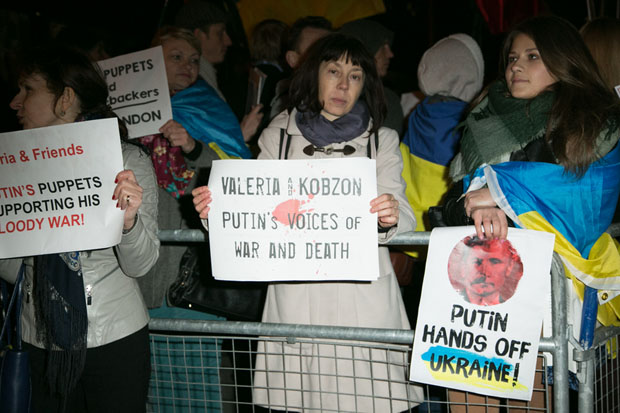
Protest outside the Royal Albert Hall in London over the recent concert staged by Russian singer Valeriya (Photo: Lensi Photography/Demotix)
At first glance, there seems to be little that Latvia’s New Wave music festival and London’s iconic Royal Albert Hall would have in common.
The former is hugely popular contemporary music festival and talent spotting contest on the shores of the Baltic Sea, attracting thousands of revellers from Eastern Europe and beyond. The latter is one of the world’s most famous venues, where some of the global music industry’s biggest and best artists regularly perform. It is also home to the Proms, the premier musical event of the British establishment.
But both have recently been embroiled in the fallout from the crisis in Ukraine, as a culture war between Russia and the west threatens to widen.
Last week it was claimed by Russia’s culture minister that the New Wave festival was on the verge of being cancelled and moved to Russia after three of the headline acts were barred by the Latvian government earlier this year.
The New Wave festival in the town of Jurmala was due to see Oleg Gazmanov, Joseph Kobzon and Alla Perfilova, known as Valeriya, perform in July.
According to the Baltic Times, the trio were banned from attending by the Latvian foreign ministry over their pro Russian views on the Ukraine crises. At the time several members of the Russian State Duma called on the festival to be moved to another Russian seaside resort, and suggested Crimea as an alternative.
“Concerning the organisation of ‘New Wave’ in Crimea, we are ready to cooperate and will gladly host any creative project in Crimea,” Crimea’s Culture Minister Arina Novoselskaya was quoted as saying.
But Russia’s Culture Minister Vladimir Medinsky has reopened the debate by suggesting that the festival is now on the verge of being moved permanently.
“This decision by the Latvian powers that be can be regarded with nothing except astonishment, and as a result, Jurmala stands to suffer serious economic losses,” he told the Baltic Times while at a private meeting in the capital Riga. “We are very close to making the decision to exit, because Russian artists will not tolerate such a slap in the face.”
The six day concert, which gives emerging artists around the world a chance to perform in front of large crowds, was started in 2002 and is considered one of the best in the region. Thousands attend the event and prizes for the winners can be in their tens of thousands of euros.
But big stars attend too.
Kobzon – once dubbed “Russia’s Frank Sinatra” and who is now a Russian MP – said that he was going to file a lawsuit at the European Court of Human Rights over his ban. “I’m suing the Latvian government for moral and material damages,” he told Pravda. “I had paid the hotel 11,500 euros for the time of my stay in Jurmala, but the hotel did not return the money to me.”
The Latvian foreign ministry released a statement at the time that said the three singers “through their words and actions have contributed to the undermining of Ukraine’s sovereignty and territorial integrity.” Latvian Foreign Minister Edgars Rinkevics sent a tweet that “apologists of imperialism and aggression” would be denied entry into Latvia for the festival. The tweet appears to have been deleted.
The issue has once again raised its head after a campaign was launched by anti-Putin activists to have several Russian artists banned from performing in the UK too. Both Kobzon and Valeriya, who were billed to play at a special one-off concert at London’s Royal Albert Hall on 21 October, were again targets of the proposed bans.
According to The Guardian, both artists signed an open letter supporting Putin’s controversial policies in Ukraine. In the week running up to the concert, Valeriya was pictured sitting next to Putin at the Russian F1 Grand Prix.
The London concert went ahead, though it would seem, not exactly as planned. Kobzon reportedly decided to not attend at the last minute, allegedly fearing he would be turned away at the UK border. Over 100 Ukrainian activists picketed the concert, holding placards that read: “Ukrainian Blood on Putin’s Hands” and “Valeria [sic] and Kobzon: Putin’s Voices of War and Death”.
“After the concert we asked some of the people who attended what was said, as they were leaving. They told us Kobzon didn’t perform, “Nadia Pylypchuk, from the London Euromaidan campaign group who organised the protest, told Index on Censorship. “Valeriya told them on stage that Kobzon couldn’t be there because of ill health. But a few days later he performed in Eastern Ukraine. He was just scared that he would not be allowed into the country,” she added.
Despite several attempts by Index to contact the Royal Albert Hall, the venue declined to answer questions about the concert, including whether Kobzon had performed.
A week later, Kobzon, who was born in the Donbass region, would be banned from entering Ukraine by the Kiev government. He nevertheless returned through the porous Russian border, which the Kiev government has little control over, to perform a concert at the Donetsk Opera House.
According to Buzzfeed he was joined on stage by rebel leader Alexander Zakharchenko for the Soviet classic I Love You, Life. Although Zakharchenko was clearly a little rusty. “It’s fine,” Kobzon reassured him after the performance. “I’m an even worse soldier than you are a singer.”
For activists back in the UK, the London concert was proof that Russia’s elite preaches one message to his home audience, whilst acting very differently abroad.
“Such hypocrisy is unacceptable,” Andrei Sidelnikov, an anti-Putin activist who has been given political asylum in the UK and who started the campaign to have the concert scrapped, told The Guardian. “In Russia, they declare that western values are bad, wrong, and not suitable for Russia. Then they travel to western countries to earn money, spend holidays, and buy real estate.”
This article was originally posted on 3 November at indexoncensorship.org
2 Nov 2014 | Campaigns, Russia, Statements
Aleksandr Bastrykin
Head of the Investigative Committee of Russian Federation
The Investigative Committee of Russian Federation
105005, Russia, Moscow, Technicheskii Lane, 2
Sunday 2 November 2014
Dear Mr Bastrykin,
RE: Request for investigation into the murder of Akhmednabi Akhmednabiyev to be transferred to the Central Investigative Department of the Russian Federation’s Investigative Committee.
On the International Day to End Impunity for Crimes against Journalists (2 November) we, the undersigned organisations, are calling upon you, in your position as Head of the Investigative Committee of the Russian Federation, to help end the cycle of impunity for attacks on those who exercise their right to free expression in Russia.
We are deeply concerned regarding the failure of the Russian authorities to protect journalists in violation of international human rights standards and Russian law. We are highlighting the case of Ahkmednabi Akhmednabiyev, a Russian independent journalist who was shot dead in July 2013 as he left for work in Makhachkala, Dagestan. In his work as deputy editor of independent newspaper Novoye Delo, and a reporter for online news portal Caucasian Knot, Akhmednabiyev, 51, had actively reported on human rights violations against Muslims by the police and Russian army.
His death came six months after a previous assassination attempt carried out in a similar manner in January 2013. That attempt was wrongly logged by the police as property damage, and was only reclassified after the journalist’s death. This shows a shameful failure to investigate the motive behind the attack and prevent further attacks, despite a request from Akhmednabiyev for protection. The journalist had faced previous threats, including in 2009, when his name was on a hit-list circulating in Makhachkala, which also featured Khadjimurad Kamalov, who was gunned down in December 2011. The government’s failure to address these threats is a breach of the State’s “positive obligation” to protect an individual’s freedom of expression against attacks, as defined by European Court of Human Rights case law (Dink v. Turkey).
A year after Akhmednabiyev’s killing, with neither the perpetrators nor instigators identified, the investigation was suspended in July 2014. As well as ensuring impunity for his murder, such action sets a terrible precedent for future investigations into attacks on journalists in Russia. ARTICLE 19 joined the campaign to have his case reopened, and made a call for the Russian authorities to act during the United Nations Human Rights Council (HRC) session in September 2014. During the session, HRC members, including Russia, adopted a resolution on safety of journalists and ending impunity. States are now required to take a number of measures aimed at ending impunity for violence against journalists, including “ensuring impartial, speedy, thorough, independent and effective investigations, which seek to bring to justice the masterminds behind attacks”.
While the Dagestani branch of the Investigative Committee has now reopened the case, as of September 2014, more needs to be done in order to ensure impartial, independent and effective investigation. We are therefore calling on you to raise Akhmednabiyev’s case to the Office for the investigation of particularly important cases involving crimes against persons and public safety, under the Central Investigative Department of the Russian Federation’s Investigative Committee.
Sadly, Akhmednabiyev’s case is only one of many where impunity for murder remains. The investigations into the murders of journalists Khadjimurad Kamalov (2011), Natalia Estemirova (2009) and Mikhail Beketov (who died in 2013, from injuries sustained in a violent attack in 2008), amongst others have stalled. The failure to bring both the perpetrators and instigators of these attacks to justice is contributing to a climate of impunity in the country, and poses a serious threat to freedom of expression.
Cases of violence against journalists must be investigated in an independent, speedy and effective manner and those at risk provided with immediate protection.
Yours Sincerely,
ARTICLE 19
Amnesty International
Albanian Media Institute
Association of Independent Electronic Media (Serbia)
Azerbaijan Human Rights Centre
Center for Civil Liberties (Ukraine)
Center for National and International Studies (Azerbaijan)
Civic Assistance Committee (Russia)
Civil Society and Freedom of Speech Initiative Center for the Caucasus
Committee to Protect Journalists
Glasnost Defence Foundation (Russia)
Helsinki Citizens’ Assembly – Vanadzor (Armenia)
Helsinki Committee of Armenia
Human Rights House Foundation
Human Rights Monitoring Institute (Lithuania)
Human Rights Movement “Bir Duino-Kyrgyzstan”
Memorial (Russia)
Moscow Helsinki Group
Norwegian Helsinki Committee
Index on Censorship
International Partnership for Human Rights
International Press Institute
International Youth Human Rights Movement
IREX Europe
Kazakhstan International Bureau for Human Rights and Rule of Law
Kharkiv Regional Foundation – Public Alternative (Ukraine)
PEN International
Public Verdict Foundation (Russia)
Reporters without Borders
The Kosova Rehabilitation Center for Torture Victims
World Press Freedom Committee
cc.
President of the Russian Federation
Vladimir Putin
23, Ilyinka Street, Moscow, 103132, Russia
Prosecutor General of the Russian Federation
Yury Chaika
125993, GSP-3, Moscow, Russia
st. B.Dmitrovka 15a
Minister of Justice of the Russian Federation
Alexander Konovalov
Ministry of Justice of the Russian Federation
119991, GSP-1, Moscow, street Zhitnyaya, 14
Chairman of the Presidential Council for Civil Society and Human Rights
Mikhail Fedotov
103132, Russia, Moscow
Staraya Square, Building 4
Head of the Investigative Committee of the Russian Federation for the Republic of Dagestan
Edward Kaburneev
The Investigative Committee of the Russian Federation for the Republic of Dagestan
367015, Republic of Dagestan, Makhachkala,
Prospekt Imam Shamil, 70 A
Ambassador of the Permanent Delegation of the Russian Federation to UNESCO
H. E. Mrs Eleonora Mitrofanova
UNESCO House
Office MS1.23
1, rue Miollis 75732 Paris Cedex 15
