Starlink offers a glimmer of hope in the internet darkness
Uganda is the latest country to shut down the internet as people goes to the polls

Uganda is the latest country to shut down the internet as people goes to the polls
It should now be clear to everyone that the year 2026 will be marked by the march of the far right further into the mainstream of European politics. Each of the major European powers now has an ultra-nationalist party capable of taking at least a share of power in a democratic election. In Italy it has already formed the government.
What’s more, these Far Right revivalists claim they are defending the key enlightenment value of free speech – although they can be highly selective in its application.
The movement is driven by its hostility towards a well-defined common enemy, not Russia or China, but the European project itself. “The real threat does not come from Moscow or Beijing or from troll farms in St Petersburg. It comes from Brussels.” This, in a nutshell, was the message of the Battle for the Soul of Europe, a conference organised in the Belgian capital in December by MCC Brussels, a thinktank devoted to the downfall of the European Union.
MCC stands for Mathias Corvinus Collegium, a Hungarian institution with close links to Viktor Orbán (Corvinus himself was a 15th century expansionist king of Hungary). Politico has described the organisation as, “The EU’s most prominent hard-right pressure group.” The speaker was Norman Lewis, a visiting fellow at MCC Brussels and a former director of management consultants PwC, who perfectly embodies the ease with which the corporate world can embrace so-called National Conservatism.
The repeated message at Battle for the Soul of Europe was clear and coherent, if somewhat monotonous: European civilisation is under threat from the combined forces of mass immigration and wokery. Patriots of sovereign nations need to wake up and fight for the Christian values of the West and make peace with Russia. Just a week after the conference, US President Donald Trump made it clear that his national security strategy is based on precisely the same principles.
Many participants felt their voices were being silenced by the liberal European establishment.
Virginie Joron, MEP for the French far-right party Rassemblement National (National Rally) expressed her horror that, in her view, the Macron government was planning to label disinformation and “malicious advertising” with the help of the NGO Reporters Without Borders (RSF) and she said felt this was an attempt to target French TV channels sympathetic to the far right. Joron’s views reflect a feud going back several years. In 2024, RSF claimed there were concerted attempts to discredit them – for defending French law on fact-based broadcasting – led by the right-wing media group Vivendi with the support of far-right politicians.
Joron went on to attack Google, George Soros and the EU’s planned Centre for Democratic Resilience as part of a wider threat to free speech disguised as initiatives to tackle fake news. She claimed there now exists a cartel of authorised speech run by Brussels and militant NGOs. “No to the Macron-Brussels globalist Ministry of Truth,” she said, in a final rhetorical flourish.
If this weren’t hyperbolic enough, the French MEP was followed on stage by Adam Starzynski, the editor of Visegrad 24, an online pro-Orbán, pro-Trump news outlet. Starzynski claimed the censorship of stories about Hunter Biden, the son of the former US President Joe Biden, represented “the suppression of news on a whole new scale.” But he did not stop there, for Starzynski, UK far-right anti-immigration activist and convicted criminal Tommy Robinson was a dissident figure in the fight for free-speech rights.
Almost to a man and woman (and there were certainly no non-binary categories here), there was a disciplined “line to take”. The one dissenting voice at the conference, Vaclav Klaus, had been a genuine dissident during the Cold War and later became Prime Minister and President of the Czech Republic. Klaus has impeccable anti-European credentials and began by saying that Brussels was “everything a democrat should disagree with”. He added that it had been a tragic mistake to confuse Europe with the European Union. For him, Europe was just a conglomeration of nation states which sometimes had common interests.
But he took issue with the very concept of the conference: “There is not a common history of Europe,” he said. People should not artificially invent a European “soul”.
The new European Far Right baulk at being called “fascists”. But this is something of a distraction. Most are happy to be considered “hard right” or “patriotic right” or “National Conservative”.
They are for the most part, united and disciplined, where their liberal opponents are confused and disorganised. Their message is simple, clear and seductive. And now it has the backing of the White House it cannot be ignored.
On the second evening of my stay in Belgrade, I wondered if someone had been rummaging around in my Airbnb. I was pretty sure that I’d double-bolted the door, but when I came back from the restaurant the door wasn’t bolted at all. It was as if it had just been pulled shut. There was nothing missing, though I searched the high-ceiling-ed narrow studio flat just to make sure someone wasn’t hiding behind a curtain or in a cupboard. The apartment was empty. And I comforted myself with the thought that an intruder wouldn’t have found much anyway. I only had a small backpack, and I had decided to take my phone and laptop everywhere I went.
Belgrade is a city which induces paranoia. I’d spent the last couple of days listening to journalists and human rights defenders talking about the unknown sonic weapon used against student demonstrators in March, and about an activist who had been arbitrarily detained for hours while spyware was installed on his phone. Amnesty International reports this is common practice now, and human rights defenders I spoke to try to check their phones regularly for spyware.
The Serbian authorities are not very friendly to foreign journalists either. Tamara Filipović, the secretary general of the Independent Journalists Association told me that Croatian and Slovenian reporters had been turned away at the border in March because they were a “threat to the country”.
But even more worrying, from my point of view, was the sinister camp just a five-minute walk away from my apartment known locally as Ćaciland. I was staying in the very centre of Belgrade and Ćaciland was in the Pionirski (Pioneer) park in front of the National Assembly building, a large baroque revival edifice in the centre of the city. The encampment was the brainchild of Serbian President Aleksandar Vučić, who had called on the Serbian people to come and defend the parliament to protect it from student demonstrators.
The students have been up in arms for more than a year marching and blockading streets and university buildings, since the collapse of a concrete canopy in the newly rebuilt Novi Sad station which killed 16 people and injured many more in November 2024. Their initial demands: an investigation into why the station was so unsafe, and the suspected government corruption around the entire building project.
As the protests became more vociferous and attracted more members of the public, Vučić and his Serbian Progressive Party (SNS) decided to mount a counter demonstration. People – supposedly “students who wanted to study” – were recruited from round the country to come defend the parliament ahead of the March demonstrations (which were attended by more than 300,000 anti-government protesters). At one point in the recruitment drive, a phone line was set up and a local investigative journalist from the news channel N1 rang it to find out what would happen. He was told that he would be paid between 50 and 80 euros a day to sit and lie down. Women were paid the lower rate, according to one human rights defender I met.
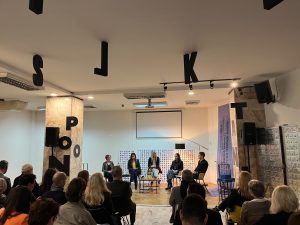
Human Rights House Serbia celebrates Human Rights Day despite threats. Photo: Sally Gimson
In reality, it wasn’t students who were attracted to the camp, but, according to various sources, petty, and even some more serious criminals. The camp now extends to the whole park and into the carpark in front of the parliament building. I saw white tents with music, portable toilets and swarms of police officers, there “to protect” the demonstrators. I also saw what seemed to be more disturbing elements, older men in masks and woollen hats, who I was told were likely Serbian veterans from the 1990s Balkans war. Even if they weren’t, they were dressed to suggest that. The whole place was fenced off with provisional metal railings, used the world round for crowd control. A few days before I arrived the top of the fencing had been greased and no one knew what the substance was.
I didn’t take any pictures on my phone and was warned not to peer too closely as I walked past. Last month, a television crew from N1, which is one of the few independent TV companies in the capital, was attacked by a man from the camp who turned out to be a convicted murderer. He was identified through footage recovered by the cameraman after his equipment was smashed. In July 2025 reporters filming Ćaciland had eggs thrown at them.
A journalist told me that the camp combined the dystopian aspects of Black Mirror mixed with the comedy of The Simpsons. It is called Ćaciland because when the students first started blockading universities and striking over the Novi Sad disaster, someone scrawled graffiti outside a local secondary school urging students in the town to go back to school. The graffitist spelled the word students as Ćaci instead of the correct spelling of Đaci. It led to a joke about their lack of education, hence Ćaciland (probably best rendered in English as Chavland).
The worst thing according to human rights defender Uroš Jovanović is that the police didn’t defend the attacked journalists but allowed them to act with impunity. Most prosecutors’ offices are dragging their feet when complaints are made to them. Students and journalists on the other hand have been detained and charged with “not following police instructions”. In August in some parts of the country – this is not just a Belgrade movement – demonstrations turned violent, with police beating protesters and some masked people throwing fireworks and stones.
The fight in Serbia is between students and a president they accuse of deep-seated corruption. Academics and schoolteachers have supported their students too. One human rights campaigner said that 100 secondary school teachers have been laid off because of their support, and some 25 headteachers and co-principals dismissed. Many ordinary members of the public have joined the protests, like the 50-year-old woman I met in a café who had been on the marches and started talking to me unprompted. She told me she had lived through five regimes in her lifetime and Vućić’s was by far the worse. She hoped the government would be overthrown soon.
Like Gen Zers around the world the students eschew politics, discuss actions through “forums” and have no leadership structure so they can’t be dismantled by the authorities. They organise primarily over social media. Those who have broken cover or have been arrested have found intimate pictures of themselves disseminated online and in government media. They’ve also been doxxed and smeared. Women have been particularly affected. Biljana Janjic, the executive director of FemPlatz, said out of 170 female activists they talked to, 87 had been assaulted and attacked by the police and pro-regime activists, and that sexual violence and rape threats had been normalised by the police. In smaller communities, women have been much more vulnerable to such attacks. The students’ ideology is unclear, except they dislike mainstream politics which they believe is so fundamentally corrupt that it resembles a big pot of shit – as one disillusioned politician described it – so that anyone who takes part becomes covered in excrement.
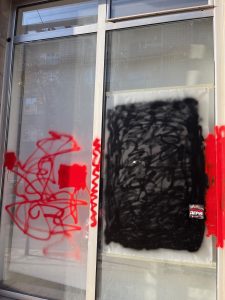
Graffiti on the HRH headquarters in Belgrade. Photo: Sally Gimson
I heard a lot about the suppression of protest and the media, not only through individual conversations, but also at the Human Rights House (HRH), just down the road from the National Assembly and the Ćaciland encampment. The front of the office has been daubed with red graffiti which covers the HRH logo: the authorities have refused to remove it for them. At least the building still rents space to the HRH Serbia team, alongside other civic society organisations.
Last week the House organised an event to celebrate Human Rights Day. The meeting was open and defiant. The leaders were mainly women. They discussed the situation in Serbia and their fears about increasing repression. Prizes were given to the director of news at N1, who HRH workers said had been vital in defending them and giving them “the courage to stay and fight”. Prizes were also given to a small group of prosecutors called Let’s Defend our Professionalism, who were praised for defending the rule of law where most of their colleagues had toed the government line. A representative from the Russian HRH in exile handed on to the director Sonja Tosković and her team the Golden Dove of Peace.
Despite their mistrust of politics and the persecution of many activists and journalists, students are organising for elections and announcing their candidates on 28 December. But there is deep tension in Serbia. Students have a history of toppling governments they don’t like. In October 2000, Slobodan Milosevic, the Serb leader in the 1990s war, was forced from power by a student-led revolution. In Belgrade’s Museum of Yugoslavia there is an celebratory exhibition about the 20th century revolutionary socialist politician Veljko Vlahović, a former student leader, and one of the leading figures in the communist government after the Second World War. In neighbouring Bulgaria, the government was overthrown by Gen Z students this December.
I’ll never know if someone really was in my apartment, but paranoia is rife in Serbia, and all have good cause to feel that way.
Contents