2 May 2025 | Asia and Pacific, Burma, News
Blocking international media from reporting in Myanmar following the huge earthquake in March shows the military junta does not tolerate press freedom, experts say.
A huge 7.7 earthquake struck central Myanmar on 28 March, mostly impacting Mandalay and Sagaing, causing the death of thousands of civilians and the collapse of homes and buildings.
International media outlets flew from all over the world, hoping to get inside Myanmar to cover the disaster. Most had flown into Bangkok, Thailand, where the tremors of the earthquake hit, causing a 30-storey skyscraper to collapse with dozens of construction workers trapped underneath.
But the Myanmar military, officially the State Administration Council, claimed the situation was too dangerous for reporters, and also said accommodation options were limited for reporters entering the country.
Journalist struggles
Silvia Squizzato, an Italian journalist for Rai TV, says she was informed that entering Myanmar brought risks.
“As soon as I arrived in Thailand, I called the Italian embassy in Myanmar to ask if they could help me speed up the visa process, as it takes at least three months to get a journalist visa,” she said. “The Italian embassy repeatedly said it wasn’t possible; they also repeated that entering Myanmar with a tourist visa was too dangerous given the civil war in the country.”
Because of the rejection of a visa, Silvia and her outlet were unable to report on the ground.
“We couldn’t report on the earthquake up close, it was very frustrating. The military junta doesn’t want journalists in the country but neither do various rebel groups. I interviewed many refugees from Myanmar, and they all didn’t agree with this choice,” she added.
Arjan Oldenkamp, a cameraman for RTL Nederland, was another journalist who flew from Europe to cover the disaster. He had travelled all the way from Amsterdam to Bangkok, in the hope that he would get into Myanmar.
“[It was frustrating] for me as a cameraman,” he said. “I wanted only one thing: to get the news right, especially in a place like Myanmar. I would have liked to make a good report. We could not get to the core of the earthquake, it was very frustrating for me. After all, I had flown 13 hours only to be told that we could not get there.”
Damage done
At least 3,700 people have been killed in Myanmar because of the earthquake, with more than 5,000 injured. Recovery efforts are still ongoing, nearly a month after the quake struck.
The earthquake has caused damage to more than 50,000 buildings with nearly 200,000 people displaced, according to the International Federation of Red Cross and Red Crescent Societies.
For those who have survived the disaster, the cost of rebuilding their homes is unmanageable, and many have been left without food, water or shelter. Bill Birtles, Indonesia correspondent for Australia Broadcasting Corporation (ABC), says if the military had allowed foreign media to enter, more aid and assistance could have been provided from the international community.
“We simply went to the embassy in Bangkok and were told to contact the Ministry of Information in Myanmar via generic email, and only after they ordered it could the embassy begin accepting and processing materials in Bangkok,” he said. “It was obvious there wasn’t a clear way to apply for the J [journalist] visa.
“I think, had the military government allowed international media crews to easily enter, they could have shown the devastation more easily to global audiences, which potentially could have increased the global aid response,” he added.
International aid
The quake did see the military make a rare plea to the international community for aid.
Teams from the UK, USA, China, Malaysia, New Zealand and South Korea pledged millions of dollars in emergency aid, while Thailand, Indonesia, Philippines, Vietnam, India, Japan, Singapore and Russia sent rescue units to help with the emergency.
But relief efforts have been complicated, as Myanmar has been suffering from a brutal civil war since the military coup of 2021.
The Myanmar military has been in battle with resistance groups, including the National Unity Government of Myanmar, and ethnic armed organisations. Today, the junta has full control over less than a quarter of the country’s territory.
But any international aid that has come into Myanmar has had to go via major cities, including the capital Naypyidaw, Yangon and Mandalay. These cities are controlled by the Myanmar military, which has raised concerns about how the aid will be distributed to earthquake-affected areas, such as Sagaing, which is partially under the control of opposition groups.
Even though state-controlled media outlets from China and Russia, two of the Myanmar military’s few international allies, were provided some reporting access, international media reporting on the ground in Myanmar has been limited. The BBC managed to get a team into Myanmar via India, while Al Jazeera and Agence France-Presse (AFP) already had small teams in Myanmar when the earthquake struck.
Local criticism
Tin Tin Nyo, the managing director of Burma News International, said the military has restricted local media, too.
“The blocking of international media demonstrates that the military junta does not tolerate press freedom or free flow of information,” she said.
“They want to prevent the media from uncovering their mistreatment of the people and their negligence regarding public wellbeing and safety. This pattern will likely extend to various disasters and human rights violations occurring in Myanmar. They have clearly restricted not only local media but also international media from conducting ground reporting on the earthquake and its aftermath, which gravely impacted on the relief and recovery process,” she added.
The Independent Press Council of Myanmar (IPCM) has called the military’s decision to ban international media a “blatant violation of press freedom”.
“The exclusion of international media from reporting on the earthquake’s aftermath, as indicated by General Zaw Min Tun’s pronouncements, is a blatant violation of press freedom and a deliberate attempt to obscure the scale of the disaster. We categorically denounce this obstruction and insist upon the unfettered right of journalists, both domestic and international, to report on this crisis, for the sake of the affected population, the international community, and humanitarian aid organisations,” an IPCM statement read.
Myanmar press freedom environment
The denial of international media only adds to the dire environment for press freedom in the country.
For years, the Myanmar military has cracked down on independent media over the past four years with outlets having their media licences revoked. Hundreds of journalists have been arrested, dozens have been detained while others have been killed. Two freelance journalists were shot dead last year during a military raid. Access to information in the country remains difficult, as journalists continue to be targeted by the military authorities.
As part of that crackdown, the junta has used other tools to prevent information flow into the country.
In January, the military enacted a new cybersecurity law in Myanmar that banned the use of virtual private networks (VPNs). Myanmar also had the most internet shutdowns across the world in 2024, according to a report released earlier this year by digital rights group Access Now. It revealed that most of the 85 shutdowns came at the hands of the military authorities.
23 Apr 2025 | Americas, News, United States, Volume 54.01 Spring 2025
This article first appeared in Volume 54, Issue 1 of our print edition of Index on Censorship, titled The forgotten patients: Lost voices in the global healthcare system. Read more about the issue here. The issue was published on 11 April 2025.
Even before the Senate confirmed Robert F Kennedy Jr as US health secretary, the Trump administration was wreaking havoc with government agencies vital to medical research and equitable healthcare.
Ignoring Title IV of the 1964 Civil Rights Act, which prohibits discrimination based on race, colour or nationality, the White House removed swathes of data from the websites of the Centres for Disease Control and Prevention (CDC) and the Food and Drug Administration (FDA) overnight, in an effort to purge the agencies of what Elon Musk has dubbed “the woke mind virus”.
Gone were vaccine guidelines for “pregnant people” and regulatory guidelines on increasing diversity in clinical trials. Even the Department of Veteran Affairs felt the impact of Musk and Donald Trump’s anti-DEI (diversity, equity and inclusion) crusade, deleting advice on LGBTQ+ veteran care.
This was followed by a 90-day freeze and stop-work order on the United States Agency for International Development (USAID), jeopardising the lives of millions of people around the world who depend on its programmes for the prevention of diseases such as HIV, tuberculosis and malaria.
How precisely this will make America – or the world – “healthy again”, to quote the slogan of Kennedy’s MAHA (Make America Healthy Again) movement, is a question that he may now wish to ponder. In his new role as director of Health and Human Services – a $1.7 trillion agency with 80,000 employees – Kennedy will be responsible for everything from medical research and pandemic prevention to regulating the cost of medicine and health insurance for the poorest Americans.
On the campaign trail, Kennedy also promised to lift safety regulations on unpasteurised “raw” milk – a potential source of bird flu – and take a “break” from infectious disease research (including for Covid-19) by having the National Institutes of Health (NIH) pivot to chronic diseases such as diabetes.
But it is Kennedy’s well-documented antipathy to vaccines that could have the most far-reaching impacts. Asked during the Senate Health Committee hearing whether he accepted studies debunking the theory that the measles, mumps and rubella (MMR) vaccine caused autism – a theory he has supported – Kennedy promised to be “an advocate for strong science”, adding that “if the data is there, I will absolutely do that.”
But for those who have followed the activities of Kennedy’s Children’s Health Defence non-profit closely, his efforts to roll back on previous anti-vax statements are not to be trusted. Indeed, even as Kennedy was testifying, a lawyer for Informed Consent Action Network – a non-profit whose founder is a close ally of Kennedy – was petitioning the FDA to revoke its approval of the polio vaccine. The vaccine is estimated to have prevented 20 million cases of paralysis globally and is widely regarded as one of the greatest achievements of US medicine.
Nor would Kennedy agree to sever his stake in ongoing litigation on behalf of people claiming to have been damaged by Gardasil, the Merck vaccine that protects against the human papillomavirus. According to financial disclosure documents filed ahead of his confirmation, Kennedy’s arrangement with law firm Wisner Baum guarantees him 10% of payouts from successful Gardasil settlements – an arrangement from which he has earned more than $2.5 million in the past two years.
Ascertaining what Kennedy believes and understands by “science” is a fool’s errand. As the editorial board of the New York Post concluded when it met him in May 2023, when it comes to medical issues his views are “a head-scratching spaghetti of what we can only call warped conspiracy theories”.
The Committee to Protect Health Care, a pro-patients doctors’ group, agrees. In a letter opposing Kennedy’s nomination, it said that, as health secretary, his policies would hit vulnerable communities particularly hard, putting millions of lives at risk.
Kennedy is reportedly considering axing or changing a key vaccine advisory committee – a move that could prompt healthcare providers to offer fewer jabs to children and inspire states to repeal recommended vaccination schedules. According to the CDC, over the past 30 years childhood vaccines have prevented an estimated 1.1 million deaths and 32 million hospital admissions in the USA. The fear is that disruption to these schedules could harm community immunisation levels, which are already down on pre-pandemic numbers.
Just as worrying is Kennedy’s record of aligning himself with propaganda films such as Medical Racism: The New Apartheid, which specifically targeted Black Americans to discourage them from getting vaccinations. In the past, Kennedy has suggested that Black people do not need to follow the same vaccine schedule as white people “because their immune system is better than ours” – a view that drew a stinging rebuke from Angela Alsobrooks, the Democrat senator from Maryland, during cross-examination.
Equally dangerous is Kennedy’s record of intervening in public health crises. In 2018, he flew to Samoa to support a campaign that falsely suggested the MMR vaccine was unsafe. Several months later, a massive measles outbreak hit more than 5,700 people in Samoa and left 83 dead, most of them young children.
And during the Covid-19 pandemic he reportedly suggested that the coronavirus could have been “ethnically targeted” to spare Ashkenazi Jews and Chinese people – a claim that is both antisemitic and scientifically highly implausible.
During the hearings, Kennedy displayed a tenuous grasp of Medicaid and other US federal healthcare programmes he would oversee. In particular, he didn’t seem to understand the role of community health centres, where many low-income Americans receive care, or that cuts to Medicaid would be particularly harmful to Black and Hispanic people, who are more likely than white people to be uninsured.
But perhaps the most revealing exchange came when Bernie Sanders, the independent senator for Vermont, asked Kennedy whether he agreed that healthcare was a fundamental human right. Kennedy’s response that healthcare should not be treated the same way as free speech and that long-term cigarette smokers were “taking from the [insurance] pool” tells you everything about his eugenicist and libertarian mindset.
Listening to Kennedy’s often-incoherent replies, it is hard not to conclude that he is someone who has studied a little medical history but has failed to absorb the lessons of germ theory or the role of social and economic conditions in determining health. Along with antibiotics, vaccines have saved more lives than any other technology in medical history. And while Kennedy’s desire to wean Americans off processed foods would no doubt go some way to addressing chronic conditions such as obesity, his plan to remove fluoride from community water would not be helpful. On the contrary, his claims that fluoridation is connected to lower IQs is based on very flawed science.
Indeed, fluoridation is one of the most beneficial public health interventions in history. Prior to its introduction in the 1940s, Americans suffered from high levels of tooth decay. For those who cannot afford fluoride toothpaste or regular visits to the dentist, de-fluoridation would likely result in a surge in dental cavities. Not so much MAHA then as MATA – Make America Toothless Again.
See also
23 Apr 2025 | Israel, Middle East and North Africa, News, Palestine
For more than 40 years, the Palestinian-run Educational Bookshop in occupied East Jerusalem has provided both locals and tourists with access to a wealth of books, magazines and cultural events, establishing itself as a cultural hub within the historic city. Now, its very existence is under threat.
On 9 February 2025, undercover Israeli police stormed the bookshop and its Arabic-language counterpart next door.
“It was a Sunday afternoon. I was having a good time with my daughter who’s 10 years old,” Mahmoud Muna, co-owner of the bookshop, told Index on Censorship.
The officers started pulling books from the shelves and examining the covers.
“Any cover that had a flag, map, words, keywords like ‘Palestine’, ‘Nakba’ or ‘Gaza’ was deemed suspicious,” said Mahmoud. “Then they Google translate[d] the cover or the blurb or the back page, and they start[ed] creating two piles on the floor, one for the books that they didn’t want to take and another pile for the books that they wanted to take. [This was] completely irrespective of the books and what they mean to us.”
The police put around 300 confiscated books into bin bags, then took Muna and his nephew Ahmad Muna into custody on charges that their books were causing “public disorder”.
“They took us to the police station where we were detained the first night and then taken to court the second night… we were released after 48 hours, myself and my nephew, who was manning the Arabic branch. [We were put] on bail: five days’ house arrest and 20 days away from the bookshop.”
Most of the confiscated books were returned. On 11 March 2025, the police raided the bookshop again, taking 50 books and arresting Mahmoud’s 61-year-old brother and co-owner, Imad Muna. Imad was released a few hours later. The police confiscated books by Banksy, Ilan Pappé and Noam Chomsky, among others.
“They came again and they replayed the whole scenario again. It was just that we were a bit more ready legally. It happened during the morning hours and it was my brother who was in the shop. So we were able to act very quickly and [he was released] before the night,” Mahmoud said.
The Educational Bookshop was founded in 1984 by Mahmoud’s father, Ahmad Muna, a Jerusalem-born teacher. The bookshop has remained a family business ever since.
“For 40 years, we’ve been in operation, trying to serve our community, trying to contribute to social, political, cultural change in a city that is torn between political upheavals. And we believe that books and conversation around books can be an important carrier, if you like, for the conversation. It can open up a space for conversation,” Mahmoud said.
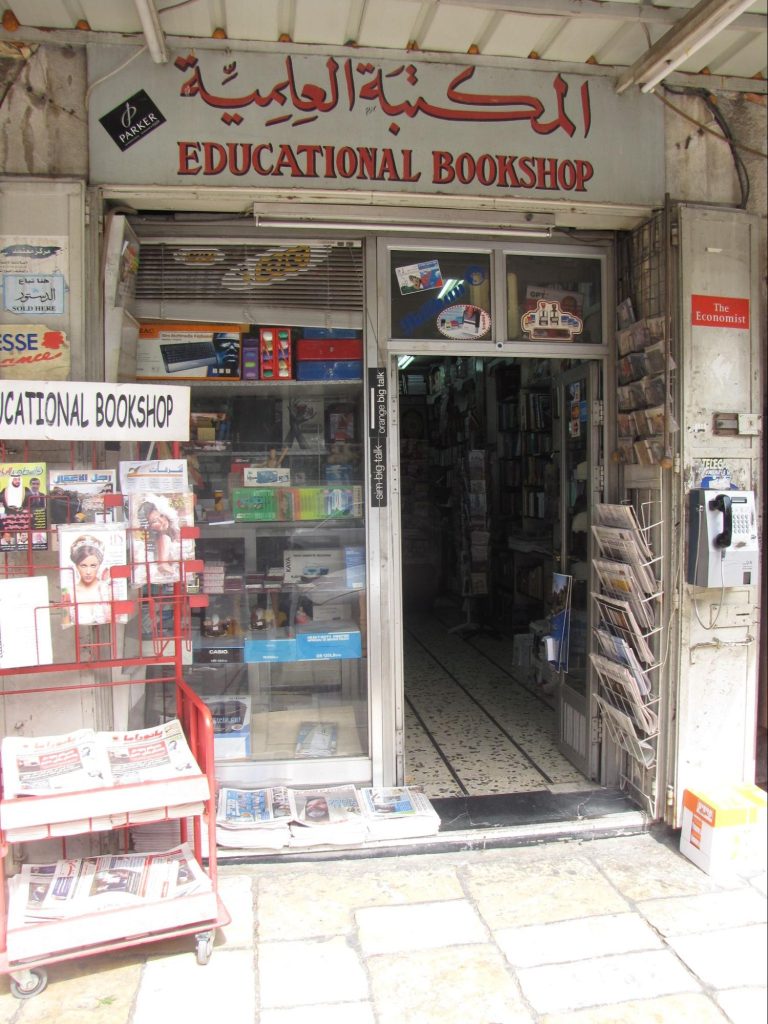
Photo by Mahmoud Muna
These raids are not isolated incidents; they form part of a wider campaign by the Israeli government to crack down on free expression, which has been intensified by the emergence of the far-right within Prime Minister Benjamin Netanyahu’s government and worsened still by Hamas’s incursion on 7 October 2023 and the war in Gaza that has followed.
Recently, authorities have also begun censoring Israeli films critical of the government, as well as events and festivals that discuss Gaza, Palestinians or the 1948 Nakba. The government has started using a revived British Mandate-era law from 1917, which allows the Culture and Sport Ministry to review films before they are screened.
“I think the political climate has really changed. Maybe the war is part of that, but it is not the reason. There is a policy of oppression towards cultural institutions. If you look at theatre, music schools, youth clubs, women’s associations for the last five, six, seven years even before the war, they have been suffering,” Mahmoud said.
Mahmoud says that he and his family have no intention of giving into the authorities’ intimidation tactics.
“We are determined, we’re not gonna give up. It makes me angry, but it also makes me believe even stronger in the power of books and words and literature. And it also opens my eyes even further to the importance of our work in our society.”
Above all, he calls on the international community to speak out against the erosion of democratic values unfolding in Israel and Palestine today.
“If we really believe in what we say, and we really want progressive liberal societies and freedom of expression in Turkey or China or Russia, then we also need to demand them in places like Jerusalem as well.”
17 Apr 2025 | Africa, Americas, Belarus, Europe and Central Asia, Mexico, News, Nigeria, United Kingdom, United States
Today, the torrent of online information, misinformation and disinformation makes it harder than ever to stay in the loop. As we get bombarded with news from all angles, important stories can easily pass us by. To help you cut through the noise, every Friday Index publishes a weekly news roundup of some of the key stories covering censorship and free expression from the past seven days. This week, we look at more news from Donald Trump’s USA, yet another rapper having his music banned for criticising the powerful, and the announcement of a new uncensored social media network from former UK Prime Minister Liz Truss.
Deportations: Trump administration faces contempt ruling over ignoring Supreme Court order
US district judge Paula Xinis says she is considering instigating contempt proceedings against the Trump administration for failing to facilitate the return to the US of Salvadorean national Kilmar Armando Abrego Garcia, who was deported in March.
Garcia, originally from El Salvador but who entered the US illegally as a teenager, is one of tens of alleged members of the MS-13 and Tren de Aragua gangs who were flown on US military planes and detained in El Salvador’s notorious Cecot (Terrorism Confinement Centre) in March. Garcia’s lawyer denies he is a member of either gang.
Garcia’s deportation came despite an immigration judge’s 2019 order barring him from being sent to his home country. The US Government said he was taken there as the result of an “administrative error”.
On 11 April, the US Supreme Court ruled unanimously (9-0) that the Trump administration must “facilitate” Garcia’s release.
Trump advisor Stephen Miller has since portrayed the ruling as being unanimously in favour of the government. “We won a case 9-0, but people like CNN are portraying it as a loss,” he said. This is despite the Supreme Court declining to block the Maryland District Court ruling that the government should do everything in its power to facilitate his return. On a recent visit to the US, El Salvador’s President Nayib Bukele said he won’t release García because he isn’t fond of releasing people from his prisons, adding that he didn’t have “the power” to return him to the USA.
The New Yorker says the Trump administration has “slow-walked or outright failed to comply with court orders related to a range of issues, most notably immigration and government funding”.
Music censorship: Afrobeat track criticising Nigeria’s President banned
On 9 April, Nigeria’s National Broadcasting Commission banned the Afrobeat track Tell Your Papa from TV and radio.
Tell Your Papa was released three days earlier by the rapper Eedris Abdulkareem with lyrics in Nigerian Pidgin English and Yoruba. The song is aimed at Seyi Tinubu, the son of Nigeria’s President Bola Tinubu, calling on him to ask his father about his jet-setting lifestyle against a backdrop of worsening socio-economic conditions in the country.
Abdulkareem rose to prominence in the 1990s as a pioneer of Nigerian hip-hop as part of the group The Remedies.
Throughout his career, he has courted controversy with his music, attacking sexual harassment in Nigeria’s universities in the song Mr Lecturer and criticising corruption and poor governance by former President Olusegun Obasanjo on the 2004 album Jaga Jaga, the title track of which was banned.
Reporting curtailed: Families of exiled Belarusian journalists harassed
Belarusian dictator Alyaksandr Lukashenka has continued his crackdown on independent journalists in exile reporting on the country and its president from abroad.
The Belarusian Association of Journalists (BAJ), which was declared an extremist organisation and banned from operating in Belarus in 2023, has reported that security forces in the country have intensified pressure on journalists remaining in Belarus, as well as on the relatives of media workers forced into exile.
BAJ reports that security officers have visited the registered addresses of independent journalists who are currently working abroad. In some instances, these visits included searches of the premises in connection with criminal cases opened against the journalists.
In January, the United Nations criticised the country for the growing use of in-absentia trials – there were 110 people subjected to these trials in 2024 compared to 18 in 2023. BAJ says that a large number of media workers have become subjects of criminal investigations as a result.
Many Belarusian journalists have also been added to Russia’s wanted persons database at the request of the Belarusian authorities, according to Mediazona. The list includes Belsat TV channel director Alina Kovshik, Euroradio’s Maria Kolesnikova and Zmitser Lukashuk, and Radio Svaboda’s Dmitry Gurnevich and Oleg Gruzdilovich from Radio Svaboda.
Journalists under attack: Indigenous radio reporter intimidated after criticising Mexican road project
An Indigenous journalist and human rights defender has received intimidating messages and calls from local authorities in Mexico after she reported on a case of land dispossession that potentially involved one of the authority’s advisors.
Miryam Vargas Teutle is a Nahua Indigenous communicator from the Choluteca region of the country who works as a journalist for Cholollan Radio. In the radio show, Vargas highlighted the Bajadas del Periférico road construction project, which could affect the ancestral territories of the Tlaxcalancingo people and limit their access to water.
After the programme was aired, posts attempting to discredit her work appeared on Facebook and she allegedly started to receive intimidating WhatsApp messages and calls by staff of the municipality of San Andrés Cholula.
According to Vargas, the senders also threatened to restrict Cholollan Radio’s airtime.
Social media: Former UK Prime Minister Liz Truss to launch social network
The Conservative ex-Prime Minister Liz Truss, who succeeded Boris Johnson in 2022 until she resigned just over six weeks later, has said she wants to launch an “uncensored” social network to counter mainstream media.
Truss’s plans mirrors those of US President Donald Trump, who launched Truth Social in 2021 to provide a platform for “people of all political stripes, and all different viewpoints, to come and participate once again in the great American debate”.
Truss revealed the news at a cryptocurrency conference in Bedford last weekend. She said the UK needs a network that is “really demanding change of our leaders” and that issues were “suppressed or promoted” by the mainstream media – “the kind of thing that we used to see going on in the Soviet Union”.
