[vc_row][vc_column][vc_single_image image=”97095″ img_size=”full” add_caption=”yes” alignment=”center”][vc_column_text]After more than twenty years of investigative reporting, one of the most popular and trusted local weeklies in Serbia, Vranjske Novine, was forced to shut down. It’s founder and editor-in-chief, Vukasin Obradovic, went in hunger strike a day later. He stressed that the fight for media freedom in Serbia was becoming meaningless, and that his move was one of a desperate journalist. The shut down of Vranjske is not a story of print media struggling in the new digital landscape. Something much more sinister appeared to be afoot.
Vranjske Novine was a local newspaper in the southern town of Vranje, but it was considered a paper of national importance.
“Vransjke wasn’t shut down because they didn’t have readers,” Andjela Milivojevic from the Center for Investigative Journalism of Serbia (CINS) told Index on Censorship. “They were shut down because the state did everything in their power to shut them down.”
Vranjske didn’t have it easy for years. It was facing threats, political pressure, financial difficulties and its journalists were often labelled as foreign mercenaries by pro-government media. In recent months Vranjske was subjected to investigations by the country’s tax authority and Obradovic received threats saying that they would continue to find something that would discredit the paper. It left him with no other choice than to stop his life’s work.
Three months earlier the paper had published an interview with a former director of the local tax inspection agency, a whistle blower, who revealed corruption. “We think this was the trigger,” said Milivojevic. Obradovic had to stop his hunger strike a few days later because of health problems. He planned to keep the Vranjske website open, but in early December he was forced to close that down as well due to a lack of financing.
Vranjske struggled for years. Their applications for government funds, specially allocated for journalistic productions of public interest, were consistently denied. Instead, subsidies went to pro-government media, Milivojevic explained. “For example, the money would go to a TV station owned by the son of a local politician”.
To Milivojevic and other independent journalists, the Vranjske case stands for everything that is wrong in the Serbian media landscape. And the moment Vukasin Obradovic announced his hunger strike was crucial.
“That was the trigger that moved all of us, because we just couldn’t accept that a journalist who had survived Milosevic, is forced to go in hunger strike in 2017,” she said.
Obradovic is a prominent journalist in Serbia and the former president of the Independent Journalists Association of Serbia (NUNS). As founder and chief-editor of Vranjske his career dates back to the 1990’s when Slobodan Milosevic ruled the country, then Yugoslavia. “They did stories that were important for the whole country, from war crimes during the 1990s to issues we have today,” said Milivojevic. “Stories that were awarded, stories that we all talked about.”
That same night about a hundred journalists and activists gathered in front of the parliament building in Belgrade, to show their support to Obradovic and his Vranjske. They carried banners reading ‘I stand with Vranjske’. It was the birth of the Group For Media Freedom, aimed to address the lack of media freedom in Serbia.
“We need to do something that will wake up citizens,” Milivojevic, who is one of the initiators, explained. She emphasised that it is not just an issue for journalists, but for all the Serbian citizens. “This is a fight for freedom of speech, and at the end of the day this concerns every single citizen,” she said. “We are fighting for a free democratic society in which we all can do our jobs normally.”
According to Reporters Without Borders’ annual World Press Freedom Index media freedom in Serbia has suffered “ever since Alexandar Vucic, Slobodan Milosevic’s former information minister, became Prime Minister in May 2014.” Serbia was ranked 66th, seven places down compared to 2015.
Vucic was elected president of Serbia in April 2017. During a protest outside the presidential building in Belgrade, several journalists faced violence by government security guards, but to date no one has been held responsible. “The public prosecutor said that there was no violence,” says Milivojevic. “But we have pictures showing a big man holding journalists, pushing them, holding them by the throat. We could see it with our own eyes.”
The Group for Media Freedom has compiled a list of demands that they’ve sent to government officials including the Prime Minister, Ana Brnabic.
The group has so far organised panels and debates. There was a 24 hour media blackout during which several independent media organisations and NGOs blacked out their websites to show what it would look like if there was no free media at all. But most importantly, they are going around the country, to smaller cities, to reach ordinary citizens. Handing out flyers and talking to people about what free media means for them, Milivojevic explained.
“People will never hear about these problems in mainstream media because they are all controlled by the ruling party,” Milivojevic said. “So we have to go on foot to the citizens and tell them what is happening. If they would know how much money is spent on corruption, how many people are employed without public competition or that the mayor of Belgrade has problematic assets, they would never vote for the ruling party.”[/vc_column_text][vc_video link=”https://youtu.be/hHytKR7rtEw”][/vc_column][/vc_row][vc_row][vc_column][vc_custom_heading text=”Mapping Media Freedom” use_theme_fonts=”yes”][vc_separator color=”black”][vc_row_inner][vc_column_inner width=”1/4″][vc_icon icon_fontawesome=”fa fa-times-circle” color=”black” background_style=”rounded” size=”xl” align=”right”][/vc_column_inner][vc_column_inner width=”3/4″][vc_column_text]
Since 24 May 2014, Mapping Media Freedom’s team of correspondents and partners have recorded and verified more than 3,700 violations against journalists and media outlets.
Index campaigns to protect journalists and media freedom. You can help us by submitting reports to Mapping Media Freedom.[/vc_column_text][/vc_column_inner][/vc_row_inner][vc_separator color=”black”][/vc_column][/vc_row][vc_row][vc_column][vc_custom_heading text=”Don’t lose your voice. Stay informed.” use_theme_fonts=”yes”][vc_separator color=”black”][vc_row_inner][vc_column_inner width=”1/2″][vc_column_text]Index on Censorship is a nonprofit that campaigns for and defends free expression worldwide. We publish work by censored writers and artists, promote debate, and monitor threats to free speech. We believe that everyone should be free to express themselves without fear of harm or persecution – no matter what their views.
Join our mailing list (or follow us on Twitter or Facebook) and we’ll send you our weekly newsletter about our activities defending free speech. We won’t share your personal information with anyone outside Index.[/vc_column_text][/vc_column_inner][vc_column_inner width=”1/2″][gravityform id=”20″ title=”false” description=”false” ajax=”false”][/vc_column_inner][/vc_row_inner][vc_separator color=”black”][/vc_column][/vc_row]
[vc_row][vc_column][vc_single_image image=”89875″ img_size=”full” add_caption=”yes”][vc_column_text]A few days before the 2 April 2017 Serbian presidential elections, a picture was posted on Twitter that caused an unexpected storm.
The picture, taken three days before the vote, which was widely expected to be won by the current prime minister Aleksandar Vucic, showed a copy of each daily newspaper from that day laid out on a table. Yet every paper looked the same. Each was wrapped in a blue, red and white election campaign poster of Vucic’s Serbian Progressive Party (SNS).
“It was a shock,” said Slavica Lekic, the newly appointed president of the Independent Journalist Association of Serbia (NUNS), from his office in Belgrade. “With this, Aleksandar Vucic clearly demonstrated that he can control over everything in this country.”
The mass advertising on the front page of the nation’s newspapers was for many a step too far; proof of how powerful Vucic and his party had become, and of the financial control they exert over Serbia’s media. Vucic won the election by a landslide, but the picture’s effect lingered. It was an important reason why, on the day after Vucic’ huge victory, tens of thousands of young Serbs took to the streets across the country to protest.
The protesters, at first mainly students, organised themselves on social media using the hashtag #protivdiktature, which means “against dictatorship”. Thousands have been protesting on a daily basis ever since. They’re worried about the state of democracy and media freedom in the country where the president-elect is consolidating his power over all institutions, leaving little room for critical voices.
Media freedom has declined since SNS came to power in 2012, and deteriorated further after Vucic became Prime Minister in 2014, according to Reporters Without Borders.
Journalists increasingly face economic and editorial pressure as well as threats and intimidation when they are critical of the government. Independent media are often the subject of smear campaigns by pro-government media outlets and TV stations, targeting them as foreign mercenaries and enemies of the state.
Lekic points out that most of Serbia’s mainstream media, including private media, are indirectly controlled by the government. There are strong ties between the government and the business community, giving both a huge leverage over advertising budgets, he explains. “When Vucic came to power he arrested the richest businessman in Serbia, Miroslav Miskovic,” says Lekic.“That act frightened all the other businesses, which are now doing whatever they can to please him.”
Even before the vote, there were opposition complaints about the uneven nature of the media’s coverage of the campaign. According to a report by the Bureau for Social Research, who monitored the campaign, Vucic appeared on television more than all the other candidates combined, and was usually portrayed in a positive light.
“He directly controls the most popular TV station, TV Pink, and the most read newspaper, Informer,” says Lekic. “The other media are subject to self-censorship due to the pressure of advertisers connected to the government.” Lekic is convinced that Vucic’s move from prime minister to president will lead to even more difficulties for Serbia’s independent media. “This is definitely the end of freedom in journalism in Serbia,” he says.
Aside from a few online voices, the only critical newspaper is the daily Danas, which means “Today” in Serbian. The paper was founded in 1997 during the repressive regime of strongman Slobodan Milosevic but grew to become a free voice in Serbia. But today Danas is struggling to stay alive. Like many across the world, business has been tough over the past few years. But it became a lot tougher when nearly every single advertiser pulled out, all within a few months.
“The problem is that nobody dares to advertise in a paper that reports critically on the government and the prime minister,” Lekic explained. “Vucic and his people have targeted Danas as a hostile newspaper.”
Protesters have been holding Danas papers in the air, using it as a symbol of the lack of media freedom. They’ve urged Serbs to buy Danas and stop them from going out of business. Danas is being sold during the protests, and people are queuing to get a copy from street sellers.
“The campaign to save our paper is working,” says Milos Mitrovic, a journalist at Danas. “Sales are actually going up. People are taking selfies with Danas and sending them to us. It’s incredible.”
There have even been reports of companies donating to the paper, but urging them not to print any adverts as they would rather stay anonymous.
Every evening the protesters march through the city, passing the building of the state broadcaster RTS, blaming the station for not covering the protests on TV. “At first they were not showing it at all,” said one protester in Belgrade. “Now they are downplaying the numbers or saying that we are paid by foreign powers.”
But even recognising the protests is progress. “There is more coverage of the protests in international press than in Serbian media,” says Stevan Dojcinovic, editor-in-chief for the investigative journalism network KRIK, nominees for the 2017 Freedom of Expression Award for journalism. His collective has investigated many cases of corruption and misuse of power by the Vucic government. Dojcinovic points out that their investigations are also widely ignored by Serbia’s mainstream media. “RTS didn’t publish anything on the interview we did with the wife of Belgrade’s mayor, Sinisa Mali,” he said. In that interview, Mali revealed examples of corruption in which her ex-husband was directly involved.
Meanwhile, Vucic, who enjoys support from both the European Union and Russia, has calmly addressed the protesters during a press conference. “We are a democratic country and everybody has the right to be pleased or displeased with the election outcome,” he said. “Those who have time to protest can protest as long as they keep it peaceful.”
Lekic has only recently been appointed as president of NUNS but is clear on what the big issues facing independent media in Serbia are. “We don’t have institutionalised censorship in the classical sense but we do have frightened and underpaid journalists who think they have to be obedient to be able to keep their jobs,” he says. “This is how self-censorship kicks in and we have to change that.”
In fact, Lekic has already had his fair share of threats and intimidation. He was the subject of smear campaigns by TV Pink and Informer. He’s been labelled a foreign spy more times than he can remember. “I’ve been a journalist for 37 years but only in the last decade I’ve got used to being a target,” he says. His biggest worry is the effect it has on his family. “My daughter of twelve once called me from school, she was crying because a boy in her class had told her that her dad is a criminal,” he says. “He’d heard so on TV.” [/vc_column_text][/vc_column][/vc_row][vc_row][vc_column][vc_basic_grid post_type=”post” max_items=”4″ element_width=”6″ grid_id=”vc_gid:1493107922412-e3b33cbb-00e3-9″ taxonomies=”113″][/vc_column][/vc_row]
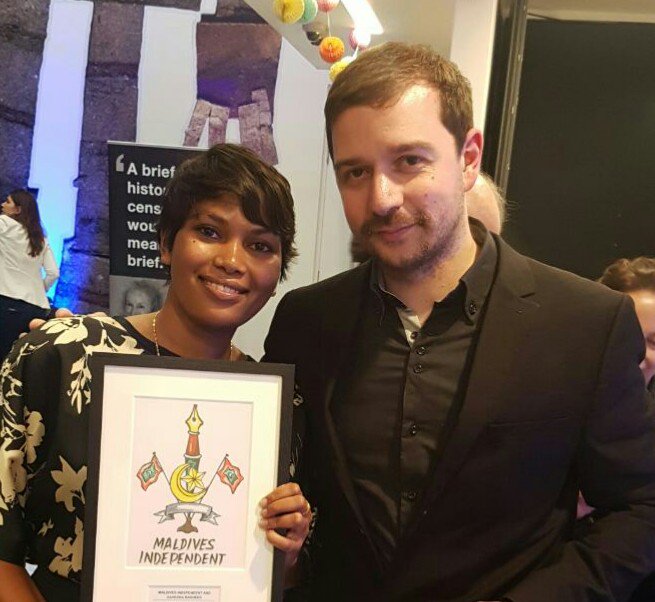
Maldives Independent’s former editor Zaheena Rasheed and KRIK editor-in-chief Stevan Dojcinovic. (Photo: KRIK)
Thousands of miles separate the Maldives from Serbia, but Zaheena Rasheed, the Index award-winning journalist and former editor of Maldives Independent, and Stevan Dojcinovic, editor-in-chief of the Serbian investigative website KRIK, but both described similar attacks on press freedom at a panel discussion at the Corinthia Hotel in London.
Rasheed lives in exile, having been forced to flee the Indian Ocean archipelago after working on an Al Jazeera documentary critical of the Maldivian government. She said she escaped just in time – a man who left a day later “barely made it out of the airport”.
Rasheed spoke of the intimidation tactics that independent news media had been subject to in the country. “Some newsrooms had gangs going inside of the newsroom and saying specifically we are not leaving until certain articles were taken down,” she said.
The Maldivian government claims that these gangs are criminals beyond their control.
As violence does not deter outlets like Maldives Independent from their investigative work, president Abdulla Yameen’s regime resorted to legal means, including imposing a draconian defamation law.
Rasheed said: “The definition of defamation is so broad that I could be sued for something I think, it doesn’t have to even be expressed. It could be a gesture. If it’s a gang or criminals after you, you can hide and avoid it, but when it’s the government you just can’t.”
On Serbia, Dojcinovic said that most in the West do not realise the extent of the country’s problems. “There’s not a real, clear picture of Serbia in the EU regarding how wild corruption and crime are,” he said.
Both journalists have seen hard-won democratic freedoms erode quickly. In Serbia this slide began in 2012 when Aleksandar Vučić was elected prime minister (this month, Vučić was also elected as the country’s president). Dojcinovic said: “The government has managed to destroy and undermine all of the democratic institutions built over 12 years within two years. We no longer have an independent judicial system and it’s the same with the media.”
In the Maldives, 2012 also left its mark. “Since the coup, a lot of democratic gains have been lost. What we saw in the first couple of years after the coup were physical assaults against journalists,” Rasheed said. “There were murder attempts, death threats and one TV station was even torched.”
She said that police turned a blind eye to these attacks. “All of the CCTV cameras were turned away from the building. The police just weren’t there.”
Whilst the threats are different in Serbia, Dojcinovic described a choked media landscape: “It’s not possible to see criticism of the government in the mainstream media. Not on any newsstand or on any TV frequency. They have destroyed all of these institutions.”
Dojcinovic said that the Serbian government is falling into the same patterns as Slobodan Milosevic’s regime: “It’s the arrests of journalists by the same group of people who were behind the murder of journalists back in the 1990s. They can’t cross this line now because it would ruin their reputation with the EU, so they find a way to make your life a nightmare without leaving fingerprints.”
Reprisals for his work have included three smear campaigns: he has been tagged as a criminal for his links to organised crime, branded a foreign agent, and had his personal life put on display.
“You cannot fight this much either because you can only publish on the internet,” Dojcinovic said. “That’s nothing compared to the newspapers which present us in this way.”
In the Maldives, however, there appears to be no such line. Rasheed said: “A member of our team was disappeared in 2014. Then a well-known gangster, who we think was involved in our colleague’s disappearance, vandalised the security cameras [at our office] and left a machete at our door. And then I got a text message saying: ‘You’re next.’”
Rasheed thinks that her colleague Ahmed Rilwan was targeted because he was seen to be in favour of secularism, and negative stories about Islamic radicalisation raise the government’s ire. “What really bothers them are these stories of growing radicalisation in the Maldives because that is what puts tourists off,” she said.
Rasheed also spoke about the difficulties of constantly fighting such repression. She told the audience that she had, to some extent, been traumatised by her experiences. However: “As a journalist, the most important thing to do is to live to tell the story.”[/vc_column_text][/vc_column][/vc_row][vc_row][vc_column][vc_basic_grid post_type=”post” max_items=”4″ element_width=”6″ grid_id=”vc_gid:1492769899588-d49a7ccf-cd47-5″ taxonomies=”8148, 9028, 8734″][/vc_column][/vc_row]
Crime and Corruption Reporting Network (KRIK) is a new independent investigative website which was founded by a team of young Serbian journalists intent on exposing organised crime and extortion in their country which is ranked as having widespread corruption by Transparency International. In their first year they have published several high-impact investigations, including forcing Serbia’s prime minister to admit that senior officials had been behind nocturnal demolitions in a Belgrade neighbourhood and revealing meetings between drug barons, the ministry of police and the minister of foreign affairs. KRIK have repeatedly come under attack online and offline for their work –threatened and allegedly under surveillance by state officials, defamed in the pages of local tabloids, and suffering abuse including numerous death threats on social media.
“KRIK has become a recognised source of discoveries and news on crime and corruption in the country,” KRIK editor Stevan Dojčinović told Index on Censorship.
See the full shortlist for Index on Censorship’s Freedom of Expression Awards 2017 here.[/vc_column_text][/vc_column][/vc_row][vc_row full_width=”stretch_row_content” equal_height=”yes” el_class=”text_white” css=”.vc_custom_1490258749071{background-color: #cb3000 !important;}”][vc_column width=”1/2″][vc_custom_heading text=”Support the Index Fellowship.” font_container=”tag:p|font_size:28|text_align:center” use_theme_fonts=”yes” link=”url:https%3A%2F%2Fwww.indexoncensorship.org%2Fsupport-the-freedom-of-expression-awards%2F|||”][vc_column_text]