13 Feb 2020 | News, Statements
[vc_row][vc_column][vc_single_image image=”105876″ img_size=”large”][/vc_column][/vc_row][vc_row][vc_column][vc_column_text]14 February 2020 – Valentine’s Day – marks my last day at Index on Censorship after nearly six years at the helm. It feels apt, then, to share how passionate I am about – free speech and the organisation that has spent nearly 50 years defending it.
Let’s start with freedom of speech. When I started at Index, I have to confess I was an armchair enthusiast. I believed in freedom of speech, of course I did – or so I thought. After all, I was a journalist. I’d worked in countries like South Africa and Ireland that had experienced – in differing forms – decades of formal censorship and centuries of informal silencing.
But what I came to realise very quickly is that while support for free speech is easy in theory, in practice it is much, much harder.
What I love about Index is we never pretend otherwise. For us, the work we do is not about defending free speech in principle, but demonstrating how and why it is so important in reality. We don’t pretend we have all the answers instantly. In a world that expects immediate responses, the pressure to provide the answer at once is huge. But we have learned that sometimes we need to say: “Hmmm, we need to think about that one.”
We have wrestled with questions that stretched from whether or not social media platforms should show beheading videos to the question of the Northern Irish bakery asked to ice a cake with words with which they disagreed. We debated the point at which hateful speech amounts to incitement to violence. We tried to address the notion of words that cause harm.
Being thoughtful doesn’t always win you headlines but it’s crucial if you want to convince those who doubt your arguments. I love that Index thinks.
I love that Index has courage. We believe passionately that everyone should have the right to speak freely – and that includes defending the rights of those with whom we profoundly disagree – or whom others find shocking, disturbing and offensive. Never in my wildest dreams did I imagine that I would find myself defending the right of a Scottish YouTuber to teach his girlfriend’s dog to do a Nazi salute. Thankfully, we were not alone.
Sadly, those who defend freedom of expression often are. It was something we fought to counter when we spoke out in defence of Charlie Hebdo – and that experience – of sticking our heads above the parapet when many others would not was a formative experience for me as a relatively new Index CEO.
We are not the courageous ones, though. The courageous ones are those who speak out in the knowledge that they could face dire consequences for doing so.
Free speech is the Turkish playwright Meltem Arikan voicing the pain of exile and the delights of creating a new home in a new language. Free speech is artist Luis Manuel Alcantara, inviting repeated arrest for refusing to make government-sanctioned art in Cuba. Free speech is Zimbabwean activist Evan Mawarire calling for a compassionate government that protects its people. Free speech is journalists like Carole Cadwalladr, Caroline Muscat and Maria Ressa defying attempts to silence them. Free speech is Nabeel Rajab exposing torture in Bahrain’s jails – speech for which he himself was jailed. Free speech is a young Saudi woman appealing for asylum and finding her cause taken up by thousands around the world. Free speech is every one of our brilliant Index on Censorship fellows.
It is also speech that hurts. It is speech that is raw, shocking, offensive – that demeans and diminishes others. In my time at Index we have had to defend words and viewpoints that I abhor. In so doing we have been accused of sharing and condoning those views – of allowing them to become mainstream.
Defending that line is hard. But we do so because none of the examples we have seen of government bans or social media restrictions ends up achieving the outcome desired – one in which we are more tolerant of one another’s differences.
We believe there is an alternative to censorship. I am hugely proud that last year I was finally able to get off the ground a project close to my heart: our Free Speech Is For Me programme, which brought together activists in Britain and the United States to debate the value of free speech. Along the way, participants learned how better to listen to one another’s ideas. Some even changed their minds. One Brexit supporter told us they had even started reading The Guardian …
Words matter to us. I love that Index continues to produce a magazine that takes a global and long-term look at the issues we face and which publishes original work by leading writers. Where else could you read interviews with legends like Margaret Atwood or Ngũgĩ wa Thiong’o, writing by the likes of Elif Shafak, Xinran, or Ariel Dorfman?
I love that for an organisation with an impressive back catalogue, we nevertheless look forward. We are grappling with the thorny questions of regulating online speech and tough questions on hate speech and free speech in the workplace. I haven’t always got that right – but we have tried to learn how we can better be the change we want to see in the world.
Index is a small outfit, battling for funds against a million and one other worthy causes. When I started, someone told me we would never be able to compete against those raising money for life-saving healthcare. I don’t want to compete. But I believe more than ever – as we have seen with events recently in China – that life-saving healthcare depends on freedom of speech.
That is why I love this cause. And why I know Index will continue to defend it without fear or favour. And why your heartfelt Valentine vow should be to support it too.
[/vc_column_text][/vc_column][/vc_row]
19 Dec 2019 | Press Releases
[vc_row][vc_column][vc_column_text]
“They like to think of themselves as strongmen but what, in fact, they are doing is channeling the worst kind of machismo,” writes Index on Censorship editor-in-chief Rachael Jolley.
In the winter issue published today Index reports on how macho leaders, from Trump and Johnson to Modi and Bolsonaro, protect their fragile egos by stifling dissent, debate and democracy.
Jolley continues: “They are extremely uncomfortable with public criticism. They would rather hold a Facebook ‘press conference’ where they are not pressed than one where reporters get to push them on details they would rather not address.”
All around the world, these so called “strong men” have stormed the polls and are coming to power. Many are being voted in democratically, but they don’t believe in freedom of speech, and are actively eroding it. “Right now these techniques are coming at us from all around the globe, as if one giant algorithm is showing them the way,” writes Jolley as part of a special report on this global trend.
In this issue news editor Miriam Grace Go of Filipino news publication Rappler writes about how the president of the Philippines, Rodrigo Duterte, tries to show his strength by being as foul-mouthed as possible. If you’re a critical journalist – and especially a woman journalist – as she is, what can you expect?
Indian journalist Somak Goshal reports on how people are being labelled as “Pakistani terrorists” for not showing “patriotism”. And Stefano Pozzebon talks to journalists in Brazil who are right in the firing line of Jair Bolsonaro’s attacks on the media, and who are now hiring security guards.
Mark Frary reviews the tools that autocrats are using to crush dissent and Caroline Lees looks at smears that are used as a tactic to silence journalists and other critics. We also publish a poem from Hong Kong writer Tammy Lai-ming Ho, which addresses the current protests engulfing the city, plus two short stories written exclusively for the magazine by Kaya Genç and Jonathan Tel.
Editor’s Notes: Index on Censorship Magazine
For interviews contact: [email protected]
Since its establishment in 1972, Index on Censorship magazine has published some of the greatest names in literature including Samuel Beckett, Nadine Gordimer, Mario Vargas Llosa, Hilary Mantel and Kurt Vonnegut. It also has published some of the greatest campaigning writers of our age from Vaclav Havel to Amartya Sen and Ariel Dorfman plus journalism from Mexico, Argentina, South Africa, China, India, Turkey and more. Editor Rachael Jolley was named British Society of Editors’ editor of the year in the specialist publication category (2016) and the magazine has received numerous awards including the APEX Award for Excellence and the Hermann Kesten prize.
Digital editions are on sale at exacteditions.com/indexoncensorship
Print copies of the magazine are also on sale at BFI, Serpentine Gallery and MagCulture (London), News from Nowhere (Liverpool), Home (Manchester) and Red Lion Books (Colchester).
Launch Event
Shake off the post New Year blues with drinks, snacks and debate at Index on Censorship’s winter magazine launch. Guest speakers include Xiaolu Guo, Dora Papp, Lindsey Hilsum and Rob Sears. The event will be hosted by Index editor-in-chief Rachael Jolley on Wednesday 15 January at Google’s London HQ. For media invitations please email: [email protected]
[/vc_column_text][/vc_column][/vc_row][vc_row][vc_column][vc_basic_grid post_type=”post” max_items=”3″ grid_id=”vc_gid:1577959618543-e337040c-9d43-2″ taxonomies=”5692″][/vc_column][/vc_row]
21 Oct 2019 | Awards, Campaigns -- Featured, Fellowship, Fellowship 2019, Statements
[vc_row][vc_column][vc_column_text]
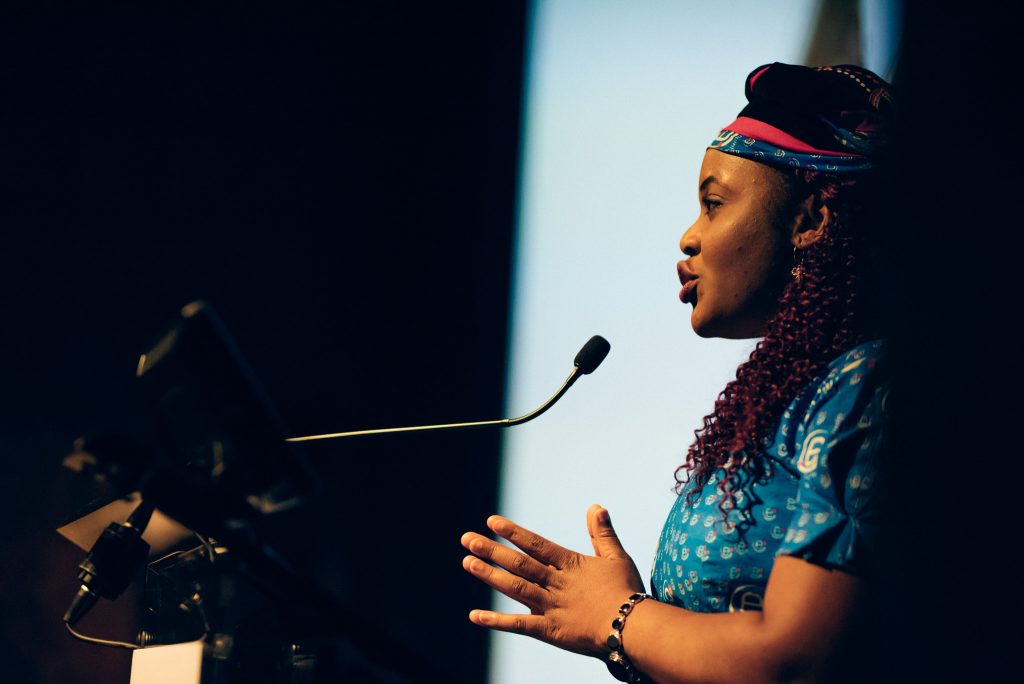
Journalism award-winning journalist Mimi Mefo (Photo: Elina Kansikas for Index on Censorship)
Mimi Mefo, winner of this year’s Index on Censorship Freedom of Expression Award, is due to give a keynote speech at the Integrity 20 conference in Brisbane. The conference, hosted by Griffith University, is an internationally renowned event bringing together the world’s leading thinkers and activists to discuss global issues.
Mefo is due to speak on Friday October 25 on media freedom and the challenges she faces as a journalist in Cameroon.
Her visa was refused because authorities said they “were not satisfied that the applicant’s employment and financial situation provide an incentive to return.”
Mimi – who flew to London in July from Berlin to speak as the guest of the UK government at a major global conference on media freedom – is currently working as a freelance journalist in Germany.
“Australia prides itself on its democratic values, including freedom of expression,” said Index on Censorship chief executive Jodie Ginsberg. “This means it needs to support and champion those being denied the right to speak in their own countries. Denying visas to journalists who have faced oppression and censorship in their own countries simply emboldens the oppressor.”
“It is frankly insulting and belittling to suggest Mimi Mefo would use the opportunity of this keynote to seek asylum in Australia.”
Mefo is due to fly from Australia straight to give the prestigious Carlos Cardoso memorial lecture at the 15th African Investigative Journalism Conference in South Africa on October 28, where Nobel Prize-winning economist Joseph E. Stiglitz will give the keynote.
Contact: Joy Hyvarinen, head of advocacy, [email protected] + 44 (0)20 3848 9820[/vc_column_text][/vc_column][/vc_row][vc_row][vc_column][vc_basic_grid post_type=”post” max_items=”4″ element_width=”6″ grid_id=”vc_gid:1571649254262-2677266b-c9f9-2″ taxonomies=”8935″][/vc_column][/vc_row]
17 Oct 2019 | News, Student Reading Lists
[vc_row][vc_column][vc_column_text]Index on Censorship was established in 1972 in a febrile period: Idi Amin had taken power in Uganda, the Vietnam war continued, direct rule was imposed in Northern Ireland, there was a coup in Bolivia and Congo was renamed Zaire by its dictator president. As writer Robert McCrum said in our 40th anniversary issue: “The abuses of freedom worldwide in the 1970s were so appalling and so widespread that the magazine rapidly found itself in the frontline of campaigns. Index became a clarion voice in the cause of free expression.” The right to protest and freedom of expression are now being sought in Hong Kong and elsewhere, and Index is still to the forefront in reporting abuses. Here are just some of the conflicts between freedom and dictatorship we have reported on in the past 47 years.
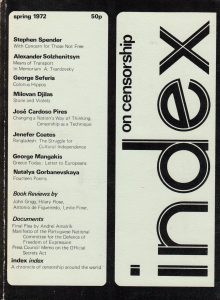
The first issue of Index on Censorship magazine, in March 1972
The Clockwork Show vol 1, issue 1, March 1972
In an anonymous article about life in Greece under the regime of the Colonels’ junta, the writer considered the psychology of the situation; the feelings and attitudes, the long-ranging impact of this harrowing experience. “There is nothing more demoralizing than to be bound to a public body, an administration, a government with which one can never for a moment identify, which is the exact opposite of everything one believes in. One cannot live side by side with Philistinism, chauvinism, bigotry, blatant hypocrisy, crass ignorance, injustice, violence and brutality and not be affected by them, even if one manages—only just—to keep them out of one’s own life. Under this regime there is no relief; no exception: the regime has penetrated every single aspect of public life.”
Read the full article
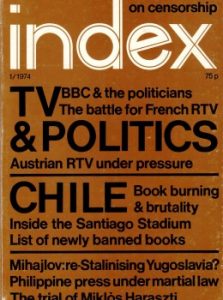
March 1974: TV, politics and Chile Index on Censorship magazine
Book burning and brutality vol 3, issue 1, March 1974
A fascinating insight into life in Chile six months after a coup ended the tyranny of President Salvador Allende: worse was to come under a military dictatorship, reported Michael Sanders, an Englishman in Santiago. “When Allende left Chile to address the UN in December 1972, a leading opposition newspaper had as its front-page a photo depicting the president flushing himself down a lavatory, with the caption ‘ good riddance’. The contrast in December 1973 is gloomy indeed. Not so much, or not only because of the drab uniformity of censored newspapers that, for all they may be censored, willingly reflect the views of the Military Junta. But for the fact that 43.6% of the population have been deprived of all means of expression, of all normal communication, and live in daily fear of their lives and jobs.”
Read the full article

Russia, East Germany, South Africa: May 1979 Index on Censorship magazine
Black journalists under apartheid volume 8, issue 3, May 1979
William A Hachten reports: Black journalists came to the fore in the Soweto riots of 1976 when they reported from the ghetto for a white press without access. Yet black journalists still faced daily harassment under apartheid, which worsened with the death of Steve Biko in 1977. Vusi Radebe, a black stringer for the Rand Daily Mail, said: “The situation is worse since the 1976 riots. Police will beat up reporters on the slightest provocation for what they consider obstruction of justice.” While whites had 23 newspapers, there were none for non-whites to express their political frustration. Black journalist Pearl Luthuli said: “The black journalist can’t be objective. We try to tell it like it is but the white editors won’t print it.” Another said: “We are black people first, journalists second. If it comes to a conflict between the struggle and the job, the struggle comes first.”
Read the full article

Beckett and Havel: Index on Censorship magazine, February 1984
Iran under the party of God, volume 13, issue 1, February 1984
“Censorship was planned by the regime of the Islamic Republic even before the February 1979 revolution brought Ayatollah Khomeini’s theocratic oligarchy to power. This particular kind of censorship may not be without precedent in history, but it must certainly be rare. There were attacks on coffee-houses, restaurants and other public places by men armed with clubs and stones; unveiled women were harassed; slogans of the opposition were cleaned from the walls; banks, cinemas and theatres were burned” – a personal account of the first years of the revolution and its attack on culture, by one of Iran’s leading writers Gholam Hoseyn Sa’edi. “And it keeps on happening. The Islamic regime of today has gone a step beyond censoring the creations of science, culture and art, beyond censoring life itself: it has rendered life vain and all but unliveable.”
Read the full article
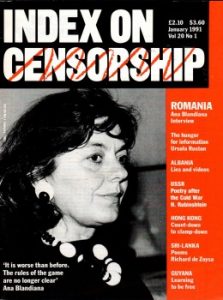
Romania, Albania, USSR: Index on Censorship magazine January 1991
A sense of solidarity, volume 20, issue 1, January 1991
Romania’s celebrated poet, Ana Blandiana, on censorship under Ceausescu and how she fought back. Her work was completely banned three times. “In my case, the form of censorship progressed from the banning of a word to that of a line, then of a poem, then of a book, to the total erasure of my signature as author: an eradication of identity. My inner freedom was assured by a decision I took in 1980, a personal one rather than as a writer. I decided to be outspoken and say what I thought at the risk of becoming a victim myself, rather than suspect a possibly honest person. At first it kept me sane, and then it helped me to be a normal writer, relatively free of self-censorship. This was the strongest form of censorship under Communism in the last 10 or 15 years, and was much more refined and subtle than the official censorship.”
Read the full article
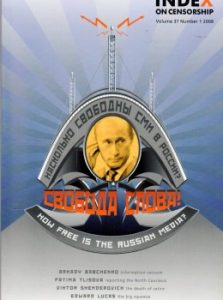
How free is the Russian media? Index on Censorship, Spring 2007
The Big Squeeze, volume 37, issue 1, Spring 2008
“The fact remains that since the departure of the oligarchs, Russian media freedom has gone from the imperfect and beleaguered to the moribund. At national television, which 90 per cent of Russians say is their main source of news, editors receive weekly or even daily instructions from the Kremlin on the ‘line to take’ on important stories; around half of Russian viewers think that what they watch is objective, a 2007 poll said. Foreign coverage is polemical and outrageously politicised. The message of all this is ‘be quiet’. If you annoy the rich and powerful you face threats, beatings or death. Even when the Kremlin is not directly involved, its reaction to the persecution of journalists sends a clear message: if you offend the powerful, don’t expect the law to protect you.” Edward Lucas gave an early taste of what freedom of expression meant under Putin.
Read the full article
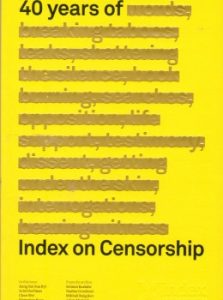
40 years of Index on Censorship March 2012
Grit in the engine, volume 41, issue 1, Spring 2012
Robert McCrum on the 40th anniversary of Index on Censorship. “The success of Index was not a foregone conclusion. Stephen Spender, its founder, was fully alert to the potential for windbaggery and failure. There was, he wrote, ‘the risk that the magazine will become simply a bulletin of frustration’. Actually, the opposite came to pass. Index became a clarion voice in the cause of free expression. The abuses of freedom worldwide in the 1970s were so appalling and so widespread that the magazine rapidly found itself in the frontline of campaigns. Perhaps the most important thing Index did, from the beginning, was to universalise an issue in peril of becoming a special interest: freedom was not ‘a luxury enjoyed by bourgeois individualists’. Along with self-expression, it was a human right, and an instrument of human consciousness.
Read the full article
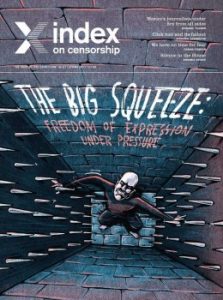
The big squeeze: Index on Censorship magazine Spring 2017
Freedom of expression under pressure, volume 46, issue 1, Spring 2017
The spring 2017 issue of Index on Censorship magazine looks at how pressures on free speech are currently coming from many different angles, not just one. Special features on how to spot fake news, articles from former BBC World Service director Richard Sambrook and former UK attorney general Dominic Grieve, an exclusive interview with the Spanish puppeteer arrested last year, and fiction from award-winning writer Karim Miské.
[/vc_column_text][/vc_column][/vc_row]
