21 Jul 2015
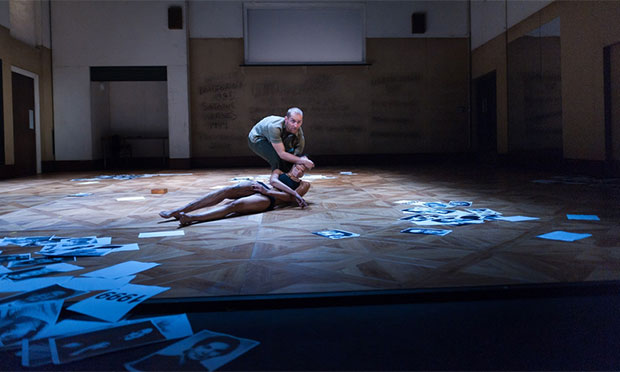
A scene from Can We Talk About This? (Photo: Matt Nettheim for DV8)
By Julia Farrington
July 2015
As part of our work on art, offence and the law, Julia Farrington, associate arts producer, Index on Censorship, interviewed Eva Pepper, DV8’s executive producer about how she prepared for potential hostility that the show Can We Talk About This? might provoke as it went on tour around the world in 2011-12.
Background
Can We Talk About This?, created by DV8’s Artistic Director Lloyd Newson, deals with freedom of speech, censorship and Islam. The production premiered in August 2011 at Sydney Opera House, followed by an international tour of 15 countries — Sweden, Australia, Hong Kong, France, Italy, Austria, Germany, Greece, Slovenia, Hungry, Spain, Norway, Taiwan and Korea and the UK between August 2011 and June 2012 — and was seen by a 60,000 people.
Extract from publicity of the show:
“From the 1989 book burnings of Salman Rushdie’s The Satanic Verses, to the murder of filmmaker Theo Van Gogh and the controversy of the ‘Muhammad cartoons’ in 2005, DV8’s production examined how these events have reflected and influenced multicultural policies, press freedom and artistic censorship. In the follow up to the critically acclaimed To Be Straight With You, this documentary-style dance-theatre production used real-life interviews and archive footage. Contributors include a number of high profile writers, campaigners and politicians.”
Q&A
Farrington: How did you set about working with the police for this tour?
Pepper: We focused on the UK with policing; I didn’t speak to any police forces in other countries at all, just in the UK cities we toured to: West Yorkshire Playhouse in Leeds; Warwick Arts Centre; Brighton Corn Exchange; The Lowry in Manchester and the National Theatre in London. But we did have a risk assessment and risk protocol that we shared with every venue we went to. We let them know the subject matter and the potential risks: security, safety of the audiences, media storms, safety of the people who were working on the show. They dealt either with their in-house security, or, in the UK, they would often alert the police as well.
Farrington: How did your preparations with police vary around the UK?
Pepper: We started with the Metropolitan Police, about six months before and told them our plans and that we would also contact other police forces. The National Theatre had their own contacts with the police who were already on standby. We still kept the MET events unit informed, but they [National Theatre] dealt with the police themselves. They were much more clued up, they had a head of security whom I briefed; we talked quite a lot. I made sure that he was copied in when anything a bit weird came up on the internet.
Our first venue was Leeds and we approached them about six weeks before the UK premiere. There was a bit of nervousness around Leeds, because of the larger Muslim population in the area. But we were only just beginning our liaison with the police and it took a little time to get a response. In the end we approached senior officers, but they often didn’t engage personally, just put us in touch with the appropriate unit to deal with.
Farrington: They didn’t see it as that important?
Pepper: They liked to be alerted that something might happen and they assured us that they were preparing. The venues also had their own police liaison; sometimes there was a bit of conflict if they had their own. I probably ruffled a few feathers when I went to a more senior officer.
Our starting point to the police was a very carefully worded letter which set out who we were. We didn’t ask permission to put it on we just alerted them that we might need police involvement. I did have some calls and a couple of meetings with officers, where they reiterated what is often said, which is that the police’s mandate is to keep the peace. It was made clear that they have as much of a duty to those people who want to protest or potentially might want to protest, as they have to allow us to exercise our freedom of expression. In Leeds nothing happened but there was a certain amount of nervousness around it.
Farrington: Where – at the venue?
Pepper: I think we were probably a bit nervous, and the police took it seriously enough. We had contact numbers to call. They were very much in the loop of the risk assessment.
Farrington: Was there a police presence on the night?
Pepper: I don’t remember seeing anybody. There was security of the venue of course, but regional venues only go so far with security. With some venues we were a little insistent that they get somebody upstairs and downstairs for example.
Farrington: And search bags, that kind of thing?
Pepper: We insisted people check in bags. The risk protocols weren’t invented for Can We Talk About This? They were really invented for To Be Straight With You [DV8’s previous show] and just tightened up for Can We Talk About This?. The risk protocols are just bullet points to get people thinking through scenarios.
Farrington: In general how would you describe your dealings with the police?
Pepper: I think generally supportive but we came to alert them that we might need them – there wasn’t a crisis. They said ‘thanks for letting us know let us deal with it.’ We would have quite liked to go through their risk assessments, but that didn’t happen. I think we were a little bit on their radar. They offered to send round liaison people to discuss practicalities around the office – stuff we hadn’t really thought about. It was a little bit tricky to get their attention.
The things we asked them to look out for were internet activity, if there was something brewing; sounds terribly paranoid. If there were issues around our London office or tour venues like hate mail, suspicious packages and then protests. So protest was just one thing our board was concerned about.
Farrington: Did you do anything else with the venue to prepare them for a possible hostile response from the media or a member of the public?
Pepper: I asked every venue artistic director or chief executive to prepare a statement. Lloyd would have been the main spokesperson for us if anything went wrong, but for a regional venue it is important that you are ready with a response and they all did that.
Farrington: What kind of thing did they say?
Pepper: We have supported this artist for the last 20 years. Lloyd has always been challenging in one way or another. This time he is challenging about this and we are going with him.
Farrington: Did you have any contact with lawyers?
Pepper: We looked carefully at the contents of the show. We had used interviews with real people and we wanted to be sure that nothing said was libellous or factually incorrect. So we had things looked at. The lawyer would say have you thought about that, did you get a release for this, are you using this from the BBC, do you have permission, have you spoken to this person, does he know you are doing it? And sometimes it is yes and sometimes it was a no.
Farrington: They pointed out some bases you hadn’t covered?
Pepper: Maybe one. We were really good and a bit obsessive. Sometimes we thought we didn’t have to ask because the information was in the public domain anyway, based on an interview that has been online for ten years for example. And the lawyer would or wouldn’t agree with that. It was good for peace of mind. That’s the thing with legal advice it doesn’t mean that nobody comes after you, because the law isn’t black and white.
Farrington: Were there some venues that you took the show to that didn’t think it was necessary to make special preparations?
Pepper: We always made them aware and we let them handle it. There are certain things that we always did. We asked them to consider security, and certainly PR. I was quite concerned that it would be a big PR story and then out of the PR story, as we saw with Exhibit B, comes the police. The protests don’t come from nowhere usually, somebody comes and stirs things up.
Farrington: Did you prepare the venue press departments?
Pepper: Yes we did, and we quite consciously had interviews, preview pieces before hand, where Lloyd could give candid interviews about the show. Almost to take the wind out of people’s sails, to put it out in the open so nobody could say they were surprised.
Farrington: How did you prepare with the performers for potential hostility?
Pepper: We talked through the risk procedure with them. We also got some advice from a security specialist, about being more vigilant than usual, noticing things that are out of the ordinary; if somebody picks a fight in the bar after the show, find a way to alert the others. So yes, the security specialist had a meeting with us here in the office, but also came up to Leeds to talk to the performers.
Farrington: Did it create a difficult atmosphere?
Pepper: It did yes, it got a bit edgy. Next time I would not do it around the UK premiere. It took a long time to set all of this up. To find the right people, to get people to take it seriously, to have meetings scheduled.
Farrington: It took time to find the right kind of security specialist?
Pepper: It also took a little while to get straight what we needed. We probably tried to figure it out for ourselves for a long time. And then got somebody in after all, just as maybe we, or the board got a bit more nervous. When you talk about protests you always worry about the general public, but as an employer there are the people who you send on tour who have to defend the show in the bar afterwards, potentially they are the targets.
Farrington: But they were behind the show?
Pepper: Yes, undoubtedly. But it’s an uncomfortable debate. There were so many voices in that show and you didn’t agree with every voice and it was never really said what really is Lloyd’s or DV8’s line. I would say that all the dancers were fine, but sometimes if somebody corners you in a bar it gets squirmy. No one is comfortable with everything.
Farrington: Can you summarise the response to the show?
Pepper: We had everything from 1 to 5 stars. We had people that loved the dance and hated the politics, who loved the politics and hated the dance. Occasionally somebody liked both. Occasionally somebody hated both. The show was discussed in the dance pages, in the theatre pages and in the comments pages. So in terms of the breadth and depth of the discussion we couldn’t have been more thrilled. Then we had dozens of blogs written about the show. For us Twitter really started with Can We Talk About This? and it was a great instrument for us. Social media was largely positive, though some people were picking a fight on Facebook at some point. It was very, very broad and very widely discussed.
Farrington: And did you interact with Twitter or did you let it roll?
Pepper: Mostly we let it roll. As part of the risk strategy we had a prepared statement from Lloyd which was very similar to the forward in the programme and anybody who had any beef would be redirected to the statement.
Farrington: Did the venues take this performance as an opportunity to have post show discussion and debate?
Pepper: Lloyd prefers preshow talks because he doesn’t like people to tell him what they thought of the shows. Quite often there is a quick Q&A before. In UK, we had one in Brighton [organised by Index] and one at the National. We had fantastic ones in Norway after the Breivik killings. In Norway they weren’t sure it was relevant and then the killings happened and then I got the call to say now we need to talk about it.
But having pre-show talks is certainly how we decided to deal with it. There is a conflict with having a white middle-aged atheist put on a show about Islam. But the majority of voices in the show were Muslim voices of all shades of opinion. It wasn’t fiction. It was based on his research and based on people’s stories – writers, intellectuals, journalists, politicians and who had a personal story to tell
Farrington: How did you prepare work with the board regarding potential controversies?
Pepper: Really the work with the board started with the previous show To Be Straight With You that already dealt with homosexuality and religion and culture; how different communities and religious groups make the life of gay people quite unbearable, internationally and in this country. And even then, we started to say, ‘can we say this? are we allowed to criticise these people like this?’ and out of that grew the ‘yes, I do want to talk about this’ because if we don’t a chill develops. Can We Talk About This? was a history about people who had spoken out about aspects of Islam that they were uncomfortable with or against and what happened to them.
Farrington: What kind of board do you need if you are going to be an organisation that explores taboos like this?
Pepper: We have got a fantastic board; it is incredibly responsible and so is Lloyd. There is a very strong element of trust in Lloyd’s work. They wouldn’t be on the board if they didn’t support him. But, as employers, they are aware of their responsibilities to everyone who works for us. As a company we have to be prepared in the eventuality that there is a PR or security disaster. What we were really trying to do was avoid that eventuality. We will never know. Maybe nothing bad would have happened. I think that Lloyd now wishes more people had seen it, that a film had been made, that it was more accessible to study by those who want to. He thinks that maybe we were a bit too careful. But as an organisation, as DV8, as an employer I think that we did the right thing by looking after people.
Farrington: What advice could you give to prepare the ground for doing work that you know will divide opinion and you know could provoke hostility?
Pepper:
E: If you can anticipate this you already have an advantage, but it’s not always possible to second-guess who might find what offensive. But if you know, I would suggest you ask yourself what buttons you are likely to push; you have to be confident why you are pushing them – usually in order to make an important point. It’s a good idea to articulate this reasoning very well in your head and on paper. Then you have got to be brave and get on with your project. Strong partners are invaluable, so try to get support. But in the end it is about standing up and being able to defend what you do.
Farrington: So you think you could have gone a bit further?
Pepper: I think if you prepare well you could go a bit further. I don’t think there is a law in this country that would stop you from being more offensive than we were. Every artist has to decide for themselves what they want to say and why they are saying it, and if they can justify it they can go for it.
Swamp of the Assassins: The black cloud
16 Feb 2015
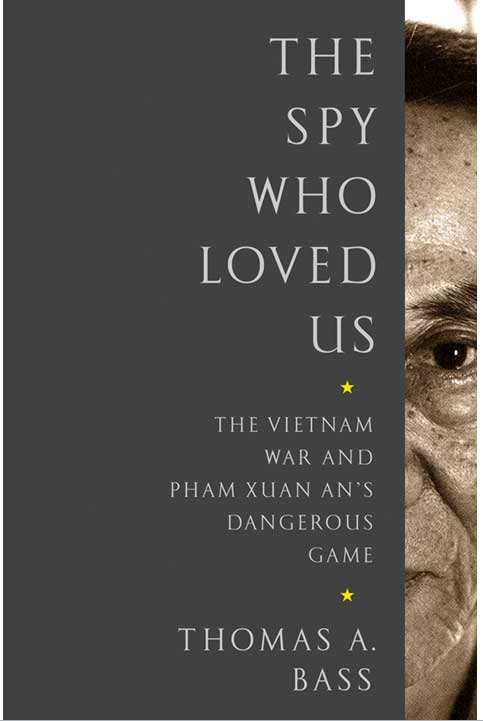
By Thomas A. Bass
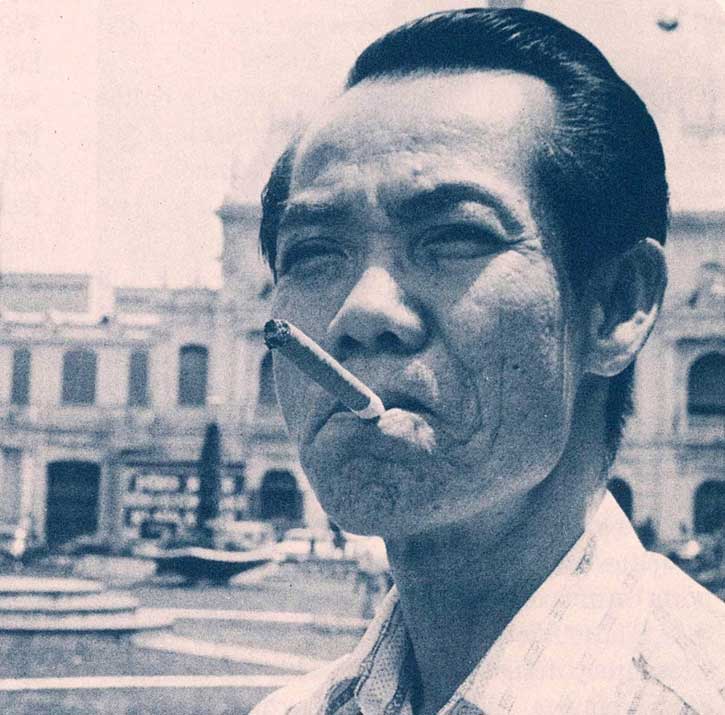
Today Index on Censorship continues publishing Swamp of the Assassins by American academic and journalist Thomas Bass, who takes a detailed look at the Kafkaesque experience of publishing his biography of Pham Xuan An in Vietnam.
The first installment was published on Feb 2 and can be read here.
I meet Bao Ninh again in 2014, when I am visiting Hanoi after the publication of The Spy Who Loved Us. I arrive at his house at seven in the evening, again with a translator and an assistant who wish to remain anonymous. Also with me are my twin sons, who will be celebrating their twenty-first birthdays in Hanoi. The evening heat is wrapped around us like a clay pot baking in Hanoi’s summer oven, Ninh uncorks a bottle of Chilean red wine and welcomes us into a living room that looks cheerier than the last time I was here, with the neon tubes on the wall not quite so pallid and a new sofa angled next to his chair, which is placed looking out toward the front door.
Ninh’s wife, Thanh, has skipped her exercise class to come home and cook dinner for us. A secondary school teacher with a wary smile, she has fried up a few dozen egg rolls, which are laid out on the coffee table along with bowls of hot sauce and nuoc mam fish sauce. I have brought soft drinks, pastries, and beer. Ninh urges us to begin eating, and my sons tuck into the meal. Our host sticks to drinking wine while Thanh flutters in and out of the kitchen. We chat about Ninh’s son, who now works in Saigon for Vina Capital, an investment company.
“It’s a different world from the one I know,” he says. He himself has retired from writing for Bao Van Nghe Tre, the literary journal for which he used to pen a weekly column. Now he works for himself, rising at midnight to write through the night, and then shredding his work at dawn, or so he says. Even relaxed over a glass of wine, Ninh is reticent about discussing his work.
When I broach the subject of his two unpublished novels, Ninh tells me that I have the wrong titles for his books and that he never wrote one of them anyway, except for a short piece that was published somewhere (he can’t remember where). Ninh has a way of shaking his head from side to side and grinning under his moustache when he disagrees with you or wants to avoid talking about something. So forget about discussing censorship, internal exile, or other sensitive subjects. He is not going to retell his story about how a thousand South Vietnamese POWs were brought North to impregnate a thousand widows in Ho Chi Minh’s natal village—even if this tale summarizes in one allegorical masterstroke the history of postwar Vietnam.
Ninh complains about the heat, and then he starts complaining about the Chinese, which is currently the number one topic in Vietnam. On April 30th—Vietnam’s national holiday for marking the unification of north and south Vietnam, the day you pick if you want to kick your enemy in the nuts and then spit in his eye—China moved a billion-dollar oil rig into Vietnam’s offshore waters and started drilling for oil. China surrounded the rig with an armada of ships and chased off any Vietnamese boats that dared to approach. The Chinese rammed Vietnamese coast guard vessels. They sank fishing boats. They fired water cannons that looked like medieval dragons spouting blue flames. As silly as these dragon boats may have looked, they proved quite effective at destroying electrical gear on the Vietnamese boats that were forced to flee.
Following this Chinese aggression, thirty thousand Vietnamese rose up in protest and started sacking Chinese textile factories around Saigon. Mobs burned at least fifteen companies and damaged another five hundred before police got the area locked down. Speculation abounds about the cause of these riots. They were orchestrated by government agents or by anti-government agents or by criminal gangs or by the Chinese themselves, since the looted factories turned out to be owned by Taiwanese and Koreans.
“We are experts on China,” says Ninh. “We just don’t talk about it. They are always smiling, but their smile is dangerous. They will be the nightmare of the world. By 2030, China will be far stronger than the United States. Our civilization will be threatened. I’m pessimistic. I see no light at the end of the tunnel,” he says, using a phrase employed by Richard Nixon during the Vietnam war. “I see only darkness,” Ninh says. “The younger generation should prepare. I feel a black cloud coming. Danger is approaching.”
Now that the red wine is gone, Ninh fills his glass with white and urges us to eat more egg rolls. Our host has a thatch of salt and pepper hair, now more salt than pepper, and a Fu Manchu moustache that gives his face the look of a window shuttered behind Venetian blinds. Wearing dark slacks and a white, short-sleeved shirt, he has kicked off his sandals and is cooling his feet on the linoleum as he settles back in his chair to ponder the dark cloud floating over Vietnam. It is quiet out on the street, save for the occasional motorbike rolling down the lane, but Ninh tells us how, during the day, he hears a constant din from the loudspeaker attached to a pole outside his door. The Party directives and propaganda become increasingly strident around holidays, the worst being April 30th, which commemorates the day in 1975 that Bao Ninh and his fellow soldiers captured Saigon.
“They talk about the old victories over and over again,” he says. “Even as a soldier I don’t like it. It’s like telling a beautiful girl she’s beautiful. She already knows she’s beautiful; so all you’re doing is annoying her. Next year, which marks the 40th anniversary of the end of the war, it’s going to be really annoying,” he says.
I have given Ninh a copy of my newly-published book. He keeps fingering it, flipping through the pages, stopping now and then to study a passage. “I don’t like intelligence agents and the police,” he says. “Maybe I’ll like them better after I read this.”
Ninh pours himself another glass of wine. “I never met Pham Xuan An,” he says. “He was a big general. I was just a soldier. Now that the government has made him a hero, they’ve started telling young people to act like him, which is really stupid. It’s like telling American teenagers they should grow up to be like Lyndon Johnson.”
Ninh stops to read the opening paragraph. “This is how you can tell if a translation is worth reading,” he says. “It looks pretty good.” Later he will send me an email praising the book and telling me how much he enjoyed reading it, even with the missing passages.
Ninh’s face is animated by the thick eyebrows that sweep over his black eyes. He windmills his hands through the air and slaps the back of his head. Then he pushes his hands in front of him like a surf swimmer heading for deep water. “The more we understand the Chinese the more we fear them,” he says. “Hitler was able to come to power because he was helped by Britain and France. They took care of him. The same is true with the United States and China. The Americans built up China’s industrial capacity. You moved your factories to China. You made the Chinese strong by doing business with them, but this strategy is going to fail in the end, just like it failed with Hitler.”
I nudge the conversation back to writing. “We have to follow the Communist Party line,” he says about censorship in Vietnam. “Every writer knows this. You’re hired for a reason; so don’t talk back. If you don’t accept the censorship system, then don’t be a writer.”
“They want to make Pham Xuan An into a political commissar,” he says. “This is why they censored your book. A good intelligence agent is like a priest. He keeps his secrets to himself.” The secrets of Pham Xuan An could be revealed only after the war and only selectively, after having been shaped into a heroic tale.
“For Vietnamese readers, a book without any cuts is a surprise,” says Ninh. “People will know where your book was cut. I prefer to read the printed version, but young people will go online to learn what you really wrote. This is becoming second nature for us, and soon we won’t have any printed books at all.”
He tells me he is writing a new novel, but he won’t say what it’s about. “We have to work quietly and not talk about it to anyone,” he says. “My time is over. I just write. I don’t publish.”
I ask him what Vietnamese writers I should be reading. “There is no generation of young writers,” he says. “There are just some individuals, one or two that I read.”
Next we talk about the movie that was being made of his novel. Film rights to The Sorrow of War were sold to a young American producer, Nicholas Simon, who also wrote the screenplay, but the project unraveled a few days before filming was to start. “We didn’t understand each other,” says Ninh. “We’re both stubborn people. He was young. He knew nothing about Vietnam. The script was so far from reality that it was ludicrous. I kept editing it, but it never got better. I yelled at him in Vietnamese. He yelled at me in English. The translator cried. Finally, the main investor, who was a friend of mine, fled after seeing our inability to get along. A movie has to be easy. My book is too hard to make into a movie.”
Before saying goodnight, Bao Ninh offers his final word on the subject of censorship. “Some guy who grew up as a peasant has the right to mess with your work? No one has the right to censor a book. When politics enters the room, ethics flies out the door. Other countries have laws protecting writers. In Vietnam, we have nothing. There are no rules to follow. The politicians make the rules.”
Part 12: The struggle
This eleventh installment of the serialisation of Swamp of the Assassins by Thomas A. Bass was posted on February 16, 2015 at indexoncensorship.org
China: Chen Xiwo banned book published in English
6 Oct 2014 | China, News
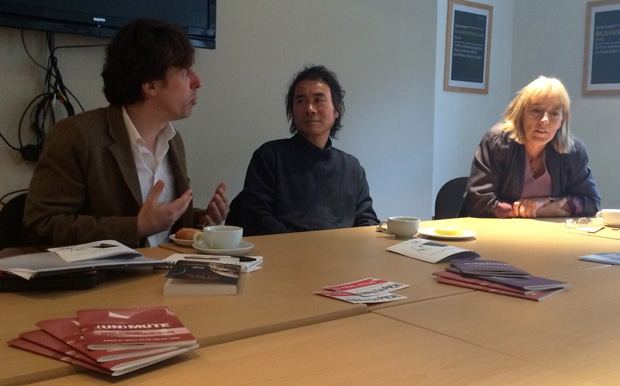
From left to right: Harvey Tomlinson from MakeDo Publishing, Chen Xiwo and translator, Nicky Harman at English PEN. (Photo: Aimée Hamilton)
Chen Xiwo, described as “one of China’s most outspoken voices on freedom of expression for writers” by Asia Sentinel, has spoken about how he challenged the Chinese government’s decision to censor his latest book ahead of its launch in English.
The Book of Sins is a collection of seven novellas exploring controversial topics including rape, incest and S&M and examine the links between sexual and political deviance.
A heavily censored version of the book was published in China, in which parts of the text, including an entire novella, were removed.
Xiwo launched a case to sue China’s customs agency in an attempt to find out why his book, which was published in full in Taiwan, had been confiscated when it arrived in China in 2007. He was originally told that it was its dark and pornographic nature that had led to it being banned in its complete form.
In an unprecedented move, Xiwo took the customs office to court. He said in the history of the People’s Republic of China, since 1949, there has never been a case of a writer suing for not being allowed to publish a book.
Originally when the court hearings got underway the domestic news outlets were able to report on the progress until the propaganda ministry sent out an order forbidding further coverage.
During a meeting today run by English PEN at the Free Word Centre in London, Xiwo said: “These days these kind of orders are usually just made by phone call, so they won’t send an email where there’ll be a record, they do it by phone.
“This makes it even harder to get to the bottom of who’s banning what and why they’re doing it, because there’s no record.”
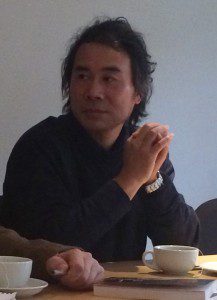
Chen Xiwo (Photo: Aimée Hamilton)
Eventually the court ruled that Xiwo’s case was a matter of national security, which ended further questions on the topic. In a blog entry for Free Word, Xiwo writes: “The Book of Sins had been impounded because it was deemed a threat to ‘national security’. In fact, they completely dropped the charge of obscenity. That meant they did not have to divulge any further information, or even say who had made the final decision.”
Xiwo’s book has now been translated into English by prolific translator Nicky Harman, who said: “Chen is a highly moral writer in my view. The sex and the small amount of violence, it’s never gratuitous. He really focuses on feelings, he has a good attitude towards women, he’s not misogynistic.”
One of the most provocative stories within the book, I Love My Mum, is about a disabled man who strikes up an incestuous relationship with his mother which ultimately ends in him murdering her. The novella is metaphorical of Chinese society and remains banned in the country.
When asked if he would challenge the banning of his books again, Xiwo said that it is inevitable future books of his will be banned, but he cannot launch a case for every one of them.
Although Chen Xiwo has written 10 books, he says only six or seven of these have been published in their complete form. The Book of Sins has won an English PEN award. Chen Xiwo will be launching the English translation of the book at Waterstones Piccadilly, tomorrow 7 October, at 7pm.
This article was posted on 6 October 2014 at indexoncensorship.org
China marks Mandela’s death with no mention of “freedom” or “democracy”
19 Dec 2013 | China, News, South Africa
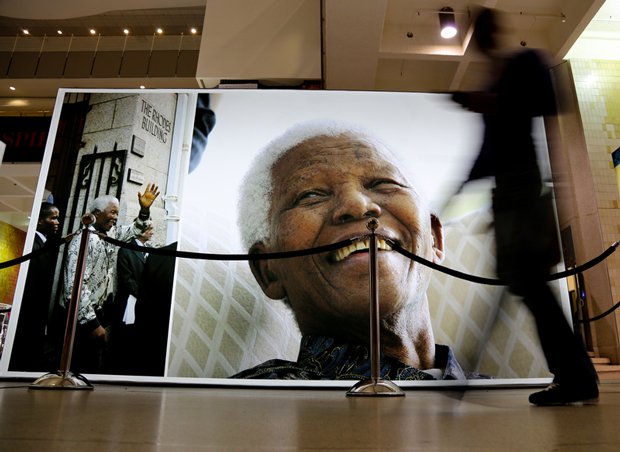
The City of Cape Town launched the Nelson Mandela Legacy Exhibition to honour his contribution to South Africa’s democracy. The exhibiton is a collection of historic photographs and visuals capturing significant moments in Mandela’s life. (Photo: Sumaya Hisham / Demotix)
Chinese coverage of Nelson Mandela’s death has reflected the government’s new-found sympathy for Maoism, its rejection of democracy and its long-standing sensitivities over Tibet and Taiwan.
When Nelson Mandela died, the official statement from President Xi Jinping praised Mandela as “an accomplished politician of global standing,” while state-owned China Central Television described him as “an old friend of China”.
This was to be a precursor for the following day’s censorship — which banned coverage referencing “freedom”,“democracy”, Mandela’s Nobel Peace Prize and foreign policy hot topics Tibet and Taiwan.
While President Xi Jinping did not attend Mandela’s funeral himself, his Vice President Li Yunchao did, and was booed by crowds as he made his memorial speech.
Xi commented on Mandela’s bright smile, called him a “towering figure” and “an old friend of China”. There was no mention of “freedom” or “democracy”.
In an op-ed for CNN, deputy director of Asia division for Human Rights Watch Phelim Kene argued that the deliberate omissions in official statements, as well as the selective censorship policy, was a ploy to distract attention away from China’s own Nobel Peace Prize-winning freedom and democracy activist, Liu Xiaobo.
In 2009, democracy activist Liu was charged with inciting subversion and sentenced to 11 years in prison. His name has since been banned from Chinese micro-blogging sites, although the state-owned Chinese newspaper Global Times broke the ban recently to issue a seething counter-West editorial, accusing American editors of falsely painting Liu as “China’s Mandela”.
According to The Global Times, outlets like The Washington Post, New York Times and CNN had deliberately focused on the imprisonment of Liu in an attempt to foster unrest.
An op-ed argued that “Mandela was awarded the Nobel Peace Prize for leading African people to anti-apartheid victory through struggle, tolerance and efforts to bridge differences,” while Liu had “confronted authorities” and “was dealt with under strict legal procedures. This system ensures that a society of 1.3 billion people runs smoothly.” The piece also argued that “mainstream Chinese society” had rejected Liu’s campaign for democracy.
Yet the circumstances of two men’s imprisonment remain remarkably similar. Mandela was charged and sentenced after he helped produce South Africa’s pro-democracy “Freedom Charter”. Liu, similarly, is one of the activists who drafted “Charter ‘08”, a manifesto for Chinese democracy. Families of both men were persecuted by the state and censorship departments in both countries attempted to remove all mention of the dissenters from the media (including previously written works).
Promotion of Mao’s legacy seems to be Xi Jinping’s communications strategy of choice — and it appears Mandela’s death has been co-opted into this “Maoisation” of Chinese politics. State press releases asserted that Mandela had read Mao’s “Little Red Book” while imprisoned on Robben Island, as well as describing himself as a “student of Mao”.
Mandela was certainly a fan of Mao, though principally for his military strategies rather than his later domestic policies. In a TIME Magazine interview, he praised the tactics used during the “Long March”, as well as his “determination and non-traditional thinking,” which Mandela briefly noted in his autobiography Long Walk to Freedom.
Overall, the Chinese press complied with censorship restrictions to censor the words “freedom” and “democracy” from accounts of Mandela’s life and death, as well as steering clear of Tibet and Taiwan, both contentious foreign policy issues that Mandela had previously weighed in on. Under his presidency, South Africa cut off ties with Taiwan over its previous support for Apartheid, and in favour of Communist mainland China.
Mandela had also met with the Dalai Lama on several occasions, who issued a video tribute to Mandela. The Tibetan leader has been refused a visa to visit South Africa twice in the last four years, regarded by many as an attempt not to risk diplomatic relations with China.
A dictat from China’s Foreign Ministry also attempted to censor “posts and comments on Weibo that take advantage of Mandela’s funeral to attack our political system and state leaders”, ordering offending content to be deleted immediately.
Property tycoon Ren Zhiqiang commented on Weibo: “Because he was a fighter — for all his life— for democracy, equality and peace and harmony, he is now an icon of all these.” Another user, from Shanxi, wrote “A great leader, rest in peace.”
Some Weibo users employed sarcasm to express their views. In response to philanthropist Fan Wei asking “Will China have its own Mandela?” one user replied, “Heroes only appear in turbulent times. In our ‘harmonious’ homeland, there is no use for Mandelas.” Another simply said, “They are in prison.”
“Old friend?” another user mocked. “He pursued justice, fairness and freedom. Does he have anything to do with you? Don’t blow your own trumpet.”
Notably, the so-called “New Left” Maoists reacted hotly to the government’s comparisons, with Weibo messages strongly in favour of Mao Zedong over Mandela.
“India’s Gandhi and South Africa’s Mandela were great. But Chairman Mao surpassed them all,” said one.
Another commented, “Mandela had bowed to racism. His consideration of the Tibetan independence movement as a human rights movement was a big, big mistake. He is a banana with dark skin.”
The death of Mandela has also resurrected an unlikely pop song from the 1990s. The Hong Kong-based band Beyond surged back into the charts with their song “Glorious Days”, reaching number one after almost a decade of hiatus.
“Glorious Days” had already achieved chart success in the post-Tiananmen era, when many were afraid to discuss political issues. Released in the midst of a music scene that mainly comprised of love songs, the Cantonese pop band achieved record sales with a song about racial equality, which was dedicated to Nelson Mandela.
This article was published on 19 Dec, 2013 at indexoncensorship.org