3 Mar 2022 | News
In the very first edition of Index on Censorship, published 50 years ago almost to the day, we raised the case of Mykhaylo Osadchy, a Ukrainian journalist and poet, who had been arrested for “anti-Soviet agitation and propaganda”. In a secret trial in his hometown of Lviv in September 1972 he was sentenced to seven years in prison and five years of exile.
An extract from The Mote, Osadchy’s lightly fictionalised memoir of a dissident writer, was published in the Autumn 1972 edition of Index. It provides a unique picture of the life of an intellectual in Ukraine under Soviet rule. “I had committed every vile deed that mankind throughout his existence could ever commit,” he writes. “I had never had the slightest suspicion of what a hostile element I was, or how hostile my thoughts had been.”
Cat and Mouse in the Ukraine by Victor Swoboda from 1973 is a lengthy but fascinating study of contemporary writers struggling, and often failing, to stay on the right side of the censor. Swoboda highlights the significance of the unpublished poem To the Kurdish Brother by Vasyl Symonenko, a writer celebrated by the Soviets as a hero of Communism but taken up by dissidents after the posthumous samizdat publication of his critical diaries. The poem tells “the Kurd” to fight chauvinists who “have come to rob you of your name and language”. It continues: “our fiercest enemy, chauvinism, fattens on the blood of harassed peoples”. It is not hard to see who the “Kurd” in the poem was intended to represent. In 1968 Mykola Kots, an agricultural college lecturer, was arrested for circulating 70 copies of the poem in which “the Kurd” had been replaced with “the Ukrainian”. He received the same sentence as Osaschy.
After the fall of the Berlin Wall, Index continued to support writers from Ukraine. As a result, we were the first to publish the work of Ukraine’s most celebrated contemporary writer, Andrei Kurkov, in English. The November 1993 issue contained an excerpt from The Cosmopolitan Anthem, a short story denounced at the 1991 All-Union Writers Conference in Yalta as “anti-Russian”. The story is, if anything, an attack on unthinking nationalism. Its narrator, an American with mixed Polish-Palestinian heritage, finds himself fighting on both sides of the Vietnam War and Afghanistan. The title of the story refers to the soldier’s utopian dreams of creating a unifying anthem to appeal to people’s better nature.
In 1999 we published extracts from Ukraine’s Forbidden Histories, which combined oral histories collected by the British Library with contemporary photographs by Tim Smith. It remains a striking document of the imprint Ukraine’s past atrocities left on the country. The authors pay tribute to the work of the organisation Memorial (now banned by Putin) in documenting the crimes of the Stalin era. The extracts include testimonies of the Babi Yar massacre of the city’s Jewish population, which has only been officially recognised in 1991. A monument to Babi Yar was reported to have been bombed during the recent invasion.
In 2001, Vera Rich, who devoted her life to translating Ukrainian and Belarusian literature, wrote Who is Ukraine? on the tenth anniversary of the country’s independence. Despite her obvious passion for the country (she translated the national poet Taras Shevchenko) it provides a clear-eyed look at the complicated nature of Ukrainian identity. “For a country to survive… a sense of national identity is required. But the question of what that identity should be has by no means been resolved,” she writes.
Finally, no collection of archive articles from Index on Ukraine would be complete without something from Andrei Aliaksandrau, who worked for Index for several years before returning to his native Belarus. He has now been in prison for over a year after being arrested by the Lukashenka regime. His piece, Brave New War from December 2014, reports on the information war being waged in Ukraine. It is a brilliant piece of reporting. “The principles of an information war remain unchanged: you need to de-humanise the enemy. You inspire yourself, your troops and your supporters with a general appeal which says: ‘We are fighting for the right cause – that is why we have the right to kill someone who is evil.’ What has changed is the scale of propaganda and the number of different platforms used to distribute it. In a time of social networks and with the whole world online, there is no need to throw leaflets over enemy lines, instead you hire 1,000 internet trolls.”
Aliaksandrau has been silenced, for now. But we will continue to report on Ukraine in tribute to him and the other courageous dissidents who have inspired the work of Index over the past five decades.
Research by Guilherme Osinski and Sophia Rigby
2 Mar 2022 | News, Russia, Ukraine
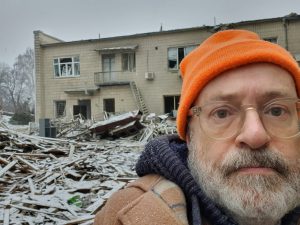
John Sweeney reporting from Ukraine for Index
Rost used to be a hot air balloon pilot before the war but now he’s a grim figure in dark hoodie, carrying a rifle, his face knotted with pressure because he is guarding Kyiv’s TV tower from Russian attack. But there is only so much that the Ukrainians can do and the previous night, Tuesday 2 March, at 1800 hours four Russian missiles punched through, hitting the tower’s control building by its base and knocking Ukrainian TV off the airwaves. The moment curfew lifted at 0800 hours Wednesday morning, I thumbed a lift to the TV tower and was the first reporter inside the complex. The more Rost showed me, the darker it got.
The tower itself disappeared into the early morning fog, not obviously touched but the control building near-by had taken a direct hit. Windows were smashed to smithereens, frames hanging loose, rubble crunching underfoot. Rost explained what had happened in Russian, a language I studied at school and then forgot. I filmed what he said and put it up on Twitter and someone translated: “The rockets flew in….they were laser-guided, they have good equipment, they came towards the building, four rockets came this way, naturally the people died here because of the explosions and I’m showing the gentleman from Britain, losses are serious, the building is ruined.”
He took me round the front of the control building and he stooped to give me a present, an evil butterfly wing of shrapnel, fired from Russia without love. On the ground was a puddle of blood one metre wide, still brightly red in the cold, snow still on the ground. A worker had been killed in the blast, his corpse removed but no-one had yet got around to washing away the blood.
That was the easy bit. We went out of a guardhouse and across a wide street, stepping over electricity cables that had fallen onto the tarmac, to the far side where there was a row of shops, some burnt out, still smoking from the attack the previous evening. On the ground was the corpse of an elderly man and, closer to the shops, the bodies of a mother and child. Ambulance workers or perhaps people from the morgue had come and were placing blankets over the dead before putting them in a dark green van for their last long journey through Kyiv.
The Russian state is saying that it is not killing civilians. That is a lie. I saw evidence of that with my own eyes this morning.
Censorship has many forms but knocking a TV station off air by firing missiles at the transmitting tower is perhaps as subtle as Vladimir Putin gets these days. Less brutal but perhaps more effective in shoring up his grip in power is switching off the last two independent media stations in Moscow, Ekho Moskvy and TV Rain. The last brave reporters with some licence to hit the airwaves have been silenced.
Moscow is fast becoming the new Pyongyang, one of the airports still open to Russian air traffic. Putin’s war is a thing of evil but it’s possible to see that he had made a miscalculation, that he has hopelessly misread the courage of ordinary, extraordinary Ukrainians from their comic turned President down to the florists now making Molotov cocktails, that the West – for once – has got its act together, that the old man in the White House has far more fight in him than the Kremlin could possibly have imagined.
So switching off sources of information, rough and ready though they may be, will become crucial as things get darker for Putin’s regime. Here in Kyiv, that is not an academic question. If the Russians do arrive here in force, then any Ukrainian journalist with a strong voice will be in trouble. Foreign journalists with big media houses at their back – CNN, ABC, Reuters – will have some protection. As a freelance, for the moment, I have my orange beanie hat. Still, telling truth to the Kremlin is a necessity in the twenty first century and it’s only just become fashionable.
The truth is that Vladimir Putin’s military machine is killing civilians in a country at peace until he invaded it. And however much the censor’s pen and switch and missiles command silence, the truth must be told.
21 Jan 2022 | Afghanistan, China, Kazakhstan, Opinion, Russia, Ruth's blog, United Kingdom, United States
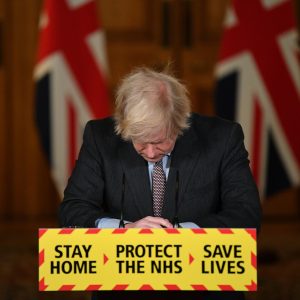
UK Prime Minister Boris Johnson looks down at the podium during a media briefing in Downing Street. Photo: Justin Tallis/PA Wire/PA Images
It should surprise no-one that I am a political geek. I love politics. I love the cut and thrust of debate. I love the moments of high drama and the intrigue. Most of all I love the fact that genuine good can be done. That people’s lives can be made just a little easier by the power of our collective democracy.
So you’d assume that I would have relished the events of the UK Parliament this week. And I’d be lying if I didn’t admit to being completely obsessed with the minutiae of the debate around Partygate and the drama of the precarious position of the Rt Hon Boris Johnson MP as he seeks to survive the biggest political crisis of his premiership.
But I’m also angry. The British Government has been distracted for weeks, caught in a political crisis of their own making about whether or not the Prime Minister knowingly broke his own Covid-19 regulations. While the political establishment awaits a report from a senior civil servant to clarify what was, or wasn’t, happening behind the doors of Number 10, important issues are being sidelined or ignored and people are suffering.
This week the British Parliament held vital debates on the genocide of the Uighurs and the use of the British legal system to silence activists and journalists. Both debates passed broadly without comment or wider notice.
The Russian Federation is threatening the sovereign status of a democratic ally, Ukraine, on an hourly basis.
Biden has marked his first year in office.
52,581 people have died of Covid.
Protestors in Kazakhstan are being threatened with death if they continue to protest against the government, with 10,000 already arrested and 225 killed by the authorities.
23 million people in Afghanistan are experiencing extreme hunger as the Taliban starts attacking women activists.
These are some of the heartbreaking and terrifying realities which are happening around the world. These are the issues that should have dominated our news agenda this week, along with a cost of living crisis, a plan to deliver net zero and attacks on free expression around the world.
Index will continue to fight for these issues to be heard. For the voices of the persecuted to be recognised. While some of our leaders focus on domestic intrigue we’ll keep fighting for those that don’t have a voice.
6 Aug 2021 | Afghanistan, Belarus, Burma, China, Hong Kong, India, Opinion, Ruth's blog
[vc_row][vc_column][vc_single_image image=”117177″ img_size=”full” add_caption=”yes”][vc_column_text]There are moments as you’re watching the news when it feels as if the world is becoming an increasingly horrible place, that totalitarianism is winning, and that violence is the acceptable norm. It’s all too easy to feel impotent as the horror becomes normalised and we move on from one devastating news cycle to the next.
This week alone, in the midst of the joy and heartbreak of the Olympics, we have seen the attempted forced removal of the Belarusian sprinter Krystina Timanovskaya from Tokyo by Lukashenko’s regime. Behind the headlines, the impact on her family has been obvious – her husband has fled to Ukraine and will seek asylum with Krystina in Poland and there have been reports that even her grandparents have been visited by KGB agents in Belarus.
This served as a stark reminder, if we needed one, that Lukashenko is an authoritarian dictator who will stop at nothing to retain power. And this is happening today – in Europe. Our own former member of staff Andrei Aliaksandrau and his partner Irina have been detained for 206 days; Andrei faces up to 15 years in prison for treason; his alleged “crime” – to pay the fines of the protestors.
In Afghanistan, reports of Taliban incursions are now a regular feature of every news bulletin, with former translators who supported NATO troops being murdered as soon as they are found and media freedom in Taliban-controlled areas now non-existent. Six journalists have been killed this year, targeted by extremists, and reporters are being forced into hiding to survive. As the Voice of America reported last month: “The day the Taliban entered Balkh district, 20 km west of Mazar e Sharif, the capital of Balkh province last month, local radio station Nawbahar shuttered its doors and most of its journalists went into hiding. Within days the station started broadcasting again, but the programming was different. Rather than the regular line-up, Nawbahar was playing Islamist anthems and shows produced by the Taliban.”
Last Sunday, Myanmar’s military leader, Gen Min Aung Hlaing, declared himself Prime Minister and denounced Aung San Suu Kyi as she faces charges of sedition. Since the military coup in February over 930 have been killed by the regime including 75 children and there seems to be no end in sight as the military continue to clamp down on any democratic activity and journalists and activists are forced to flee.
At the beginning of this week Steve Vines, a veteran journalist who had plied his trade in Hong Kong since 1987, fled after warnings that pro-Beijing forces were coming for him. The following day celebrated artist Kacey Wong left Hong Kong for Taiwan after his name appeared in a state-owned newspaper – which Wong viewed as a ‘wanted list’ by the CCP. Over a year since the introduction of the National Security Law in Hong Kong the ramifications are still being felt as dissent is crushed and people arrested for previously democratic acts, including Anthony Wong, a musician who was arrested this week for singing at an election rally in 2018. Dissent must be punished even if it was three years ago.
And then there is Kashmir… On 5 August 2019, Narendra Modi’s government stripped Jammu and Kashmir of its special status for limited autonomy. Since that time residents inside Kashmir have lived under various levels of restrictions. Over 1,000 people are still believed to be in prison, detained since the initial lockdown began, including children. Reportedly 19 civilians have died so far this year caught in clashes between the Indian Army and militants. And on the ground journalists are struggling to report as access to communications fluctuates.
Violence and silence are the recurring themes.
Belarus, Afghanistan, Myanmar, Hong Kong, Kashmir. These are just five places I have chosen to highlight this week. Appallingly, I could have chosen any of more than a dozen.
It would be easy to try and avoid these acts of violence. To turn off the news, to move onto the next article in the paper and push these awful events to the back of our mind. But we have a responsibility to know. To speak up. To stand with the oppressed.
Behind every story, every statistic, there is a person, a family, a friend, who is scared, who is grieving and in so many cases are inspiring us daily as they stand firm against the regimes that seek to silence them. Index stands with them and as ever we shine a spotlight on their stories – so that we can all bear witness.[/vc_column_text][/vc_column][/vc_row][vc_row][vc_column][three_column_post title=”You may also want to read” category_id=”41669″][/vc_column][/vc_row]
