7 Jun 2013 | Americas, Campaigns, Digital Freedom
Index on Censorship is appalled at the reports of alleged US mass surveillance programmes sweeping up data from internet and communications firms.
CEO Kirsty Hughes said “Mass surveillance is never justified — democracies should be standing up for digital freedom at a time when it is under threat from countries like China and Iran, not undermining it.”
The Guardian and the Washington Post have reported on PRISM — a “top secret program that claims to have direct access to servers of firms including Google, Facebook and Apple.” The program allows officials to snoop into a range of web content — live chats, emails, file transfers and video calls, the papers wrote, drawing from a classified document about PRISM. The Guardian previously reported that the government had seized numbers from Verizon’s network.
Related: ‘Mass surveillance is never justified’
Today on Index
The EU must take action on Turkey | Iran tightens the screw on free expression ahead of presidential election
Index Events
Caught in the Web: How free are we online?
The internet: free open space, wild wild west, or totalitarian state? However you view the web, in today’s world it is bringing both opportunities and threats for free expression — and ample opportunity for government surveillance.
4 Jun 2013 | Asia and Pacific, China
On the 24th anniversary of the Tiananmen Square protests — when Chinese security forces carried out a violent crackdown on protesters occupying the legendary square in Beijing’s centre killing hundreds — Index on Censorship calls on the Chinese government to honour its constitutional commitment to free speech and to allow free access to information about the events. Sara Yasin writes
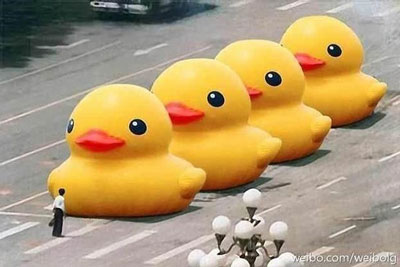 China has been working hard to crush attempts to commemorate the anniversary — both on and offline. Dozens of police officers have blocked the gates to the Wanan cemetery where victims of the massacres are buried, visited annually by the Tiananmen Mothers.
China has declared today “Internet maintenance day” — where the authorities darken sites in the name of “maintenance.” In previous years, China’s day of online maintenance has included shutting down blogs and websites with reputations for veering from the ruling party’s line. The Chinese-language Wikipedia page containing an uncensored account of the massacre was blocked by authorities on Monday.
Users of China’s most popular microblogging site, Sina Weibo, have been blocked from typing in variants of phrases like “June 4”, “Today”, “candle”, and “in memory of.” Also included in the banned list is “big yellow duck” — a reference to a photoshopped image where tanks were replaced with rubber ducks in the iconic photograph of a lone protester standing before a row of tanks in Tiananmen Square.
The United States today called on Chinese authorities to release the full account of those two bloody days, as there is not even an official death toll. China shot back through the state-run Xinhua news agency, urging the US to “stop interfering in China’s internal affairs so as not to sabotage China-US relations.”
A reputation for censorship
China’s ruling Communist Party has also recently released a list of seven banned topics, and has been quick to curb discussion of the “dangerous Western influences” online. The political topics, which include “freedom of speech”, “civil rights”, “crony capitalism”, and “The historical errors of the Chinese Communist Party”, were banned by the country’s top propaganda officials. When East China University of Political Science and Law professor Zhang Xuezhong posted the seven “speak-nots” online, the post was quickly deleted by censors.
As Wen Yunchao wrote for Index, Chinese censorship is “mainly aimed at the control of news and discussion of current affairs. Day-to-day censorship in China falls into two categories. The government’s propaganda authorities supervise websites that are legally licensed to carry news, while those without a license are dealt with by the public security authorities and the internet police. Unlicensed websites that are considered particularly influential may also be overseen by propaganda officials.”
The Chinese state’s control of the web is a model of bad behaviour for other nations around the world, according to a New York Times report. A dirty dozen or so control what the country’s citizens read and write online.
With over 500 million web users in China, the shear size of the Chinese user base makes censorship a leaky bucket for the country. A study conducted by two American computer scientists estimated that 30 per cent of banned posts are removed within half an hour of posting, and 90 per cent within 24 hours. Suzanne Nossel, executive director of the PEN American centre, wrote in April that China’s censors are caught in “a race against new platforms and technologies.”
The country’s notoriously strict censorship machine has earned it low rankings for press freedom and freedom of expression: it ranked 173rd out of 179 in this year’s World Press Freedom Index released by Reporters Without Borders — only coming ahead of free speech all-stars Iran, Somalia, Syria, Turkmenistan, North Korea, and Eritrea. According to the report, “commercial news outlets and foreign media are still censored regularly.” The Committee to Protect Journalists has reported that China uses libel suits to silence journalists — and there are 32 jailed journalists as of December 2012.
3 Jun 2013 | Campaigns, Europe and Central Asia, Turkey Statements
As protests continue in many cities across Turkey, the reactions of government, police and media have shown up only too clearly to a wider audience – domestic and international – the increasingly problematic nature of Turkish democracy, and its growing authoritarian tendencies. Index on Censorship CEO Kirsty Hughes writes
Police brutality in response to the mainly peaceful protesters has been rightly criticised. The failure of mainstream Turkish media to cover the protests from the start – choosing instead cooking programmes and other non-contentious fare – has surprised some, and also being strongly criticised. If anyone inside or outside Turkey had not paid attention to growing censorship, including self-censorship, of Turkish media, it has now been widely exposed for all to see. Yet comments from some, including the European Union, have been surprisingly limited – focusing mainly on police brutality and not the wider human rights and democracy issues.
While some commentators rashly labelled the protests a ‘Turkish spring’, those who have followed Erdogan’s AKP government in its move from promoting a number of key democratic reforms ten years ago to showing a more authoritarian side in the last few years were clear that these authoritarian tendencies are underpinning this outburst of discontent. As Amberin Zaman writes: “My overall impression, and it’s commonly shared, is that the Taksim Park project has morphed into a vehicle for popular resentment against Erdogan’s increasingly dismissive and authoritarian ways”.
As she concisely puts it: “He is a democratically elected leader who has been acting in an increasingly undemocratic way.”
While Erdogan successfully stood up to ‘soft’ and anti-democratic attempts to undermine his government – the ‘e-coup’ in 2007, the attempted ‘ judicial coup’ in 2008 – subsequent years have seen increasing numbers of journalists jailed, considerable political pressure on media outlets, with journalists and editors widely self-censoring, and many being dismissed for expressing opinions freely in their writing.
Index highlighted this censorship in shortlisting Turkish journalists for its media freedom award this year. The Turkish media themselves have now highlighted it in their failure to fully cover these widespread protests.
Those who have been promoting Turkey as a role model for ‘Arab Spring’ countries like Egypt and Tunisia, or who have been holding back on criticising Turkey’s increasing attacks on free speech for reasons of diplomacy and real politik, now must surely face up to the more difficult reality that Turkey is a country that imprisons more journalists today than Iran or China. The European Union’s foreign policy supremo Cathy Ashton did, with a delay, come out to condemn disproportionate use of force by the police.
Related: “There is now a menace which is called Twitter”
Index Events
Join Index on Censorship and a panel of Turkish and British writers to discuss free speech in Turkey, 22 June, Arcola Theatre London
But the EU should have addressed sooner and more strongly the clear and growing attacks on media freedom in Turkey – and Ashton has, even now, yet to come out strongly on this in the context of the protests. The EU has rather little influence in Turkey compared to a decade ago when membership talks were about to start – these talks have now faltered and slowed. But the EU does insist all candidate countries meet its ‘Copenhagen Criteria’ that say candidates must be democracies who respect the rule of law and human rights. Back in 2004, when the Union’s leaders agreed to start talks Turkey was said to “sufficiently meet” those criteria.
It is no longer clear, given its deliberate creation of media censorship, and the brutality of police in the face of mass protests, that Turkey does meet those criteria. If the EU stands for human rights in its neighbourhood, surely it should make a much stronger, robust condemnation of Turkey’s growing anti-democratic tendencies and its attacks on freedom of expression.
31 May 2013 | In the News
INDEX REPORT
Taking the offensive – defending artistic freedom of expression in the UK
Report Contents: Summary | Introduction | What is artistic freedom of expression? | What are the limits to freedom of expression? | Institutional self-censorship | Reinforcing support for artistic freedom of expression | Conclusion | Appendix I: Audience Feedback and Statistics | Appendix II: Conference Programme | Appendix III: Cases of Censored Artwork | Artist Videos | Full report in PDF
Self-censorship stifling UK artistic expression
Widespread self-censorship and fear of causing offence is suppressing creativity and ideas in the United Kingdom, according to a report published by Index on Censorship. (Index on Censorship)
GLOBAL
Facebook and the outer limits of free speech
The great thing about the Web is that it has given the opportunity to billions of people, who would otherwise never have had a chance to publish, to express their most urgent thoughts with an Internet connection and a few finger-flicks. (Reuters)
ADL’s Foxman Analyzes Intersection of Online Hate and Free Speech in New Book
Abraham H. Foxman, national director of the Anti-Defamation League (ADL), on June 4 is releasing his new book VIRAL HATE: Containing Its Spread on the Internet, co-written with attorney Christopher Wolf, a pioneer in Internet law. (The Algemeiner)
AUSTRALIA
Cash for no comment tramples free speech
Bend over and take your cuts. The headmaster is dishing out the cane to a variety of backsides, most of whom don’t deserve any punishment at all. (The Sydney Morning Herald)
BRAZIL
Brazilian court gags protester in latest social media ruling
A judge from the Brazilian state of São Paulo has barred a protester from an allegedly illegal construction site or even posting about it on Facebook. It’s the latest in a string of rulings targeting social media in the country. Rafael Spuldar reports (Index on Censorship)
CANADA
Rob Ford, Toronto Star, And Libel Chill: How Gawker Got The Crack-Smoking Scoop
If a newspaper isn’t willing to deliver news of public interest to its readers, it’s only a matter of time before someone else will step in. The Toronto Star learned that lesson the hard way earlier this month when Gawker, a New York-based gossip blog, scooped the century-old newspaper by announcing Toronto Mayor “Rob Ford Smokes Crack Cocaine” in a blog post that has since been viewed by almost 1 million people. (International Business Times)
IRAN
US eases export restrictions in bid to aid free speech
The United States has lifted a ban on sales of communications equipment to Iranians and opened access to internet services and social media, aiming to help the Iranian people circumvent tough government controls. (The Telegraph)
SINGAPORE
Singapore: Regulation or censorship?
Singaporean journalists and bloggers are criticising a new media regulation that they believe will stifle independent news and information about the country. (Al Jazeera)
TUNISIA
Tunisia: Amend Counterterrorism Law – Reforms Necessary to Protect Fundamental Rights
Tunisian legislators should revise the 2003 counterterrorism law, Human Rights Watch said today in a letter to the National Constituent Assembly. The 2003 law uses an overly broad definition of terrorism and incitement to terrorism and undermines the right to an effective defense. Prosecutors should not charge anyone under the law until it is amended in line with Tunisia’s human rights obligations, Human Rights Watch said. (All Africa)
Tunisia topless protester faces new charges
A Tunisian judge on Thursday announced fresh charges against a young Tunisian woman with the topless protest group Femen, as three Europeans began a second night in custody after baring their breasts. (AFP)
UNITED KINGDOM
Artists afraid of losing sponsors ‘are self-censoring,’ says Sir Nicholas Serota
The director of Tate Galleries warns of influence of special interests as study reveals limit to creative freedom. (The Independent)
Censorship and the arts: There’s a web of challenges to free expression
Many acknowledge that fear of causing offence feeds self-censorship; others stress that over-protectiveness denies the audience the opportunity to decide for itself. (The Independent)
Theresa May betrays our values by banning extremists from the airwaves
Theresa May’s proposals to ban radical preachers from the airwaves and block extremist websites are illiberal, impractical and may breach the UK’s commitment to human rights, Michael Harris writes. (Index on Censorship)
Snooper’s charter is threat to internet freedom, warn web five in letter to May
Google, Microsoft, Facebook, Yahoo! and Twitter dismiss email tracking as too costly and ‘highly contentious’. (The Guardian)
UNITED STATES
Did Public Television Commit Self-Censorship to Appease Billionaire Funder David Koch?
Filmmakers Tia Lessin and Carl Deal say plans for their new documentary to air on public television have been quashed after billionaire Republican David Koch complained about the PBS broadcast of another film critical of him, “Park Avenue: Money, Power and the American Dream,” by acclaimed filmmaker Alex Gibney. Lessin and Deal were in talks to broadcast their film, “Citizen Koch,” on PBS until their agreement with the Independent Television Service fell through. (Democracy Now)
Dark money is not free speech
Let’s be clear. Gov. Rick Perry’s veto of a “dark money” bill is not about free speech, as he claims.
It’s about dirty politics and secret donors. The veto is support for old-school cronyism. (San Antonion Express-News)
ZIMBABWE
Baba Jukwa manifests freedom of speech
THE Baba Jukwa social media phenomenon — which has taken Zimbabwe by storm as the anonymous writer nears 100 000 likes on Facebook — needs to be evaluated in the context of free speech and free flow of information in a democratising society such as Zimbabwe, as it gives a critical dimension into resistance struggles that do not necessarily involve “big men” but “small men” agency which has sent shock waves across the entire authoritarian system while ruffling feathers of the powers that be. (Zimbabwe Independent)
