15 Nov 2016 | Bahrain, Bahrain Statements, Campaigns, Campaigns -- Featured, Statements
[vc_row][vc_column][vc_column_text]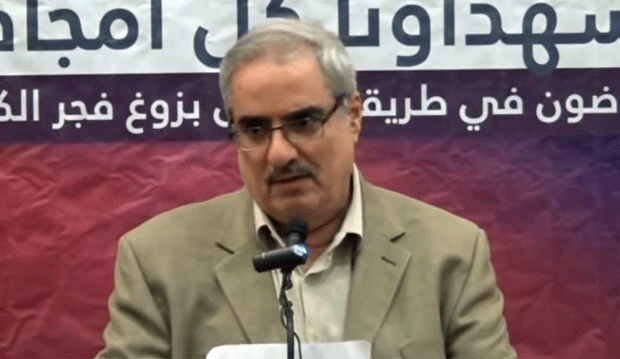
Bahrain’s public prosecution on Sunday 13 November charged leading opposition politician Ebrahim Sharif under article 165 of the penal code with “inciting hatred against the regime,” after he spoke to the Associated Press last week. We, the undersigned, consider this to be a violation of his right to freedom of expression and a reprisal against his political activity.
The charge carries a three-year sentence and comes after Prince Charles’ controversial visit to the Gulf monarchy last week. It is the latest development in the Bahraini government’s intensified crackdown on civil society in the past year.
Speaking on Prince Charles’ arrival in the country Sharif, the former leader of the secular National Democratic Action Society (Wa’ad), told AP he was afraid the visit would “whitewash” human rights abuses.
Sharif told AP: “I don’t see what’s gone on behind closed doors or whether the prince raised any questions of human rights. Bahrain’s government values its relations with the U.K. and if the U.K. puts its weight behind the improvement of human rights in Bahrain, the government will listen. They need friends.”
He further said: “All parties should compromise. We can’t have absolute power in the hands of the ruling family.”
“Ebrahim Sharif was expressing his opinion and no one should ever be prosecuted for that,” said Sayed Ahmed Alwadaei, Director of Advocacy at the Bahrain Institute for Rights and Democracy (BIRD). “Bahrain claims to be inclusive, that’s the image they tried to sell with Prince Charles’ visit. But Sharif’s prosecution reveals the barefaced lie.”
Prince Charles’ visit courted controversy, with campaigners accusing him of participating in a PR exercise aimed at hiding Bahrain’s poor human rights record. In his visit, the Prince of Wales highlighted religious tolerance in Bahrain, a theme also highlighted by visiting Middle East Minister Tobias Ellwood MP, visiting the Al Fateh Grand Mosque and Bahrain’s Hindu temple, and meeting members of the country’s Jewish community. But the royal tour failed to meet with members of the Shia community, who make up a majority of Bahrain’s citizen population, and who have faced heightened discrimination from the government in the past months. In August, five UN experts called on Bahrain to end its “persecution of Shias”.
Ebrahim Sharif is the former Secretary General of Wa’ad. He was a member of the Bahrain 13, a group of high profile activists arrested, tortured and sentenced by military court in 2011. He was released in June 2015, but re-arrested weeks later and sentenced to another year in prison for a political speech he gave calling for continued peaceful opposition. Sharif was released from prison in July 2016. He is currently under a travel ban order.
At the time of Sharif’s June 2015 release, the US State Department lifted an arms ban on Bahrain, citing “meaningful progress on human rights.” However, Bahrain’s Ministry of Interior re-arrested him less than three weeks later on charges of “inciting regime change and hatred and contempt against the regime.” A court found him guilty and sentenced him to one year in prison. As a result of the deteriorating human rights situation in the country, including Sharif’s re-arrest, both the US Senate and House of Representatives introduced bipartisan legislation calling for the resumption of an arms ban on the Bahrain Defense Force (BDF) and National Guard, forbidding the sale of weapons that could be used to suppress peaceful dissent. The bills would allow for the sale of arms only after the Secretary of State certifies that the Bahraini government has fully implemented all 26 recommendations made by the Bahrain Independent Commission of Inquiry (BICI) in 2011. As of 2016, the US State Department assessed that key recommendations of the BICI still have yet to be implemented by the Bahraini government and, Americans for Democracy & Human Rights in Bahrain (ADHRB), the Bahrain Center for Human Rights (BCHR), and BIRD have found that only two of the Commission’s recommendations have been fully implemented.
“Though the Bahraini government continues to falsely claim that it has implemented all 26 BICI recommendations, virtually all independent assessments reveal a complete failure to reform on key human rights issues,”said Husain Abdulla, Executive Director of ADHRB. “The prosecution of Ebrahim Sharif for his interview with AP follows the authorities’ decision to similarly charge prominent human rights defender and BCHR president Nabeel Rajab for his open letter in the New York Times. These actions clearly demonstrate that the government remains committed to suppressing all forms of criticism.”
The Government of Bahrain’s actions violate the freedom of expression, as protected under Article 19 of both the Universal Declaration of Human Rights and the International Covenant on Civil and Political Rights, which Bahrain acceded to in 2006.
We condemn this violation of the right to free expression and call for the immediate dropping of all charges against Ebrahim Sharif, and all other persons prosecuted for their speech.
Signed,
Americans for Democracy & Human Rights in Bahrain (ADHRB)
Bahrain Center for Human Rights (BCHR)
Bahrain Institute for Rights and Democracy (BIRD)
European Centre for Democracy and Human Rights (ECDHR)
Index on Censorship[/vc_column_text][/vc_column][/vc_row][vc_row][vc_column][vc_basic_grid post_type=”post” max_items=”4″ element_width=”6″ grid_id=”vc_gid:1479198588631-d2e752f2-c2f3-0″ taxonomies=”7706″][/vc_column][/vc_row]
21 Sep 2016 | Bahrain, Bahrain News, Middle East and North Africa, mobile, News
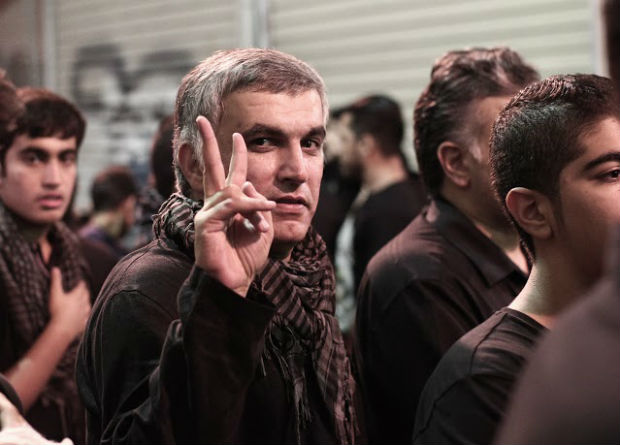
Bahraini human rights defender Nabeel Rajab (Photo: The Bahrain Institute for Rights and Democracy)
Prince Charles is to make an official visit to Bahrain in November despite the escalating human rights crackdown in the country. This endorsement comes after Queen Elizabeth sat next to the king of Bahrain at her 90th birthday celebrations this summer.
Last week, the UN Human Rights Council commissioner Zeid Ra’ad Al Hussein expressed grave concerns about the country: “The past decade has demonstrated repeatedly and with punishing clarity exactly how disastrous the outcomes can be when a government attempts to smash the voices of its people, instead of serving them.”
Today, Sayed Ahmed Alwadaei, director of advocacy at the Bahrain Institute for Rights and Democracy, told The Times: “The timing of Prince Charles’s visit suggests that the major human rights violations in 2016 are not in the British monarchy’s mind.”
Here are just a few things Index on Censorship would encourage the prince to keep in mind ahead of his trip:
1. The treatment of Nabeel Rajab
Human rights campaigner Nabeel Rajab, who has been arrested multiple times because of his peaceful activism, has been detained since 13 June for comments he made on Twitter. Charges brought against him for his tweets, and even retweets, include spreading “false or malicious news, statements, or rumours”, “offending a foreign country” and “offending a statutory body”.
Rajab was also recently charged with “defaming the state” after a critical op-ed he wrote appeared in The New York Times.
Just last week, the UK government was urged by a group of 50 NGOs to put pressure on Bahrain over Rajab’s treatment. With news of the state-sanctioned Prince Charles visit, it appears these calls have of fallen on deaf ears.
Rajab is expected to be sentenced at his next court hearing on 6 October. He faces more than 15 years in prison.
2. The detention of critics
The Bahraini government has repeatedly used prison as a weapon to silence its critics. Opposition activist Zainab Al-Khawaja was sentenced to three years in prison in December 2014 for “insulting the king” after she ripped up a picture of him. Though she has now been released, her father Abdulhadi Al-Khawaja, a human rights activist and a member of the Bahrain 13, remains in prison along with over 3,500 other prisoners of conscience.
On 22 June 2011 a military court sentenced all members of the Bahrain 13 to between five years and life in prison, on trumped-up charges of attempting to overthrow the regime, “broadcasting false news and rumours” and “inciting demonstrations”. All but two of them remain behind bars.
Last year, the Liberties and Human Rights Department of Al-Wefaq National Islamic Society recorded a total of 1,765 arrests by security services for reasons related to the opposition political movement, including the detention of 120 children and five women.
3. Rendering critics stateless
Another abusive tactic used by the government of Bahrain is to revoke the citizenship of many of its critics. This is illegal under several international agreements, including the Universal Declaration of Human Rights and the International Covenant on Civil and Political Rights. Regardless, 208 Bahrainis were rendered stateless in 2015 alone.
Since amending its citizenship law in 2014, Bahrain’s judges can strip citizenship from anyone convicted under anti-terrorist laws. However, the law does not properly define “terrorism” and several of those subjected to this fate in 2015 were convicted under vague terms such as “inciting and advocating regime change” to “defaming brotherly countries”.
Most of those rendered stateless have been deported, along with their families.
4. Censoring the internet
Named by Reporters Without Borders as an “enemy of the internet“, Bahrain has been busy clamping down on the web over the last few years. Despite being one of the best-connected countries in the world from a technical perspective, Freedom House gives the country an online freedom rating of 72, with 100 being the worst possible score.
News, human rights and opposition websites are routinely blocked, with estimates putting the total number at over 1,000. Social media users have been arrested and had posts forcibly removed, including those of the satirical account @Takrooz whose only post is now: “They tortured me in prison.”
The government is also working on a new Russian-inspired default search engine that would allow it to filter results without the cooperation of Western-based companies such as Netsweeper, which was exposed by the Associated Press as a facilitator of Bahrain’s censorship program.
11 Jul 2016 | Bahrain, Bahrain Statements, Campaigns, Campaigns -- Featured, Statements
On Tuesday, 12 July 2016, the trial of the prominent human rights defender Nabeel Rajab was set to begin. His case has been postponed until 2 August 2016. Facing charges related to comments on the social media website Twitter, Rajab may be sentenced to more than ten years in prison. We, the undersigned NGOs, hold the government of Bahrain responsible for the deterioration of Rajab’s health due to poor detention conditions. We call on the Bahraini authorities to immediately and unconditionally release Rajab, and to drop all charges against him.
Rajab is a leading Bahraini human rights defender, well known in the region – and worldwide – for his defense of human rights, and his efforts towards more freedom for all. As a result of his work he has been repeatedly jailed. He is the President of the Bahrain Center for Human Rights (BCHR), Founding Director of the regional Gulf Center for Human Rights (GCHR), Deputy Secretary General of the International Federation for Human Rights (FIDH) and is also on the Advisory Committee of Human Rights Watch’s Middle East Division.
On 13 June 2016, in the early hours of the morning, Rajab was arrested without any declared reason. He was not informed of his charges until the following day, when he was brought before the public prosecution and officially charged with “spreading false news and rumors about the internal situation in a bid to discredit Bahrain.” He was then remanded to seven days in custody pending investigation. This charge was in response to statements he gave during past television interviews in early 2015 and 2016.
On 28 June 2016, Rajab was transferred to the Bahrain Defense Hospital’s Coronary Care Unit for an irregular heartbeat. His family was informed that he is also suffering from high blood pressure, a condition for which he was treated two years ago. Despite his weak condition, he was hastily transported from the Coronary Unit back to jail the following day.
Since the arrest, Rajab has been detained in extremely poor conditions in solitary confinement. His cell is filthy, the toilet and shower are unclean and unhygienic, and there is little or no clean water in the bathroom. These conditions have been detrimental to Rajab’s health; he has lost eight kgs in just two weeks. Blood tests have shown that he has acquired both a urinary tract infection and low mononucleosis, and he is awaiting the results of additional screenings. Rajab also needs surgery to treat gallstones and an enlarged gallbladder. He is also suffering from an enlarged prostate and needs to be seen by a hematologist. His surgeries will not be scheduled before August.
On 26 June 2016, the authorities notified Rajab that his first court hearing for another case would be for 12 July 2016. This separate case is related to other tweets and retweets about Jau prison and the war in Yemen, which were posted in 2015. He may face up to 13 years in prison if found guilty, and the authorities have ordered that Rajab remain in detention until his hearing.
We remind the Bahraini government of its obligation to preserve the right to free expression under article 19 of the International Covenant on Civil and Political Rights, to which Bahrain acceded in 2006. We call for action to be taken to guarantee and protect the health of human rights defender Nabeel Rajab from further deterioration. We reiterate repeated calls by United Nations officials, and others in the international community, to immediately release Rajab.
The Signatories
Bahrain Center for Human Rights (BCHR)
Americans for Democracy & Human Rights in Bahrain (ADHRB)
Amnesty Denmark
Bahrain Institute for Rights and Democracy (BIRD)
Bahrain Interfaith
Cairo Institute for Human Rights Studies (CIHRS)
Canadian Journalists for Free Expression (CJFE)
CIVICUS
Danish Institute Against Torture
European Bahraini Organisation for Human Rights (EBOHR)
European Center for Democracy and Human Rights (ECDHR)
FIDH, within the framework of the Observatory for the Protection of Human Rights Defenders
Frontline Defenders
Gulf Center for Human Rights (GCHR)
Human Rights First
Human Rights Sentinel
IFEX
Index on Censorship
International Partnership for Human Rights (IPHR)
Justice for Human Rights (JHRO)
No Peace Without Justice
Physicians for Human Rights (PHR)
Project on Middle East Democracy (POMED)
REPORTERS SANS FRONTIÈRES (RSF)
Salam for Democracy and Human Rights
World Organisation Against Torture (OMCT), within the framework of the Observatory for the Protection of Human Rights Defenders
For Background Information on Nabeel Rajab, please visit this page, and for any further developments on his case please visit this page as it is regularly updated with the latest information.
3 Jun 2016 | Bahrain, Middle East and North Africa, mobile, News
Bahraini authorities this week released opposition activist Zainab Al-Khawaja, who had been imprisoned with her infant son since March. She had been convicted of insulting the Bahraini king after she ripped up a picture of him.
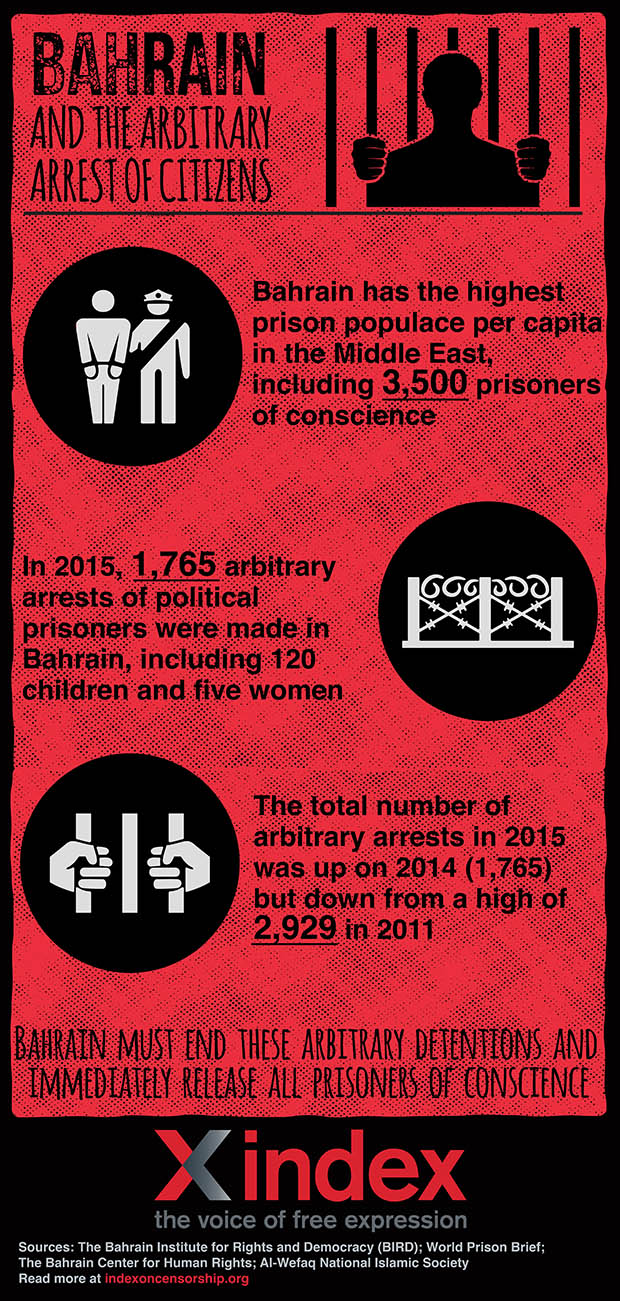
Al-Khawaja may now be out of prison — though she could be re-arrested at any time — but her father, Abdulhadi Al-Khawaja, is one of over 3,500 prisoners of conscience who remain in Bahrain’s jails. According to research by World Prison Brief, Bahrain has the highest number of prisoners per capita in the Middle East, with 301 people in jail per 100,000 people of its 1.3 million population (followed by Israel at 256).
Arbitrary detention is the imprisonment of a person without proper evidence that they committed a crime or a case in which there has been no proper due process. Last year, the Liberties and Human Rights Department (LHRD) of Al-Wefaq National Islamic Society recorded a total of 1,765 arrests by security services for reasons related to the opposition political movement, including the arrests of 120 children and five women.
The total number of arbitrary arrests last year was up on 2014 (1,765) but down on 2013 (2,192), 2012 (2,221) and 2011 (2,929).
The UN Working Group on Arbitrary Detention, a UN body consisting of five experts, has repeatedly concluded that Bahrain has violated several international standards of a fair trial. In September of last year, the group found the detention of the secretary general of Al-Wefaq National Islamic Society, Sheikh Ali Al-Salman — this month sentenced to nine years imprisonment — to be arbitrary and “falls under category II and III of the Working Group’s categories of arbitrary detention”.
The five categories of arbitrary deprivation of liberty, according to the UN group are: when it is clearly impossible to invoke any legal basis justifying the deprivation of liberty (I); when the deprivation of liberty results from the exercise of the rights or freedoms (II); when the total or partial non-observance of the international norms (III); when asylum seekers, immigrants or refugees are subjected to prolonged administrative custody without the possibility of administrative or judicial review or remedy (VI); and when the deprivation of liberty constitutes a violation of international laws for reasons of discrimination (V).
In 2013, the UN Working Group on Arbitrary Detention found the imprisonment of Index on Censorship’s Freedom of Expression Awards 2016 judge Nabeel Rajab (since pardoned) to be arbitrary, and, along with Index, called for his release.
Last year’s arbitrary arrests of prisoners of conscience in Bahrain included Mohammed Mahdi Alekri, a member of Al-Wefaq’s advisory board who was arrested on 4 January 2015 by security forces during a demonstration against the arrest of Al-Salman.
Also among those arrested was Sayed Sa’eed Isa, a member of The Martyrs Associate and father to Sayed Hashim Saeed, the 15-year-old boy killed during the security crackdown on demonstrations in Sitra late 2011.
The Bahraini authorities have continued to use arbitrary detention to silence political opponents and opposition supporters.
