18 Sep 2024 | Iran, News, Volume 53.02 Summer 2024
In a perceptive video essay titled Irani Bag, made in 2020, Maryam Tafakory illustrates how Iranian filmmakers get around the Islamic taboo on touch. Interweaving her commentary with film clips from 1989 to 2018, she highlights how bags have long been a recurring device in Iranian films, allowing men and women to “touch” on screen.
In one clip, a man and a woman riding on a motorbike are separated – or connected – by a bag lying between them. It functions as a substitute for human touch or an object of shared intimacy.
A bag can also be an extension of the body, and Tafakory demonstrates how men and women in these scenes repeatedly push, pull or strike each other using bags.
By contrast, in the scenes she shows without a bag, hands hover centimetres away from another person – the actors forbidden from touching.
If no direct contact materialises on screen, the filmmaker can dodge censorship. And, as Tafakory shows, Iranian cinema has developed a cinematic language “to touch without touching”.
Touch is not the only prohibition in Iranian cinema. The government has sought to align cinema and other arts with its interpretation of Islamic principles, and an overarching rule is gender segregation, which prevents men and women who are not mahram (related by blood or marriage) from interacting with each other.
As part of this, the wearing of the veil in public is strictly policed, as witnessed by Mahsa Jina Amini’s police custody death in 2022 and the ensuing Woman, Life, Freedom protests. Since cinema is regarded as a public space, female characters are always expected to be veiled – even indoors with their families where they would not wear veils in real life.
Cinema is regulated by the Ministry of Culture and Islamic Guidance (MCIG). Directors must submit their synopsis or screenplay for a production permit and, later, their completed film for a screening permit. At each stage they can be asked to make changes or otherwise risk censorship. When a film is released, the Iranian press can accuse the makers of siāh-namāyi: presenting the country in a negative light.
There are some obvious red lines for the censors: no direct criticism of Islam or Iran’s Islamic Republic, nothing too violent, and certainly no sex. But MCIG guidelines are not detailed, so moviemakers have learned other censorship criteria through trial and error.
What is permissible is always shifting due to changes in society and filmmakers pushing against boundaries.
It is important to observe that state censorship is not the only obstacle that Iranian filmmakers encounter. International funders and markets impose expectations of what their films should be about. Indeed, many filmmakers have reported to me that they find these restrictions to be as challenging as censorship.
But where censorship is concerned, filmmakers who want to explore intimacy and other sensitive topics must find creative ways to work around imposed constraints. This is reminiscent of Hollywood under the Production Code from 1934 to 1966 when political, religious and cultural restrictions on filmmaking compelled directors to employ subtle techniques that left more to viewers’ imaginations.
In Iranian cinema in the 1980s and 1990s, it was noticeable how often key roles were given to children. This was partly a creative response to new taboos as, in the early decades of the Islamic Republic, filmmakers realised that children could overcome constraints of gender segregation by acting as adult substitutes or purifiers of male-female contact.
For example, when the protagonist Nobar shares intimate moments with her lover Rasul in The Blue Veiled (1995), her youngest sibling, Senobar, serves as a mediator. Senobar even rests her head in Rasul’s lap, a proxy for her sister. The child lends an innocent aura to an erotically charged scene.
Children can also cross social boundaries and navigate between private and public spaces. In Jafar Panahi’s debut feature The White Balloon (1995), a little girl, Razieh, embarks on a quest to buy a goldfish for Nowruz (Persian New Year) and encounters people from different walks of life on Tehran’s streets, including an Afghan balloon seller.
Filmmakers have subtly used children to highlight Iran’s sociopolitical realities, among them the after-effects of the Iran-Iraq war (as in the 1989 film Bashu, the Little Stranger), the plight of the country’s Afghan minorities (The White Balloon) and the Kurds’ hardships on the Iran-Iraq border (for example, A Time for Drunken Horses from 2000, or 2004’s Turtles Can Fly).
The political climate has waxed and waned as moderate and hardline governments have relaxed censorship restrictions and tightened them again. Yet intermediaries for male-female contact have been enduring ploys throughout.
In one of several storylines in Tehran: City of Love (2018), a woman called Mina dates a man, Reza, who ultimately confesses he is married. As consolation, he couriers her a giant teddy bear. Subsequently, Mina is seen waiting at a bus shelter side-by-side with the gargantuan soft toy – Reza’s comic stand-in.
Another creative solution has been the use of the road movie genre. Simultaneously private and public, a car is a space that allows small, everyday transgressions. Being in a car relaxes the rules of compulsory veiling and encourages behaviour normally kept behind closed doors. It emboldens people to express themselves more freely. Filmmakers tap its emancipatory potential in both their production strategies and their on-screen representations.
In Ten (2002), a female passenger, whose fiancé has jilted her, removes her headscarf to reveal her head shaved in mourning and as a token of a new beginning. In Panahi’s Taxi Tehran (2015) – his third feature made clandestinely since his 2010 filmmaking ban – a series of passengers take a taxi. The cabbie is Panahi himself, masquerading in a beret. Before his ban, he was accustomed to filming in the bustling outdoors. With the car and small digital cameras, he can shoot outside again.
One of his passengers is lawyer Nasrin Sotoudeh, renowned for her work defending political prisoners. Like Panahi, she has been repeatedly imprisoned and banned from leaving Iran and practising her profession. As she gets out, she advises him to delete her words from his film to avoid more hassle from authorities. This is an underground film – made illegally, without official permits, and distributed on Iran’s black market and abroad. So Sotoudeh’s words survive the edit, registering the film’s furtive mode of production.
In Atomic Heart (2015), we first encounter Arineh and Nobahar intoxicated after a party. They are part of a modern, Westernised subculture that likes to revel, drink and take drugs, and largely rejects the Islamic Republic’s values. As their anti-regime attitude cannot be directly shown, the film hints at their unconventional lifestyle by inhabiting the road movie genre – associated with freedom and rebellion – as they whirl around nocturnal Tehran. The film evokes the subversive behaviour of real-life Iranian youth who, given restrictions on public gathering as well as bans on nightclubs and disapproval of open displays of romantic affection, have taken to the highways, especially at night.
Inserting a story within a story is a further tactic for circumventing censorship. In The Salesman (2016), Emad and Rana perform Arthur Miller’s Death of a Salesman in an amateur theatre group. The film mirrors the play, highlighting the couple’s relationship after Rana is assaulted by an intruder in their apartment – a scene left unshown to avoid censorship and engage the audience in speculating about what transpired between Rana and her attacker. In the story within a story, meaning is multi-layered, residing in the inner as well as the outer tale.
Since short films are less strictly regulated by screening permit requirements, directors are bypassing these rules by composing feature films from several shorts. Mohammad Rasoulof’s There Is No Evil (2020) comprises four short stories about characters involved in the state’s capital punishment system. Given Rasoulof’s filmmaking ban, his production team tactically applied for four short film permits without listing his name on the forms.
In Tales (2014), which was also created as multiple shorts joined together as a feature, a documentary filmmaker character shoots a film within a film. When an official notices his camera filming a workers’ protest, the recording halts. The film segues to the next story, suggesting the camera’s confiscation. Later, the filmmaker retrieves his camera without the seized footage. He determines to continue filming, stating: “No film will ever stay in the closet. Someday, somehow, whether we’re here or not, these films will be shown.” His words reflect a popular Iranian saying that a film’s purpose is to be shown to an audience.
These kinds of strategies are testament to Iranian filmmakers’ creativity. Although they cannot be overtly critical of the regime, they have developed resourceful ways to try to ensure that their films can explore sensitive topics and still be shown.
19 Nov 2021 | Brazil, News
There is a highly symbolic scene in Marighella, a Brazilian film that has only reached movie theatres now, even though it has been ready for release since 2019. An American agent (Charles Paraventi) praises Police Chief Lúcio (Bruno Gagliasso) for the inventiveness with which the revolutionary group Ação Libertadora Nacional (ALN) infiltrated radio stations, broadcasting a subversive message using only a tape recorder and circumventing the censorship. The sequence fulfils at least two functions: to reinforce the deep ties between the brutality of the Brazilian military dictatorship and North American imperialist interests; and reinforcing political and social resistance through creativity, a typically Brazilian trait often described as jeitinho or malandragem – a way of circumventing the bureaucratic norms.
I evoke this idea of trickery because it is at the centre of the imbroglio involving the release of Marighella, a political biopic of Carlos Marighella, a Brazilian Marxist-Leninist communist, politician and writer.
Marighella, born in 1911, was regularly in and out of jail between the 1930s and 1950s for criticising the Brazilian government as an active member of the Communist Party.
In 1966, he published The Brazilian Crisis, which argued for an armed struggle against Brazil’s military dictatorship which had been installed as a result of the 1964 coup in the country. Two years later, Marighella was expelled from the Communist Party and he went on to found the ALN, which became involved in robbing banks to finance guerilla warfare and the kidnapping of high profile individuals to win the release of political prisoners.
After the ALN’s involvement in the kidnapping of US Ambassador Charles Burke Elbrick, Marighella became a target. On 4 November 1969, he was ambushed by the police in São Paulo and shot dead.
The release of the biopic during the presidency of Jair Bolsonaro, an apologist of Latin American military dictatorships and nostalgic for the bloodthirsty Brazilian regime that acts as the de facto villain of the film, is timely.
Marighella was supposed to be released in early 2020 but Ancine, the government agency that works to promote national cinema in Brazil, withheld funding of R$1 million (roughly £134,000) for its distribution, alleging a problem in the accounts for another production by O2 Filmes, the film’s producer.
Celebrated actor Wagner Moura, who debuts here as the director, had no doubt that the film was censored.
“It was a time when Bolsonaro was talking about filtering and regulating Ancine,” Moura said at a press event about the movie.
Brazil hasn’t had a censorship department since the end of the military dictatorship, which ended with popular elections in the mid-1980s. The constitution that was enacted at that time was so influenced by the “years of lead” (as the times under the regime are known) that censorship was expressly prohibited by the law.
There are, of course, age rating systems and, with the justification of “protecting the innocence of children”, certain films, events or exhibitions are only released for certain ages, and/or with parents’ authorisation, very much alike the ratings systems in the US or the UK. That’s why, as long as it feels the need to comply with the Constitution, the current far-right Brazilian government needs to be at least as creative as the speeches it seeks to curb.
Hence Moura’s revolt, saying that there would be “veiled censorship”, different than what happened during the dictatorship, applied as a state policy.
“Today they infiltrate people in these agencies, and they make anything impossible to happen. That’s what they did with Marighella. They found a way to make the release impossible, from a bureaucratic point of view,” he said in an interview with Veja magazine.
Without this being state policy, made official by documents, it is difficult to say that there is de facto censorship. Carlos Marighella symbolises much of what the radical wing of the government despises, finding it absurd that public money is used to finance “non-aligned” works.
Bolsonaro himself has even threatened Ancine with extinction because the productions it finances are no longer “aligned” with the government. His government’s special secretary of culture, former actor Mário Frias has even tweeted a response to Moura’s statements: “Did you think I was going to get public funds for this pamphlet garbage?”
This type of declaration by a state representative helps to understand the Brazilian Government’s relationship with culture. Its origin lies in one of the ideological consequences of the end of the military dictatorship, in which some far-right intellectuals and disgraced military personnel came to the conclusion that the left had “won” the “cultural war”, infiltrating universities and fostering ideologically aligned artistic production .
This conclusion was, in part, a reaction to the establishment of the National Truth Commission, dedicated to revealing and documenting the crimes against humanity committed by the dictatorship, and the result of a bad reading (and also in bad faith, it should be said) of the theories of Antonio Gramsci, an Italian Marxist intellectual.
The rise and permanence of the extreme right in power, they think, would be conditioned to the dismantling of an apparatus of cultural incentive and promotion, developed over the years of redemocratisation. This explains the presence of someone like Frias in charge of culture and the use of jeitinho to impede the exhibition of “misaligned” films such as Marighella.
This institutional trickery, in this case at least, has backfired, since a work is not an isolated object of its historical context. Since release – without the benefit of government funding – Marighella has become the most watched Brazilian production of the last two years, with 100,000 spectators in 300 theatres across the country. This is low in a historic context, as the screen quota which usually ensures that cinemas show a certain amount of locally produced content to counter the influx of foreign films is currently suspended while a new proposal, suggest by Brazil’s opposition parties, is considered.
Despite its success, the film has problems – from the annoying overacting to the lack of real interest in its main character – and it perhaps wouldn’t be so celebrated in another time. In Brazil at the end of 2021, with all the absurdities committed by action or inaction of the Bolsonaro government, Marighella has become the film to be seen.
16 Feb 2021 | News, United Kingdom
[vc_row][vc_column][vc_single_image image=”116256″ img_size=”full” add_caption=”yes”][vc_column_text]I can think of few public figures I hold in greater contempt than Ken Loach. Mr Loach may be an esteemed film maker but I regard his politics as those of the sewer. His involvement in the cancelled original production of Perdition, the notoriously antisemitic play, ought to have led all decent people to shun him. Far from that happening, however, he has been widely feted and his career has soared. And yet not only do his views remain the same, he misses few opportunities to promote them.
In short, I loathe the man and find him deeply offensive.
All of which is true, but all of which should be irrelevant to anyone but me and those who are interested in my views of Mr Loach. There are many other public figures whose views I find deeply offensive. To which you rightly respond: Who cares?
Except people do care. Not about my specific response, but about the offence Mr Loach generates among many of my fellow Jews. And that is an issue.
Earlier this month, a brouhaha arose over a decision by students at St Peter’s College, Oxford, to invite Mr Loach to speak (as it happens, about his films rather than, er, Jews). Would I have invited him? I think you know the answer to that. But the invitation was issued, Mr Loach accepted, and we are where we are.
Vile as I – and, let’s be clear, many others – may find him to be, if a group of Oxford students wish to hear from Ken Loach, so be it. He has broken no laws when speaking and has as much right to put forward his views – and, of course, to talk about his films to a group of people interested in hearing from him about them – as anyone else.
Ordinarily, that would have been the end of the matter. But when the event was made public, the Board of Deputies of British Jews weighed in, demanding that the invitation be withdrawn. They argued – correctly – that many Jews find Mr Loach’s views deeply offensive. But, bizarrely and ludicrously, they concluded from this that he should therefore have been banned from speaking.
The sheer idiocy of this position takes some grappling with. For most of my time as editor of the Jewish Chronicle, a recurring story has been how representatives of Israel face violence and intimidation on campus to stop them speaking. In other words, one group of people believe that the offence they take at hearing a certain view entitles them to silence that view. The Board of Deputies has rightly criticised such attempts.
Do they really not see the contradiction? For Jewish students, the greatest campus battle at the moment is the right to be heard. All too often they are shouted down and attacked by anti-Israel activists. The Board of Deputies’ position is that if someone is regarded as offensive by enough people, they should be denied the opportunity to speak. Presumably anywhere, always. If Mr Loach is to be denied the chance to speak at St Peter’s, is he also to be barred from promoting his films? Or from making films?
As one can see, the whole thing unravels with a moment’s thought – as well as being so obviously counter-productive. It will not be long before the next attempt to silence an Israeli speaker, this time doubtless claiming to be based on the Board of Deputies’ own logic, that their presence is offensive to many people.
As readers of this site well know, free speech issues can be complicated. But not always. Sometimes the issue is obvious. I loathe Ken Loach. But I defend his right to speak.[/vc_column_text][/vc_column][/vc_row]
29 Jul 2016 | Academic Freedom, Campaigns -- Featured, Europe and Central Asia, Mapping Media Freedom, News, Turkey
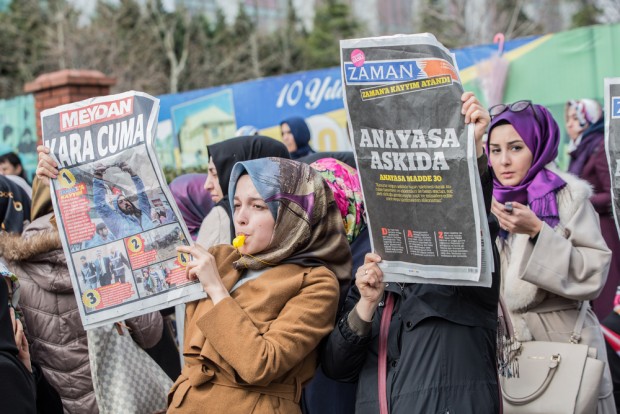
People gather in solidarity with the press outside Zaman newspaper in Istanbul in March 2016
By Ianka Bhatia and Sean Vannata
The spotlight has been on Turkey following the attempted coup against President Recep Tayyip Erdogan and the government’s ensuing crackdown on journalists, teachers, judges and soldiers. How did it come to this? Here are five key articles on Turkey from Index on Censorship showing the escalation of threats to freedom of expression prior to July’s failed coup.
1. Silence on campus
Early in 2015, an academic at Ankara University’s political sciences department spent an evening writing questions for an exam. He never for one minute suspected that one of those questions might lead to death threats. Index’s Turkey editor Kaya Genç reported on the struggle for academic freedom in Turkey’s election year for the summer 2015 issue of Index on Censorship magazine.
2. “Judicial coup” sends clear warning to Turkey’s remaining independent journalists
“Nothing could illustrate the course of developments in Turkey better than the case of prosecutor Murat Aydın,” Yavuz Baydar wrote for Index on 8 June 2016. “In what was described as a ‘judicial coup’ in critical media, Aydin was one of 3,746 judges and prosecutors, who were reassigned in recent days, an unprecedented move that has shaken the basis of the justice system. Some were demoted by being sent into internal “exile”, some were promoted.”
3. Turkey war on journalists rages on
The ongoing deterioration in Turkey’s press freedom has been well documented by Index on Censorship’s Mapping Media Freedom project since its launch in 2014. Back in March 2015, Index’s assistant online editor Ryan McChrystal looked at how, with journalists being killed, detained and prevented from working, the crackdown on Turkey’s media only appears to be getting worse.
4. Interviews with Turkey’s struggling investigative reporters
Kaya Genç interviews writers from the acclaimed independent newspaper Radikal about its closure and the shape of Turkish investigative journalism today for the summer 2016 issue of Index on Censorship magazine.
5. Turkey’s film festivals face a narrowing space for expression
The Siyah Bant initiative, which carries out research on censorship of the arts in Turkey, has given much coverage to obstacles to freedom of expression in the cinematic field in research published in recent years. In June 2016, Index published a report on cases of censorship at Turkish film festivals.
