16 Apr 2020 | Awards, Fellowship, Fellowship 2020
[vc_row][vc_column][vc_video link=”https://youtu.be/CHeaC4lQRjI”][vc_column_text]OKO Press is the one of the first free investigative journalism and fact-checking websites in Poland.
They investigate and evaluate statements made by politicians, monitor public spending, and fight for access to public information. Their work also supports grassroots activism; crucial in an environment sliding further and further into authoritarianism and censorship.
OKO Press have paved the way for other news sources to follow suit. This has contributed to a safer and stronger public sphere, fighting for immunity from government propaganda.
The environment in which they work is becoming increasingly hostile. Political polarisation, lack of transparency, suspicion, threats and withholding of information are common. In the face of this, OKO Press shows resilience and determination.
“Ladies and Gentlemen, we are OKO.press. “Oko” means “eye” in Polish.
Since 2016, we keep an eye on what is happening in the EU and the world, but most importantly in Poland. Our country is going through a tough trial under the government of the populist right that invokes the worst nationalist traditions.
As journalists, we check whether those in power are not misleading us. We shine a light on the things they are trying to hide.
We are a participatory medium. We give a voice to all kinds of community initiatives. Which — like us — believe in the values of constitutional democracy, truth and transparency, human rights, including gender equality, the rights of LGBT+ people, as well as animal rights, environmentalism, and protecting the planet from climate change.
We are honoured to receive the award, but also humbled but the fact that other nominees, from Hong Kong, Venezuela of Burundi are acting in much harder circumstances. Friends, we admire your courage, determination and quality of work.
Kaczyński is no Maduro, Nkurunziza, Putin, or Erdogan, but apparently he takes his inspiration from them. We are not a dictatorship yet, though we are close to the so-called electoral authoritarianism, where all forms of public scrutiny, besides the elections, are being suppressed.
The prize is a great distinction for us, but also proof that the world is interested in what is happening in Poland. And justly so, because the virus in one EU country will spread further [until] there are no countries left free of infection. It is short-sighted and arrogant to think that Poland or Hungary are irrelevant because they are merely Eastern Europe.
Index on Censorship is the organisation which prevents us from silencing our consciences. In many places of the world we face political violence, laws being broken, and a wave of authoritarian right-wing populism.
Truth is the weapon of the civilised society. The pandemic has show that truth is ever more important, as the lack of the feeling of safety can lead to mass retreat from freedom. But catastrophes and crises also give rise to what is best and change the world. The Covid-9 crisis can come out for the better as well.
We promise to continue the fight against the anti-democratic virus which is taking over the world. We have one humble measure: the word. But as Vaclav Havel said, this is and always has been Power of the Powerless.
We believe the danger will wane, both epidemic and political. We will wake up in a healthier world.
Please help us to keep going. Read and support OKO.press.
Thank you for the award! “[/vc_column_text][/vc_column][/vc_row]
2 Apr 2020 | News, Turkey
[vc_row][vc_column][vc_column_text]
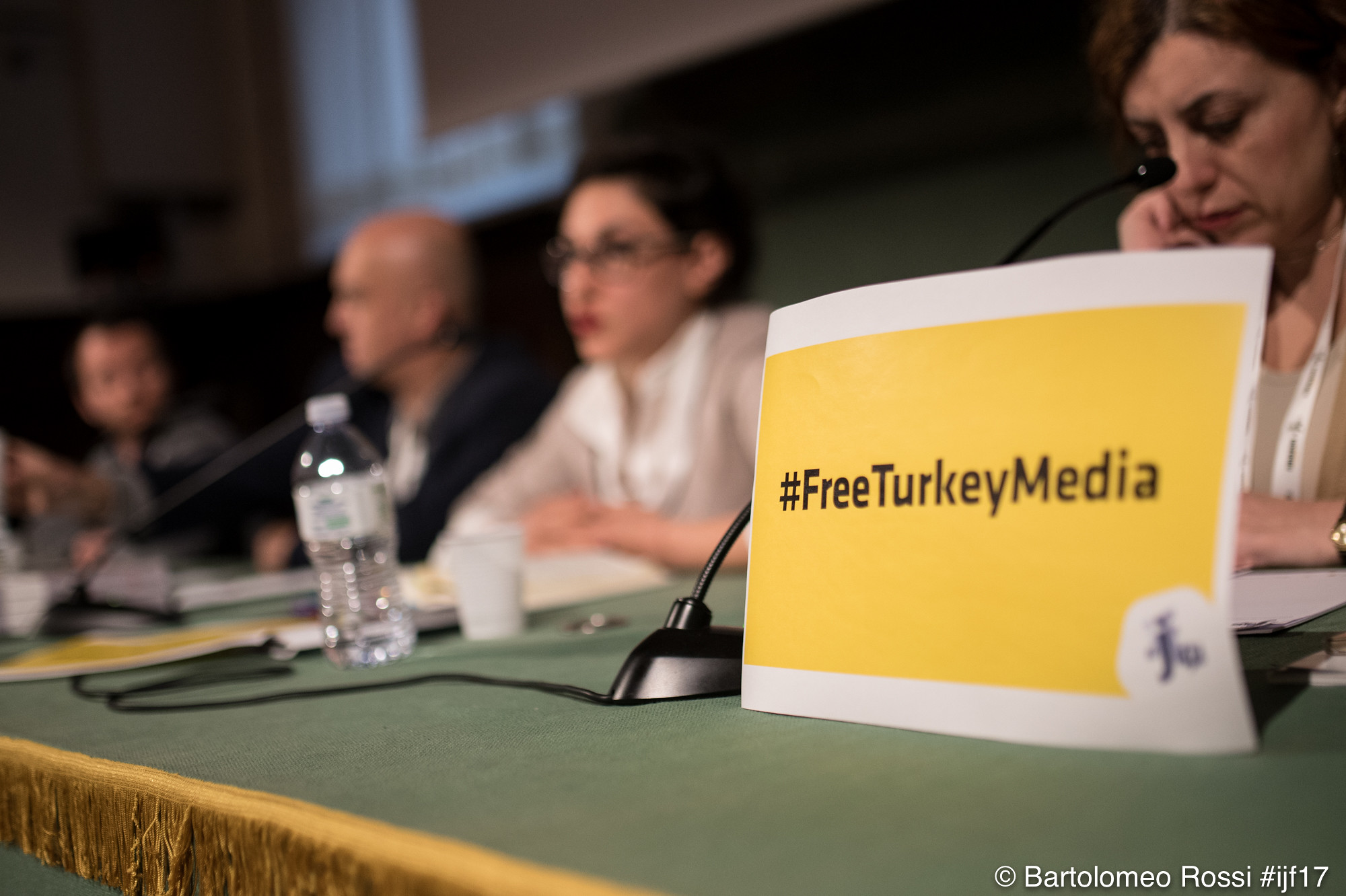
International Journalism Festival/Flickr
[/vc_column_text][/vc_column][/vc_row][vc_row][vc_column][vc_column_text]“In the Middle Ages people watched convicts getting quartered in public squares. Nowadays, on social media, they watch reporters as they live-tweet their ordeals: detention, physical attacks on the streets, losing their livelihoods,” said Turkish author and journalist Kaya Genç.
“For most Turks, watching journalists getting sacked or imprisoned or destroying each other’s careers became entertainment.”
Genç spoke to Index to answer questions posed by the Index youth advisory board about life as a journalist in Turkey under President Recep Tayyip Erdogan, and his latest book, The Lion and the Nightingale: A Journey Through Modern Turkey.
The youth board are elected for six months, and meet once a month online over that period to discuss freedom of expression issues. They are based around the world.
Hana Meihan Davis, from Hong Kong, asked how Erdogan managed to strip Turkey of journalistic freedom. Genç explained that divisions have existed between political sects in the media for decades, which the current ruling party was then able to take advantage of.
“When Islamists were in trouble in the 1990s secularists supported court cases against them; when secularists were locked up some liberals applauded; when Kurds were imprisoned most journalists looked the other way. Now as most of their colleagues are sacked or locked up conservatives act as if all is normal,” said Genç, who is also a contributing editor to Index on Censorship magazine.
Amid this sense of apathy Erdogan moved to create “a small army of loyalists in the media” as other news sites and newspapers were closed down.
Davis followed up her question, asking if people realised what was happening at the time? This is a question often asked when we look back with hindsight at the gradual erosion of freedoms. Were people like a frog who doesn’t realise the temperature of his water is slowly being increased to boiling? Genç said some journalists saw the dangers.
“Reporters and editors declared their independence, or found new patrons, and they are producing excellent work away from the influence of state power. I’m sure they were aware of what was happening while they worked at titles now tamed and indirectly owned by the government.”
The landscape for journalists in Turkey today is rocky terrain. There is an acute awareness of the censorship laws that can be imposed, coupled with a determination to provide much needed accurate reporting.
From the UK, Saffiyah Khalique asked about the laws around “public sensitivities”, which can result in imprisonment for up to a year for disrespecting the beliefs of religious groups, insulting Turkishness and other such “offences”. Genç said they are used within society to silence political dissenters.
“Twitter trolls who present themselves as pro-government journalists use these unclear laws to put their enemies behind bars. If an artist, piano player or actor says something critical about the government, they go through their timeline, find something they find insulting, and ask the public prosecutor to step in.”
Despite this possibility of prosecution being ever around the corner, Genç said he does not feel unsafe or threatened as a journalist in Turkey. “I feel free”, he answered to a question from Emily Boyle, a dual citizen of the UK and Switzerland
Recognising the value of objectivity appears to be Genç’s lifeline. When Indian national Samarth Mishra asked what is the most difficult part of being a journalist in Turkey, Genç said: “The hardest thing for a writer reporting from Turkey is to remain objective. You can’t be bitter about the government. Readers can benefit from the cold heart of a writer who does her best to be objective in her reporting.”
He said: “Our job, as writers, is to hold people with power to account, not to promote this or that political leader, defend this or that political ideology, propagate for this or that country … When a writer inhibits a space where nobody can accuse her of partisanship, believe me the effect of her writing will be much greater.”
The Lion and the Nightingale, Genç’s latest book, was published recently. It takes the reader on a journey through modern Turkey while exploring its history, via interviews he conducted on the road. Egil Sturk, from Sweden, asked Genç if there were any questions he was hesitant to ask his interviewees.
Genç said: “I am hesitant to ask questions about people’s religious beliefs and fiery ideological commitments. I prefer to give them enough space to articulate themselves where the bizarre, the eerie appears like a diamond in a mine. When people feel safe they tell you the most amazing things. Like an analyst you need to just sit there and listen.”
In answer to a question from Aliyah Orr (UK) about the emotional impact of the interviews he was conducting, Genç said:
“The prison chronicle of my friend and colleague Murat Çelikkan … had the strongest emotional effect on me. We used to work together, behind adjacent desks, and his experience in prison was empowering and unsettling. His account of imprisonment was rich with detail and you could see a great writer disappearing into the story’s characters and particulars of his story.”
Faye Gear from Canada asked what is different about today’s landscape in terms of freedom of expression. To tackle the suppression of free speech, Genç said people must think for themselves.
“I grew up idolising individual thinkers and writers: Susan Sontag, Jacques Derrida, Chantal Mouffe, VS Naipaul,” said Genç. “Nowadays we are invited to subscribe to what seems to be the most forward-thinking tribe and then follow its leaders by liking and retweeting their political snippets.”
In the face of an atmosphere of censorship, Genç remains defiant. In answer to a question from Satyabhama Rajoria, from India, about the struggles he faces as a journalist and author, Genç said: “There is of course always the anxiety that comes with publishing your writing, but that is healthy. Bullies, from the left and the right, may take your sentences out of context but that, too, is something one can deal with.”[/vc_column_text][/vc_column][/vc_row][vc_row][vc_column][vc_single_image image=”112300″ img_size=”full”][/vc_column][/vc_row][vc_row][vc_column][vc_basic_grid post_type=”post” max_items=”3″ grid_id=”vc_gid:1585828417099-e398f95f-d0bf-6″ taxonomies=”7355″][/vc_column][/vc_row]
17 Dec 2019 | News, United States, Volume 48.04 Winter 2019
Our Index on Censorship winter 2019 podcast features those who are living under the leadership of “macho” men and what exactly that means for their work and lives. Guests include Richard Hine aka @RealDonalDrumpf, who discusses what it is like running a Donald Trump parody account; news editor at Vice Italy Leonardo Bianchi talks about how Italian politician Matteo Salvini uses Trump-like tactics to silence the media and especially women journalists; also speaking of women journalist harassment is Brazilian reporter Patricia Campos Mello, who discusses working in the increasingly hostile environment under Bolsonaro; and finally Hungarian journalist Viktoria Serdült discusses the surprise election victory of an opposition candidate in Budapest, and Eurovision.
Print copies of the magazine are available on Amazon, or you can take out a digital subscription via Exact Editions. Copies are also available at the BFI, the Serpetine Gallery and MagCulture (all London), News from Nowhere (Liverpool). Red Lion Books (Colchester) and Home (Manchester). Each magazine sale helps Index on Censorship continue its fight for free expression worldwide.
29 Oct 2019 | Statements, Uncategorized

İdris Sayılgan’s father Ramazan, mother Sebiha and sisters Tuğba and İrem are waiting for İdris (Credit: Özgün Özçer)
Global press freedom groups, including Index on Censorship, argue Turkey no longer offers domestic remedy
A coalition of 10 international press freedom and journalism organisations has intervened at the European Court of Human Rights (ECtHR) in support of a case brought by İdris Sayılğan, a Turkish-Kurdish journalist jailed since 2016 on baseless anti-terror charges. The intervention focuses on the crucial question of domestic remedy, which has significant implications for the ECtHR’s handling of cases from Turkey.
Jessica Ní Mhainín, policy research and advocacy officer at Index on Censorship said: “Journalists and others in Turkey who have been criminalised and imprisoned for exercising their right to freedom of expression continue to be denied meaningful redress. We are hopeful that the ECtHR will recognise this lack of access to justice by accepting to take up İdris Sayılğan’s case. The situation in Turkey remains deeply concerning and journalists, such as Sayılğan, who speak out on issues relating to Turkey’s Kurdish minority remain particularly at risk.”
Sayılğan worked for the now-shuttered pro-Kurdish Dicle news agency (DİHA) before his arrest on October 7, 2016. Authorities did not inform him of the charge – membership of an armed terrorist organisation – until an indictment was produced nine months later. Typical of Turkey’s ongoing crackdown on the media, prosecutors’ evidence consists solely of Sayılğan’s journalistic work, indicating a politically driven effort to silence criticism.
His detention and trial have been marked by major violations of the right to a fair trial, described in documents filed by Sayılğan’s lawyers before the court. These violations include interference with Sayılğan’s right to legal counsel, denying him the right to appear personally in court, and preventing defence lawyers from calling witnesses. Sayılğan’s appeal to Turkey’s Constitutional Court, filed in July 2018, has gone unanswered. In January 2019, Sayılğan was sentenced to eight years and three months in prison.
The coalition’s intervention argues that the ECtHR should not require applicants from Turkey, such as Sayılğan, to first exhaust all “domestic remedies” – proceeding through all stages of the national-level appeals process – before applying to the Court. This argument is based on evidence that Turkey’s justice system, including the Constitutional Court, no longer offers an effective remedy. Judicial independence has been compromised and courts are unable to address cases in a fair, timely and consistent manner. The ECtHR’s current insistence on domestic remedy in Turkey largely prevents journalists and others from obtaining any meaningful redress to fundamental rights violations suffered.
“Idris Sayılğan’s case is but one of hundreds of examples of arbitrary detention and prosecution of Turkey’s journalists and the abject failure of a judicial system cowed by the political forces unleashed in 2016 to silence criticism,” said IPI Turkey Programmes Manager Oliver Money-Kyrle. “The European Court of Human Rights can offer a first step towards justice by recognising the absence of domestic remedy and accepting to take up Sayılğan’s case.”
A total of 130 journalists are behind bars in Turkey, and most are the victims of a wide-ranging crackdown on critics of the government of President Recep Tayyip Erdogan, which was set in motion following the July 2016 coup attempt and the subsequent enaction of a State of Emergency. Anti-terror laws have been Turkey’s main tool of choice to prosecute the press, though journalists have been frequently held for extended periods without official charges. Indictments invariably rely on journalists’ professional work, including articles, social media posts and conversations with sources. Trials are marked by violations of basic rights of defence.
Sayılğan is represented before the ECtHR by the Media Legal Defence Initiative (MLDI) and the Turkey-based Media and Law Studies Association (MLSA). The application argues violations of Article 5 (liberty and security), 6 (fair trial), 10 (freedom of expression), 13 (effective remedy) and 18 (limitation on rights).
The Intervention was submitted by the International Press Institute (IPI) on Friday, October 18, on behalf of a coalition of leading press and freedom of expression organisations including Article 19, the Association of European Journalists (AEJ), the Committee to Protect Journalists (CPJ), the European Centre for Press and Media Freedom (ECPMF), English PEN, the European Federation of Journalists (EFJ), Index on Censorship, the International Federation of Journalists (IFJ) and PEN International. The intervention was drafted with the help of international law firm Freshfields Bruckhaus Deringer.
