30 Mar 2026 | Americas, Asia and Pacific, Europe and Central Asia, Guatemala, Hong Kong, Israel, Middle East and North Africa, News, Palestine, Philippines, United Kingdom, United States
JAMES CAMERON MEMORIAL LECTURE 2026 – MARCH 4, 2026 – LONDON
It is January 2000; an aspiring student journalist is on a two-week work placement in Plymouth.
She writes stories on local music concerts, mix-ups over the introduction of the metric system for selling fruit and vegetables, clashes between local school sports teams, the building of a new community centre. She interviews strangers in the street about their favourite books as part of a nationwide survey and for their views on dentists. She covers sports, politics, arts, charity, business. And she knows, as she has known since she was six years old, that all she wants to be is a journalist.
It is January 2026. A photographer heads to cover protests in Minneapolis in the United States. As he tries to live stream and take photos of the crowd that has gathered to protest immigration enforcement in which a protestor was shot dead, he is tackled to the ground by immigration officers and pepper sprayed. He is handcuffed and arrested. And in that moment, the moment when he is hurled to the ground by officials in combat gear, clutching a face mask he’d bought in a local hardware store to protect himself from tear gas, the photographer thinks only of one thing. He must protect the images he has captured of these events – and he throws his camera out from under him in the hope someone will save it.
The journalist in Plymouth, on a two-week placement with the Evening Herald, was me. Then a postgraduate diploma student here at this very university. The photographer is John Abernathy, one of hundreds of journalists in the United States now grappling with a surge in violence against the profession.
We dreamed a lot of dreams when we were at City. I dreamed of being the Director General of the BBC. A friend of being the Editor of The Sun. Some wanted to be political reporters, others sports, some wanted to write about arts and culture, others economics and finance. We knew that over the years many would leave the profession. Some went on to great success in the very careers they envisaged, others took unexpected turns into academia, the civil service, and entertainment.
But what none of us could have predicted was how radically the environment would change for the profession itself. That the kinds of preparations journalists used to undertake to cover war zones would be needed to cover protests in North America. That journalists covering Westminster or the White House would regularly receive death threats. That a journalist in a European Union country might be killed for their investigative reporting.
But that is what has happened. Now, this moment, is the most dangerous time in recent history to be a journalist. Last year, a record 129 journalists and media workers were killed worldwide, the highest number ever in the more than 30 years that the Committee to Protect Journalists has been documenting such data. For the past three years, more than 300 journalists were in jail at the end of the year – including in countries that are supposed democracies. Journalists are subjected to daily online harassment, including threats of death and rape. They are smeared by those in power and mistrusted by those without it.
And yet – although this is the worst time in the world to be a journalist – it is also the most important time.
Today, I want to examine why journalism has become so devalued, why journalists have become so demeaned, and why those whose job it is to deliver facts, to speak truth to power, to expose corruption and injustice, are now in greater peril than at any time in recent history. I also want to share what we can do about it.
And why – if we want to live in anything approaching fair and just societies, ones that uphold rights and freedoms for all – it is essential that we step up to defend a free press — in deeds not just in words.
First, let me tell you a little bit about the Committee to Protect Journalists, the organisation I now lead. Based in New York, the Committee to Protect Journalists was founded in 1981 to defend press freedom and journalist safety worldwide. One of our first advocacy campaigns was in support of three British journalists arrested in Argentina while covering the Falklands War. A letter from then CPJ Honorary Chairman Walter Cronkite helped spring them from prison.
Sadly, the days when a letter and a stern word could provoke such a result are long gone, so CPJ now works in three ways:
• We research and document threats to press freedom globally,
• We provide direct assistance to journalists at risk,
• And we advocate on behalf of those targeted for their work.
Last year, we provided more than $1.3 million in direct financial assistance to journalists needing emergency support, covering everything from the cost of legal fees for reporters wrongfully imprisoned for their work, to medical bills and trauma support for journalists attacked and harassed in retaliation for their reporting, to exile assistance. We reached an unprecedented total of 3,877 journalists last year – more than 5 times the number of the previous year.
It’s no surprise those numbers have grown – because attacks on the press have grown exponentially in the past decade. In 1992, when CPJ first started systematically documenting attacks on the press, 56 journalists and media workers were killed. Last year’s number is more than double that. In 1992, there were 113 journalists in jail. Last year’s number is more than triple that.
In 1992, Mark Zuckerberg was 8 years old, the launch of Google was still six years away, and Facebook and Twitter would not emerge for more than another decade.
Now, the internet and social media dominate communications, and online harassment – especially of women and those from marginalised communities – is rife. Let me give you one recent example. In 2023, Sabrina Schnur, a young female reporter at the Las Vegas-Review Journal in the United States wrote about the hit-and-run killing of a retired police chief. Schnur was the first journalist at the scene after the killing and also the first local reporter to talk to the police chief’s family. But after screenshots of a month-old obituary sparked accusations the Review-Journal was downplaying the death, Schnur was subjected to a slew of hate-filled abuse. Her email inbox and social media mentions were flooded with personal attacks. She was accused of being anti-white. Her photo was shared, and her office phone number circulated. The attackers hurled antisemitic abuse at Schnur, told her they hoped she would get cancer, that she would die. They found her private social media accounts and unearthed posts she’d made as a teenager, going as far back as 2015.
Schnur and her colleagues had more reasons than most to be concerned about online threats. A year earlier one of the Review-Journal’s leading reporters – Jeff German – was stabbed to death by a local official who was the subject of German’s reporting. The suspect first targeted German with attacks on social media.
How did we get here? Not by accident.
The decline in press freedom and journalism safety is directly tied to a decline in democratic norms and a rise in authoritarianism that we are experiencing worldwide. And no wonder. Autocrats and demagogues have long known that to control a population, you need to control the flow of information to that population. Targeting the press is the first step to stifling dissent.
If we want to tackle this, we need to understand the playbook for attacking the media, which in essence goes something like this: Smear, Harass, Criminalise, Kill.
Let’s start with smearing. This is one you may be familiar with. Name calling may feel like the petulant act of the playground bully but it’s remarkably effective. Hungary’s leader Viktor Orbán does it, smearing the press as “fake news,” former Filipino President Rodrigo Duterte did it, calling them “presstitutes”, US President Donald Trump does it, calling journalists “enemies of the people” and most recently calling one journalist “piggy” and telling another who asked him about his ties to Epstein to “smile”.
More insidiously, we are increasingly seeing a tendency to smear journalism itself as a nefarious act – think of the way in which the US Secretary of Defence conjured images of journalists roaming the Pentagon as a security risk. What Pete Hegseth of course conveniently forgot was that journalists have operated successfully from the Pentagon for decades, while it was Hegseth himself who shared secure information about military plans on a Signal chat group in which a journalist had been mistakenly added. Rather than be seen as critical work in the public interest to expose abuses of power, journalism itself is being rebranded as a subversive act.
Smears escalate. By setting the tone at the top, those in power create a permission structure for harassment. Sometimes that might be formally orchestrated by those in power, more often it develops organically, among their supporters and sympathisers. Diaspora news outlet, The Haitian Times, for example, received a slew of racist abuse after it reported on the false claims made during the US presidential campaign about Haitians eating pets. In a demonstration of the online to offline risks, one reporter even had police show up at her house after a false report was made about a crime being committed there – a practice known as swatting.
Harassment does not just take the form of online or even physical abuse. It can be legal and regulatory as well. This includes the use of so-called SLAPPs – vexatious lawsuits that are designed to drain journalists and media organisations of money and morale. At the time of her murder in 2017, investigative Maltese journalist Daphne Caruana Galizia was facing 47 such suits. In July last year, CBS owner Paramount settled a case that legal experts widely agreed was spurious for $16 million – a case brought by none other than the US President himself. Weeks later the US broadcast regulator, the Federal Communications Commission, approved a multi billion dollar merger involving Paramount.
Harassment can also take financial form. Cutting funding or using public money to favour political friends and punish political enemies has long been a tactic of autocrats but we increasingly see this in democracies. Since Trump took office, his administration has all but eliminated funding for publicly funded media, mostly impacting local, regional broadcasters serving rural communities, as well as effectively shuttering Voice of America, Radio Free Europe and Radio Free Asia – all services that provided information to and about countries where media freedom is severely curtailed.
So, smearing, then harassment. These are steps one and two.
But it does not stop there. Because mud sticks. Demeaning journalists, branding them as cheats and liars paves the way for the third factor that is common to this playbook: actually criminalising journalism and journalists. Nobel laureate Maria Ressa has spoken extensively about the way branding of journalists as criminals by those in power helps soften the public up for subsequent actual criminalisation and arrest – and of course even killing. Years before the state launched lawsuits against her, the Philippines was readying the public to believe she was an actual criminal by painting her as one.
Dubbing journalists as criminals is a deliberate strategy intended to sow doubt in the mind of the public about their trustworthiness – and therefore about the trustworthiness of their information. It’s a means to control the narrative.
But criminalising journalists is not just about controlling public perception. It’s also used as a means to silence individual journalists – and to send a warning to other reporters and news outlets.
It is a tactic used increasingly, even in supposed democratic regimes. Take the example of Hong Kong where 78-year-old British citizen Jimmy Lai, founder of the independent Apple Daily newspaper, was given a 20 year jail sentence. Lai has been in jail in Hong Kong. Largely in solitary confinement, since 2020 on numerous charges, including sedition and collusion with foreign forces for having the temerity to publish a newspaper that covered pro-democracy protests. In Guatemala, José Rubén Zamora, who for decades has exposed government corruption in his country, was recently released from jail in Guatemala where he faced trumped up charges of money laundering. In both cases, the legal teams for these journalists have themselves faced targeted harassment and threats – and in both cases the newspapers they founded have been forced to shutter as a result of legal action.
And, of course, we have seen this over and over again in Gaza, where Israel repeatedly smears journalists as terrorists and militants, without providing evidence – as a way to justify subsequently killing them.
Killing journalists is the ultimate form of censorship. And no discussion of journalist safety in the current moment can avoid what has been the deadliest assault on journalists since CPJ began. Of the 129 journalists and media workers killed last year, 86 were killed by Israel. The majority of them were Palestinians. Israel has now killed more journalists than any other government since CPJ began collecting records in 1992, making the Israel-Gaza war the deadliest on record for journalists. And let’s be clear. These are not the ordinary casualties of war. In at least 38 cases documented by CPJ last year alone, we believe journalists were deliberately targeted. This includes Al Jazeera reporter Anas al-Sharif, whose life CPJ publicly warned was in danger after repeated, unsubstantiated smears by Israel against him. Following years of such threats, Al-Sharif was murdered on August 10, alongside three other Al Jazeera staff journalists and two freelancers in a strike on a tent housing reporters. Journalists are civilians. Deliberately targeting them constitutes a war crime.
The magnitude of Israel’s killings is exceptional, but – worldwide – the killing of journalists, the smearing of journalists, the harassment, the legal threats, the financial punishments – these are no longer an exception.
Ok. So at this point, you may be shrugging your shoulders and saying, “Who cares?” Maybe you think the media brought it on themselves. Maybe you hate the “lamestream” media and think we all deserve to be smeared, harassed and attacked.
I want to tell you why it matters.
It matters because information is a prerequisite for free and open societies. Attacks on journalists are the first sign of democratic decline. Study after study shows that attacks on journalists matter because they are a clear indicator that attacks on other rights, our rights, will follow.
It matters because journalism is essential for our everyday lives. Without it, we don’t have the information about the decisions being made by governments in our name or how our taxes are being spent. We don’t have information that might help keep us safer or healthier or might help stop abusive practices.
It matters because journalism is essential if we want to understand the world. In Gaza, it is Palestinian journalists who have been our eyes and ears for two and a half years so that we can understand what is happening there. With no independent international access allowed since October 7, it is local journalists who are bearing witness to the genocide that they are also living through.
Journalism is essential if we want to understand our own country. In the UK, it is journalists who have repeatedly uncovered government scandals. Journalists like my friend, former City alum, and multi award winning journalist Pippa Crerar, who – among other things – exposed the Partygate scandal. Harriet Harman, who chaired the parliamentary investigation into Partygate praised Pippa’s journalism in the Commons, saying: “This episode has shown that wrongdoing has not gone undiscovered and attempts to cover it up have failed, but it would have been undiscovered had not the press doggedly investigated.”
Journalism is essential because reliable, fact-based information can save lives. When wildfires broke out in California at the start of the year, local residents turned to local media for information about the outbreaks: about where was safe, how the fires were moving, what precautions to take. In many rural parts of the United States, there is no reliable internet. Local radio is the most important source of information, especially in an emergency. In rural Alaska, it is the local independent radio stations who are tasked with providing early warnings of tsunamis and extreme weather – stations whose funding has been gutted by federal cuts.
In the absence of independent, reliable fact-based media, a vacuum is created. One that is easily filled with lies, half-truths and propaganda.
We cannot afford to be complacent. Journalism has value, it has impact – and yet journalists are being killed at a faster rate than in any other time in recent history, journalists are being jailed in higher numbers than at any other moment in recent history. News deserts – places with no access to credible news and information about their local community – are spreading. Funding for independent journalism in and about countries with little or no media freedom has been slashed.
So, if we know journalism has value and if we know that it is under attack like never before, what are we going to do about it?
Well, firstly, we need to accept that current ways of operating are failing and we need to look for new ones.
One example of this is impunity. It is widely recognised that impunity – a failure to punish those responsible for attacks on journalists – creates environments that allows further attacks – more egregious, more violent attacks – to persist and flourish.
More than a decade ago, the United Nations established the International Day to End Impunity for Crimes Against Journalists as an effort to draw attention to this fact. Each year for more than a decade we at the Committee to Protect Journalists would publish a report on the worst offenders – the countries where most journalist murders had gone unpunished. And yet the numbers remained stubbornly and persistently high.
So, instead of thinking about what everyone else needed to do to address this, this year we took a look at ourselves.
And that’s why on International Day to End Impunity this year, CPJ decided to drop our annual Impunity Index. Measuring which governments were – literally – getting away with murder was a useful way to shed light on the issue a decade ago, but it’s no longer enough.
We are overhauling our approach to focus where we know we can have impact and on new initiatives that hold promise.
These initiatives include:
Firstly, pursuit of justice in key cases. Our experience in the past decade has shown that one of the most effective mechanisms for tackling impunity is a relentless pursuit of justice in individual cases. Going forward, CPJ is dedicating increased resources to a select number of such emblematic cases, supporting families and local communities in their often-lengthy fights to continue investigations and prosecutions.
Secondly, we are pushing for the establishment of a standing independent international investigative task force focused on violent crimes against journalists. Relying on perpetrators of crimes against journalists to lead investigations into those crimes and hold those responsible accountable will always make ending impunity an uphill if not impossible battle. We need an independent global body readily available to support investigations – local, regional or international – into attacks.
Thirdly, we need to see increased accountability from companies. Businesses play a key role in enabling attacks on journalists. CPJ is stepping up its focus on investigating and seeking accountability over the use of companies’ technology in cases where journalists are targeted or harmed. The increased use of drones is likely to be a particular focus in 2026.
We asked ourselves, “What can and should we be doing in this moment?” and it is a question we must all ask ourselves.
So here are some things you can do as an individual:
1. Spend money! Invest in local media
The evisceration of local media has been credibly linked to worsening outcomes for communities, including loss of community cohesion, lack of oversight and accountability leading to poor spending decisions, increased corruption, and even rising local taxes.
If you don’t already, do it, go out today and subscribe to your local news outlet. Or someone else’s. When the Kansan local newspaper the Marion Country Record in the US was wrongfully raided by police a few years ago, subscribers flooded to support the outlet – including many who lived hundreds of miles away. One Florida man told the Record’s editor he subscribed because he’d read local newspapers as a boy and missed the sense of community (2,500 kms away).
2. Lobby your local authorities and governments, and your employers!
It is not enough for governments to say they support a free press. They need to demonstrate this in practice, both at home, and in their dealings with governments abroad – and they need to know their constituent’s care.
As voters, we can ask our elected representatives to make these issues a priority.
As employees, we can ask our employers to make this a priority. If you are an academic, does your university have programs for exiled journalists/ journalists at risk? Do your professional journalism courses include safety modules as standard? If you are a journalist, does your employer provide digital health checks or privacy tools? If the answer to these questions is no, ask for them. I can help you…
3. Let’s do our jobs as journalists.
When I started at CPJ three and a half years ago, the motto of the organisation was “using the tools of journalism to protect journalists.” To be honest, as a former reporter, I somewhat scoffed at this description. After all, we are not a news agency. We are not a newspaper of record. We are an advocacy organisation. But over the past three years, as I have watched our profession fail over and over again in its coverage of Gaza, I have come to realise how important it is for all of us to recommit to, and publicly champion, the core principles of good journalism. It is the very essence of good journalism – the ruthless pursuit and public dissemination of facts – that will be our strongest defence.
Recentring facts means explaining how we got them and why they matter. One of the reasons I would argue that journalists have suffered such a loss of trust in recent years – quite apart from some clear and obvious failures, including illegal phone hacking here in the UK – is that we assumed people understood what we did and what value we had. But as more and more individuals claim to be journalists or news outlets claim to be conducting journalism, those who are engaged in actual journalism – reporting to establish facts – need to do more to show how they arrived at the information and why they should be trusted.
Recentring facts also means celebrating your impact. When I became a reporter, I was told time and again that journalists didn’t like to report on ourselves. That reporting on issues facing the industry could be considered self-indulgent. But if we want people to understand the worth of journalism, we must report not just the news, but how and when our reporting has effected change.
Let’s be half as brave as our colleagues who risk everything to report the truth. I was asked in a recent interview what message I had for Western journalists covering Gaza. My response – although in slightly more colourful language – was “Do your job.” The job of a journalist is not that of a parrot – it is not simply to ask questions and rehearse what we are told. That’s not fact finding. That’s stenography. Our job is to dig deeper, to see with our own eyes and hear with our own ears where possible, and – if not possible – to gather as much information from as many sources as possible to establish the truth.
Instead of worrying about being perceived to take sides, our responsibility is to report the facts. It requires courage. Cowardice is the enemy of good journalism. George Orwell had this right back in his original proposed preface to Animal Farm. “Obviously,” Orwell wrote, “it is not desirable that a government department should have any power of censorship… But the chief danger to freedom of thought and speech at this moment is not the direct interference of the MOI or any official body. If publishers and editors exert themselves to keep certain topics out of print, it is not because they are frightened of prosecution but because they are frightened of public opinion. In this country intellectual cowardice is the worst enemy a writer or journalist has to face, and that fact does not seem to me to have had the discussion it deserves.” Animal Farm was published in 1945. What Orwell wrote then is as true today: our job as journalists is to stand up to the bullies – not to bow to them. That’s what CPJ wrote to Shari Redstone, former chair of Paramount, when we urged her not to settle with Trump over his lawsuit against CBS. Capitulation creates a precedent – and each individual capitulation weakens the entire ecosystem.
I am by no means saying this is easy. Journalism will always be risky as will defending it. It takes a certain level of defiance – a willingness to speak truth to power, to report things as they are, as we see them, and to place them in context – even, and perhaps especially, when it’s not what people want to hear. Doing it well takes courage and conviction. In 2009, prominent Sri Lankan journalist Lasantha Wickrematunge was murdered by a group of men on motorcycles. He had been receiving threats for months but refused to stay silent about the injustices in his country. For the last decade, Filipino journalist – now Nobel Laureate, Maria Ressa has been subject to a relentless legal campaign intended to discredit, bankrupt, and ultimately silence the critical reporting coming from both her and her newsroom, Rappler. At one point, she faced a possible sentence of more than a hundred years behind bars. But Maria knows that the job of a journalist is to report the facts, not to bend to those who benefit from their burial. She refuses to stay silent.
More than 200 Palestinian journalists have been killed by Israel since the start of the Israel-Gaza war. Many have been deliberately threatened and warned explicitly by Israel to stop their reporting. All know the risks they take in wielding cameras when Israel has repeatedly targeted journalists even when wearing press vests and working from known press zones. They know that in the end facts are our superpower. They know that killing the messenger does not kill the message. So, they refused to stop. They refused to be silent. If we want to save journalists, if we want to save journalism, we all must do the same.
BY JODIE GINSBERG
CEO, COMMITTEE TO PROTECT JOURNALISTS
Editors note:
This is the alert that the CPJ put out over the weekend in response to an Israeli strike on a media car which killed three journalists in Southern Lebanon.
31 Jul 2019 | Azerbaijan, Monitoring and Advocating Coverage, News
[vc_row][vc_column][vc_single_image image=”108305″ img_size=”full” add_caption=”yes”][vc_column_text]The morning of 9 April did not promise to be out of the ordinary for Sevinc Osmanqizi, an Azerbaijani journalist based in the suburbs of Washington DC. She started her morning routine by making a fresh pot of coffee and readying her two sons for school. Prior to starting the daily broadcasts of her YouTube-based OsmanqiziTV channel, she checked her messages, which included links sent by friends to a broadcast that had aired a few days earlier on the recently-launched Real TV in Azerbaijan.
The host of the broadcast was all too familiar to Osmanqizi. It was her former colleague Mirshahin Aghayev, known to the TV-viewing public by only his first name. She saw her picture on the studio background monitors, and then heard her own voice. “It was a complete shock,” she said, describing her emotions. “This [was broadcast on] national TV, so why is my voice there, why am I hearing my personal conversation?”
The 9 April 2019 broadcast replayed a series of private voice messages Osmanqizi had exchanged with a media colleague who is in exile in Germany. “My first question was ‘how did they get ahold of it?’ The conversation took place more than a month prior. I was trying to remember the details. I couldn’t remember what platform I had used [to communicate]. This was one of many conversations that I’d had, it was personal,” she said. Some time later, she still seems disturbed by the incident. “I was asking myself, ‘if they have this conversation, what else do they have?’”
As Osmanqizi watched the rest of the broadcast, she grew more anxious. “It contained direct hints that they had more. They ran ads saying so.” In the next two weeks, the situation worsened, she said.
The channel that Aghayev operates, where he hosts his TV show, began airing information she said she had never shared on social media, including photos. Aghayev ominously promised his audience that they would see “much more.” In subsequent broadcasts, Aghayev revealed a series of intimate emails between Osmanqizi and a US-based man who Aghayev claimed was working for US intelligence services. He also insinuated that Osmanqizi herself was on the payroll of US special services, and threatened to air intimate photos and videos of her.
“I began to understand this is not a one-man operation, there is definitely official involvement,” Osmanquizi said, implying the involvement of the government of Azerbaijan.
“I immediately got very worried about her, and about another person she had a conversation with, after the broadcasts,” said Gulnoza Said, a senior researcher with the Committee to Protect Journalists (CPJ), a New York-based media freedom watchdog. “I was outraged because any conversation that two people have should remain private, and should never be used as state propaganda or to harass a journalist. And that’s exactly what we dealt with in Sevinc Osmanqizi’s case,” she said.[/vc_column_text][/vc_column][/vc_row][vc_row][vc_column][vc_column_text]Been there, seen that
Said and others’ concerns were not unfounded. Although Aghayev and his TV channel have scaled back their threats to air intimate photos, videos, and her remaining correspondence, these were not empty threats. Sonia Zilberman, South Caspian Energy and Environment Program Director at Crude Accountability, an environmental and human rights organisation in Washington DC, said that alarming parallels came to mind when she heard about the threats against Osmanqizi.
“This isn’t the first time. The case with Khadija Ismayilova was even more excruciating,” she said, referencing the 2012 case in which the Azerbaijani government had been widely criticised for airing intimate footage that had been obtained through illegal surveillance of another Azerbaijani female journalist. Ismayilova’s reporting on government corruption involving the country’s “first family” became sufficiently problematic that the authorities resorted to blackmail. Ismayilova was filmed at a private residence with a male companion, and was blackmailed with stills of video footage from a camera installed in a ceiling light. She was warned to stop her journalist investigations, and when she refused and disclosed the attempted blackmail, the video footage was leaked online.
“Talking at a human level, the amount of pressure that the Azerbaijani journalists face is enormous. Not only inside the country, but as we are seeing right now, outside the country as well,” Zilberman said. “Their personal lives are being infiltrated, they are constantly under pressure.” At the same time, she added, the pressure shows how far the Azerbaijani government is willing to go, and how dirty it is prepared to play.
Said agreed. “Khadija Ismayilova’s case was the first thing that came to my mind when I spoke to Sevinc. Also, I recall many other cases when women were harassed or extorted, or attempted to be extorted, by similar means.”
Whereas Khadija Ismayilova was illegally surveilled and recorded inside Azerbaijan, Osmanqizi’s data was collected while she resided in the United States. This is a cause for some additional concern, according to Said. “We have known for some time, and have heard allegations that the Azerbaijani authorities practice surveillance of journalists and opposition members in the country,” she said. “The case with Osmanqizi [showed] that they may go as far as to target Azerbaijanis with critical views living outside the country. This is very concerning.”
The similarity between Ismayilova’s case and the threats against Osmanqizi were not lost on other journalists. A number of media and journalism organisations issued statements condemning the actions of the Azerbaijani authorities. Both Said’s and Zilberman’s organisations have issued statements in support of Osmanqizi, and Deutsche Welle and others tweeted their support. One Free Press Coalition included her name in the 10 “Most Urgent” Threats to Press Freedom Around the World.[/vc_column_text][/vc_column][/vc_row][vc_row][vc_column][vc_column_text]“We are everything they are not”
The Azerbaijani authorities have been pouring millions, if not billions, of US dollars into “reputation laundering” to improve its standing in the west. Said noted that Azerbaijani authorities employed different tools, such as hiring respectable PR firms in Washington and some European capitals, and allegedly bribing some parliament members in Europe. “People like Sevinc Osmanqizi, or other journalists who live abroad and try to show to the world the real face of the Azerbaijani authorities, defeats the whole [set of] policies of the Azerbaijani authorities in creating their positive image,” she said, adding that the government perceives critical voices living outside the country as enemies they want to silence.
Osmanqizi’s YouTube channel airs daily broadcasts and call-in shows in Azerbaijani, and offers biting criticism of the government of Ilham Aliyev, the president of Azerbaijan, who is often chastised by international governments and organisations for his anti-democratic policies and imprisonment of journalists. She offers opinions not available on the government-controlled Azerbaijani media. She provides airtime to opposition figures and dissidents to whom other Azerbaijani television has been hostile for many years.
Osmanqizi is not alone.
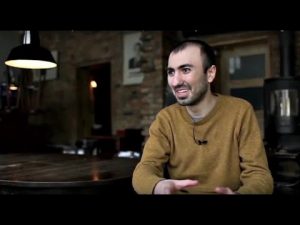
Hebib Muntezir was nominated for a 2016 Freedom of Expression Award for his work at Meydan TV.
“Since there are no normal conditions for free and independent media to function inside the country, and the local media are under control of the government and oligarchs, no one can directly criticise the authorities. So, in the last few years, many journalists and bloggers have left the country because of the persecution and pressure against them and their families. They started to create new media abroad, so they could continue their professional work. That is why these types of exiled Azerbaijani media have been mushrooming,” said Habib Muntezir, member of the board of the Berlin-based MeydanTV YouTube channel.
Osmanqizi said she “simply cannot” broadcast from within Azerbaijan. “I would be arrested the next day. That’s a clear cut case.”
What unites nearly all YouTube-based channels broadcasting from abroad is their stance in opposition to the current Aliyev government. “You can only show one side of the story. You cannot be impartial. In order to be impartial, you would have to cover all sides of the story. But if [the officials] refuse to talk to you, your platform becomes partial and lopsided. They label you ‘opposition,’ ‘activist’ media. But, as a journalist, you might be forced into this category against your wish,” he explains, saying that even independent experts on non-political matters are afraid to speak to independent exiled media sources for fear of persecution.
These channels form a diverse tapestry of voices, and vary in audience size, length of establishment, frequency of broadcasts, and most importantly, level of professionalism. Some are headed by professional journalists like Osmanqizi, a veteran alumna of the first independent TV channel ANS, where she had for years worked side by side with Aghayev, the host of broadcasts attempting to intimidate her. After leaving ANS, she worked for the BBC in London. Her channel has around 120,000 subscribers, impressive for a country the size of Azerbaijan.
Other channels, launched by people who lack journalistic experience or education, are often merely outlets for their operators to voice criticism of the government in the form of crude and insulting insinuations and rants. Some of these have impressive audiences, as well, as people look to them as the outlet for voicing their own pent up anger and frustration.
“Nowadays in the Azerbaijani media, there are very few professional journalists. Many were originally activists, people with courage, and they gain experience on the job. Lack of formal training leads to mistakes that violate media ethics, and some unprofessional action. Pressure and fear of persecution by the government are lowering the quality of the Azerbaijani media,” Muntezir said, noting the impact of an unfree society on both sides of the camera or microphone.
“If the environment were free, if people didn’t freeze with fear whenever they saw a microphone, if citizens were not afraid to speak to media, if the government, president, and ministers talked to the free media, we would not live in a blockade state,” Muntezir said.
According to Osmanqizi, when it comes to attacks on exiled media, “the government is losing the competition” for the hearts and minds of the public. “We are everything they are not,” she said. “What they are lacking is the truth, the reality. People see themselves in our programs, they recognise their problems, which is not the case with government-sponsored TV programs. That is why they tune into our channel.”
In her view, the choice between traditional and online media is really a choice between information and disinformation, and the latter is very easy to identify, she said. “You cannot fool anyone and make them believe that Real TV or [state broadcaster] AzTV is real news. People only watch them when they lose their remote control,” Osmanqizi adds, laughing.
The new internet-based TV channels offer the chance for the people to express their own opinions, and to hear the voices of average citizens they identify with. “They participate,” she explains. “Unfortunately, this is not something that can be done from inside Azerbaijan.”
Viewers are calling from inside the country for better journalism, and sometimes their support for the hosts of foreign-based channels speaking truth to power may cost them their freedom. Osmanqizi said this fate befell her viewer, Elzamin Salayev, after he recorded a video appeal condemning Aghayev’s campaign against her. According to Osmanqizi, he was given a fifteen day prison sentence for condemning Aghayev and questioning his morals for threatening to broadcast her intimate footage.[/vc_column_text][/vc_column][/vc_row][vc_row][vc_column][vc_column_text]Camera… Lights… Attack!
There is very little doubt in the mind of Osmanqizi and others interviewed for this article as to where the orders for the attacks on journalists originate. “I have absolutely no doubt that they’re coming from the highest political leadership of Azerbaijan,” Osmanqizi said.
It is common knowledge in Azerbaijan as to who stands behind attacks appearing in the Azerbaijani media. Both Osmanqizi and Muntezir point to Ali Hasanov, an aide to the president on political and social affairs, as the architect of the attacks. “The order to attack is coming from Ali Hasanov and his group. I call the people who plan these attacks the presidential apparatus trolls,” Muntezir said, referencing Hasanov’s office as part of the president’s executive office. “The [TV] channels are being directly ordered what to broadcast. XazarTV is owned by Hasanov’s son, Shamkhal Hasanov. SpaceTV is owned by Sevil Aliyeva, the sister of the president.” The channels, he argued, are completely subservient to the authorities.
Osmanqizi agrees. “Hasanov has been the president’s media adviser for 23 years. He was Heydar Aliyev’s advisor, and now he is Ilham Aliyev’s advisor.” Heydar Aliyev, the nation’s former president, passed the helm to his son Ilham.
Earlier this year, Mirshahin Aghayev, the journalist from Real TV who threatened Osmanqizi, received a medal from the state security ministry (MTN) commemorating the 100th anniversary of “State Security and Foreign Intelligence Services.” The medal was awarded by Ilham Aliyev’s presidential decree and presented to Aghayev by MTN’s head of public affairs, Arif Babayev, during a ceremony at the TV station. In footage of the event broadcast on Real TV, Babayev calls Aghayev “someone we love very much.” Osmanqizi was dismayed that a journalist would be awarded such a medal by the intelligence service, and more so, that the ceremony would be proudly broadcast. She also wondered about Aghayev’s accomplishments that merited such an unusual recognition. “What has he done for them?” she asks. “Have you heard of any such thing in another country?”
Aghayev has been a prominent journalist in Azerbaijan since the early 1990s. He began his career at ANS TV, the first independent media source in the country after the fall of the Soviet Union. He gained popularity with daring broadcasts that blurred the line between news reporting and opinion. In a country where there was no alternative to rigid state-controlled TV news, his reporting was a breath of fresh air, revitalising the media environment.
A degree of criticism was tolerated by the senior Aliyev’s regime, and ANS was allowed certain journalistic liberties. The government invariably pointed to ANS when defending itself against domestic and foreign critics who accused it of persecuting journalists. However, the Azerbaijani government’s toleration of ANS ended on 29 July 2016 when the station’s licence was revoked after ANS broadcast an interview with Fethullah Gülen, an exiled Turkish cleric based in the United States who Turkey was attempting to extradite.
“ANS was shut down because it broadcasted reports that were not in line with presidential apparatus policy,” said Muntezir. “The condition to return ANS’s licence was that it would begin working under the direct supervision of Hasanov, and not broadcast a single sentence without the presidential apparatus’s approval nor stray from its dictates,” he said.
Prior to and during the controversy around ANS, Aghayev benefited from his stardom by teaching journalism. He was regarded as an institution.
He re-emerged from relative obscurity in March 2018, when the government granted a licence to a new broadcaster, Real TV. Aghayev took the helm at Real TV, and since then has been attacking and using insults and his signature word play and intentional slips of the tongue to smear anyone who dares to disagree with or criticise the authorities. Both Osmanqizi and Muntezir say that the motivation for allowing Aghayev back on the air and installing him at the helm of a new TV channel was the government’s need to counteract exiled media and critics of the regime who were outside its legal reach.
“[Before being allowed back on TV] Mirsahin [Aghayev] was made to promise that he would go on air every week and attack not only the opposition, but also those who think differently from the government. Otherwise, he could not return to TV. And he does so, every week,” said Muntezir. He added that Aghayev’s recently-launched Real TV was issued a new broadcast licence.
On 7 April, Aghayev made one of the most notorious appeals in the history of his editorial broadcasting. Using word play and double negatives, he called for treating opposition members “as if they did not have the Azerbaijani identity card,” meaning non-citizens with no rights. “If we did not live in a democratic country, I would call on emergency medical personnel not to treat them, bus drivers not to allow them to board buses, bread sellers not to sell them bread. But we live in a democratic society,” he said on the air. Media experts and lawyers in Azerbaijan have debated whether these words rise to the level of hate speech, and quite a few of them agreed, in interviews, that it did. So do many members of the opposition.
On April 21, Aghayev issued an ultimatum to Osmanqizi on his TV broadcast demanding that she stop her critical YouTube broadcasts, “or else.” When she refused, she said, “on 28 April my intimate materials were aired.”
In addition to airing private conversations and email correspondence pertaining to Osmanqizi, Aghayev also said that Osmanqizi had asked him to assign her to conduct interviews with local businesses. Imitating her manner of speech and voice inflection, he accused her of seeking to benefit financially from puff pieces that she would air. Aghayev and Osmanqizi had worked together at ANS between 2008 and 2013. He had been her supervisor.
Finally, on 16 July, Aghayev doubled down against the chorus of condemnation, and admitted in a television interview that he is no longer unbiased, something his critics accused him of for quite some time. “Now we have a position. It is impossible to have a position and remain unbiased. Now, we take a side,” he is quoted as saying in an article, promising to be “even more harsh, and give everyone what is due to them.” The irony that was not lost on anyone in the country, judging by numerous public comments on social media, that it was ANS TV that had made him iconic and brought him his following. For years, ANS had started and ended its broadcasts with the slogan, “Reliable, Conscientious, Unbiased.” [/vc_column_text][/vc_column][/vc_row][vc_row][vc_column][vc_column_text]Trollin’ trollin’ trollin’/Don’t try to understand them/ Just rope and throw and brand ’em
The government of Azerbaijan not only uses terrestrial broadcasters, such as Aghayev’s Real TV and other television channels that it controls, but also utilises armies of fake accounts to discredit dissident journalists, known as troll factories.
The comments sections of YouTube videos posted to OsmanqiziTV, MeydanTV, and other critical channels are full of comments from people with fake names and accounts. These comments often contain threats, insults, inane arguments or praise for the ruling regime.
But the measures taken by the Azerbaijani government to sideline, marginalise and silence critical voices in exiled media, although impressive, do not appear to be working, according to both Osmanqizi and Muntezir.
“People don’t believe them, definitely,” Muntezir said of the trolls. “It is wrong to say that the people don’t know the truth, and cannot separate fact from fiction. They know the truth very well, and are aware of what is going on in the country. They are aware of the trolls and their work. They know the Azerbaijani government supports them, they know they spread lies.”
According to Muntezir, this troll network is neither professional nor effective. “They open a new profile with no picture, a clean slate. They repeatedly copy and paste the same text, often from presidential speeches. They paste the text under content that is not even political,” he explained, saying that even news stories about football have comments citing Ilham Aliyev’s speeches and heaping praise on the government.
Muntezir said he has a good guess as to the identity of the people behind the troll profiles. “I know it for a fact that they compile reports about their work. It might be a student, or a teacher, or a government employee. Once a week, it is their turn, and they are sat down and made to copy and paste comments. They have to report how many comments they make, and support the data with screenshots. They have dedicated Whatsapp groups,” he said, referencing the smartphone app through which the trolls purportedly communicate and receive their marching orders. “People have repeatedly sent me screenshots of those conversations. They have lists of media sources they are expected to attack. But they burn themselves too fast, they operate unprofessionally,” Muntezir said.
According to Osmanqizi, the effect is exactly the opposite of the goal. She calls it the “boomerang effect.” “We are more popular, and have wider reach. On the other hand, they are not serving their target. They have not proven effective because nowadays, people can differentiate the truth from the lies. People have grown accustomed to the constant attacks accusing us of things we have not done,” she said. “They know it is propaganda. It is a lie machine.”
She said these efforts “only prove that what we are doing is important. The government of Azerbaijan is wasting its resources and money to combat its rivals and critics [because it cannot tolerate criticism].” She calls the attacks on her “the government’s defence mechanism,” because the government does not like being held accountable. “The people understand it’s a matter of accountability,” she said. “[Holding the government accountable] is something media in Azerbaijan should have been doing, but since the free media has been marginalised and destroyed [in the country, the people] appreciate our work.”
Muntezir believes that idea behind troll factories originated in Russia. “Putin started doing this with a higher degree of professionalism. Our [officials] talk about the integration with the west, while copy-pasting all of the disgusting things from Russia at the same time.” He describes the quality of the Azerbaijani trolls as akin to “Chinese-made counterfeits of the original.”
Osmanqizi, no stranger to mass troll attacks on the comments section under her videos, said that the attacks prove the effectiveness of exiled media. “If it was not the case [that exiled media was effective], we would not be targeted… They woke up one day and realised they can no longer influence public opinion. It is being formed beyond their reach and authority. Now they are playing catch-up, and they have not been very creative. They cannot prevent people from watching us. All they can do is smear and harass,” she said.
Crude Accountability’s Zilberman agrees with the ineffectiveness of the government’s tactics. “I think the government is shooting itself in the foot by dishonouring the Azerbaijani women who provide access to information inside their country. In any country, dishonouring somebody personally is really shameful, because the attack is personal, and not professional.”[/vc_column_text][/vc_column][/vc_row][vc_row][vc_column][vc_column_text]
Journalist Ismail Djalilov recalls his recent experience with trolls
[/vc_column_text][vc_column_text]As a former friend and colleague of Mirshahin Aghayev, this was a difficult article for me to write. It took a long time, because in the middle of writing about trolls, I myself have become the target of a wall of faceless, nameless hordes and a mass concerted effort against my online presence. I needed to distance myself from the attacks, and regain my composure, to ensure I could resume working on this article as impartially and honestly as I could.
To make matters worse, much worse, I suspect that I have become the target of attacks not by pro-government trolls, but trolls working for one of the largest opposition parties in Azerbaijan, which declares its adherence to principles of democratic development and freedom.
Following my broadcast of an interview with an opposition group member in which he criticised the leader of a much larger opposition party, I was singled out and barraged by insults, insinuations, and homophobic comments (I am openly gay in a country considered the most homophobic in wider Europe). This was a shocking experience for me, as I myself did not utter a word during the part of the interview about the opposition leader, and considered the comments by my guest to be measured and within ethical norms that did not merit my interruption.
What was shocking and bewildering to me is that these attacks came from the opposition party for which I admitted voting when I lived in Azerbaijan decades ago. I felt betrayed by the very people whose ideals I believed in and whose rights I had been trying to defend, and whose plight I had been trying to publicise in my work.
I understand that in a country with a ruthless regime playing dirty with anyone who dares to dissent, opposition parties must employ some of the government’s tactics in order to protect themselves and survive. If the government employs throngs of trolls to smear the opposition, the opposition must do something similar in order to protect itself. It is understandable that some of the proponents of opposition leaders have taken it upon themselves to engage in smear campaigns and vicious personal attacks against me. They saw me, as the owner of the channel, as ultimately responsible for whatever criticism that was voiced against their beloved leader.
I had time for little other than deleting insults from the comments sections of my videos for two days straight. My Facebook page was shut down numerous times (I lost count after eight suspensions in the span of four days). There were mass complaints against my account for “impersonating someone else.” First, I had to send a picture of my ID showing my personal data. I would regain access. Then, Facebook demanded a picture of me holding the ID. Rinse, repeat.
Once my account was unblocked, I made a passionate, and somewhat angry, appeal to the leader of the party in question. Not mincing words, I told him I had no longer considered him a friend of free press, since he had remained silent in the face of attacks by his party members against a journalist doing his best to do honest work. I called on him to deny that his party employed trolls, like many of his supporters had claimed on my Facebook page and in public comments. I called on his party to reject troll tactics, condemn them, and unequivocally state that trolls are detrimental to civilised public discourse in our country which is under ruthless dictatorial rule.
None of that happened. During an appearance on a YouTube broadcast, his supporters proceeded to call me “an American pig” (I am a United States citizen), and said that “they had lists of those they would hang when they come to power. I was on them.” Strangely, these comments were not blocked or deleted during or in the hours after the broadcast.
Due to the bizarre logic of “enemy of my enemy is my friend,” I found myself defended by pro-government newspapers, Facebook pages and journalists. The very same ones that had, a year earlier, run shaming headlines leaking pictures of my wedding (to another man) and calling me an abomination or far worse. The shame of being defended by regime apologists is the worst thing with which I must now come to terms.
At the time, the party denied any involvement. Officials and supporters alike demanded that I produce screenshots of the comments. Though I had deleted most of them out of sheer embarrassment, I was able to send them the ones I and my friends had saved. There were denials that these commenters had been affiliated with the party in question, but my friends pointed to their profiles, which showed that they were. Then the response was that these accounts had been hijacked by government trolls to attack me. At that point, I stopped following the zigzags of disingenuous denials. However, I have heard privately from friends that a few of the party’s members “have been chided,” and were told not to use slurs regarding sexual orientation. I will take that.
The very nature of trolling means people do not use their real names or pictures most of the time. They do not pose for avatar pictures holding their party IDs in their hands. I cannot name names, but I did what I could. In addition, I know for a fact that I was not the first, nor will I be the last person to be attacked by the trolls affiliated with this particular political party. There have been numerous cases before me, and I believe the public was on my side. I feel I was vindicated. I learned a valuable lesson in the process: speaking truth to power does not entail just the regime; at times, it means even the pro-democracy opposition. This was a shocking and unpleasant discovery that informs the direction of my future work. [/vc_column_text][/vc_column][/vc_row][vc_row][vc_column][vc_column_text]The author of this piece, Ismail Djalilov, previously worked with Mirshahin Aghayev at ANS. Djalilov and Sevinc Osmanqizi did not coincide with each other at ANS. He is also host of duzdanisaq (Straight Talk), a YouTube channel broadcasting into Azerbaijan.[/vc_column_text][/vc_column][/vc_row][vc_row][vc_column][vc_custom_heading text=”Monitoring and Advocating for Media Freedom” font_container=”tag:h3|text_align:left” use_theme_fonts=”yes”][vc_row_inner][vc_column_inner width=”1/4″][vc_icon icon_fontawesome=”fa fa-times” color=”black” background_style=”rounded” size=”xl” align=”right”][/vc_column_inner][vc_column_inner width=”3/4″][vc_column_text]Index on Censorship’s Monitoring and Advocating for Media Freedom project documents, analyses, and publicises threats, limitations and violations related to media freedom in Azerbaijan, Belarus, Russia, Turkey and Ukraine, in order to identify possible opportunities for advancing media freedom in these countries.
The project collects, analyses and publicises limitations, threats and violations that affect journalists as they do their job, and advocates for greater press freedom in these countries and raises alerts at the international level.
The project builds on Index on Censorship’s 4.5 years monitoring media freedom in 43 European countries, as part of Mapping Media Freedom platform.[/vc_column_text][/vc_column_inner][/vc_row_inner][/vc_column][/vc_row][vc_row][vc_column][three_column_post title=”Incidents by month: Azerbaijan” full_width_heading=”true” category_id=”34499″][/vc_column][/vc_row][vc_row][vc_column][vc_custom_heading text=”Press Freedom Violations in Azerbaijan” font_container=”tag:h3|text_align:center” use_theme_fonts=”yes”][vc_column_text]
Number and types of incidents recorded between 1 February and 30 June 2019
Incidents can be in more than once category.
[/vc_column_text][vc_row_inner css=”.vc_custom_1558428123542{background-color: #f4f4f4 !important;}”][vc_column_inner width=”1/3″][vc_column_text]
0
Death/Killing
[/vc_column_text][/vc_column_inner][vc_column_inner width=”1/3″][vc_column_text]
0
Physical Assault/Injury
[/vc_column_text][/vc_column_inner][vc_column_inner width=”1/3″][vc_column_text]
13
Arrest/Detention/Interrogation
[/vc_column_text][/vc_column_inner][/vc_row_inner][vc_row_inner][vc_column_inner width=”1/3″][vc_column_text]
11
Criminal Charges/Fines/Sentences
[/vc_column_text][/vc_column_inner][vc_column_inner width=”1/3″][vc_column_text]
8
Intimidation
[/vc_column_text][/vc_column_inner][vc_column_inner width=”1/3″][vc_column_text]
15
Blocked Access
[/vc_column_text][/vc_column_inner][/vc_row_inner][vc_row_inner css=”.vc_custom_1558428157046{background-color: #f4f4f4 !important;}”][vc_column_inner width=”1/3″][vc_column_text]
0
Attack to Property
[/vc_column_text][/vc_column_inner][vc_column_inner width=”1/3″][vc_column_text]
3
Subpoena/Court Order/Lawsuits
[/vc_column_text][/vc_column_inner][vc_column_inner width=”1/3″][vc_column_text]
15
Legal Measures/Legislation
[/vc_column_text][/vc_column_inner][/vc_row_inner][vc_row_inner][vc_column_inner width=”1/3″][vc_column_text]
1
Offine Harassment
[/vc_column_text][/vc_column_inner][vc_column_inner width=”1/3″][vc_column_text]
1
Online Harassment
[/vc_column_text][/vc_column_inner][vc_column_inner width=”1/3″][vc_column_text]
2
DDoS/Hacking/Doxing
[/vc_column_text][/vc_column_inner][/vc_row_inner][vc_row_inner css=”.vc_custom_1558428169374{background-color: #f4f4f4 !important;}”][vc_column_inner width=”1/3″][vc_column_text]
4
Censorship
[/vc_column_text][/vc_column_inner][vc_column_inner width=”1/3″][vc_column_text]
31
Total
[/vc_column_text][/vc_column_inner][vc_column_inner width=”1/3″][/vc_column_inner][/vc_row_inner][vc_separator][vc_column_text]
Source of the incidents recorded between 1 February and 30 June 2019
[/vc_column_text][vc_row_inner css=”.vc_custom_1558428178637{background-color: #f4f4f4 !important;}”][vc_column_inner width=”1/3″][vc_column_text]
0
Employer/Publisher/Colleague(s)
[/vc_column_text][/vc_column_inner][vc_column_inner width=”1/3″][vc_column_text]
24
Police/State Security
[/vc_column_text][/vc_column_inner][vc_column_inner width=”1/3″][vc_column_text]
0
Private Security
[/vc_column_text][/vc_column_inner][/vc_row_inner][vc_row_inner][vc_column_inner width=”1/3″][vc_column_text]
16
Court/Judicial
[/vc_column_text][/vc_column_inner][vc_column_inner width=”1/3″][vc_column_text]
10
Government official(s)/State Agency/Political Party
[/vc_column_text][/vc_column_inner][vc_column_inner width=”1/3″][vc_column_text]
1
Corporation
[/vc_column_text][/vc_column_inner][/vc_row_inner][vc_row_inner css=”.vc_custom_1558428186205{background-color: #f4f4f4 !important;}”][vc_column_inner width=”1/3″][vc_column_text]
1
Known private individual(s)
[/vc_column_text][/vc_column_inner][vc_column_inner width=”1/3″][vc_column_text]
1
Another Media Outlet
[/vc_column_text][/vc_column_inner][vc_column_inner width=”1/3″][vc_column_text]
0
Criminal Organisation
[/vc_column_text][/vc_column_inner][/vc_row_inner][vc_row_inner][vc_column_inner width=”1/3″][vc_column_text]
2
Unknown
[/vc_column_text][/vc_column_inner][vc_column_inner width=”1/3″][/vc_column_inner][vc_column_inner width=”1/3″][/vc_column_inner][/vc_row_inner][/vc_column][/vc_row]
