16 Jan 2015 | Azerbaijan, Azerbaijan Letters, News
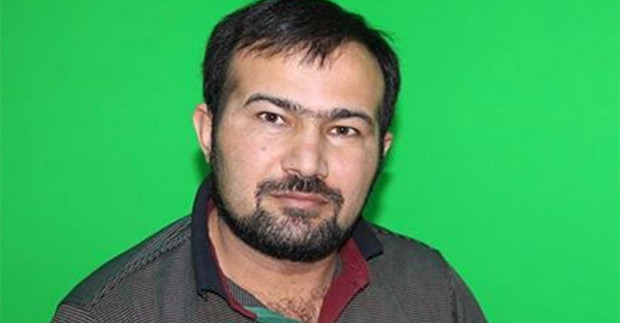
Journalist Seymur Hezi, who works for Index award-winning Azadliq newspaper, is in prison awaiting trial. Hezi was arrested on trumped-up charges of hooliganism on 29 August 2014. The journalist denies the charges, says they are politically motivated and are linked to his work.
Hezi has shared a letter with Meydan TV:
I feel good in the prison. I have no complaints in regard to my health and general mood. There is nothing different besides that I miss my friends and relatives. I think about what is going around and read much. I wouldn’t like to waste my time. I don’t know how much time I’ll spend here, so I don’t want to lose this period. My advice to the youth in freedom is that, wasting time for nothing is unacceptable, whatever the conditions are.
Sometimes I get some newspapers. Recently, I’ve read in one of them the letter Khadija Ismail wrote from the prison and I was impressed. Maybe, the very first reason is that we are very close here from the viewpoint of distance. Here, in Kurdakhany, the distance between us may be some 100 feet, only. Maybe, even less. The author of the letter is kept some 100 feet away me.
I possess strange feelings after reading her letter. The letter full of will and determination has been written by a woman. An Azerbaijani woman. You know that we had many of such determined and strong-willed women in our history. But such determination and will of struggle in a woman in prison… It is a true historical event. It is the history of our will, determination and decisiveness. Particularly, of our women…
Khadija Ismail is one of the greatest examples of righteousness truthfulness and the direct expression of true words. For her, there is only truth and nothing else and it is right, whatever the arguments are. It is right despite of all obstacles in front of her. She is being tested for it every single day.
I don’t know whether we owe it to extreme patriarchal state of our society or something else, expressing the power, endeavor and bravery of a woman, our fathers have always said: “Sheis a woman like a man”. Today, observing a woman like Khadija, we can change this saying. For expressing the manhood and will of a man, I would say: “He is a man like the Azerbaijani woman” or more correctly: “He is a man just like Khadija”.
My greetings to my friends and relatives. I kiss and hug all of you. Wish to reach beautiful days of freedom. Earlier or later, we will meet soon. I love you.
Your friend,
Seymur Hezi
01/13/2015
This article was originally posted on 14 January 2015 at meydan.tv. It is reposted here with permission.
15 Jan 2015 | Bahrain, News, Statements
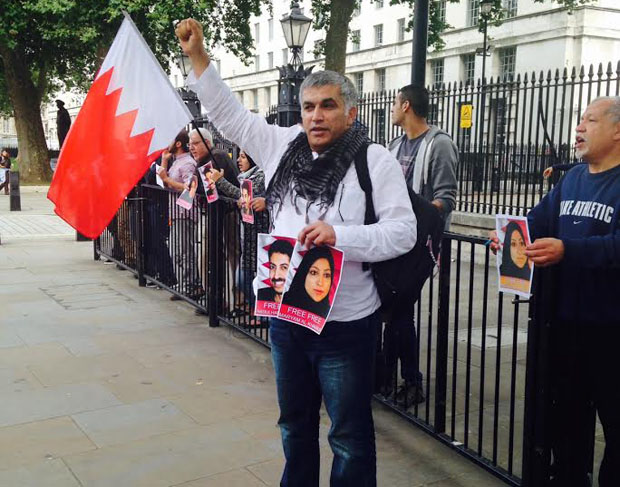
Nabeel Rajab during a protest in London in September (Photo: Milana Knezevic)
Index on Censorship is calling on the government of Bahrain to drop its charges against human rights campaigner Nabeel Rajab.
In October a Bahraini court ruled that Nabeel Rajab would face criminal charges stemming from a single tweet in which both the ministry of interior and the ministry of defence allege that he “denigrated government institutions”. If convicted, Rajab could face up to six years in prison.
“Nabeel Rajab, an Index on Censorship Freedom of Expression award winner, was arrested for a tweet in which he did no more than simply express an opinion. For this he faces years in jail. As the world renews its focus on freedom of expression it is vital that we defend those punished for speaking out no matter where they are in the world. Join us in calling for Nabeel’s release,” Index on Censorship CEO Jodie Ginsberg said.
15 January 2015 — 16 human rights organisations have written to 47 States to express grave concern ahead of a 20 January verdict in the trial of Nabeel Rajab, a prominent Bahraini human rights defender. Additionally, Americans for Democracy and Human Rights in Bahrain, The Bahrain Center for Human Rights and The Bahrain Institute for Rights and Democracy sent letters to members of parliament in all 47 States and United Nations officials, urging them to publicly call on the Government of Bahrain to drop all charges against Rajab.
On 1 October 2014, Rajab reported to the Cyber Crimes Unit of Bahrain’s General Directorate of Criminal Investigations (CID) after being summoned for questioning. Following hours of interrogation in relation to a tweet he published while abroad, Rajab was arrested. The tweet read: “Many #Bahrain men who joined #terrorism & #ISIS came from security institutions and those institutions were the first ideological incubator.”
For this tweet, Rajab was charged with insulting the Ministries of Interior and Defense under article 216 of Bahrain’s penal code, which states that “A person shall be liable for imprisonment or payment of a fine if he offends by any method of expression the National Assembly, or other constitutional institutions, the army, law courts, authorities or government agencies.” Rajab was released on bail on 2 November, but was banned from traveling outside the country. If found guilty, he could face up to six years in prison.
The charges leveled against Rajab are illegal under Bahrain’s commitments to the international community and international human rights law. Bahrain is party to the International Covenant on Civil and Political Rights (ICCPR), having acceded to the covenant in 2006. Article 19 of the ICCPR provides everyone with the fundamental rights to opinion and expression. Further, international jus cogens norms protect against the arbitrary deprivation of liberty, especially in relation to acts related to free expression. By prosecuting Rajab for statements that he made over Twitter, the Bahraini government violates its own commitments to the international community.
The ongoing suppression of basic human rights in Bahrain has drawn heavy criticism from the international community. In June 2014, 47 United Nations Member States signed a joint statement on Bahrain expressing concern “about the continued harassment and imprisonment of persons exercising their rights to freedom of opinion and expression, including human rights defenders.” The statement also called on Bahrain to “release all persons imprisoned solely for exercising human rights, including human rights defenders.” In 2014 a European Parliament resolution also called for “the immediate and unconditional release of all prisoners of conscience, political activists, journalists, human rights defenders and peaceful protesters, including Nabeel Rajab. …”
The undersigned NGOs close the letter by urging the international community to explicitly and publicly call for the Government of Bahrain to immediately drop all charges against Rajab and the many others currently facing charges or serving arbitrary jail sentences for exercising their rights to freedom of expression, association and assembly.
NGO signatories:
Amnesty International
CIVICUS
English Pen (Letter to the UK Foreign Office only)
Freedom House
Front Line Defenders
Human Rights Watch
Index on Censorship
Pen International
Project on Middle East Democracy
Rafto Foundation for human rights (Letter to the Norwegian Ministry of Foreign Affairs only)
FIDH in the framework of the Observatory for the Protection of Human Rights Defenders
OMCT in the framework of the Observatory for the Protection of Human Rights Defenders
Americans for Democracy and Human Rights in Bahrain
Bahrain Center for Human Rights
Bahrain Institute for Rights and Democracy
Gulf Center for Human Rights
Additional Background:
Nabeel Rajab is the President of the Bahrain Center for Human Rights, Deputy Secretary General of the International Federation for Human Rights (FIDH), and a member of Human Rights Watch’s Middle East Advisory Board.
Bahraini authorities have previously prosecuted Rajab on politically motivated charges. They have never presented any credible evidence that Rajab has advocated, incited or engaged in violence.
Rajab was detained from May 5 to May 28, 2012, for Twitter remarks criticizing the Interior Ministry for failing to investigate attacks carried out by what Rajab said were pro-government gangs against Shia residents. On 28 June 2012, a criminal court fined him 300 Bahraini Dinars (US$790) in that case.
Authorities again detained Rajab on 6 June 2012, for another Twitter remark calling for Prime Minister Khalifa bin Salman al Khalifa to step down. On 9 July 2012, a criminal court convicted and sentenced him to three months in prison on that charge. A court of appeal overturned that verdict, but in a separate case a criminal court sentenced him to three years in prison for organizing and participating in three unauthorized demonstrations between January and March 2012. An appeals court reduced the sentence to two years, which Rajab completed in May 2014.
In September 2014, Rajab traveled to Europe to call for stronger international action on Bahrain. He met with representatives of various European governments and the EU, spoke to the media, and addressed UN fora.
In the current case, Rajab was detained on 1 October 2014, within 24 hours of his return to Bahrain.
15 Jan 2015 | Events, Saudi Arabia
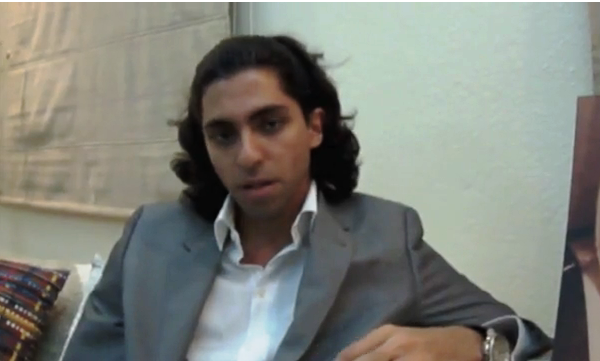
Index on Censorship, English PEN and Article 19 will hold a peaceful vigil in front of the embassy of Saudi Arabia at 9am on Friday 23 January in condemnation of the ongoing flogging and imprisonment of Raif Badawi. Please meet at the Curzon Street side of the embassy.
Blogger and activist Badawi will receive his second set of 50 lashes on the 23rd after a postponement on Friday Jan 16 to let the wounds from his first 50 lashes heal. Badawi’s punishment will continue every week until 1,000 lashes have been given. He is being punished for speaking out against Islam and powerful Saudi religious figures on his blog, Free Saudi Liberals, which encouraged political debate. As well as the lashings, he has been sentenced to 10 years in prison and fined 1 million riyals (£175,000).
He received his first 50 lashes in the port city of Jeddah on Friday 9 January. An anonymous witness said:
“A security officer approached him from behind with a huge cane and started beating him. Raif raised his head towards the sky, closing his eyes and arching his back. He was silent, but you could tell from his face and his body that he was in real pain. The officer beat Raif on his back and legs, counting the lashes until they reached 50.”
It’s crucial that we take a stand against the Saudi government’s brutal treatment of this political prisoner. Every week that Raif Badawi is dragged to the public square in Jeddah and given another 50 lashes for exercising his right to freedom of expression, scores of Saudi activists will muffle themselves in fear of a similar reprisal.
We call on the Saudi government to stop this extreme punishment, and to release Raif immediately.
Join us at 9am. Please meet at the Curzon Street side of the embassy.
15 Jan 2015 | Magazine, Volume 43.04 Winter 2014
[vc_row disable_element=”yes” css=”.vc_custom_1495018452261{margin-right: 0px !important;margin-left: 0px !important;border-bottom-width: 1px !important;padding-top: 15px !important;padding-bottom: 15px !important;border-bottom-color: #455560 !important;border-bottom-style: solid !important;}”][vc_column css=”.vc_custom_1474781640064{margin: 0px !important;padding: 0px !important;}”][vc_column_text css=”.vc_custom_1477669802842{margin-top: 0px !important;margin-right: 0px !important;margin-bottom: 0px !important;margin-left: 0px !important;padding-top: 0px !important;padding-right: 0px !important;padding-bottom: 0px !important;padding-left: 0px !important;}”]CONTRIBUTORS[/vc_column_text][/vc_column][/vc_row][vc_row disable_element=”yes” css=”.vc_custom_1495018460243{margin-top: 0px !important;padding-top: 0px !important;}”][vc_column width=”1/3″ css=”.vc_custom_1474781919494{padding-top: 0px !important;padding-bottom: 0px !important;}”][staff name=”Karim Miské” title=”Novelist” color=”#ee3424″ profile_image=”89017″]Karim Miské is a documentary maker and novelist who lives in Paris. His debut novel is Arab Jazz, which won Grand Prix de Littérature Policière in 2015, a prestigious award for crime fiction in French, and the Prix du Goéland Masqué. He previously directed a three-part historical series for Al-Jazeera entitled Muslims of France. He tweets @karimmiske[/staff][/vc_column][vc_column width=”1/3″ css=”.vc_custom_1474781952845{padding-top: 0px !important;padding-bottom: 0px !important;}”][staff name=”Roger Law” title=”Caricaturist ” color=”#ee3424″ profile_image=”89217″]Roger Law is a caricaturist from the UK, who is most famous for creating the hit TV show Spitting Image, which ran from 1984 until 1996. His work has also appeared in The New York Times, The Observer, The Sunday Times and Der Spiegel. Photo credit: Steve Pyke[/staff][/vc_column][vc_column width=”1/3″ css=”.vc_custom_1474781958364{padding-top: 0px !important;padding-bottom: 0px !important;}”][staff name=”Canan Coşkun” title=”Journalist” color=”#ee3424″ profile_image=”89018″]Canan Coşkun is a legal reporter at Cumhuriyet, one of the main national newspapers in Turkey, which has been repeatedly raided by police and attacked by opponents. She currently faces more than 23 years in prison, charged with defaming Turkishness, the Republic of Turkey and the state’s bodies and institutions in her articles.[/staff][/vc_column][/vc_row][vc_row equal_height=”yes” content_placement=”top” css=”.vc_custom_1474815243644{margin-top: 30px !important;margin-right: 0px !important;margin-bottom: 30px !important;margin-left: 0px !important;}”][vc_column width=”1/2″ css=”.vc_custom_1474619182234{background-color: #455560 !important;}”][vc_column_text el_class=”text_white”]Editorial
“We had tongues, but could not speak. We had feet but could not walk. Now that we have land, we have the strength to speak and walk,” said a group of women quoted in Ritu Menon’s article discussing why ownership of land has started to shift the power balance in India.
[/vc_column_text][/vc_column][vc_column width=”1/4″ css=”.vc_custom_1474720631074{margin-top: 0px !important;margin-bottom: 0px !important;padding-top: 0px !important;padding-right: 0px !important;padding-bottom: 0px !important;padding-left: 0px !important;background-color: #78858d !important;}” el_class=”image-content-grid”][vc_row_inner css=”.vc_custom_1495018553351{margin-top: 0px !important;margin-right: 0px !important;margin-bottom: 0px !important;margin-left: 0px !important;border-top-width: 0px !important;border-right-width: 0px !important;border-bottom-width: 0px !important;border-left-width: 0px !important;padding-top: 65px !important;padding-right: 0px !important;padding-bottom: 65px !important;padding-left: 0px !important;background-image: url(https://www.indexoncensorship.org/wp-content/uploads/2014/12/winter2014-magazine-cover-e1434042891830.jpg?id=62269) !important;background-position: center !important;background-repeat: no-repeat !important;background-size: cover !important;}”][vc_column_inner css=”.vc_custom_1474716958003{margin: 0px !important;border-width: 0px !important;padding: 0px !important;}”][/vc_column_inner][/vc_row_inner][vc_column_text css=”.vc_custom_1495018522192{margin-top: 0px !important;margin-right: 0px !important;margin-bottom: 0px !important;margin-left: 0px !important;padding-top: 20px !important;padding-right: 20px !important;padding-bottom: 20px !important;padding-left: 20px !important;background-color: #78858d !important;}” el_class=”text_white”]Contents
A look at what’s inside the winter 2014 issue[/vc_column_text][/vc_column][vc_column width=”1/4″ css=”.vc_custom_1474720637924{margin-top: 0px !important;margin-bottom: 0px !important;padding-top: 0px !important;padding-right: 0px !important;padding-bottom: 0px !important;padding-left: 0px !important;background-color: #78858d !important;}” el_class=”image-content-grid”][vc_row_inner css=”.vc_custom_1495018679207{margin-top: 0px !important;margin-right: 0px !important;margin-bottom: 0px !important;margin-left: 0px !important;border-top-width: 0px !important;border-right-width: 0px !important;border-bottom-width: 0px !important;border-left-width: 0px !important;padding-top: 65px !important;padding-right: 0px !important;padding-bottom: 65px !important;padding-left: 0px !important;background-image: url(https://www.indexoncensorship.org/wp-content/uploads/2014/12/Gaiman-pic-credit-Kimberly-Butler.jpg?id=62304) !important;background-position: center !important;background-repeat: no-repeat !important;background-size: cover !important;}”][vc_column_inner css=”.vc_custom_1474716958003{margin: 0px !important;border-width: 0px !important;padding: 0px !important;}”][/vc_column_inner][/vc_row_inner][vc_column_text css=”.vc_custom_1495019209534{margin-top: 0px !important;margin-right: 0px !important;margin-bottom: 0px !important;margin-left: 0px !important;padding-top: 20px !important;padding-right: 20px !important;padding-bottom: 20px !important;padding-left: 20px !important;background-color: #78858d !important;}” el_class=”text_white”]Podcast
Neil Gaiman and Martin Rowson on censorship[/vc_column_text][/vc_column][/vc_row][vc_row equal_height=”yes” css=”.vc_custom_1491994247427{margin-top: 0px !important;margin-right: 0px !important;margin-bottom: 0px !important;margin-left: 0px !important;}”][vc_column width=”1/3″ css=”.vc_custom_1493814833226{margin-top: 0px !important;margin-right: 0px !important;margin-bottom: 0px !important;margin-left: 0px !important;border-top-width: 0px !important;border-right-width: 0px !important;border-bottom-width: 0px !important;border-left-width: 0px !important;padding-top: 0px !important;padding-right: 0px !important;padding-bottom: 0px !important;padding-left: 0px !important;background-color: #78858d !important;}”][vc_row_inner css=”.vc_custom_1495018869817{margin-top: 0px !important;margin-right: 0px !important;margin-bottom: 0px !important;margin-left: 0px !important;border-top-width: 0px !important;border-right-width: 0px !important;border-bottom-width: 0px !important;border-left-width: 0px !important;padding-top: 65px !important;padding-right: 0px !important;padding-bottom: 65px !important;padding-left: 0px !important;background-image: url(https://www.indexoncensorship.org/wp-content/uploads/2014/12/15721410208_a036ffe467_o.jpg?id=62585) !important;background-position: center !important;background-repeat: no-repeat !important;background-size: cover !important;}”][vc_column_inner 0=””][/vc_column_inner][/vc_row_inner][vc_column_text css=”.vc_custom_1495018840047{margin-top: 0px !important;margin-right: 0px !important;margin-bottom: 0px !important;margin-left: 0px !important;padding-top: 20px !important;padding-right: 20px !important;padding-bottom: 20px !important;padding-left: 20px !important;background-color: #78858d !important;}” el_class=”text_white”]Information war
Andrei Aliaksandrau investigates the new information war as he travels across Ukraine.[/vc_column_text][/vc_column][vc_column width=”1/3″ css=”.vc_custom_1493815095611{padding-top: 0px !important;padding-right: 0px !important;padding-bottom: 0px !important;padding-left: 0px !important;background-color: #78858d !important;}” el_class=”image-content-grid”][vc_row_inner css=”.vc_custom_1495019050825{margin-top: 0px !important;margin-right: 0px !important;margin-bottom: 0px !important;margin-left: 0px !important;border-top-width: 0px !important;border-right-width: 0px !important;border-bottom-width: 0px !important;border-left-width: 0px !important;padding-top: 65px !important;padding-right: 0px !important;padding-bottom: 65px !important;padding-left: 0px !important;background-image: url(https://www.indexoncensorship.org/wp-content/uploads/2014/12/magna-carta.jpg?id=62653) !important;background-position: center !important;background-repeat: no-repeat !important;background-size: cover !important;}”][vc_column_inner 0=””][/vc_column_inner][/vc_row_inner][vc_column_text css=”.vc_custom_1495019017760{margin-top: 0px !important;margin-right: 0px !important;margin-bottom: 0px !important;margin-left: 0px !important;padding-top: 20px !important;padding-right: 20px !important;padding-bottom: 20px !important;padding-left: 20px !important;background-color: #78858d !important;}” el_class=”text_white”]1215 and all that
John Crace on the Magna Carta: Don’t shit with the people, or the people shit with you. Or something like that.[/vc_column_text][/vc_column][vc_column width=”1/3″ css=”.vc_custom_1493815155369{padding-top: 0px !important;padding-right: 0px !important;padding-bottom: 0px !important;padding-left: 0px !important;background-color: #78858d !important;}” el_class=”image-content-grid”][vc_row_inner css=”.vc_custom_1495019157426{margin-top: 0px !important;margin-right: 0px !important;margin-bottom: 0px !important;margin-left: 0px !important;border-top-width: 0px !important;border-right-width: 0px !important;border-bottom-width: 0px !important;border-left-width: 0px !important;padding-top: 65px !important;padding-right: 0px !important;padding-bottom: 65px !important;padding-left: 0px !important;background-image: url(https://www.indexoncensorship.org/wp-content/uploads/2016/01/20160127-_MG_4305.jpg?id=72965) !important;background-position: center !important;background-repeat: no-repeat !important;background-size: cover !important;}”][vc_column_inner 0=””][/vc_column_inner][/vc_row_inner][vc_column_text css=”.vc_custom_1495019127591{margin-top: 0px !important;margin-right: 0px !important;margin-bottom: 0px !important;margin-left: 0px !important;padding-top: 20px !important;padding-right: 20px !important;padding-bottom: 20px !important;padding-left: 20px !important;background-color: #78858d !important;}” el_class=”text_white”]Thoughts policed
Max Wind-Cowie on free speech in politics
[/vc_column_text][/vc_column][/vc_row][vc_row][vc_column width=”1/2″][vc_single_image image=”90659″ img_size=”full” onclick=”custom_link” link=”https://shop.exacteditions.com/gb/index-on-censorship”][/vc_column][vc_column width=”1/2″][vc_column_text]
Subscribe to Index on Censorship magazine on your Apple, Android or desktop device for just £17.99 a year. You’ll get access to the latest thought-provoking and award-winning issues of the magazine PLUS ten years of archived issues, including Drafting freedom to last.
Subscribe now.
[/vc_column_text][/vc_column][/vc_row]
