29 Sep 2021 | Afghanistan, Americas, Artistic Freedom Commentary and Reports, Asia and Pacific, Australia, Burma, Cuba, Ecuador, Europe and Central Asia, Israel, Lukashenko letters, Magazine, Magazine Contents, Middle East and North Africa, Religion and Culture, Russia, Syria, Turkey, Uganda, United Kingdom, United States, Volume 50.03 Autumn 2021, Volume 50.03 Autumn 2021 Extras

The Autumn issue of Index magazine focuses on the struggle for environmental justice by indigenous campaigners. Anticipating the United Nations Climate Change Conference (COP26), in Glasgow, in November, we’ve chosen to give voice to people who are constantly ignored in these discussions.
Writer Emily Brown talks to Yvonne Weldon, the first aboriginal mayoral candidate for Sydney, who is determined to fight for a green economy. Kaya Genç investigates the conspiracy theories and threats concerning green campaigners in Turkey, while Issa Sikiti da Silva reveals the openly hostile conditions that environmental activists have been through in Uganda.
Going to South America, Beth Pitts interviews two indigenous activists in Ecuador on declining populations and which methods they’ve been adopting to save their culture against the global giants extracting their resources.
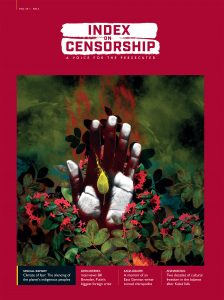 Cover of Index on Censorship Autumn 2021 (50-3)[/caption]
A climate of fear, by Martin Bright: Climate change is an era-defining issue. We must be able to speak out about it.
The Index: Free expression around the world today: the inspiring voices, the people who have been imprisoned and the trends, legislation and technology which are causing concern.
Pile-ons and censorship, by Maya Forstater: Maya Forstater was at the heart of an employment tribunal with significant ramifications. Read her response the Index’s last issue which discussed her case.
The West is frightened of confronting the bully, by John Sweeney: Meet Bill Browder. The political activist and financier most hated by Putin and the Kremlin.
An impossible choice, by Ruchi Kumar: The rapid advance of Taliban forces in Afghanistan has left little to no hope for journalists.
Words under fire, by Rachael Jolley: When oppressive regimes target free speech, libraries are usually top of their lists.
Letters from Lukashenka’s prisoners, by Maria Kalesnikava, Volha Takarchuk, Aliaksandr Vasilevich and Maxim Znak: Standing up to Europe’s last dictator lands you in jail. Read the heartbreaking testimony of the detained activists.
Bad blood, by Kelly Duda: How did an Arkansas blood scandal have reverberations around the world?
Welcome to hell, by Benjamin Lynch: Yangon’s Insein prison is where Myanmar’s dissidents are locked up. One photojournalist tells us of his time there.
Cartoon, by Ben Jennings: Are balanced debates really balanced? Ask Satan.[/vc_column_text][/vc_column][/vc_row][vc_row][vc_column][vc_custom_heading text=”Special Report” font_container=”tag:h2|font_size:22|text_align:left”][/vc_column][/vc_row][vc_row][vc_column][vc_column_text]
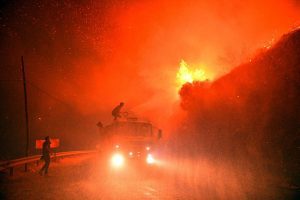
Credit: Xinhua/Alamy Live News
It’s not easy being green, by Kaya Genç: The Turkish government is fighting environmental protests with conspiracy theories.
It’s in our nature to fight, by Beth Pitts: The indigenous people of Ecuador are fighting for their future.
Respect for tradition, by Emily Brown: Australia has a history of “selective listening” when it comes to First Nations voices. But Aboriginal campaigners stand ready to share traditional knowledge.
The write way to fight, by Liz Jensen: Extinction Rebellion’s literary wing show that words remain our primary tool for protests.
Change in the pipeline? By Bridget Byrne: Indigenous American’s water is at risk. People are responding.
The rape of Uganda, by Issa Sikiti da Silva: Uganda’s natural resources continue to be plundered.Cigar smoke and mirrors, by James Bloodworth: Cuba’s propaganda must not blight our perception of it.
Denialism is not protected speech, by Oz Katerji: Should challenging facts be protected speech?
Permissible weapons, by Peter Hitchens: Peter Hitchens responds to Nerma Jelacic on her claims for disinformation in Syria.
No winners in Israel’s Ice Cream War, by Jo-Ann Mort: Is the boycott against Israel achieving anything?
Better out than in? By Mark Glanville: Can the ancient Euripides play The Bacchae explain hooliganism on the terraces?
Russia’s Greatest Export: Hostility to the free press, by Mikhail Khordokovsky: A billionaire exile tells us how Russia leads the way in the tactics employed to silence journalists.
Remembering Peter R de Vries, by Frederike Geeerdink: Read about the Dutch journalist gunned down for doing his job.
A right royal minefield, by John Lloyd: Whenever one of the Royal Family are interviewed, it seems to cause more problems.
A bulletin of frustration, by Ruth Smeeth: Climate change affects us all and we must fight for the voices being silenced by it. Credit: Gregory Maassen/Alamy[/caption]
The man who blew up America, by David Grundy: Poet, playwright, activist and critic Amiri Baraka remains a controversial figure seven years after his death.
Suffering in silence, by Benjamin Lynch and Dr Parwana Fayyaz The award-winning poetry that reminds us of the values of free thought and how crucial it is for Afghan women.
Heart and Sole, by Mark Frary and Katja Oskamp: A fascinating extract gives us an insight into the bland lives of some of those who did not welcome the fall of the Berlin Wall.
Secret Agenda, by Martin Bright: Reforms to the UK’s Official Secret Act could create a chilling effect for journalists reporting on information in the public interest.
24 Sep 2021 | Bosnia, China, News, Turkey, Volume 50.03 Autumn 2021 Extras
[vc_row][vc_column][vc_single_image image=”117556″ img_size=”full” add_caption=”yes”][vc_column_text]Almost three decades ago, some three million books and countless artefacts went up in flames when Sarajevo’s National and University Library – inside the Vijecnica (city hall) – was burned to the ground. The destruction of the Vijecnica at the beginning of the war was a symbol for one of the aggressor’s main objectives – silencing the soul of the city and crushing the cultural identity of an entire society.”
So said Dunja Mijatović, the current Council of Europe commissioner for human rights, who was born in Sarajevo when it was part of Yugoslavia.
Just weeks before the anniversary of the burning of the library on 25 August 1992, Mijatović spoke to Index about its symbolism and what its destruction was meant to achieve.
She quoted Heinrich Heine’s play, Almansor: “Where they burn books they will also, in the end, burn people.”
Libraries and archives have been targets for centuries, and the reason is always the same: it’s about taking away knowledge and stifling free thinking.
Libraries are, and have always been, symbols of freedom – the freedom to think and learn and find documents and books to debate and discuss.
Throughout history, when authoritarians take power and seek to control thought and behaviour, they either lock up libraries or destroy the manuscripts and books inside them.
The Serbian forces who burned the Sarajevo library were seeking to obliterate evidence of Bosnia and Herzegovina’s existence as a successful multicultural and multi-ethnic state. The documents they burned told a different history from the one that the army leaders wanted to portray.
Omar Mohammed, who reported as Mosul Eye on the Isis occupation of his city in Iraq, risked his life to blog anonymously about the occupiers’ wish to destroy books as well as to execute people as they sought to repress the population.
Mohammed told Index that it was not just the university library that was destroyed in Mosul, but it was the one that was reported on the most.
Many other libraries, even private collections, were wiped out. “The only possible reason is because knowledge is power,” he said. “Once you prevent people from accessing knowledge then you will have full control over them.”
Like many other scholars who have delved into the history of libraries, Mohammed understands that it is not about the buildings themselves.
“They don’t want people to have this access because they know if people write the history, it will be completely different from the one they wanted it to be,” he said.
Targeting libraries sends out a powerful message to scholars, historians and scientists, he added.
“When they see that such people are able to totally target the libraries, that they are literally able to destroy everything, it’s a manifestation of brutality.”
Today, Richard Ovenden, the most senior librarian at the Bodleian libraries at the University of Oxford, is worried about libraries in Turkey being closed under pressure from the government of president Recep Tayyip Erdoğan.
According to some sources, at least 188 libraries were closed there between 2002 and 2020.
Ovenden’s book, Burning the Books, looks at the history of the intentional destruction of knowledge. He was recently contacted by a Turkish student, who said: “I’ve just read your book and I want you to know how bad it is in Turkey, because libraries are being destroyed. And all the things that you write about are true in Turkey today.”
Ovenden said: “There is an absolutely authoritarian control over knowledge. Attacks on knowledge are being exercised by the authoritarian leader of Turkey right now. It is the ability for the population to generate their own ideas and to come up with their own thoughts that some governments, some authoritarian powers, some dictators and rulers do not like.”
When dictatorships seek to establish that certain minorities don’t exist, or haven’t lived somewhere, getting rid of the documentary evidence is very convenient.
Archives that establish the existence of Uighurs in China and Muslims in parts of India also look like targets.
Ovenden feels that what is fantastically important about libraries is that they “preserve the past thoughts and ideas of human beings so they’re parts of that evidence base”.
He added: “They’re also disseminating institutions [where] you can borrow the books, you can come and take those ideas away and write other books about them, or pamphlets, or newspaper articles, or whatever it is.”
Governments around the world are failing to protect libraries as a resource, sometimes by withdrawing or drastically reducing funding.
In the UK, almost 800 libraries closed between 2010 and 2019, and a major campaign kicked off in Australia this year to save the national archives.
Michelle Arrow, professor of history at Macquarie University in Sydney, argued in April that if funding cuts were not reversed, irreplaceable audio-visual collections would fall apart. After a public campaign, the national government has delivered some extra funding, but this has not solved all the archives’ problems.
She told Index that with a reduction in staff of almost 25% since 2013, more staff would be needed to deal with the large backlog of requests to view archived material.
She said the archives contained “unique records, and they touch almost every Australian: it is a democratic archive, a collection of ordinary people’s records, rather than famous or renowned Australians”.
While some countries are seeing numerous library closures due to financial or other threats, there are new defenders coming to light. In the coastal city of Santa Cruz in California, there’s a massive investment in upgrades to current libraries, and new ones are opening over the next two years.
Santa Cruz mayor Donna Meyers told Index: “In California, we just tend to believe in public institutions. We believe that public education, public libraries, all of that, lead to a better community, lead to a more informed society.”
Santa Cruz residents passed a special tax – by 78% of the vote – to pay for investment in the libraries which, Meyers says, is a sign of how committed the community is to libraries being around for future generations.
Back in Sarajevo, Mijatović can see the new library that rose from the ashes of the Vijecnica from her terrace.
She said: “One hopes that the soul and the people of Sarajevo will recover and that new generations will hopefully enjoy this magnificent symbol of Sarajevo and, more importantly, live in peace.”
Library destruction in recent history
1914: German troops destroy the library of the Catholic University of Louvain
1939: The Great Talmudic Library in Lublin is destroyed by the Nazis
1966-76: Chairman Mao destroys libraries across China as part of the Cultural Revolution
1976-79: The Khmer Rouge deliberately destroy libraries across Cambodia, including the Phnom Penh national library
2013: Islamic troops set fire to the library in Timbuktu, Mali
[/vc_column_text][/vc_column][/vc_row]
8 Jul 2021 | Croatia, Monaco, News, Statements
[vc_row][vc_column][vc_column_text]
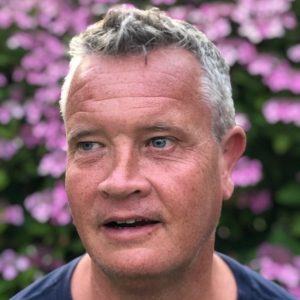
Whistleblower Jonathan Taylor
We are delighted to announce that on Wednesday 7 July 2021, Croatian Justice Minister Ivan Malenica formally rejected the request by Monaco to extradite UK whistleblower Jonathan Taylor. Jonathan Taylor’s Support Group extends its gratitude to the Minister for taking the right decision.
The move comes following sustained calls for the past 11 months from human rights and civil liberties campaigners across Europe – and UK MPs – for his immediate release and safe return home. Legal experts backing the release of Jonathan Taylor said there was no proper legal basis for Monaco to seek Mr. Taylor’s extradition and the process was retaliatory in nature. Lawyers acting on behalf of Jonathan Taylor argued that it constituted an abuse of process.
Jonathan Taylor was arrested whilst on a family holiday in Croatia last July, and has been restrained there since. He has been isolated, away from his family, and unable to support himself or his family, all of which have taken an extreme toll on his mental wellbeing.
A former in-house lawyer for oil firm SBM Offshore based in Monaco, Jonathan Taylor blew the whistle in 2013 on a massive bribery scheme. Jonathan’s whistleblowing disclosures led to SBM Offshore paying over $800 million in fines in the US, Netherlands and Brazil and investigations which led to successful prosecutions of two former CEOs for fraud-related offences.
Yet nine years later, he was arrested on a questionable Interpol Red Notice whilst on holiday, and wanted for questioning in Monaco over allegations made by his former employer over his settlement. The Red Notice was withdrawn by Monaco last December on the eve of Interpol making a determination on its validity. Jonathan denies wrongdoing and his lawyers have long argued there is no legal basis for extraditing him for questioning as he is neither charged nor convicted of any offences.
“I am of course elated that justice has finally prevailed and I am appreciative that Minister of Justice Ivan Malenica was able to pay regard to the salient legal arguments of my lawyers that were seemingly overlooked by the Courts in making his decision to reject Monaco’s flawed attempt at extraditing me,” states Jonathan Taylor.
“Special thanks go to all my supporters in Europe, overseas and in Croatia who somehow kept me sane in my year of need! Be assured that I remain resolute and proud of exposing serious wrongdoing at SBM Offshore and I will never be intimidated by the corrupt and those that shamefully seek retaliation against me for exposing them. I continue to stand ready to assist the Monaco Prosecutor in the event that a decision is made to pursue those responsible for SBM Offshore’s illicit business practices instead of me.”
We agree with Jonathan. The Minister of Justice of Croatia, Ivan Malenica, carefully considered the position of Jonathan Taylor as a whistleblower and a protected witness. His decision in this case has wider implications for the rule of law in Europe: it is a victory for the public’s right to know about wrongdoing by protecting the messengers of that information. Whistleblowers play a vital role in Europe’s fight against global corruption. Croatia has demonstrated its commitment to the rule of law and to the protection of whistleblowers.
We now call on Monaco to drop any further proceedings against Jonathan Taylor and to focus on the actions of SBM Offshore as a proper target for their investigations.
We wish Jonathan a safe return to the UK where he can begin to rebuild his life.
European Centre for Press and Media Freedom (ECPMF)
Whistleblowing International Network (WIN)
Martin Bright, Editor, Index on Censorship (United Kingdom)
Protect (United Kingdom)
Guernica 37 International Justice Chambers (United Kingdom)
Centre for Free Expression (Canada)
Free Press Unlimited
The Government Accountability Project (USA)
ARTICLE 19
The Platform to Protect Whistleblowers in Africa (PPLAAF)
Transparency International EU
The Daphne Caruana Galizia Foundation (Malta)
Pištaljka (Serbia)
Blueprint for Free Speech (Germany and Australia)
The Signals Network (USA/France)
Transparency International – Bulgaria
Transparency International Italy
SpeakOut SpeakUp Ltd
European Organisation of Military Associations and Trade Unions (EUROMIL)
Transparency International Secretariat
Access Info Europe
GlobaLeaks
European Federation of Journalists (EFJ)
Eurocadres – Council of European Professional & Managerial Staff
Professor David Lewis, Middlesex University (UK)
Osservatorio Balcani Caucaso Transeuropa (OBCT)
Sherpa (France)
WhistleblowersUK
Baroness Kramer, Co-Chair of the All Party Parliamentary Group on Whistleblowing (UK)
Mary Robinson MP, Co-Chair of the All Party Parliamentary Group on Whistleblowing (UK)[/vc_column_text][/vc_column][/vc_row]
19 May 2021 | Croatia, Monaco, News
[vc_row][vc_column][vc_column_text]
Mr. Ivan Malenica
Minister of Justice
Ulica grada Vukovara 49
Maksimirska 63
10 000 Zagreb
Republic of Croatia
Tuesday 18 May 2021
Dear Minister,
Jonathan Taylor is a whistleblower; he is a witness to a crime who has cooperated with law enforcement bodies in seven different jurisdictions and should be protected as such. He has been in Croatia for nearly 10 months appealing against a request for extradition from Monaco. Now that the Supreme Court of Croatia has issued its judgment, the final decision on whether or not to extradite Mr. Taylor is up to you, the Minister of Justice.
The Supreme Court of Croatia fully recognises Mr. Taylor’s status as a whistleblower and for the reasons we set out below, we urge you, the Minister of Justice, to refuse Monaco’s abusive request to extradite Mr. Taylor to Monaco and to allow him to return home to the United Kingdom immediately.
Mr. Taylor is a British national who, during the course of his employment as a lawyer for the Dutch-listed oil industry firm SBM Offshore N.V., with its main office in the Principality of Monaco, uncovered one of the largest corruption and bribery scandals in the world that resulted in criminal investigations in the United Kingdom, United States of America, Netherlands, Switzerland and Brazil. His evidence contributed to the company paying fines amounting to over US$800 million and, to date, the imprisonment of three individuals directly involved in the scandal, including the former CEO of SBM Offshore N.V.
Monaco to date has failed to initiate a single criminal investigation into highly credible and well documented allegations of bribery and corruption on the part of SBM Offshore. Instead, it has targeted the one person who blew the whistle and brought public scrutiny to such widespread financial crimes.
On 30 July 2020, over eight years after blowing the whistle on corruption, Jonathan travelled to Dubrovnik, Republic of Croatia for a family holiday. He was arrested at the airport on the basis of a communication issued by Monaco on what was originally stated to be allegations of bribery and corruption. Not only do these allegations have no proper basis in law or fact and constitute an abuse of process but crucially, Mr. Taylor, his lawyers and the Croatian Courts have since been informed in writing that Mr. Taylor is wanted for questioning to determine whether or not to charge him.
At no stage did the law enforcement or judicial authorities in Monaco seek his extradition from the United Kingdom, where Mr. Taylor has lived since 2013, until he was apprehended in Dubrovnik, for the very reason that they knew it would not succeed.
Mr. Taylor has made it clear since 2017, when he first became aware that his former employer, the Dutch listed SBM Offshore N.V. had lodged a criminal complaint in Monaco three years earlier, that he would answer any questions the authorities had of him from the United Kingdom, either remotely or in person. And since his unlawful detention in Croatia, the offer to answer questions there has been repeated on the agreement that he is able to return home to the United Kingdom.
For Jonathan to be returned to Monaco to face questioning in order to determine whether charges should be laid amounts to a clear act of retaliation for his having disclosed the corrupt practices of a major offshore oil firm and one of the largest private sector employers in the small principality.
In March 2021, after the Supreme Court of Croatia partially upheld a second appeal against extradition, the Dubrovnik court was ordered to seek further clarification from the Monegasque authorities regarding the status of the criminal proceedings for which Mr. Taylor was allegedly charged. A letter from the Director of Judicial Services in Monaco sent on 1 March 2021 confirmed there Mr. Taylor is not charged with anything as there are no criminal proceedings, nor is there any execution of a judgement for which he is wanted – which are the only two valid legal bases for seeking extradition. In fact, Interpol confirmed yet again on the 23rd March 2021 that Mr. Taylor is no longer subject to Interpol Red Notice. This after Monaco withdrew the arrest warrant in December 2020.
Further, now that Mr. Taylor’s status as a whistleblower has been confirmed by the Supreme Court of Croatia, even if the Minister accepts that conditions for extradition have been met, in light of Croatia’s duties and obligations under the EU Directive on the protection of whistleblowers and the clearly retaliatory nature of the Monegasque request to extradite Mr. Taylor for questioning, we humbly submit that the decision by the Minister should be to reject it.
Croatia is part of the European Union and one of the 27 Member States which must transpose the EU Directive on the protection of whistleblowers into its national legal system by December 2021. The Directive seeks to harmonise protections for those who report wrongdoing and corruption across Europe. It is crucial that Croatia upholds both the spirit and obligations of the Directive to ensure that whistleblowers are protected by law and this includes ensuring they are immune from civil and criminal liability for having blown the whistle. In a case of such serious corruption like this one, it is essential that vital anti-corruption whistleblower protections do not fall down between borders. To do otherwise, allows those involved in corruption to send a chilling warning to whistleblowers and investigative journalists across the globe that undermines all the efforts of the European Union and the Croatian Government to prevent and root out the corruption that undermines the fabric of its societies and the well-being of its people.
For these very important reasons, and because of his protected status as a whistleblower, we, the undersigned, urge you, the Minister of Justice, to uphold the Rule of Law, reject the extradition order and allow Jonathan Taylor to return home immediately.
Yours sincerely,
Anna Myers, Executive Director, Whistleblowing International Network
on behalf of the Jonathan Taylor Support Committee
With support from:
Access Info Europe (Spain/Europe)
African Centre for Media & Information Literacy (Nigeria)
ARTICLE 19 (United Kingdom)
Blueprint for Free Speech (Australia)
Campax, Switzerland
Center for Whistleblowers Protection (Slovenia)
Centre for Free Expression (Canada)
European Centre for Press and Media Freedom (ECPMF)
European Federation of Journalists (EFJ)
FIND – Financial Investigations (UK)
Free Press Unlimited (Netherlands)
General Workers Union Portugal (UGT-P)
GlobaLeaks (Italy)
Guernica 37 International Justice Chambers (United Kingdom)
Human Rights House Zagreb (Croatia)
Le Réseau Panafricain de Lutte contre la Corruption (UNIS)
Maison des Lanceurs d’Alerte (France)
OBC Transeuropa
Parrhesia Inc (UK)
Pištaljka (Serbia)
Protect (United Kingdom)
South East Europe Media Organisation (SEEMO), (Austria)
SpeakOut SpeakUp Ltd (United Kingdom)
Terra Cypria-the Cyprus Conservation Foundation (Cyprus)
The Daphne Caruana Galizia Foundation (Malta)
The Signals Network (USA/France)
Transparency International (Secretariat, Germany)
Transparency International Bulgaria
Transparency International EU
Transparency International Ireland
Transparency International Italia
Transparency International Slovenia
Vanja Jurić, Attorney at law (Croatia)
WBN – Whistleblower Netzwerk (Germany)
Whistleblowers UK
Baroness Kramer, Co-Chair of the All Party Parliamentary Group on Whistleblowing
Dr John O’Connor Physician and Whistleblower (Canada)
Martin Bright, Editor, Index on Censorship (United Kingdom)
Peter Matjašič, Senior Program Officer, Open Society Initiative for Europe (OSIFE)
Professor David Lewis, Middlesex University. (United Kingdom)
Professor Wim Vandekerckhove, University of Greenwich (United Kingdom)
Susan Hawley, Executive Director, Spotlight on Corruption (UK)
Thomas Devine, Legal Director, Government Accountability Project (USA)
[/vc_column_text][/vc_column][/vc_row][vc_row][vc_column][three_column_post title=”You may also want to read” category_id=”256″][/vc_column][/vc_row]
