23 Mar 2017 | Belarus, Campaigns, Campaigns -- Featured, Statements
Dear Mr. President
We, 48 undersigned organizations from 24 countries, strongly condemn the continuing wave of detentions and harassment of peaceful protesters, journalists, human rights defenders, civil society activists, anarchists and opposition party members in Belarus.
Most of the detentions and harassment are linked to participation in peaceful protests demanding the cancellation of Presidential Decree No. 3, the so-called “social parasite” legislation, which imposes a tax on unemployed people in Belarus. Decree No. 3 obligates citizens to work a specific number of days or pay a special duty to the State under threat of arrest. This is contrary to Art. 41 of the Belarusian Constitution and violates international human rights law.
According to reports from Belarusian and international human rights organizations, as of 22 March 2017 more than 250 people have been detained since 3 March 2017, including at least 31 journalists. At least 110 people have been sentenced to 3-15 days of administrative arrest. Many of them remain in detention, while others have been subject to different forms of harassment.
We strongly condemn the fact that several detentions of peaceful protesters at different places across Belarus have been carried out with the excessive use of force by Belarusian security officers.
Several Belarusian organizations have announced a demonstration that will take place in Minsk and in other cities in Belarus on 25 March 2017. We are deeply concerned about the physical and psychological integrity of the participants of these protest marches.
As the president of Belarus we urge you:
- to respect the right to peaceful assembly and expression
- to ensure that there are no obstructions to the exercising of these rights in Belarus, including in relation to the planned demonstration on 25 March 2017 in Minsk and in other cities across the country
- to guarantee in all circumstances the physical and psychological integrity of all peaceful protesters at the demonstration on 25 March 2017 in Minsk as well as at all other peaceful demonstrations across Belarus
- to refrain from the use of excessive force by security officers on 25 March 2017 in Minsk as well as at all other peaceful demonstrations across Belarus
- to ensure that journalists are able to fully exercise their professional duties, including during peaceful demonstrations
- to immediately and unconditionally release all protesters, journalists, human rights defenders, civil society activists and opposition members who have been detained in connection with the current wave of demonstrations solely for peacefully exercising their right to freedom of assembly and expression
- to refrain from preventively detaining journalists, human rights defenders, civil society activists, anarchists and opposition activists
- to immediately stop the persecution, harassment and intimidation of those who exercise their right to freedom of assembly, expression and association and ensure these rights to all Belarusian citizens
- to abolish Presidential Decree No. 3 since it violates international human rights law
Signatories:
Albanian Helsinki Committee
Analytical Center for Interethnic Cooperation and Consultations (Georgia)
Article 19 (UK)
Association UMDPL (Ukraine)
Bir Duino (Kyrgyzstan)
Bulgarian Helsinki Committee
Center for Civil Liberties (Ukraine)
Center for the Development of Democracy and Human Rights (Russia)
Charity foundation “East-SOS” (Ukraine)
Civic Belarus (Czech Republic)
CIVICUS: World Alliance for Citizen Participation, Johannesburg
Committee to Protect Journalists (USA)
Crude Accountability (USA)
FIDH, Paris
Freedom Files (Russia/Poland)
German-Russian Exchange (Germany)
Helsinki Committee for Human Rights in Serbia
Helsinki Committee of Armenia
Helsinki Foundation for Human Rights (Poland)
Human Rights Center “Postup” (Ukraine)
Human Rights Center (Azerbaijan)
Human Rights Information Center (Ukraine)
Human Rights Monitoring Institute (Lithuania)
Humanrights.ch (Switzerland)
Index on Censorship (UK)
Institute Respublica (Ukraine)
International Partnership for Human Rights (Belgium)
IRFS (Azerbaijan)
JEF Europe: Young European Federalists, Brussels
Kazakhstan Interantional Bureau for Human Rights and the Rule of Law
Kharkiv Human Rights Protection Group (Ukraine)
KRF Public Alternative (Ukraine)
Libereco – Partnership for Human Rights (Switzerland/Germany)
Macedonian Helsinki Committee
Memorial International, Moscow
Menschenrechte in Belarus e.V. (Germany)
Moscow Helsinki Group (Russia)
NESEHNUTI – Independent Social Ecological Movement (Czech Republic)
Norwegian Helsinki Committee
Ostgruppen – Swedish Initiative for Democracy and Human Rights
Promo LEX (Moldova)
Protection of Rights without Borders NGO (Armenia)
Public Verdict Foundation Russia)
Reporters Without Borders International, Paris
The Netherlands Helsinki Committee
The Swiss Helsinki Committee
Ukrainian Helsinki Human Rights Union
World Organisation Against Torture (OMCT), Geneva
8 Feb 2017 | Azerbaijan, Mapping Media Freedom, News
[vc_row][vc_column][vc_column_text]
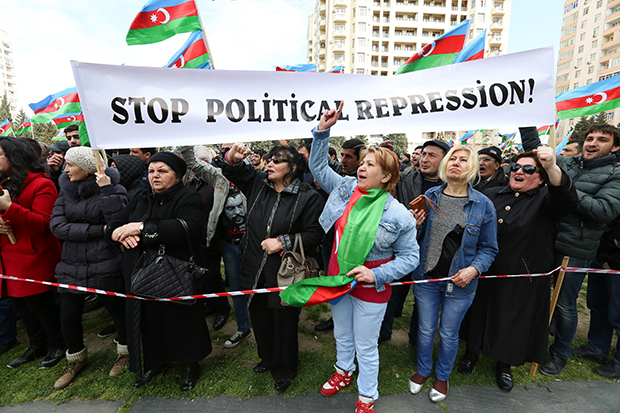
Photo: Aziz Karimov
For Azerbaijan’s president Ilham Aliyev and many other authoritarian leaders across the world, independent journalism and what it represents is bad news. The more irritating leaders find journalists’ work, the harsher consequences are for those reporting. This has been one of the most worrying trends across the world in recent years.
In 2016, there were 38 threats to press freedom reported to the Index on Censorship project Mapping Media Freedom. Journalists critical of the government were tortured and arrested. Internet sites were repeatedly blocked. TV outlets were knocked off the air through revocation of broadcast licences. Newspapers were starved to near bankruptcy and prevented from printing. Online criticism of the country’s hereditary president has been outlawed. Even family members of journalists have been targeted.
“In the last year alone, authorities have either detained, arrested, questioned six journalists and one blogger. Some parliament members have even hinted at introducing legislation that would monitor social media. The relentless pressure on media professionals and citizen journalists in Azerbaijan is aimed at shutting down any criticism of the Aliyev regime. The continued crackdown on freedom of speech is a clear violation of human rights,” Hannah Machlin, Mapping Media Freedom project officer, said.
The dismal state of free expression in Azerbaijan catalogued by Mapping Media Freedom is indirectly validated by Reporters Without Borders’ 2016 Press Freedom Index. That organisation found a disturbing decline in respect for media freedom around the world.
“It is unfortunately clear that many of the world’s leaders are developing a form of paranoia about legitimate journalists,” secretary general of RSF Christophe Deloire said.
Azerbaijan ranks 163rd on the press freedom index. The country’s ruling powers have long banned independent journalism and anyone who remained defiant was branded an agent, a traitor, a hooligan, a drug addict, anything but a journalist. While Mapping Media Freedom began closely monitoring the country in the second quarter of 2016, the clampdown on journalists long precedes this.
In 2014, authorities shut down the office of Azerbaijan Service for Radio Free Europe Radio Liberty. Around the same time, the dissident media outlet Meydan TV, shut down its office fearing a similar action. Its reporters on the ground have been detained, questioned and placed on travel ban lists ever since. Independent newspapers such as Zerkalo and Azadliq have been stifled with numerous libel charges. Both newspapers ceased printing issues with Azadliq available to its readers online only. One, columnist and TV anchor Seymur Hezi, remains in jail following a charge of “aggravated hooliganism” saw him sent to prison for over five years.
Azerbaijan’s media in exile
As the space for a free media shrank over the past few years, journalists fled the country. Some have chosen neighbouring Georgia as their base while others continue their work from Berlin and elsewhere.
Since 2015, a group of exiled Azerbaijani civil society activists who have been based in Georgia have designed a project to create opportunities for Azerbaijani journalists based in Georgia’s capital, Tbilisi, to work with local media outlets. Under the guidance of the Human Rights House Tbilisi, this initiative has involved at least a dozen journalists from Azerbaijan. The group has reported on the human rights and the day-to-day of living in Georgia.
Gulnur Kazimova left Azerbaijan out of fear of persecution and is currently based in Tbilisi where she lives with her family. She was among the participants of the HRH initiative. During the programme she reported on women’s issues that Azerbaijani community faced in Georgia. One such story was about a 19-year-old woman who was constantly beaten and threatened by her husband who kidnapped her at the age of 13 and eventually murdered her by cutting her throat. Another exiled journalist, Tural Gurbanli, wrote about the issue of wearing hijab in the village of Karajala, which is mostly populated by Azerbaijanis who have settled in Georgia.
Emin Milli, a former political prisoner, who currently lives in exile in Berlin, created Meydan TV, an online media platform. With over 400,000 likes on their Facebook page, and over 60,000 subscribers to its YouTube Channel, Meydan TV has strived to present a comprehensive picture of Azerbaijan by collecting news, conducting interviews and providing independent reporting. Its freelance contributors inside the country have paid a heavy price for this: they have been persecuted by the police, detained, questioned and placed on no travel lists.
Radio Free Europe and Radio Liberty Azerbaijan Service’s contributors have also been targeted by officials in the country. Like Meydan TV, Radio Liberty has a large following on Facebook with over 400,000 readers and more than 100,000 subscribers on YouTube.
Index on Censorship Award-winning Azadliq newspaper continues its coverage of the country through its online presence despite the ongoing targeting by the government. The newspaper’s editor-in-chief is exiled while his family members have been harassed by the authorities, and the newspaper’s chief financial director was arrested for his alleged support for Gulen religious movement said to be behind the failed coup in Turkey and his criticism of the authorities and was recently sentenced to 10 years in jail.
The current list of political prisoners that stands around 100 individuals includes prominent journalist Seymur Hezi, as well as other journalists and bloggers who have been jailed on bogus charges. Despite the release of top investigative reporter Khadija Ismayil in May of 2016, along with a number of other prominent political prisoners, the new arrests and crackdown against existing independent media, its reporters and its platforms are indicative of a revolving door policy when it comes to press freedom in Azerbaijan. [/vc_column_text][vc_basic_grid post_type=”post” max_items=”4″ element_width=”6″ grid_id=”vc_gid:1486487716820-6a1b311c-3186-5″ taxonomies=”7145″][/vc_column][/vc_row]
10 Oct 2016 | mobile, News, Turkey, Turkey Reports
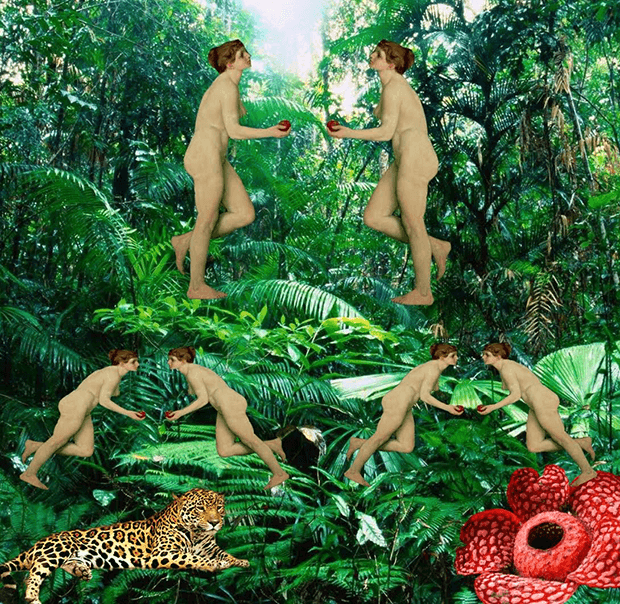
Yeni Bir Şarkı Söylemek Lazım, Video, 2016, Işıl Eğrikavuk
Asena Günal is the program coordinator of Depo which is a center for arts and culture at Tophane, Istanbul. She is one of the co-founders of Siyah Bant, a research platform that documents censorship in the arts in Turkey.
“Is it just me? I don’t think so, but these days I’m in a state where I don’t know what to hold on to, what to do. I push myself to continue my work. Should I continue with art, or should I channel myself to more urgent things; that’s how suffocated I feel,” Hale Tenger, a prominent contemporary artist from Turkey, said in a roundtable discussion published in the Istanbul Art News.1 This pessimism reflects the general mood of artists and many other intellectuals in Turkey, a country that has experienced incidents so numerous in the past year that they could fill decades.
Since July 2015, almost 300 people have been killed and thousands wounded in various attacks by IS and the Kurdistan Freedom Eagles (TAK). After the elections in June 2015, in which the Kurdish party passed the 10% threshold and AKP lost its single party position, president Erdoğan pushed for another election. In November 2015, the AKP won the election and ended the peace process with the Kurdistan Workers Party (PKK). The government put severe limitations on the Kurdish and pro-peace opposition. A total of 2,212 academics, who signed a petition to condemn the state violence in the southeast of Turkey, have been targeted by Erdoğan, received threats, have been faced with criminal and disciplinary investigations, and four of them were detained and jailed for about a month. A growing number of academics have been dismissed or suspended, some were forced to resign and had to leave the country. Almost two thousand lawsuits have been filed against people alleged to have insulted the president online or offline.2
In January 2016, two members of the art community were arrested and then sued for participating in the peaceful demonstration “I am Walking for Peace” in Diyarbakır. The march was organised to protest state violence in the Kurdish region and ask for the restarting of the peace process. Artists Pınar Öğrenci and Atalay Yeni were arrested and then released conditionally. Their court cases still continue.
The impact of the recommencement of the war has made itself felt in various fields and ways. The cancellation of the exhibition “Post-Peace” in February 2016 shows the difficulty of expressing critical views on state policies. The exhibition curated by an Amsterdam-based curator Katia Krupennikova was cancelled by the institution Aksanat just five days before the opening, with the director citing the rising tension and the mourning after another bombing in Turkey as the reason. Given that other events went on as scheduled, many thought one of the video works in the exhibition, critical of the dirty war policies of the Turkish state against the Kurdish guerilla was considered risky by Aksanat.3 This was one of the incidents in which the state itself did not act, and actors in the artistic community took on this role. It created a discussion in the art scene about how to struggle in times of repression.4
Ayhan ve ben (Ayhan and me) from belit on Vimeo.
In April 2016, the screen of the public art project YAMA on a hotel roof was shut down by the Istanbul municipality on the basis of an anonymous complaint, claiming that the work of artist Işıl Eğrikavuk, a video animation, projecting the slogan “Finish up your apple, Eve!”, insulted religious sensibilities. When pressed, the municipality cited “visual pollution” as the reason for discontinuing the screening. This turn illustrates a strategy by the national and local government to legitimise their acts of censorship as purely procedural and administrative actions. After Eğrikavuk made a statement, YAMA’s curator Övül Durmuşoğlu declared the project’s support for the artist. Durmuşoğlu organised a meeting to discuss the case and invited Egrikavuk, legal consultants and people from the art scene. In the following days, Eğrikavuk did a performance based on this restraint. Both the meeting and the performance attracted a wide audience.
Even before the coup attempt of 15 July, there was such an atmosphere where people were worried about terrorist attacks, human rights violations, and limitations on freedom of expression. The coup attempt left 246 citizens and 24 coup planners dead and a nation deeply traumatised. The Gülen movement is accused of being behind the last coup attempt. The coup attempt was followed by a State of Emergency which allowed the cabinet under the chairmanship of the president to issue decrees that have the force of law.5 Unsurprisingly, Erdoğan has been using the attempt as an opportunity to eliminate critical voices.
In the five days between the coup attempt and the declaration of State of Emergency on 20 July, many festivals, biennials and concerts were postponed or cancelled by their organisers. The Sinop Biennial (Sinopale) was postponed “due to recent events in Turkey”, the One Love Festival was cancelled “due to availability problems on the schedules of artists and groups”, many concerts of the Istanbul Jazz festival including a performance by Joan Baez was cancelled6, Muse cancelled its concert“due to recent capricious events” and Skunk Anansie did the same “in light of the recent extraordinary events”. One issue of the satirical magazine Leman was banned as it suggested that both soldiers and civilians involved in the country’s recent unsuccessful coup were pawns in a larger game.
After the coup attempt, Erdoğan called the people to “Democracy Watch”-meetings. The biggest and final meeting, was the one at Yenikapı on 7 August 2016.7 Erdoğan invited popular figures, like singers, actors, and actresses to join the meeting. Pop singer Sıla announced on social media that although she was against the coup she would not be part of such a “show” and would not participate in the big meeting in Yenikapı. Sıla was the only figure brave enough to make such a declaration and not step back. But this resulted in the cancellation of her concerts in five different cities. Many people supported her by sharing her music videos and their own photos with an album of Sıla online.
Theatre actor Genco Erkal’s company “Dostlar Tiyatrosu” was banned from performing a play based on the writings of Turkish communist poet Nazim Hikmet and Bertolt Brecht. It was going to be performed in the garden of Kadıköy High School but the school cancelled the contract due to security reasons. It was obvious that security was not the issue and the school was under pressure from the Ministry of Education because of Genco Erkal’s critical stance. After protests of the theater company and members of the main opposition party (CHP), who brought the case to the Parliament, the Governorate lifted the ban.
Municipal and state theaters have been under a tight grip for some time and there have been ongoing discussions about privatisation of these institutions. The State of Emergency not only aimed at Gülenists who were accused of being part of the planning of the coup but also many artists with apparent oppositional stance were affected. On 1 August, the Istanbul Municipality fired 20 people, including director Ragıp Yavuz, actor Kemal Kocatürk, and actress Sevinç Erbulak from the Municipal Theatre based on the decree law number 667 which was announced after the declaration of the State of Emergency. They were not even granted an explanation for why they lost their jobs, but only received a vague reference to supposedly having failed “the evaluation criteria”8. Obviously, they did not have any connection with coup plotters. Eleven of them have been reinstated in their former positions.
Besides bans and purges, the State of Emergency has enabled the government to re-regulate the organisational structure of the state. A new law that would bring the privatisation of State Theatre, State Opera and Ballet, Atatürk Cultural Center, and Turkish Historical Society was discussed in Parliament. Many people from the field of theatre, opera and ballet expressed their concern that the State of Emergency might be utilised to bring privatisation after years of discussion on instating an independent arts council.
It is now common for the members of the ruling party to randomly target artists, writers, or academics in order to intimidate wider cultural milieu. A recent example is from the field of contemporary arts: In September 2016, an AKP MP Bülent Turan targeted the curator of the Çanakkale Biennial Beral Madra and called on the Çanakkale Municipality (run by CHP) not to work with her. The accusation was being critical of Erdoğan, and hence -so the argument went further- being “pro-coup”. Madra became a target because of her critical tweets and Facebook posts. Being critical of Erdoğan has long been risky but now it is associated with being “pro-coup”. Beral Madra withdrew from her position as to not put the Biennial at risk. Then the organising institution announced that the biennial would be cancelled altogether. They were saddened by the current political atmosphere, which did not place art as a primary point of concern. The CHP-run municipality and many people from the art scene expressed concern over the cancellation, highlighting instead the potential of art to counter the authoritarian discourse of AKP and expressing their wishes for the Biennial to go ahead as planned.
Despite this rising authoritarianism and the pessimistic atmosphere, Turkey’s culture and art scene will continue its struggle. Last week there were many openings in different galleries around Istanbul and almost all of them were crowded. People from the art scene are in need of each other more than ever, aware of the vital importance of solidarity in times of hardship. Film, music, dance and performance festivals started to take place, their posters filling the streets. So I would like to finish with another quote from the same issue of Istanbul Art News, by Deniz Artun,9 the director of Ankara Galeri Nev, as I tend to share its optimistic sentiment: “I guess that art history has shown us time and again just how deep the traces left by exhibitions, artworks, artists emerging with ‘pertinacity’ will be; not those amidst freedoms and prosperity, but those coming forth among fears and uncertainties that are burdensome for all of us.”
- September 2016, no. 34.
- Although many have been dropped after the attempted coup d’état in a show of good will they nonetheless can be said to have had a chilling effect on oppositional voices.
- See https://www.indexoncensorship.org/2016/05/75504/ for the open letter of belit sağ, the artist of that particular video work, and the artists’s response to the cancellation. Sara Whyatt elaborates the case in detail, http://artsfreedom.org/?p=11374.
- Özge Ersoy discusses this incident in terms of the different approaches to responsibility, transparency, sensitivity, institutional self-censorship, and institutional sustainability. See her report on the relationship between artists, curators, and institutions in the context of artistic freedom in Turkey: http://www.siyahbant.org/wp-content/uploads/2016/07/SiyahBant_Arastirma_KuratoryelPratikler-1.pdf.
- According to the Turkish Constitution, the Council of Ministers, which is led by the President, can declare a State of Emergency based on “widespread acts of violence aimed at the destruction of the free democratic order.” It must be approved by Parliament and allows the ministers to pass decrees that have the force of law, although they can be overruled by Parliament. It gives the state the right to derogate certain rights, including freedom of movement, expression and association, during times of war or a major public emergency.
- Joan Baez gathered reactions from Turkey with her statement that “I’m not sure I’ve seen anything like the immense and unpredictable danger which presents itself in today’s Turkey”. Istanbul Jazz Festival Director Pelin Opçin expressed her disappointment as Baez made them feel alone and punished by way of isolation: http://www.hurriyetdailynews.com/turkish-fans-let-down-by-joan-baez-remarks.aspx?pageID=238&nID=101923&NewsCatID=383
- Two opposition parties (CHP and MHP) were invited but the Kurdish opposition party (HDP) was not, showing the problematic character of the rhetoric of “democracy” and “national unity”.
- “As well as not being able to get an answer as to who, on what criteria judged our performance we could not reach any official explanation for our dismissal”, stated the theatre actors; https://twitter.com/oyuncusendika/status/763749835094822912?lang=tr
- September 2016, no. 34.
More about the arts in Turkey:
Belit Sağ: Refusing to accept Turkey’s silencing of artistic expression
Life is getting harder for objective journalists in Turkey, says cartoonist sued by Erdogan
Turkey: Artistic freedom and censorship
Turkey: Artists engaged in Kurdish rights struggle face limits on free expression
19 Sep 2016 | Magazine, Volume 45.03 Autumn 2016
[vc_row][vc_column][vc_column_text]
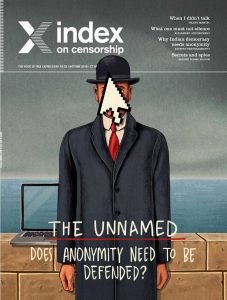
Autumn 2016 magazine cover
Anonymity is out of fashion. There are plenty of critics who want it banned on social media. It’s part of a harmful armoury of abuse, they argue.
Certainly, social media use seems to be doing its best to feed this argument. There are those anonymous trolls who sent vile verbal attacks to writers such as US author Lindy West. She was confronted by someone who actually set up a fake Twitter account under the name of her dead father.
Anonymity has been used in other ways by the unscrupulous. Earlier this year, a free messaging app called Kik was the method two young men used to get in touch with a 13-year-old girl, with whom they made friends online and then invited her to meet. They were later charged with her murder. Participants who use Kik to chat do not have to register their real names or phone numbers, according to a report on the court case in the New York Times, which cited other current cases linked to Kik activity including using it to send child pornography.
So why do we need anonymity? Why does it matter? Why don’t we just ban it or make it illegal if it can be used for all these harmful purposes? Anonymity is an integral part of our freedom of expression. For many people it is a valuable way of allowing them to speak. It protects from danger, and it allows those who wouldn’t be able to speak or write to get the words out.
“If anonymity wasn’t allowed any more, then I wouldn’t use social media,” a 14-year-old told me over the kitchen table a few weeks ago. He uses forums on the website Reddit to have debates about politics and religion, where he wants to express his view “without people underestimating my age”.
Anonymity to this teenager is something that works for him; lets him operate in discussions where he wants to try out his arguments and gain experience in debates. Anonymity means no one judges who he is or his right to join in.
For others, using a fake or pen name adds a different layer of security. Writers for this magazine worry about their personal safety and sometimes ask for their names not to be carried on articles they write. In the current issue, an activist who works helping people find ways around China’s great internet wall is one of our authors who can’t divulge his name because of the work he does.
Throughout history journalists have worked with sources who want to see important information exposed, but do not want their own identity to be made public. Look at the Watergate exposé or the Boston Globe investigation into child sex abuse by priests. Anonymous sources can provide essential evidence that helps keep an investigation on track.
That right, to keep sources private, has been the source of court actions against journalists through the years. And those who choose to work with journalists, often rely on that long held practice.
Pen names, pseudonyms, fake identities have all have been used for admirable and understandable purposes over the centuries: to protect someone’s life; to blow a whistle on a crime; for a woman to get published at a period when only men did so, and on and on. Those who fought for democracy, the right to protest and other rights, often had operate under the wire, out of the searching eyes of those who sought to stop them. Thomas Paine, who wrote the famous pamphlet Common Sense “Addressed to Inhabitants of America”, advocating the independence of the 13 states from Britain, first published his words in 1776 anonymously.
From the early days of Index on Censorship, when writing was being smuggled across borders and out of authoritarian countries, the need for anonymity was paramount.
Over the years it has been argued that anonymity is a vital component in the machinery of freedom of expression. In the USA, the American Civil Liberties Union argues that anonymity is a First Amendment right, given in the Constitution. As far back as 1996, a legal case was taken in Georgia, USA, to restrict users from using pseudonyms on the internet.
Today, in India, the world’s largest democracy, there are discussions about making anonymity unlawful. Our article by lawyer and writer Suhrith Parthasarathy considers why if minister Maneka Gandhi does go ahead with plans to remove anonymity on Twitter it could have ramifications for other forms of writing. As Anja Kovacs of the Internet Democracy Project told Index, “democracy virtually demands anonymity. It’s crucial for both the protection of privacy rights and the right to freedom of expression”.
We must make sure that new systems aimed at tackling crime do not relinquish our right to anonymity. Anonymity matters, let’s remember it has a role to play.
Order your full-colour print copy of our anonymity magazine special here, or take out a digital subscription from anywhere in the world via Exact Editions (just £18* for the year). Each magazine sale helps Index on Censorship fight for free expression worldwide.
*Will be charged at local exchange rate outside the UK.
Copies will be available at the BFI, the Serpentine Gallery, MagCulture, (London), News from Nowhere (Liverpool), Home (Manchester), Carlton Books (Glasgow) and on Amazon. Each magazine sale helps Index on Censorship continue its fight for free expression worldwide.
The full contents of the magazine can be read here.[/vc_column_text][/vc_column][/vc_row][vc_row][vc_column][vc_custom_heading text=”From the Archives”][vc_row_inner][vc_column_inner width=”1/3″][vc_single_image image=”89160″ img_size=”213×289″ alignment=”center” onclick=”custom_link” link=”http://journals.sagepub.com/doi/pdf/10.1177/0306422011400799″][vc_custom_heading text=”Going local” font_container=”tag:p|font_size:24|text_align:left” link=”url:http%3A%2F%2Fjournals.sagepub.com%2Fdoi%2Fpdf%2F10.1177%2F0306422011400799|||”][vc_column_text]March 2011
If the US’s internet freedom agenda is going to be effective, it must start by supporting grassroots activists on their own terms, says Ivan Sigal.[/vc_column_text][/vc_column_inner][vc_column_inner width=”1/3″][vc_single_image image=”89073″ img_size=”213×289″ alignment=”center” onclick=”custom_link” link=”http://journals.sagepub.com/doi/pdf/10.1177/0306422013512242″][vc_custom_heading text=”On the ground” font_container=”tag:p|font_size:24|text_align:left” link=”url:http%3A%2F%2Fjournals.sagepub.com%2Fdoi%2Fpdf%2F10.1177%2F0306422013512242|||”][vc_column_text]December 2013
Attacked by the government and the populist press alike, political bloggers and Twitter users in Greece struggle to make their voices heard.[/vc_column_text][/vc_column_inner][vc_column_inner width=”1/3″][vc_single_image image=”89161″ img_size=”213×289″ alignment=”center” onclick=”custom_link” link=”http://journals.sagepub.com/doi/pdf/10.1177/0306422011409641″][vc_custom_heading text=”Meet the trolls” font_container=”tag:p|font_size:24|text_align:left” link=”url:http%3A%2F%2Fjournals.sagepub.com%2Fdoi%2Fpdf%2F10.1177%2F0306422011409641|||”][vc_column_text]June 2011
Whitney Phillips reports on a loose community of anarchic and anonymous people is testing the limits of free speech on the internet.[/vc_column_text][/vc_column_inner][/vc_row_inner][vc_separator][/vc_column][/vc_row][vc_row][vc_column width=”1/3″][vc_custom_heading text=”The unnamed” font_container=”tag:p|font_size:24|text_align:left” link=”url:%20https%3A%2F%2Fwww.indexoncensorship.org%2F2017%2F09%2Ffree-to-air%2F|||”][vc_column_text]The autumn 2016 Index on Censorship magazine explores topics on anonymity through a range of in-depth features, interviews and illustrations from around the world.
With: Valerie Plame Wilson, Ananya Azad, Hilary Mantel[/vc_column_text][/vc_column][vc_column width=”1/3″][vc_single_image image=”80570″ img_size=”medium” alignment=”center” onclick=”custom_link” link=”https://www.indexoncensorship.org/2016/11/the-unnamed/”][/vc_column][vc_column width=”1/3″][vc_custom_heading text=”Subscribe” font_container=”tag:p|font_size:24|text_align:left” link=”url:https%3A%2F%2Fwww.indexoncensorship.org%2Fsubscribe%2F|||”][vc_column_text]In print, online. In your mailbox, on your iPad.
Subscription options from £18 or just £1.49 in the App Store for a digital issue.
Every subscriber helps support Index on Censorship’s projects around the world.
 SUBSCRIBE NOW[/vc_column_text][/vc_column][/vc_row]
