3 Dec 2021 | Greece, News, Turkey
Ingeborg Beugel had been living and working in Greece on and off for years when, last month, a stone thrown at her head and a wave of online bullying and threats against her life forced her to return to the Netherlands. The attacks happened after she asked Greek prime minister Kyriakos Mitsotakis why he “keeps lying about pushing back refugees” from Greek to Turkish waters. Her case adds to a growing list of violations against media freedoms in Greece, a worrying sign that all is not well in the European country.
“I hadn’t expected a digital witch hunt”, Beugel told Index on Censorship after she had returned to the Netherlands. Beugel is known in the Netherlands for her many reports from the Greek islands, where refugees are held in camps in dire conditions and where she tracks refugees personally, collecting first-hand evidence of those who are sent back to Turkey. Press conferences with authorities are not her cup of tea, but this time was different, she said:
“This was my chance to let two prime ministers, Mitsotakis of Greece and Rutte from the Netherlands, not get away with denial of push-backs anymore. Until the last minute I wasn’t sure how to phrase my question, but I knew I had to be sharp.”
What she came up with was: “When at last will you stop lying about the push-backs? Please don’t insult either mine or the intelligence of all the journalists in the world. There has been overwhelming evidence and you keep denying and lying. Why are you not honest?”
Mitsotakis reacted furiously, taking it as an insult to both himself and the Greek people. Asked if she had been impolite, Beugel answered: “You know what’s impolite? Pushing refugees back, which is against international law, and lying about it.”
In the evening following the press conference, a rock was thrown at her as she left a grocery shop, grazing her forehead. She ran home and only then discovered the digital witch hunt. [Some of those online were criticising Beugel for helping an asylum seeker, for which she was briefly arrested over the summer. – Editor]
A couple of days later, she was on a plane back to the Netherlands. The Dutch embassy in Athens, the Dutch Foreign Affairs Ministry and the Dutch Journalists Union NVJ strongly advised her to leave because her safety couldn’t be guaranteed anymore.
“’Let it blow over’, they said. So I’m waiting for it to blow over,” Beugel said.
Yannis Kotsifos, director of the Journalists’ Union of Macedonia and Thrace in Greece and chairperson at the European Center for Press and Media Freedom (ECPMF) in Germany, told Index: “Mitsotakis didn’t react in the right way to Beugel’s question and even though I didn’t like her style, I understand why she did it this way. But we need to be careful not to make the debate about press freedom political. Greece’s position on the press freedom list is in decline but it’s not just about this government. The problems are deeper rooted.”
Beugel agreed, and indeed placed the way she phrased her question in a wider context of the Greek media landscape, in which media don’t dedicate a lot of space to the illegal turning away of refugees to Turkey. “Mitsotakis’ denial keeps defining the journalistic narrative and I wanted to break that,” Beugel said. “I knew I would have a big audience at this press conference and that Greek pro-government media couldn’t ignore what I said and what then happened.”
Beugel recalls when she first started as an aspiring journalist in Greece 40 years ago. There was a lot of hope for the future, following the end of the Greek junta, a military dictatorship that lasted from 1967 to 1974.
“But now, the press is mostly in the hands of tycoons who are not in media for the sake of good journalism. Public TV works for the government in power, and has been underfunded,” she said.
Ownership is a problem, but ECPMF’s Kotsifos also highlighted a lack of self-regulation in the press, a lack of finances for independent journalism and for proper working conditions, and a growing distrust in the media because of rising polarisation.
“This leads to hate rhetoric against journalists and sometimes to physical violence,” said Kotsifos.
To break this cycle and encourage a freer press, the Media Freedom Rapid Response, a project that has monitored violations of media freedom across the EU since March 2020, and the ECPMF are conducting a fact finding mission in Greece this month.
The mission was considered necessary because of several worrying “signals”, the worst being earlier this year when crime reporter Giorgos Karaivaz was fatally shot outside his house in Athens. Other incidents include surveillance by the Intelligence Service of Stavros Malichoudis, who reports about migration and refugees.
New legislation is of concern too, most notably the proposed introduction of fines and jail sentences for journalists found guilty of publishing “fake news”, which would, MFRR said,”undermine the freedom of the press and have a chilling effect at a time when independent journalism is already under pressure in Greece”. SLAPP lawsuits, in which journalists are bombarded with legal cases to drain them financially and stifle their work, are also a huge point of concern (as reported here by Index).
Today Beugel is in Amsterdam waiting until the commotion “blows over”. She said: “I want to return as soon as possible. I miss my dogs, who are luckily taken care of by a friend. I miss my friends, my house, my work. This situation is hard, but I know there is not only rejection, but support for my work in Greece as well.”
23 Jun 2021 | News
[vc_row][vc_column][vc_single_image image=”116981″ img_size=”full” add_caption=”yes”][vc_column_text]Unless you are a classical Greek scholar or a student of the French philosopher Michel Foucault, it is unlikely that you will have heard of parrhesia. It is an Ancient Greek term meaning “to speak freely”. Its use implied not only the freedom to speak without fear but also an obligation to do so for the common good, even at great personal risk to the speaker. In common parlance, it is the virtue at the heart of whistleblowing.
Whistleblowing is not new. In Ancient Greece, Euripedes used it in his play The Bacchae as a medium to remind and instruct the (male) citizens of Athenian society in beneficial social practice. It reappeared in the Roman Empire in the form of delatores, and in early mediaeval England under qui tam practices, which existed in law until 1951.
It crossed the Atlantic to the USA to be encapsulated in the False Claims Act, otherwise known as the Lincoln Law, which combatted procurement fraud during the American Civil War; and it is the genetic antecedent to the current Public Interest Disclosure Act in the UK, and the Sarbanes-Oxley Act and the Dodd-Frank Act in the USA.
Despite its long ancestral line, there is a basic problem with whistleblowing. It demands a competition of one’s loyalties: a fundamental contest between loyalty to values and loyalty to the organisation. Whistleblowing asks the individual to consider between exposing what is wrong and an implied debt of allegiance to country, regiment, company, colleagues, friends and even family.
Whistleblowing also requires raw courage; it asks its exponents to place themselves in great danger.
Whistleblowing asks that the powerful recognise that they need the knowledge that only the vulnerable can give.
In Ancient Athens, the parrhesiastic contract not only offered protection but imposed sanctions against those responsible for the wrongdoing and those responsible for reprisals on the parrhesiastes – the whistleblower. The powerful offered not only freedom to speak openly but also protection for doing so. It is this principle that the Athenians understood
I approach the issue in part from personal experience. I am the whistleblower behind the recent Airbus scandal that started with revealing corruption in government-to-government defence contracts in Saudi Arabia. It has just resulted in a £30million fine for GPT, the UK subsidiary, in addition to being one of the triggers to the deferred prosecution agreements between Airbus Group and the USA, the UK and France, penalties of more than €3.6 billion, and the removal of most of the group’s senior management.
I have found that if we really want to change things for the better then we must find a way to better protect whistleblowers. So I have founded a charity called Parrhesia Inc, which brings together experts in whistleblowing research and policy from around the world in order to focus on the practice, protection and human rights of whistleblowers, by co-ordinating, commissioning and collating research to provide the evidence needed by policymakers to form and reform whistleblowing legislation.
We intend to sow the seeds of the parrhesiastic contract into legislation and all parts of modern society.[/vc_column_text][/vc_column][/vc_row][vc_row][vc_column][three_column_post title=”You may also want to read” category_id=”581″][/vc_column][/vc_row]
21 Jun 2021 | Austria, Macedonia, Media Freedom, Netherlands, Ukraine
[vc_row][vc_column][vc_column_text]
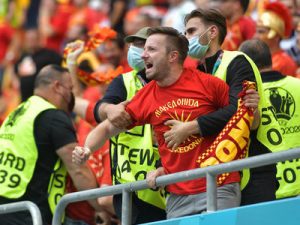
North Macedonia fans at Euro 2020. Razvan Pasarica/SPORT PICTURES/PA Images
In celebration of one of football’s biggest international tournaments, here is Index’s guide to the free speech Euros. Who comes out on top as the nation with the worst record on free speech?
It’s simple, the worst is ranked first.
We continue today with Group C, which plays the deciding matches of the group stages today.
1st Ukraine
Ever heard of the “Information War”? It is probably the biggest threat to freedom of speech in Ukraine and consumes most of the attention directed towards the state where there is often a distinct lack of freedom of expression. The information war between Russia and Ukraine is supposedly solely pro-Russian propaganda, but recent trends show that Ukraine is just as guilty of press freedom violations in this area.
The former Index employee currently detained in his native Belarus Andrei Aliaksandrau explained the tensions and Information War between the two countries back in 2014.
He wrote: “The more you lie, the less you need to shoot. And if you are very good at propaganda, you don’t need to shoot at all to win a war. The principles of an information war remain unchanged: you need to de-humanise the enemy. You inspire yourself, your troops and your supporters with a general appeal which says: “We are fighting for the right cause – that is why we have the right to kill someone who is evil.””
Essentially, propaganda between the two has forced true, fact-checked information to become secondary to a slanging match that has accompanied a territorial dispute between Russia and Ukraine over Crimea.
Ukrainian law stripped three Russian state TV channels of their licences in February earlier this year and they can no longer be shown in Ukraine.
At the time Jeanne Cavelier, the head of RSF’s Eastern Europe and Central Asia desk said: “Even if the desire to combat propaganda is legitimate, it does not justify the use of censorship, and banning these TV channels is liable to stir up violence against journalists. This violation of freedom of expression violates Ukraine’s international obligations.”
The situation has also created an atmosphere in which journalists can be targeted and physically attacked. Eight journalists have been killed in Ukraine since 2014, according to the Committee to Protect Journalists, four of them seemingly in a crossfire between Ukrainian and pro-Russian separatist forces.
The most recent killing was in 2019 with the death of Vadym Komarov, killed after a Facebook post revealed that he planned to publish allegations of corruption within local authorities.
Komarov was found in the city of Cherkasy, central Ukraine, with blunt trauma injuries to the head on 4 May 2019, he died in hospital on 20 June.
2nd North Macedonia
In North Macedonia, journalists are no stranger to threats and harassment. This, added to the actions of corrupt officials leads to what Reporters Without Borders (RSF) describes as a “culture of impunity”.
Violent threats towards reporters are common. Journalist Miroslava Byrns was subjected to threatening messages online after reporting on a wedding with 200 guests in the town of Tetovo, during the Covid-19 pandemic in July 2020. Byrns received one message that read “you will see what will happen to you” and was given 24-hour police protection in response.
Similarly, journalist Tanja Milevska received equally disgusting abuse after questioning the use of “Macedonia” by Hungarian Prime Minister Viktor Orbán. The country’s name was changed in 2019, ending a long running dispute with Greece.
As a result, Milevska received a variety of awful online threats and abusive messages, including those of rape and graphically detailed violence.
Threats, sadly, are indicative of a culture of targeting bred by some North Macedonian officials.
In February 2020, then assistant head of department at North Macedonia’s Central Registry Emil Jakimovski, sent threats that included sexual comments to Meri Jordanovska and Iskra Korovesovska, the deputy editor of news website A1on and editor-in-chief of local broadcaster Alfa TV respectively. Jakimovski was later sacked.
The incident was not unusual. In 2019, local government staffers in the town of Aračinovo attempted to force a journalist and cameraman from TV21 to delete camera footage of interviews with local residents after requesting an interview with Mayor Milikije Halimi.
The two were locked in a room before being forcibly driven to the TV21 headquarters.
There is general distrust between the media and government. In 2015, the Macedonian government were found to have been wiretapping citizens, as well as over 100 journalists. The scandal led to the downfall of the then government.
It was found that the government was using the spying software FinFisher. FinFisher, according to Computer Weekly, is “a sophisticated and easy-to-use set of spying tools that is sold only to governments”.
Use of this technology is a clear violation of the rights of North Macedonian journalists to report without fear or intimidation.
3rd Austria
Most of the concerns around free speech in Austria arise due to defamation suits.
Strategic lawsuits against public participation (Slapps) are common in Austria. Slapps are a type vexatious defamation lawsuit usually aimed at journalists by large corporations or governments. The aim is to stop the journalist from publishing certain information, or pressure them with court cases that are time consuming and extremely costly.
According to Georg Eckelsberger of the investigative media outlet Dossier, letters threatening legal action are often received by journalists in Austria.
In 2017, for example, vice president of the autonomous province Bolzano in Italy and its minister for agriculture Arnold Schuler filed a Slapp against the Jurek Vengels and the Munich Environmental Insititue (MEI) and author Alexander Schiebel. The MEI and Schiebel had helped uncover the use of dangerous pesticides by farmers in Germany.
Commissioner for human rights of the Council of Europe Dunja Mijatović cited the case in expressing her concerns over Slapps. She said: “While this practice primarily affects the right to freedom of expression, it also has a dramatic impact on public interest activities more broadly: it discourages the exercise of other fundamental freedoms such as the right to freedom of assembly and association and undermines the work of human rights defenders.”
The non-profit organisation Freedom House pointed towards libel laws protecting politicians from proper questioning, particularly members of the right-wing populist party, the Freedom Party of Austria (FPÖ). The FPÖ have been responsible for the targeted bullying of Austrian journalists.
A growing trend in the country is also tensions between press and anti-lockdown protesters, something that has been echoed across Europe (BBC Newsnight political editor Nick Watt was hounded outside Downing Street only last week).
On 6 March 2021, several photojournalists covered anti-lockdown demonstrations in the Austrian capital of Vienna. Once again, the FPÖ were heavily involved and signs and placards were seen that read “the lying press”.
4th Netherlands
The Netherlands’ record on free speech is generally good.
Perhaps one of the clearest developments regarding free speech in the Netherlands in recent years is the court case involving the online abuse of journalist Clarice Gargard.
The case, which took two years to reach a judgement, saw 24 people convicted of incitement, insult and discrimination after Gargard was abused during a live stream of a protest she took part in against Zwarte Pieta, a blackface caricature part of traditional Christmas celebrations in the Netherlands.
The case, which journalist Fréderike Geerdink wrote about for Index in the recent winter edition of the magazine, was a landmark moment in retributory action taken against those threatening journalists in the country.
The case exists now as a precedent that may deter people from sending the kind of racist and sexist abuse Gargard was subjected to.
Freedom of speech is protected by the Dutch constitution but is not absolute and it is the incitement law that is contentious. Dutch people can be charged with incitement even if the comment is in relation to an inanimate object.
Generally, however, there is little to stop someone one the Netherlands, legislatively speaking, from speaking out. Also, on the case of incitement, 70 to 90 per cent of cases don’t go to trial, according to an article by The New Republic.
That said, the International Press Institute (IPI) has expressed concern over an increase in threats to reporters after government-imposed coronavirus curfew restrictions. A number of senior reporters in news organisations have noticed increasingly threatening attitudes towards journalists during the pandemic. Partly, some believe, due to conspiracy theorists equating government restrictions such as lockdowns a face masks being supposedly due to a media narrative.
They said: “In 2020, monitoring groups in the Netherlands charted a significant increase in threats and acts of aggression against journalists, with figures nearly trebling on the previous year from 52 to 141. While this may in part be down to the success of the new PressVeilig (Press Safety) hotline – a joint initiative of the NVJ, the Association of Editors-in-Chief, the Police and the Public Prosecution Service – editors have still noted a clear increase in hostility.”
Other Groups
Group A
Group B
Group D
Group E
[/vc_column_text][/vc_column][/vc_row][vc_row][vc_column][three_column_post title=”You may also like to read” category_id=”581″][/vc_column][/vc_row]
4 Jun 2021 | Belarus, China, Hong Kong, News
[vc_row][vc_column][vc_column_text]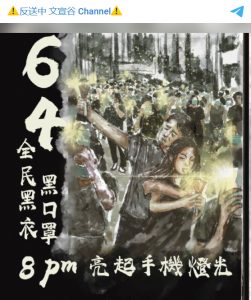 As you scroll through your Telegram feed, one image jumps out.
It shows crowds of young Hong Kongers, all dressed in black, at a protest, holding their smartphones aloft like virtual cigarette lighters from a Telegram channel called HKerschedule.
The image is an invitation for young activists to congregate and march to mark the anniversary of the Tiananmen massacre on 4 June. Wearing black has been a form of protest for many years, which has led to suggestions that the authorities may arrest anyone doing so.
Calls to action like this have migrated from fly posters and other highly visible methods of communication online.
Secure messaging has become vital to organising protests against an oppressive state.
Many protest groups have used the encrypted service Telegram to schedule and plan demonstrations and marches. Countries across the world have attempted to ban it, with limited levels of success. Vladimir Putin’s Russia tried and failed, the regimes of China and Iran have come closest to eradicating its influence in their respective states.
Telegram, and other encrypted messaging services, are crucial for those intending to organise protests in countries where there is a severe crackdown on free speech. Myanmar, Belarus and Hong Kong have all seen people relying on the services.
It also means that news sites who have had their websites blocked, such as in the case of news website Tut.by in Belarus, or broadcaster Mizzima in Myanmar, have a safe and secure platform to broadcast from, should they so choose.
Belarusian freelance journalist Yauhen Merkis, who wrote for the most recent edition of the magazine, said such services were vital for both journalists and regular civilians.
“The importance of Telegram has grown in Belarus especially due to the blocking of the main news websites and problems accessing other social media platforms such as VK, OK and Facebook after August 2020,” he said.
“Telegram is easy to use, allows you to read the main news even in times of internet access restrictions, it’s a good platform to quickly share photos and videos and for regular users too: via Telegram-bots you could send a file to the editors of a particular Telegram channel in a second directly from a protest action, for example.”
The appeal, then, revolves around the safety of its usage, as well as access to well-sourced information from journalists.
In 2020, the Mobilise project set out to “analyse the micro-foundations of out-migration and mass protest”. In Belarus, it found that Telegram was the most trusted news source among the protesters taking part in the early stages of the demonstrations in the country that arose in August 2020, when President Alexander Lukashenko won a fifth term in office amidst an election result that was widely disputed.
But there are questions over its safety. Cooper Quintin, senior security researcher of the Electronic Frontier Foundation (EFF), a non-profit that aims to protect privacy online, said Telegram’s encryption “falls short”.
“End-to-end encryption is extremely important for everyone in the world, not just activists and journalists but regular people as well. Unfortunately, Telegram’s end-to-end encryption falls short in a couple of key areas. Firstly, end-to-end encryption isn’t enabled by default meaning that your conversations could be intercepted or recovered by a state-level actor if you don’t enable this, which most users are not aware of. Secondly, group conversations in Telegram are never encrypted [using end-to-end encryption], lacking even the option to do so, unlike other encrypted chat apps such as Signal, Wire, and Keybase.”
A Telegram spokesperson said: “Everything sent over Telegram is encrypted including messages sent in groups and posted to channels.”
This is true; however, messages sent using anything other than Secret Chats use so-called client-server/server-client encryption and are stored encrypted in Telegram’s cloud, allowing access to the messages if you lose your device, for example.
The platform says this means that messages can be securely backed up.
“We opted for a third approach by offering two distinct types of chats. Telegram disables default system backups and provides all users with an integrated security-focused backup solution in the form of Cloud Chats. Meanwhile, the separate entity of Secret Chats gives you full control over the data you do not want to be stored. This allows Telegram to be widely adopted in broad circles, not just by activists and dissidents, so that the simple fact of using Telegram does not mark users as targets for heightened surveillance in certain countries,” the company says in its FAQs.
The spokesperson said, “Telegram’s unique mix of end-to-end encryption and secure client-server encryption allows for the huge groups and channels that have made decentralized protests possible. Telegram’s end-to-end encrypted Secret Chats allow for an extra layer of security for those who are willing to accept the drawbacks of end-to-end encryption.”
If the app’s level of safety is up for debate, its impact and reach is less so.
Authorities are aware of the reach the app has and the level of influence its users can have. Roman Protasevich, the journalist currently detained in his home state after his flight from Greece to Lithuania was forcibly diverted to Minsk after entering Belarusian airspace, was working for Telegram channel Belamova. He previously co-founded and ran the Telegram channel Nexta Live, pictured.
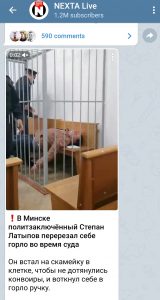
Nexta’s Telegram page
Social media channels other than Telegram are easier to ban; Telegram access does not require a VPN, meaning even if governments choose to shut down internet providers, as the regimes in Myanmar and Belarus have done, access can be granted via mobile data. Mobile data is also targeted, but perhaps a problem easier to get around with alternative SIM cards from neighbouring countries.
People in Myanmar, for instance, have been known to use Thai SIM cards.
The site isn’t without controversy, however. Its very nature means it is a natural home for illicit activity such as revenge porn and use by extremists and terror groups. It is this that governments point to when trying to limit its reach.
China’s National Security Law attempts to censor information on the basis of criminalising any act of secession, subversion, terrorism, and collusion with external forces, the threshold for which is extremely low. It has a particular impact on protesters in Hong Kong. Telegram was therefore an easy target.
In July 2020, Telegram refused to comply with Chinese authorities attempting to gain access to user data. As they told the Hong Kong Free Press at the time: “Telegram does not intend to process any data requests related to its Hong Kong users until an international consensus is reached in relation to the ongoing political changes in the city.”
Telegram continues to resist calls to share information (which other companies have done): it even took the step of removing mobile numbers from its service, for fear of its users being identified.
Anyone who values freedom of expression and the right to protest should resist calls for messaging platforms like Telegram to pull back on encryption or to install back doors for governments. When authoritarian regimes are cracking down on independent media more than ever, platforms like these are often the only way for protests to be heard
[/vc_column_text][/vc_column][/vc_row][vc_row][vc_column][three_column_post title=”You may also want to read” category_id=”581″][/vc_column][/vc_row]
