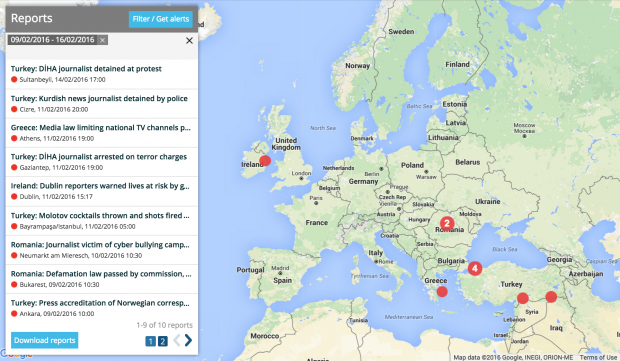
Each week, Index on Censorship’s Mapping Media Freedom project verifies threats, violations and limitations faced by the media throughout the European Union and neighbouring countries. Here are just five reports from 9-16 February that give us cause for concern.
1. Ireland: Reporters receive death threats amid Dublin’s gangland feud
Irish secretary for the National Union of Journalists Seamus Dooley said he was “gravely concerned” by the threats. “Journalists and media organisations will not be intimidated by such threats, which have no place in a democratic society,” he said.
The death threats come almost 20 years after the high-profile murder of journalist Veronica Guerin, who dared to investigate organised crime in Dublin. “Successive governments have let down the memory of Veronica … by failing to provide the resources required to beat the gangs,” said Jimmy Guerin, brother of Veronica.
2. Romania: Journalist faces campaign of cyberbullying and online threats
Boróka Parászka, an ethnic Hungarian publicist and editor working at the public radio in Marosvásárhely/Târgu Mureş area, has become the victim of cyberbullying and online abuse. On 10 February, an online petition was published entitled We Are Sick and Tired of Parászka, which appealed to media outlets not to publish or broadcast any of the journalist’s “left-liberal” work. It claims her pieces are “subversive” (felforgató), that she aggressively attacks everything “Hungarian” and she “undermines the community interests”.
In the wake of the petition, derogatory messages were sent to Parászka via Facebook, including anti-Semitic slurs, sexual comments and threats of violence.
Some Romanian journalists have criticised the draft law as a means to protect politicians from criticism. “This law aims to protect the politicians from being criticised for their actions,” TV producer Radu Banciu said. “In the name of defending tolerance of group differences, they just want to control not only the mass media but also Facebook and other social media.”
4. Greece: New media law limits national TV channels
The law has angered many. “You are choosing the path of authoritarian practices, which alienate the country from the European principles of justice,” New Democracy leader Kyriakos Mitsotakis told MPs. The Association of Private TV Channels (EITISEE) has also accused the government of performing a “sleight of hand” by basing its decision to launch a tender for just four TV licenses on a study that contains calculations that are incorrect.
5. Turkey: Molotov cocktails thrown and shots fired at newspaper headquarters
While there were no casualties, a fire broke out in front of the building and some vehicles were damaged. Firefighters rushed to the scene as police cordoned off the area. Tight security measures were put in place around the building.
The United States Ambassador to Turkey, John Bass, and his German counterpart Martin Erdmann have condemned the attack. “No violence against journalists is acceptable. Free and polyphonic press is essential to a democratic society,” said Bass.
Freedom of the press has always been a pretty reliable litmus test for the state of any democracy. However, as Index on Censorship’s Mapping Media Freedom project shows, countries that are seen as traditionally open, with constitutions protecting freedom of expression, are currently rife with violations against the media.
“It is extremely troubling that media workers have been physically and sexually assaulted, arrested and denied access to key reporting areas in countries with strong democratic institutions,” Hannah Machlin, Index’s Mapping Media Freedom project officer, said. “We hope governments take action to prevent these types of violations from occurring at such a frightening rate.”
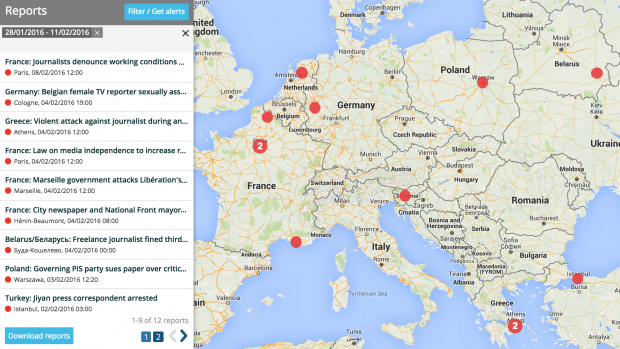
So far this year, Mapping Media Freedom has verified 61 media violations. Here are just five examples from the last fortnight that highlight some of the failures of these democracies to live up to their own standards.
1. Germany: Belgian TV reporter assaulted live on air
Just weeks after hundreds of women were sexually assaulted on the streets of Cologne, a journalist, Esmeralda Labye, was sexually assaulted while reporting from the Cologne carnival for Belgian TV station RTBF on 4 February. One man grabbed her breast and another kissed her neck while she was live on air.
“Two or three men gathered behind me and attempted to make themselves the centre of my attention,” Labye told The Guardian. “I was focusing on the broadcast, and then I felt a kiss on my neck.”
Writing for RTBF online, Labye condemned the “wretched and cowardly men” who assaulted her and complained of the increasing difficulty for female journalists to do their job without being harassed.
2. France: Proposed law will increase role of government’s media watchdog
On 4 February, plans to increase the role of the CSA — the French broadcast watchdog whose members are chosen by the government — as a guarantor of the independence of the media were discussed in the French National Assembly.
The French journalists’ union SNJ criticized the planned bill, written by a Parti Socialiste MP, stressing that the CSA is not independent from political influence. They wrote: “The CSA has no responsibility and legitimacy on matters related to the control of information or journalists. It should have none!”
3. Greece: Violent attack against journalist during anti-austerity demonstration
Protests against the Greek government’s plan to change its pension policy as part of the country’s third international bailout brought an estimated 40,000 people onto the streets of Athens and other cities, including journalists. On 4 February, Dimitris Perros, a journalist from the local radio station Athens 9,84, was violently attacked by unknown assailants while covering the demonstration. He was transported to the hospital with major injuries.
Newspapers reported that the attack was denounced in statements from across the political spectrum including Syriza,PASOK and the Greek Communist Party and the Journalist’s Union of the Athens Daily Newspapers. “The strangers who approached him asked him first if he is a journalist and when he answered affirmatively they started beating him with planks, while the police looked on,” the union stressed in an announcement.
4. The Netherlands: Journalists denied access to meeting on housing asylum seekers under “extremist” ban
On 28 January, several journalists were denied access to a citizens’ meeting about the possible creation of a new asylum seeker centre in the village of Luttelgeest, according to newspaper reports. An emergency regulation was issued to refuse journalists access to the meeting. The mayor also banned journalists from travelling within a radius of five kilometres of the village.
The Dutch Association of Journalists, the NVJ, condemned the measure saying that it was not the first time journalists have been banned. “It has happened many times now,” NVJ secretary Thomas Bruning said. “If journalists are denied access, they are obstructed from doing their job. This is alarming and should not happen in a democracy.”
5. Poland: Government uses defamation law to stop media critics
Even Europe’s youngest democracies are fighting off attacks on media freedom.
As Index on Censorship has previously reported, there is a growing trend in Poland of the government using defamation actions to stop criticism in the media. The most recent example, on 3 February, saw Poland’s ruling Law and Justice party, PiS, file a libel suit against the largest daily newspaper in the country, Gazeta Wyborcza about an opinion piece it disliked.
The article argued that PiS and Poland’s president Andrej Duda have behaved like a “mafia state” for pardoning former anti-corruption official Mariusz Kaminski, for abuse of power. Duda issued the pardon before Kaminski had exhausted the appeals process, a point that the author of the piece, Wojciech Czuchnowski, criticised in his opinion piece.
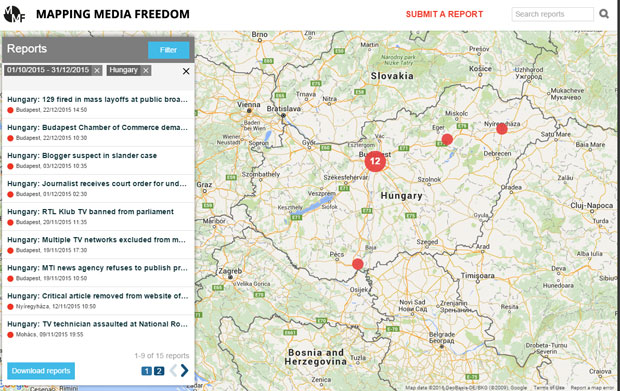
Hungary’s media outlets are coming under increasing pressure from lawsuits, restrictions on what they can publish and high fees for freedom of information requests, according to a survey of the 15 verified reports to Index on Censorship’s media monitoring project during the fourth quarter of 2015.
The Mapping Media Freedom project, which identifies threats, violations and limitations faced by members of the press throughout the European Union, candidate states and neighbouring countries, has recorded 129 verified incidents in Hungary since May 2014. In the fourth quarter of 2015 the country had the second-highest total of verified reports among EU member states and the sixth highest total among the 38 countries monitored by Mapping Media Freedom.
In 2015, Hungary was ranked #65 (partially free) on the World Press Freedom Index compiled by Reporters Without Borders. Only two EU member states, Greece and Bulgaria received a worse score.
In autumn 2015, the law governing freedom of information (FOI) was amended after a series of investigative reports uncovered wasteful government spending through FOI requests. Under the changes, the Hungarian government was granted sweeping new powers to withhold information and allowed the government and other public authorities to charge a fee for the “labour costs” associated with FOI queries. Critics warned that fees would prevent public interest journalism, and, in at least one case, it appears they were right.
In other cases, journalists have been sued for slander and issued court orders for undercover reporting on the refugee crisis.
Here are the 15 reports with links to more information.
The Budapest Chamber of Commerce (BCCI) asked for 3-5 million HUF ($10,356-16,352) to answer a freedom of information (FOI) request submitted by channel RTL Klub. The Budapest Chamber of Commerce and Industry said that the price will cover the salaries of 2-3 employees who would be given the task to respond to the FOI regarding BCCI’s spending and finances.
Those fired included journalists, editors and foreign correspondents. According to the MTVA, the reason for the dismissal was the “better exploitation of synergies”, “increase of efficiency” and “cost reduction”.
András Jámbor, a blogger is suspect in a slander case because he refuted the claims of Máté Kocsis, the mayor of Józsefváros (8th district of Budapest). In August 2015, Mayor Kocsis published a Facebook post alleging that the refugees have been making fires, littering, going on rampage, stealing and stabbing people in parks.
In response, Jámbor wrote a post for Kettős Mérce blog, disproving the mayor’s claims. He added that “Máté Kocsis is guilty of instigation and scare-mongering”. The mayor denounced him for slander.
On 3 December 2015, Jámbor confirmed to police that he is the author of the blog post and sustains the affirmations he made. The police took fingerprints and mugshots of the journalist.
Gergely Nyilas, a journalist working for Hungarian online daily Index.hu, was summoned to court for his undercover report on refugee camp conditions published in August 2015.
The journalist reentered Hungary’s borders with a group of asylum seekers and, upon being detained, told the border guards that he was from Kyrgyzstan. Dressed in disguise, Nyilas reported on his treatment by border guards, the conditions at the Röszke camp, a bus ride and his experience at the police station in Győr. He eventually admitted he was Hungarian, at which point the police let him go, the Budapest Beacon reported.
Based on a police investigation, prosecutors first charged Nyilas with lying to law enforcement officials and forging official documents. The charges were then dropped but prosecutors still issued a legal reprimand against the journalist.
On 20 November 2015, László Kövér, the speaker of the parliament has banned RTL Klub television from entering the parliament building, saying that the crew broke parliament rules on press coverage. According to Kövér, the journalists were filming in a corridor, where filming was forbidden, and then refused to leave the premises after they were repeatedly asked to.
The day before, on 19 November, RTL Klub was not allowed to participate at a press conference held by Hungarian prime minister Viktor Orbán and NATO secretary general Jens Soltenberg in parliament.
RTL Klub, along with other Hungarian media outlets such as 444.hu or hvg.hu, were not invited to the press conference, but RTL Klub journalists still showed up. They attempted to enter the room with the camera rolling but were denied access. This incident reportedly led to the ban on their access.
RTL Klub TV, 444.hu and hvg.hu journalists were not invited to a joint press conference held in parliament by Hungarian prime minister Viktor Orbán and NATO secretary general Jens Soltenberg.
RTL Klub journalists still attempted to attend by entering the room with a camera already rolling but were still barred from entering.
They were told that the meeting was “private”, and journalists were not allowed to ask questions. Bertalan Havasi, the press secretary for the Hungarian prime minister, told them that their pass was only for the plenary session and that they must leave. However, state media outlets like M1 were allowed live transmission of the press conference, and MTI, the Hungarian wire service also published a piece about the meeting.
Publicly funded news agency MTI refused to publish a press release by Hungarian Socialist Party vice president Zoltán Lukács, where he asked for a wealth gain investigation into István Tiborcz, the son-in-law of the Hungarian prime minister. MTI refused to publish the press release, claiming that István Tiborcz is not a public figure.
The business interests of the son-in-law of Prime Minister Victor Orbán are widely discussed in the Hungarian media, especially because companies connected to Tiborcz are frequently winning public procurement tenders.
The article titled, A Mass of People Saluted Viktor Orbán at Nyíregyháza – Or Not?, had a photo showing that only two dozen people gathered around the Hungarian prime minister visiting the city of Nyíregyháza. Soon after the piece was published, it was removed from the szon.hu website. However, it was reportedly still available temporarily in Google cache.
The article was a reaction to a photo published by the state news agency, MTI, that was shot in such a way that it leaves the impression that there was a big crowd around the prime minister.
A technician working for Hír TV news television was assaulted at a meeting of the National Roma Council held in the city of Mohács. The technician was standing near a door, when the daughter of a member of the National Roma Council, hit him in the stomach, as she was leaving the room.
The mother of the aggressor, Jánosné Kis denied any wrongdoing, although her daughter actions were captured on film.
The Hungarian publishers’ association claimed that if the draft proposal by the interior ministry is passed by parliament, it could “harshly interfere with and damage” media freedom, and would facilitate censorship. The association represents over 40 of Hungary’s largest media companies.
Geza Szocs, the cultural commissioner in the Hungarian Prime Ministry, has asked for a modification of Hungary’s media law that would criminalise defamation, in an article for mandiner.hu. Szocs has also asked for a stricter regulation of damages caused by defamatory articles.
The commissioner wrote the piece in response to a series of articles published by index.hu, which criticised the Hungary’s presence at the 2015 Milan World Fair, a project that Szocs was managing.
“Don’t take pictures of the state secretary while he is eating,” a staff member told the journalist, who works for vs.hu.
The journalist briefly interviewed Tállai, who is also head of the Hungarian Tax Authority, in the township of Mezőkövesd, where the politician started the conversation by asking, “Why do you want to write a negative article about me?”. Tállai then smiled and asked the journalist, “You are registered at the Tax Authority, right?”
Editors at MR I Kossuth Rádió, part of Hungarian public radio, did not broadcast an interview with János M. Rainer, one of the most acclaimed historians on the 1956 Hungarian revolution.
“We don’t need a Nagy Imre-Rainer narrative!” was the justification given by one of the editors to censor the content, the reporter who interviewed Rainer claimed.
Hungarian state news agency MTI refused to publish a press release issued by Lehet Más a Politika (LMP), an opposition parliamentary party.
In the press release, LMP criticised MTI by stating the Hungarian government is spending more money every year on the news agency, yet MTI fails to meet the standards of impartiality and is being transformed into a government propaganda machine.
Hungarian journalists were not allowed to ask questions at a press conference held after a meeting between the Hungarian president János Áder and the PM of Croatia, Kolinda Grabar-Kitarovic.
Only international journalists from Reuters and the Croatian state television were allowed to ask the politicians questions.
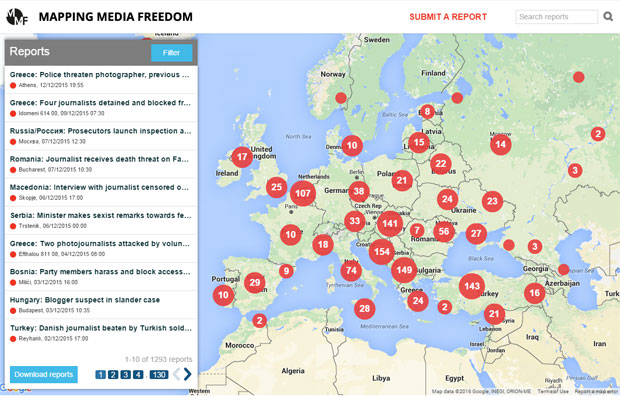
The attacks on the offices of satirical magazine Charlie Hebdo in Paris in January set the tone for conditions for media professionals in 2015. Throughout the year, Index on Censorship’s Mapping Media Freedom correspondents verified a total of 745 violations of media freedom across Europe.
From the murders of journalists in Russia, Poland and Turkey to the growing threat posed by far-right extremists in Germany and government interference in Hungary — right down to the increasingly harsh legal measures imposed on reporters right across the continent — Mapping Media Freedom exposed many difficulties media workers face in simply doing their jobs.
“Last year was a tumultuous one for press freedom; from the attacks at Charlie Hebdo to the refugee crisis-related aggressions, Index observed many threats to the media across Europe,” said Hannah Machlin, Index on Censorship’s project officer for the Mapping Media Freedom project. “To highlight the important cases and trends of the year, we’ve asked our correspondents, who have been carefully monitoring the region, to discuss one violation each that stood out to them.”
Belarus / 19 verified reports between May-Dec 2015 Journalist blocked from shooting entrance to polling station
“It demonstrates the Belarusian authorities’ attitude to media as well as ‘transparency’ of the presidential election – the most important event in the current year.” — Ольга К.-Сехович
Greece / 15 verified reports in 2015 Four journalists detained and blocked from covering refugee operation
“This is important because it is typical ‘attempt to limit press freedom’, as the Union wrote in a statement and it is not very hopeful for the future. The way refugees and migrants are treated is very sensitive and media should not be prevented from covering this issue.” — Christina Vasilaki
Hungary / 57 verified reports in 2015 Serbian camera crew beaten by border police
“These physical attacks, the harsh treatment and detention of journalists are striking because the Hungarian government usually uses ‘soft censorship’ to control media and journalists, they rarely use brute force.” — Zoltan Sipos
Italy / 72 verified reports in 2015 Italian journalists face up to eight years in prison for corruption investigation
“I chose it because this case is really serious: the journalists Emiliano Fittipaldi and Gianluigi Nuzzi are facing up to eight years in prison for publishing books on corruption in the Vatican. This case could have a chilling effect on press freedom. It is really important that journalists investigate and they must be free to do that.” — Rossella Ricchiuti
Lithuania / 9 verified reports in 2015 Journalist repeatedly harassed and pushed out of local area
“I chose it because I found it relevant to my personal experience and the fellow journalist has been the only one to have responded to my hundreds of e-mails — including requests to fellow Lithuanian journalists to share their personal experience on media freedom.” — Linas Jegelevicius
Macedonia / 27 verified reports in 2015 Journalist publicly assaults another journalist
“I have chosen this incident because it best describes the recent trend not only in Macedonia and my other three designated countries, Croatia, Bosnia and Montenegro, but also in the whole region. And that is polarization among journalists, more and more verbal and, like in this unique case, physical assaults among colleagues. It best describes the ongoing trend where journalists are not united in safeguarding public interest but are nothing more than a tool in the hands of political and financial elites. It describes the division between pro-opposition and pro-government journalists. It is a clear example of absolute deviation from the journalistic ethic.” — Ilcho Cvetanoski
Poland / 11 verified reports in 2015 Law on public service broadcasting removes independence guarantees
“The new media law, which was passed through Poland`s two-chamber parliament in the last week of December, constitutes a severe threat to pluralism of opinions in Poland, as it is aimed at streamlining public media along the lines of the PiS party that holds the overall majority. The law is currently only awaiting president Duda’s signature, who is a close PiS ally.” — Martha Otwinowski
Portugal / 9 verified reports in 2015 Two-thirds of newspaper employees will be laid off
“It’s a clear picture of the media in Portugal, which depends on investors who show no interest in a healthy, well-informed democracy, but rather in how owning a newspaper can help them achieve their goals — and when these are not met they don’t hesitate to jump boat, leaving hundreds unemployed.” — João de Almeida Dias
Russia / 37 verified reports between May-Dec 2015 Media freedom NGO recognised as foreign agent, faces closure
“The most important trend of the 2015 in Russia is the continuing pressure over the civil society. More than 100 Russian civil rights advocacy NGOs were recognized as organisations acting as foreign agents which leads to double control and reporting, to intimidation and insulting of activists, e.g., by the state-owned media. Many of them faced large fines and were forced to closure.” — Andrey Kalikh
Russia / 37 verified reports between May-Dec 2015 TV2 loses counter claim to renew broadcasting license Roskomnadzor
“It illustrates the crackdown on independent local media, which can not fight against the state officials even if they have support from the audience and professional community.” — Ekaterina Buchneva
Serbia / 41 verified reports in 2015 Investigative journalist severely beaten with metal bars
“It’s a disgrace and a flash-back to Serbia’s dark past that a journalist, who’s well known for investigating high-level corruption, get’s beaten up with metal bars late at night by ‘unknown men’.” — Mitra Nazar
Turkey / 97 verified reports in 2015 Police storm offices of Koza İpek, interrupting broadcast
“The raid on Bugün and Kanaltürk’s offices just days ahead of parliamentary elections was a drastic example — broadcasts were cut by police and around 100 journalists ended up losing their jobs over the next month — of how the current Turkish government tries to strong-arm media organisations.” — Catherine Stupp
Mapping Media Freedom
Click on the bubbles to view reports or double-click to zoom in on specific regions. The full site can be accessed at https://mappingmediafreedom.org/