25 Jun 2019 | Events
[vc_row][vc_column][vc_single_image image=”82824″ img_size=”full”][vc_column_text]On 13th June 2019, UK Home secretary Sajid Javid signed a request for Julian Assange to be extradited to the USA. He has since been ordered by the court to face a full extradition hearing in February next year. If granted, the Wikileaks founder could face 18 indictment charges in the US, including those under the Espionage Act. If found guilty he could receive a potential prison sentence of 175 years.
Now that Assange has been ejected from the Ecuadorian embassy and is serving a 50-week sentence in Belmarsh Prison for bail violations, how does the journalism community view the founder of Wikileaks? Assange claims Wikileaks was never involved in hacking classified information and is “nothing but a publisher”. His QC says the US extradition case “represents an outrageous and full-frontal assault on journalistic rights.” For many, there are still unanswered questions.
Does Julian Assange merit our support and solidarity – as a journalist and a defender of the freedom to inform? Or does his personal conduct – in light of allegations of rape and sexual assault, and his documented collaboration with Russian intelligence to disrupt Hillary Clinton’s election campaign – cancel out the debt owed to him by the editors and journalists who used the Wikileaks documents to publish, broadcast and post their many ground-breaking stories and reports?
Join us as the Frontline Club brings together all sides of the debate to discuss the legacy and future of Julian Assange. Each speaker will be cross-examined for 10 minutes by our chair, and face five minutes of questions from the floor. Former editor-in-chief of the Guardian Alan Rusbridger will be joined by columnist and broadcaster David Aaronovitch, chief executive of Index on Censorship Jodie Ginsberg and freelancer Vaughan Smith, with more panellists to be announced.[/vc_column_text][/vc_column][/vc_row][vc_row][vc_column][vc_custom_heading text=”Panel” font_container=”tag:h3|text_align:left” use_theme_fonts=”yes”][vc_row_inner][vc_column_inner width=”1/3″][vc_single_image image=”107623″ img_size=”full”][vc_column_text]Chair
Robin Lustig is a journalist and broadcaster. From 1989-2012 he presented Newshour on BBC World Service and The World Tonight on BBC Radio 4. He studied politics at the University of Sussex and began his journalistic career as a Reuters correspondent in Madrid, Paris and Rome. He then spent 12 years at The Observer before moving into broadcasting in 1989. He has extensive experience of covering major world events for the BBC, and has broadcast live programmes from Abuja, Amman, Baghdad, Berlin, Harare, Hong Kong, Islamabad, Istanbul, Johannesburg, Jerusalem, Kabul, Kosovo, Moscow, New York, Paris, Rome, Sarajevo, Shanghai, Tehran, Tokyo and Washington. He has won a number of awards, including the 1998 Sony Silver Award for Talk/News Broadcaster of the Year. In 2013 he received the Charles Wheeler award for outstanding contribution to broadcast journalism.[/vc_column_text][/vc_column_inner][vc_column_inner width=”1/3″][vc_single_image image=”107624″ img_size=”full”][vc_column_text]David Aaronovitch is a writer, broadcaster and commentator on culture, international affairs, politics and the media. His regular column appears every Thursday in The Times. A former television researcher, producer and programme editor, he has previously written for The Independent, The Guardian and The Observer, winning numerous accolades, including Columnist of the Year 2003. He has appeared on the satirical TV current affairs programme Have I Got News For You, presented a number of radio and television series and programmes on current affairs and historical topics. His first book, and account of a journey by kayak on the rivers and canals of England, Paddling to Jerusalem, was published in 2000 and won the Madoc Prize for travel writing. In 2009 he published Voodoo Histories, a book on the history and attraction of conspiracy theories.[/vc_column_text][/vc_column_inner][vc_column_inner width=”1/3″][vc_single_image image=”103419″ img_size=”full”][vc_column_text]Jodie Ginsberg is Chief Executive of Index on Censorship, a London-based organisation that has published work by censored writers and artists and campaigned globally on freedom of expression issues since 1972. Prior to joining Index, Jodie worked as a foreign correspondent and business journalist and was UK Bureau Chief for Reuters news agency. She sits on the council of global free expression network IFEX and the board of the Trust for The Bureau of Investigative Journalism, and is a regular commentator in international media on freedom of expression issues.[/vc_column_text][/vc_column_inner][/vc_row_inner][vc_row_inner][vc_column_inner width=”1/3″][vc_single_image image=”107625″ img_size=”full”][vc_column_text]Suzanne Moore is an English journalist and columnist.[/vc_column_text][/vc_column_inner][vc_column_inner width=”1/3″][vc_single_image image=”107627″ img_size=”full”][vc_column_text]Alan Rusbridger was Editor in Chief of the Guardian from 1995-2015. He is currently Principal of Lady Margaret Hall, Oxford, and Chair of the Reuters Institute for the Study of Journalism. During his time at the Guardian, both he and the paper won numerous awards, including the 2014 Pulitzter Prize for Public Service Journalism. The Guardian grew from a printed paper with a circulation of 400,000 to a leading digital news organisation with 150m browsers a month around the world. He launched now-profitable editions in Australia and the US as well as a membership scheme which now has 1m Guardian readers paying for content.[/vc_column_text][/vc_column_inner][vc_column_inner width=”1/3″][vc_single_image image=”107626″ img_size=”full”][vc_column_text]Vaughan Smith founded the Frontline Club in London in 2003 as an institution to champion independent journalism. During the 1990’s he ran Frontline Television News, an agency that represented the interests of freelance video journalists. Since 1988 Vaughan has filmed in Iraq, Afghanistan, Bosnia, Chechnya, Kosovo and elsewhere, including the only uncontrolled footage of the Gulf War in 1991 while disguised for two months as a British Army officer. His home was refuge to WikiLeaks founder Julian Assange for thirteen months in 2011/12.[/vc_column_text][/vc_column_inner][/vc_row_inner][vc_column_text]
When: Tuesday 2 July 7:30pm BST
Where: Frontline Club, 13 Norfolk Place, London W2 1QJ
Tickets: This event is fully booked
[/vc_column_text][/vc_column][/vc_row]
18 Jun 2019 | Academic Freedom, News, Scholar at Risk
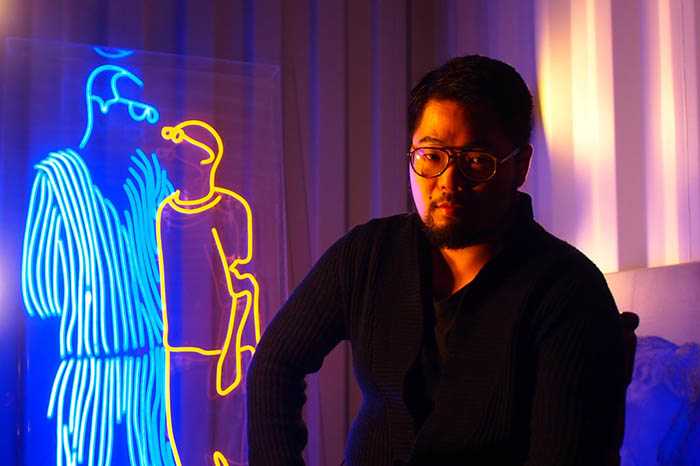
[vc_row][vc_column][vc_column_text]This article is part of an ongoing series created in partnership with Scholars at Risk, an international network of institutions and individuals whose mission it is to protect scholars, promote academic freedom, and defend everyone’s right to think, question, and share ideas freely and safely.[/vc_column_text][vc_single_image image=”107359″ img_size=”full” add_caption=”yes”][vc_column_text]
“I realised that I had been cheated by the Chinese government,” legal scholar Teng Biao said describing his drive to pursue a career in human rights law.
Teng said that he was motivated by the Tiananmen Square movement, the student-led protests that bloomed after the death of pro-reform communist leader Hu Yaobang in April 1989. An officially-sanctioned mourning period provided an opening for Chinese to express their anxieties about the direction of the country. Officials reacted with a mixture of conciliatory and hardline tactics that revealed a split with the communist party leadership. Ultimately, the hardliners won out, with the country’s paramount leader at the time, Deng Xiaoping, and his allies resolving to use force to suppress the movement. Up to 300,000 troops mobilised under a martial law order implemented on 20 May. On 4 June 1989, the troops were ordered into central Beijing, killing both demonstrators and bystanders in the process. Estimates of the death toll vary from several hundred to thousands.
“So many people have sacrificed their lives to fight for democracy and freedom, so I cannot be silent, and I cannot give up,” Teng said.
For his efforts to defend human rights in China by taking on politically sensitive cases, Teng, who has been abducted three times, moved to the USA in 2014. He continues to pursue human rights law and activism as a visiting scholar at Princeton, Harvard, and New York University.
As the Chinese regime continues its crackdown on scholars, intellectuals, journalists and human rights lawyers, Teng analyzes the way in which the Chinese regime under Xi Jinping has used high-technology totalitarianism to successfully target and suppress dissidents.
Although Teng now lives in the United States, he still feels the weight of censorship and pressure from the Chinese regime. In 2016, the American Bar Association abruptly cancelled the publication of his book, “Darkness Before Dawn”, which details his 11-year career as a rights defender in China.
Despite his setbacks, Teng has co-founded Beijing’s China Against the Death Penalty, and the Open Constitution Initiative, an organisation of lawyers and academics that advocates for the rule of law in China. He also co-founded the China Human Rights Accountability Center from the United States.
Summer Dosch interviewed Teng for Index on Censorship.
Index: What motivated you to specialise in human rights law?
Teng Biao: Before I went to the university, I was a brainwashed high school student, and I didn’t know the meaning of law, human rights, or politics. After a few years of studying in law school at Peking University, I realised that I had been cheated by the Chinese government. I gradually had to develop independent thinking. Once I knew more about the human rights situation in China, I decided to become a scholar. Before I got my PhD, my idea was to focus on academic and intellectual work so that I could use it to promote human rights law in China. Soon after I began to teach at a university in Beijing, I participated in a very influential case, and then I founded a human rights entity. After that, I became a human rights lawyer and dedicated my work to the human rights cause in China.
Index: When did you start receiving threats from the Chinese regime for your work?
Teng: When I started my human rights work, my first case was quite influential, so I was prepared to receive harassment from the government; however I didn’t. Shortly after continuing my human rights work, I received harassment and warnings from the university and the government.
Index: What motivated you to keep teaching, and pursuing human rights law despite the limitations you faced and the threats you received from the Chinese regime?
Teng: I feel as though I have a special responsibility to promote human rights in China as a lawyer and an intellectual. In the early 2000’s, I felt that China was in the process of democratisation, and that there was still so much human rights work to do. It is dangerous, but I thought that I needed to take more risks as an intellectual. Two years after the Tiananmen massacre, I went to the university and I started learning the truth behind it, and I saw myself as survivor of the massacre. So many people have sacrificed their lives to fight for democracy and freedom, so I cannot be silent, and I cannot give up. The feeling of being a survivor of the Tiananmen massacre motivated me to keep going.
Index: What do you think of the current situation in China today?
Teng: After the Tiananmen massacre in 1989, the Chinese Communist Party instituted some economic reforms. In terms of the political system, the reform never happened; therefore it remains a one party system. The fundamental freedoms and human rights of the Chinese people remain very limited. In terms of human rights and press freedom, China has always been one of the worst countries in the world. Before Xi Jinping came to power in late 2012, the crackdown on Chinese society was severe. Although censorship and persecution were there, they were not like what Jinping has been doing for the past six years. After 2013, the human rights situation deteriorated even more. Jinping has turned China’s collective dictatorship into a personal dictatorship.
The Communist party is also establishing what I call high-technology totalitarianism. This kind of high-tech totalitarianism has never happened in human history. It includes DNA collection, facial recognition, artificial intelligence, big data, and a sociocratic system, which have all been used by the Chinese government to strengthen its control over society. Jinping and the Chinese government started a comprehensive crackdown that targeted all the forces that had been fighting for freedom and human rights law, including human rights lawyers, bloggers, scholars, underground churches, and the internet. This crackdown is getting worse, and will continue to get worse in the years to come.
Index: What do you think of Chinese-American relations today? How do they continue to threaten international freedom and intellectual freedom?
Teng: I am quite critical of the American policy towards China. American and other western democracies have adopted an engagement policy. They think that if they permit China to be a part of WTO and international human rights treaties, China will start to move towards democracy, and promote more of an open society; however this has not happened. Human rights activists and dissidents have always called for policy change, and for a link between human rights and business; however the United States has not listened until just recently. Within the last two to three years, I sense that the United States is thinking about a policy change. They have seen more and more evidence that China has become a threat to international free order. Then we also see the trade war between the United States and China, which indicates that there will be more tension between the two countries. The Chinese government has violated human rights and freedom in China, and in doing so has become a threat to global human rights and freedom. So I believe that the threat is from the Chinese government, not from China-United States relations.
Index: How do current Chinese-American relations affect your work as a human rights lawyer today?
Teng: Before 2014, I was in Taicheng publishing my articles and books, and I was also traveling internationally. Because of my human rights activities, I was put under house arrest, kidnapped by the secret police, and tortured. During this time, I wasn’t able to continue my human rights work. Even in the United States, I still feel pressure and interference from the Chinese government. A publishing unit refused to publish my book after I had signed the agreement because they were afraid of the Chinese government. They told me that my book would endanger their programs in China. My graduate talk was also canceled by an ivy league university in the United States.
After I came to the United States, my wife and my children were prevented from leaving China, and were held by the Chinese government as hostages. I also received death threats from anonymous Twitter users, who were obviously working for a Chinese agent. There are many more examples similar to these. Again the threat to my work comes from the Chinese government, not from China-United States relations.
Index: How have intellectuals in China responded to the decline of intellectual freedom in China?
Teng: Most intellectuals, writers, scholars, and journalists are controlled by the Chinese government. No matter what kind of belief or ideology they have, they don’t criticise the Chinese government publically. Only a few intellectuals are brave enough to share their independent thoughts that criticise the current government system. Some of these intellectuals would be seen as dissidents if they went any further. For the past five to six years, intellectual and academic freedom has been decreasing very rapidly. The information control of districts, universities, and publishers became severe. More intellectuals are afraid of being outspoken, so they stay silent, delete their social media, and don’t write critical articles. Only a few dozen intellectuals are still active and courageous enough to be critical.
Index: Do you think there has been a significant emigration of scholars and intellectuals from China?
Teng: I have seen some intellectuals go to the United States in exile, and there will be more. The problem is that it is not easy to live in the United States in exile. Some scholars and human rights activists are in great danger if they continue to live in China. Some of them have been fired, imprisoned, or tortured and therefore have to leave China to apply for political asylum. Most scholars who feel unhappy and pressure from the government, but are not facing immediate danger do not think that it is easy to live in a foreign country. So we haven’t seen hundreds and thousands of Chinese scholars and intellectuals moving outside of the country.
Index: Why did you decide to flee to the United States and what has life been like for you and your family since moving there?
Teng: When I was in China, I was detained and tortured a few times, and my family was targeted. Even after my abduction, disappearance, and torture, I continued my work. In late 2013, many activists of the New Citizens Movement were arrested, and I am one of the initiators of the New Citizens Movement. At that time I was also a visiting scholar at a Chinese university in Hong Kong, so it was quite clear that if I went back to China from Hong Kong, I would be arrested and no longer able to continue my work. I then accepted an invitation from Harvard Law School.
Index: How has your family adapted to life in the United States?
Teng: They are accustomed to American life, but it is always a challenge for foreigners to live in a new country. The language barrier, and the culture difference make life especially difficult. Because of the pressure from the Chinese government, my wife was fired from the company that she had been working for for 17 years. It is not easy for me to get a job because my degree is from China, so I have had to start from zero in the United States; however at least my wife and children are not living in fear. I appreciate the free and safe environment in the United States where I can continue to pursue my human rights activism.
Index: What were you teaching or working on when you were abducted by the secret police?
Teng: The first time I was abducted was in 2008, and the second time was in 2011. I was a lecturer at the China University of Political Science and Law. I was teaching jury’s prudence and constitutional law, but the main reason I was abducted was because of my involvement in several human rights cases, which related to Tibetans, underground churches, and unlawful convictions. I have been involved in many politically sensitive cases. The third time I was abducted was in 2012, and I was only held hostage for one night. I was released before my friends, family, and the media knew about my abduction.
Index: Do you have plans to go back to China in the near future?
Teng: As a human rights lawyer, I really want to work in China. I enjoyed the time I was fighting for human rights law and democracy with my Chinese colleagues. But now, I am unable to return to China without being blocked or arrested by the Chinese government. I predict that government control will only tighten in the coming years, and because of this I will not be able to go back to China. But I really hope that I can go back to either a free China, or as a human rights lawyer to continue my human rights work without being imprisoned for the long-term.
Index: What are your thoughts about the protests against the extradition law being proposed in Hong Kong?
Teng: On June 10 2014, by issuing a ‘white paper’, Beijing had destroyed ‘one country two systems’ which is not only a promise to Hong Kong and UK, but also a part of international commitment. Hong Kong has been an impressive example that a dictatorial regime will not tolerate a special region which has political freedom. The Umbrella Movement was a failed fight for universal suffrage, but the protest against the extradition law seems to be the ‘last fight’, because if this extradition bill is passed, a free Hong Kong will be over soon. It is the shame of the WHOLE WORLD to helplessly see how a free and prosperous city was occupied and killed by a dictatorial regime, and by the appeasement policy adopted by the democracies.
[/vc_column_text][/vc_column][/vc_row][vc_row full_width=”stretch_row_content”][vc_column][three_column_post title=”Scholars at Risk” full_width_heading=”true” category_id=”31940″][/vc_column][/vc_row]