Contents – Land of the Free? Trump’s war on speech at home and abroad
Contents

Contents
What’s one book that changed how you see the world?
Books can transform us. They open up new perspectives, help us understand lives different from our own, and spark ideas we might never have imagined. The freedom to read – to explore, question and connect through stories – is a vital part of any free and open society.
But that freedom is under threat.
Around the world, writers face censorship, imprisonment and violence simply for putting words on a page. Booksellers from Iran to Belarus, Israel to Hong Kong have been harassed and silenced. Publishers in China and Russia are being pressured and censored. In places like the USA, Brazil, Hungary and even the UK, books are being banned and pulled off the shelves in libraries because of the ideas they hold and the questions they raise.
Why? Because stories are powerful. Because reading can challenge the status quo.
Banned Books Week UK returns from 5–11 October 2025. It’s a week to celebrate the books that have been challenged, removed or silenced, and to stand with the people who write, sell and share them. Join Index on Censorship in honouring the right to read freely and the courage it takes to speak up. In partnership with the International Publishers Association and Hay Festival Global.
Get Involved!
Email: [email protected] to take part.
About Banned Books Week UK
Index on Censorship is the UK partner for the USA Coalition, which runs ‘Banned Books Week’. Banned Books Week was launched in 1982 in response to a sudden surge in the number of challenges to books in libraries, bookstores, and schools. Typically (but not always) held during the last week of September, the annual event highlights the value of free and open access to information and brings together the entire book community — librarians, educators, authors, publishers, booksellers, and readers of all types — in shared support of the freedom to seek and to express ideas. You can read more about Banned Books Week here: About | Banned Books Week.
Banned Books Week UK is led by Index on Censorship as a parallel campaign to Banned Books Week in the USA. It ran successfully for a couple of years prior to the pandemic and is re-launching in 2025. Index invites booksellers, libraries, literary organisations, publishers, schools, writers and any other organisations interested in getting involved with the campaign. The aim of Banned Books Week UK is to become a truly nationwide campaign. Follow us on X.
Budapest Pride marked its 30th anniversary this year, but the government’s decision to ban the event in March cast a sombre sky over such a joyous occasion. For many Hungarians, this was not just an attack on the LGBTQ+ community, but an attack on all of us. The freedom to love who we want and the freedom to express this love through a peaceful gathering is something that cannot be taken away. That is our civil right.
If the government can ban Pride, what will be next?
Attendees of the event were threatened with fines of up to 200,000 Hungarian forints (approximately €500), enforced through facial recognition technology. This is something that many Hungarians simply cannot afford to pay. The police also denied to give permission for the event, due to the government ban. However, Gergely Karácsony, the mayor of Budapest, came up with a solution: relabelling Pride as a municipal event, meaning that it didn’t require a permit. This made sure no one had the legal grounds to stop it from happening.
But either way I was sure about one thing – I was going to be there.
When I reached the meeting point on Saturday 28 June, which was a warm, sunny day, I couldn’t see the start of the march due to the sea of people buzzing on the street. There was a sense of joy and togetherness, something that reassured me. I knew this is where I belonged.
As I was waiting for my friends, I started to talk to Bea, 52, a mother of four, who came to Pride to protest against the government and fight for her children’s future. “One day we exclude one group of people, the next day another, then a third, and eventually we are going to end up with a yellow star again. I’m really afraid of that,” she said. “I want a future for my children where they can live freely.”
“I feel hopeless, absolutely hopeless,” she added. “I have this secondary embarrassment that the people I voted for, the ones I once believed in, led the country to where it is now. I am embarrassed to be living among people who think this way.”
These same thoughts have been lingering in my own mind for years. I keep asking myself: how can so many people vote for this government? Is it their lack of compassion? Or is it just propaganda tainting their views?
But as I was standing at Deák Ferenc square, surrounded by thousands of people who chose to show their resistance that day, something started to shift in me.
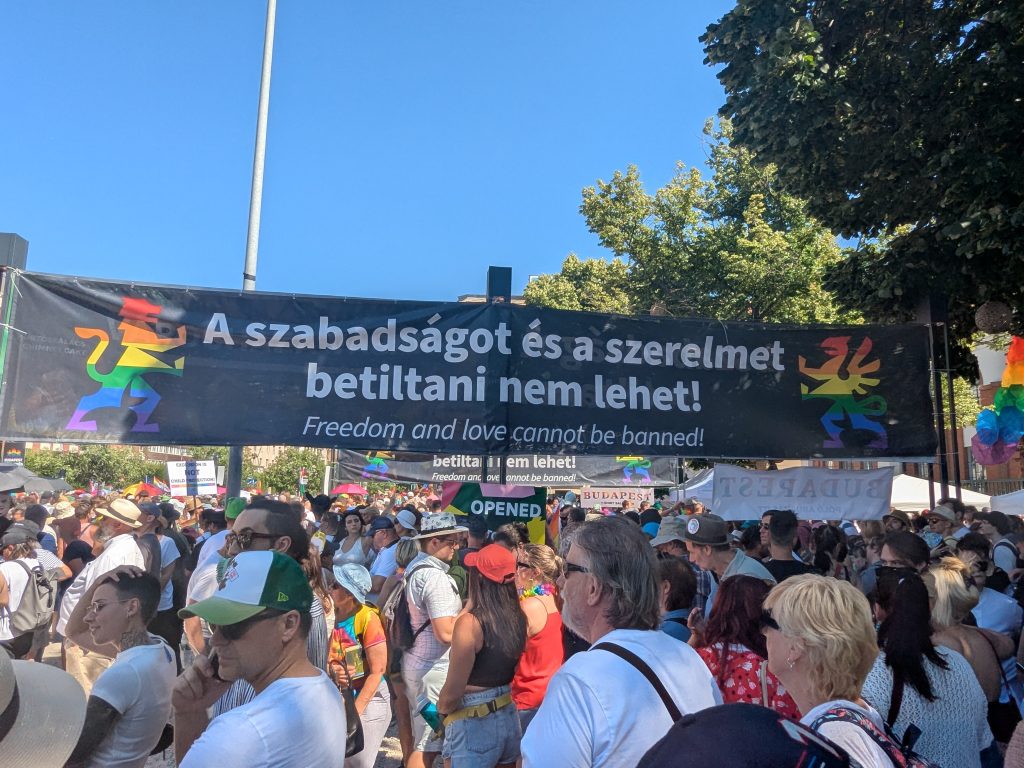
Photo by Anna Péter
When the crowd walked down Károly körút and passed a facial recognition camera, a man in his fifties jokingly shouted at it: “Take me to prison, take me to prison.” His defiance and total absence of fear of the consequences was infectious. It inspired me and made me so proud to be standing alongside him and others.
The march was originally heading to the Freedom Bridge but the far right party, Mi Hazánk (Our Homeland Movement) had blocked it, leaving us with no choice but to reroute and go across the Elisabeth Bridge instead.
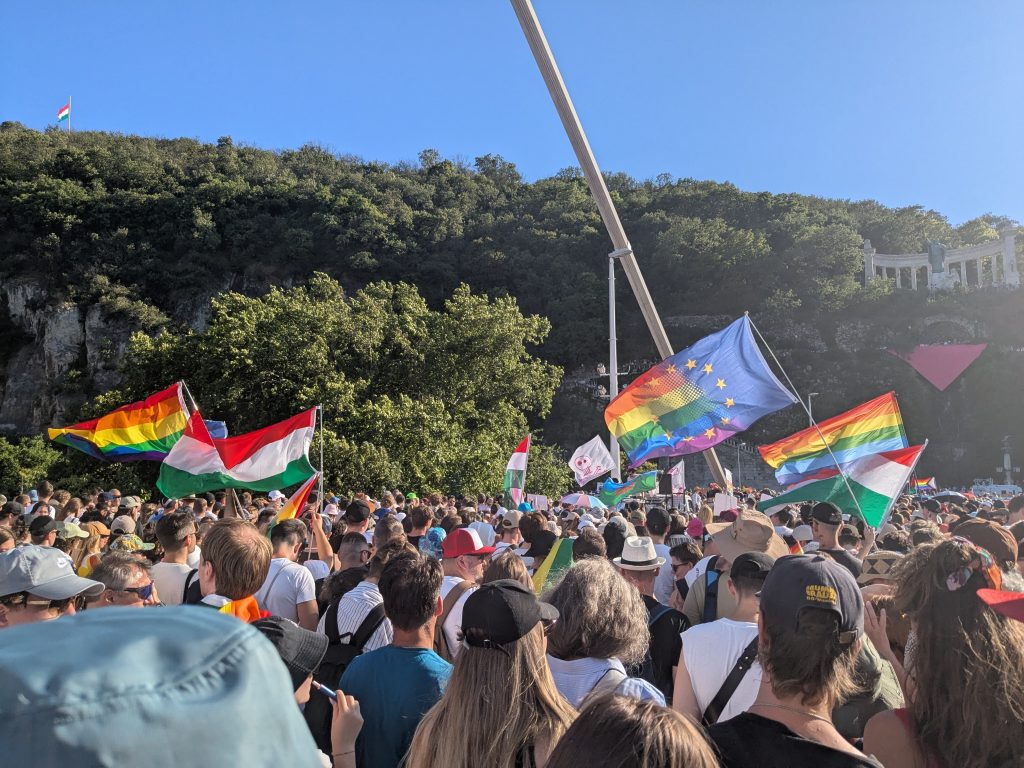
Pride marchers walking over Elisabeth Bridge. Photo by Anna Péter
During the walk, I met Orsi from Budapest, who said she wants to live in a country where she can exercise her basic human rights, such as the right to free assembly. “Everyone is equal, regardless of their gender or religion. I came here today to support the LGBTQ+ people but if any other group of people were banned from marching, I would still be here.”
Orsi recently attended a demonstration against the abolition of the right to assembly where police shouted into her ear with a megaphone. “I didn’t feel safe, even as a peaceful protestor,” she said. “I am afraid not only of the fine that I can get but also how the police may react today.”
She is not alone in this fear. Even the day before Pride, I kept thinking about the worst-case scenario: what if the police acted irrationally? What if counter protestors turned violent? What if the whole Pride just got out of hand?
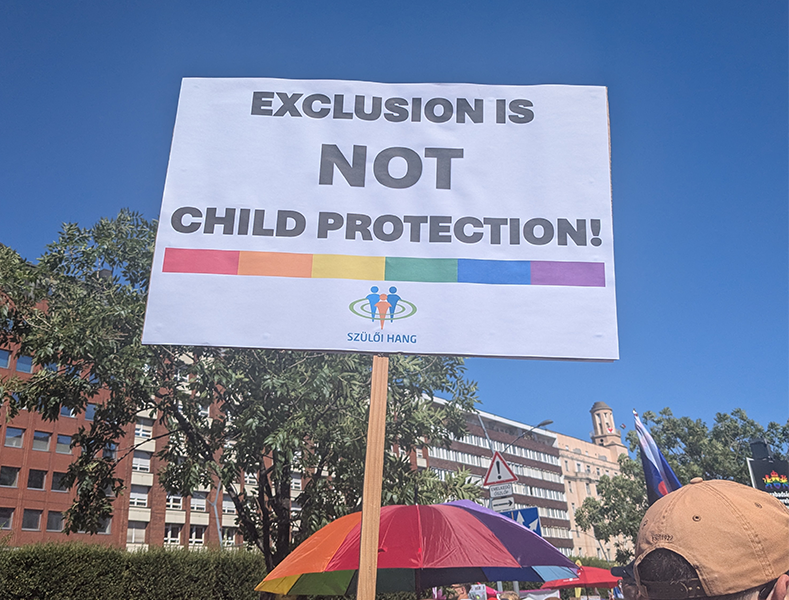
Photo by Anna Péter
I believe these are all valid questions many of us have asked ourselves but as we marched forward and saw no police or any kind of violent interference in this peaceful protest, these questions seemed like a distant memory.
As we approached Műegyetem, our final destination, Hungarian actors and entertainers made sure that the atmosphere didn’t fade and kept the energy going.
Armand, 15, another marcher from Sopron in western Hungary, said that although he had never been to Pride before, he felt that the growing hatred must stop. “We have to stand up for minorities and for Hungarians in general,” he said.
He continued: “I really hope people will admit that not everyone is the same and that this needs to be accepted. Everyone deserves to be loved the way they are. I think together we can create a beautiful future for Hungary.”
At the end of this warm summer’s day, Armand’s words echoed in my ears. I felt the wind of change was not a distant idea anymore; it finally felt real.
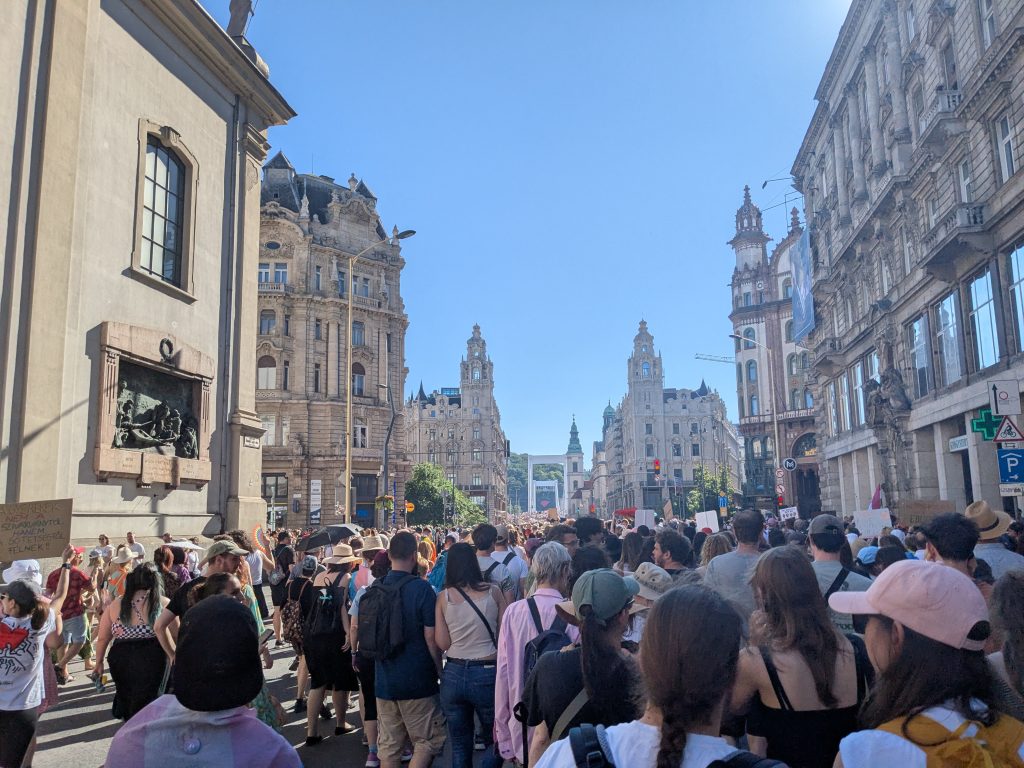
Photo by Anna Péter
In the age of online information, it can feel harder than ever to stay informed. As we get bombarded with news from all angles, important stories can easily pass us by. To help you cut through the noise, every Friday Index publishes a weekly news roundup of some of the key stories covering censorship and free expression. This week, we look at Hungary’s banned Pride demonstration, and mass anti-government protests in Kenya.
Pride in spite of the law: Hungary’s LGBTQ+ march to go ahead in violation of police ban
On Tuesday 18 March, Hungary’s ruling Fidesz party led by Viktor Orbán rushed a bill through parliament banning LGBTQ+ pride marches, sparking outrage from the EU and activists. The ban was made on the grounds that such events are allegedly harmful to children, with Orbán stating “We won’t let woke ideology endanger our kids.” This put Budapest’s annual Pride march, scheduled to take place on Saturday 28 June, in jeopardy – but Hungary’s LGBTQ+ community is refusing to back down.
The march, which marks the 30th anniversary of Budapest Pride, is scheduled to go ahead with backing from Budapest’s liberal mayor, who has taken the step of organising the event through the city council under the name “Day of Freedom” to circumvent the law against LGBTQ+ gatherings – but the city police, still under the control of Fidesz, will be moving to quash these efforts. Those partaking in the event will be targeted by facial recognition technology and could face fines. With more than 200 Amnesty International delegates set to march alongside thousands of Hungarians in solidarity, Saturday is likely to see a clash between Hungary’s LGBTQ+ community and the state police.
Brutality begets brutality: Kenyan protests against government cruelty result in further loss of life
On 25 June 2024, a mass protest outside parliament in Nairobi against tax rises escalated into a tragedy, with Kenyan police officers firing on protesters as they attempted to storm the parliament building. The Kenyan National Commission on Human Rights announced that 39 had been killed in the nationwide demonstrations, and it was recently revealed by BBC Africa Eye that some officers had shot and killed unarmed protesters. Marking a year since this incident, Kenyans took to the streets this week to demonstrate against the government, and further brutality has followed.
Amnesty International Kenya has reported that 16 people were killed at the anniversary protests on 25 June 2025, with approximately a further 400 injured. CNN witnessed police firing live ammunition to disperse peaceful protesters, and the government regulator, Communications Authority of Kenya, issued an order for all local TV and radio stations to stop broadcasting live coverage of the protests. Tensions have been on the rise in recent months, with the murder of Kenyan blogger Albert Ojwang in police custody, and the shooting of street vendor Boniface Kariuki at a demonstration in Ojwang’s honour inflaming the situation further.
Free at last: Pro-Palestinian student activist Mahmoud Khalil released
Palestinian-Algerian activist and Columbia University student Mahmoud Khalil was released from his detention in a Louisiana Immigration and Customs Enforcement (ICE) facility on the evening of Friday 20 June after 104 days in detention.
Khalil’s arrest sparked a national outcry. A prominent pro-Palestinian activist on Columbia’s campus, he would sometimes act as a spokesperson for the student protest movement, making him a prime target for ICE’s crackdown on immigrant protesters – despite Khalil holding a green card, which grants an individual lawful permanent resident status in the USA.
He was arrested without a warrant on 8 March 2025. Charged with no crime, Khalil was earmarked for deportation by Secretary of State Marco Rubio under the belief that his presence in the country had “foreign policy consequences”. This move was deemed unconstitutional, and Khalil was released after a Louisiana judge ruled that Khalil was neither a flight risk nor dangerous, and that his prolonged detention – which led to him missing the birth of his son – was potentially punitive.
Khalil returned to the frontlines of protests just days after his release, but his feud with the Donald Trump administration is far from over. The government is reportedly set to appeal the ruling to release Khalil, and rights groups such as the American Civil Liberties Union (ACLU) have suggested that there could be a long legal road ahead.
Unfairly dismissed: Australian journalist wins court case after losing her job over Gaza repost
Australian journalist Antoinette Lattouf has won her court case against Australia’s national broadcaster, Australian Broadcasting Corporation (ABC), with a judge ruling she was unfairly dismissed from her job after sharing a post on social media about the Israel-Gaza conflict.
Lattouf reportedly shared a post by Human Rights Watch that accused Israel of committing war crimes in Gaza in December 2023, resulting in her sacking from her fill-in radio presenter role just hours later.
ABC claimed that the post violated its editorial policy, but after the ruling has apologised to the journalist, saying it had “let down our staff and audiences” in how it handled the matter. According to The Guardian, the broadcaster had received a “campaign of complaints” from the moment Lattouf was first on air, accusing her of anti-Israel bias based on her past social media activity. It has also been reported that due process around Lattouf’s dismissal was not followed, with the allegations in the email complaints not put to her directly prior to her sacking.
Justice Darryl Rangiah ruled that Lattouf had been fired “for reasons including that she held a political opinion opposing the Israeli military campaign in Gaza”, in violation of Australia’s Fair Work Act. Lattouf was awarded 70,000 Australian dollars ($45,000) in damages. She told reporters outside the courtroom “I was punished for my political opinion”.
Sudden freedom: 14 Belarusian political prisoners freed from prison following US official visit
During the visit of the US special envoy Keith Kellogg to Belarus’s capital Minsk, dictator Alyaksandr Lukashenka made the surprise move of releasing 14 political prisoners from detention on 21 June 2025. The US brokered deal, reportedly led by Kellogg, saw the release of prominent Belarusian activist Siarhei Tsikhanouski who was arrested in 2020 and sentenced with 18 years in prison after declaring his intention to run for president. Also released was journalist Ihar Karnei who worked at Radio Free Europe/Radio Liberty for more than 20 years.
Tsikhanouski has recounted his experience in prison as being “torture”. He said he was kept in solitary confinement and denied adequate food and medical care, and he lost more than 100 pounds during his five years’ imprisonment. He told the Associated Press that prison officials would mock him, saying “You will be here not just for the 20 years we’ve already given you – we will convict you again” and “You will die here.”
Tsikhanouski is the husband of Sviatlana Tsikhanouskaya, who following his arrest took his place in running for president and became the main opposition leader in Belarus. Now living in exile in Lithuania, the two have been reunited in Vilnius – but Tsikhanouskaya insists that her work is not finished with reportedly more than 1,100 political prisoners still remaining inside Belarusian jails.