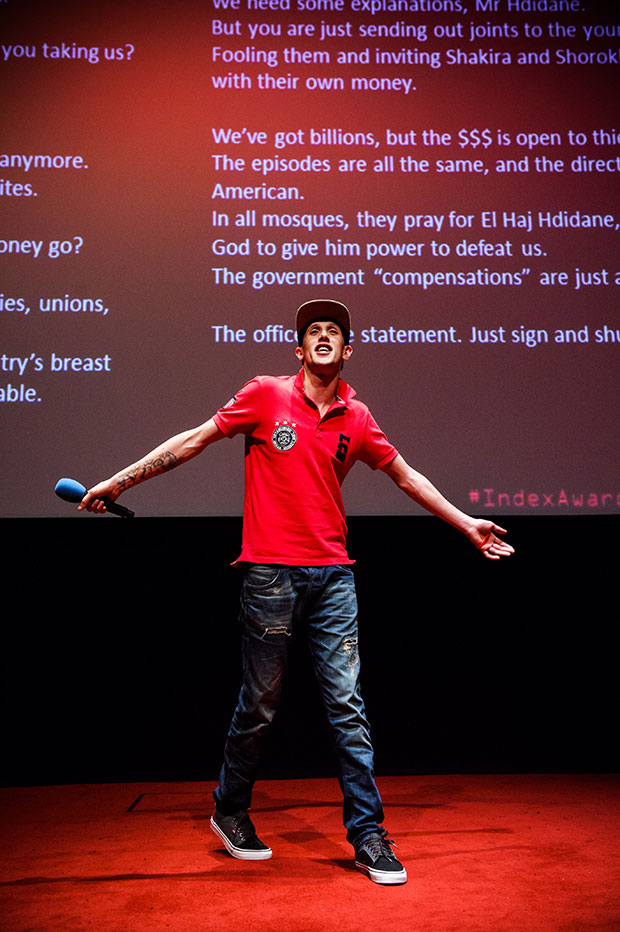
Moroccan rapper and human rights activist Mouad “El Haqed” Belghouat (roughly translated as “the enraged”) has not only seen his songs censored and his album banned but has also been imprisoned three times since 2011 – including a one-year jail term for lyrics critical of the police in his song Dogs of the State. Imprisoned for four months in 2014, after seeing witnesses at his trial stopped from testifying and key pieces of evidence barred, El Haqed continues to make music about endemic corruption in the Moroccan state and widespread poverty in his country. He is the recipient of the 2015 Index on Censorship Freedom of Expression Award for Arts.
I take this opportunity to thank you for this honour, especially Helen and David for everything they did for me to obtain my visa to be here today among you. And I can’t forget the many people who believe in my case and helped me through since I was jailed for the first time in 2011. I’m sorry that I can’t reveal more names but I will remember you forever.
While I was writing this speech, I didn’t know yet if I would be able to join you or not — because so often my visa applications have been refused. I hope future generations will have more freedom to travel without obstacles — because the earth belongs to us and we belong to it.
I’m very honoured by this nomination and I dedicate it to the soul of my mother and to all people who were prisoners, or are right now still incarcerated, or will be prisoners in the future because of their mere thoughts or opinions.
I was jailed three times because of my opinions. It would take a long time to speak about each arrest, so to make a long story short, just a few words on why they arrested me each time:
The first time: because of my activities in 20 February movement. We were asking for freedom, equality and democracy.
The second time: because of a song that someone else uploaded to YouTube three years earlier. It doesn’t make sense at first, but it does when you realise that it didn’t allow me to finish the album I was working on.
The third time: the same old story. I was going to a stadium and they arrested me because I continue to refuse to change my positions.
I have been through difficult times: I was jailed, fired from my work, rejected by many friends. I am still forbidden to sing in my own country. But after all that I am still determined that I will never change my position. I will fight for freedom, equality and human rights for ever.
I am very happy to have the chance to speak freely in front of you today. I hope I will one day be able to speak freely and sing in my own country in front of my fans.
Right now, as we celebrate, there are a lot of people behind bars because of their opinions. I hope for freedom for them really soon.
Freedom of expression is your arm. Lift it to fight for dignity and equality. Even if they kill us or jail us they cannot do the same with our thoughts or opinions. You cannot kill an idea or opinion. You cannot put it behind bars.
Thank you again everyone and have a great evening.
Banned from performing at home in Morocco, Arts category winner Mouad “El Haqed” Belghouat sang at the Index awards (Photo: Alex Brenner for Index on Censorship)
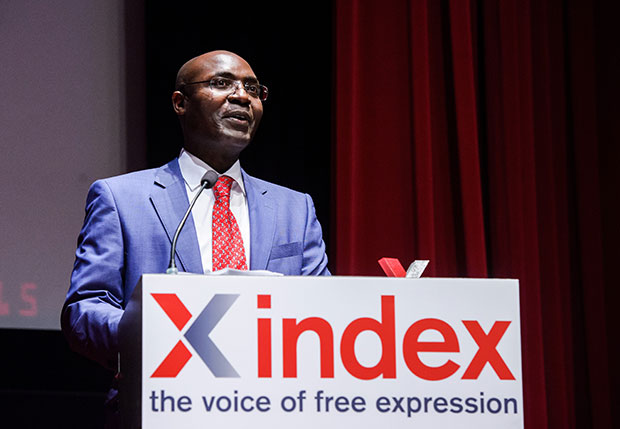
Both as a journalist and human rights activist, Rafael Marques de Morais has exposed government and industry corruption in Angola – speaking out for those whose human rights have been violated in his country. Despite repeated arrests and threats, including a 40-day detention without charge during which he was denied food and water for days, Marques de Morais has continued his investigations, most recently detailing human rights abuses within Angola’s diamond companies – including 500 cases of torture and 100 murders of villagers living in the vicinity. After filing charges of crimes against humanity against seven Angolan generals, Marques do Morais is now being counter-sued for $1.6 (£1.09) million. Undeterred, he continues to write on corruption in Angola. He is the joint recipient of the 2015 Index on Censorship Freedom of Expression Award for Journalism.
With an award comes a greater responsibility. It is therefore my privilege to accept this journalism award, and dedicate it to my fellow Ethiopian colleagues Eskinder Nega, Reeyot Alemo, and the Zone 9 bloggers. They are in jail, currently serving some of the harshest sentences in Africa, for the crime of exercising their right to freedom of expression. For over a year, the Ethiopian government has denied adequate health care to Reeyot Alemu, who is in desperate need.
Ethiopia is the seat of the African Union, and its regime is one of the worst offenders for upholding the freedoms of the press and of expression. When a regime in Africa succeeds in trampling their citizens’ rights with impunity, and enjoys such good international standing and legitimacy as Ethiopia, it becomes a textbook case for other authoritarian regimes.
I believe in the power of solidarity. I have experienced troubles of my own. It has been the solidarity of others that has helped to strengthen my courage and resolve to continue my journey.
Back in 1996, being in London and aghast at press censorship in Angola, I decided to bring it to international attention. Because I could not speak English, I fumbled through an organization’s directory, and found Index on Censorship. I could understand the word Censorship. I called them and attended a meeting on Africa. My remarks were most convincing and incredibly short! “Censorship in Angola bad. Dos Santos [the president] bad. Very bad!” Then, a few months later I had an article translated and published in Index’s magazine. It was disseminated through other publications in a number of countries.
On my return to Angola from this trip, I will be sitting in court, on 24 March, as the defendant on 11 separate charges of defamation brought against me by seven powerful generals and four of their business associates. I wrote a book that exposed human rights abuses in the diamond industry, in which the plaintiffs are major shareholders and whose private security company has executed many of the violations.
I am proud and honored to stand up against such a mighty power to enable many of the victims to speak out through my reports, which I have been producing for the past 10 years. I will come out of this trial stronger and empowered by the experience.
Thank you very much for this wonderful occasion.
Journalist and human rights activist Rafael Marques de Morais (Photo: Alex Brenner for Index on Censorship)
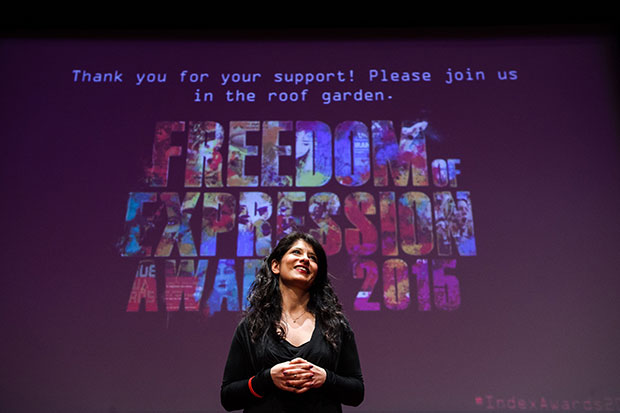
Comedian Shappi Khorsandi, the host of this year’s Index on Censorship Freedom of Expression Awards, understands the effects of censorship first hand.
Her father, Iranian writer and comic Hadi Khorsandi, was forced to flee to Britain in 1979 with his family, including a young Shappi, following the Iranian revolution and his criticism of the new regime. Even in the UK, Khorsandi continued to receive death threats.
“During the 1979 revolution against the Shah, there were crowds calling for my father’s execution because of his satirical writings. The only way to stay in Iran was to toe the party line. He chose exile, a profound experience for a writer,” Khorsandi says.
Khorsandi speaks movingly of the effects of exile on writers, saying: “They have to leave their home country to be able to express themselves freely in their native language. Censorship was a huge thing in my family.”
Once in Britain, Hadi Khorsandi continued writing and also published a satirical newspaper: “Because of this there was a plot to assassinate him in 1984,” says his daughter.
Many of those shortlisted for this year’s freedom of expression awards have experienced similar attempts to silence them. Lirio Abbate, an Italian journalist who faces constant threat of attack because of his investigations into the mafia, has 24-hour police protection. Others, like Angolan journalist Rafael Marques de Morais, Moroccan rapper El Haqed, or Ecuadorian cartoonist Bonil, are repeatedly threatened with jail for challenging powerful government and business interests.
Index on Censorship magazine featured Hadi Khorsandi’s work in two of its 1986 issues, describing his humour as “aimed at the follies and absurdities of the present Iranian regime and giving the reader a vivid picture of life in a country where ideology and zeal have been allowed to reign unchecked.” The October issue in which Hadi Khorsandi’s work features also includes an essay by Nobel Prize-winning author Gabriel Garcia Marquez.
“I’ve known about Index on Censorship for years – there were always Index logos in our house because of my father’s work,” says Khorsandi. “It’s quite an honour to have been asked to host the awards, one I accept on my father’s behalf.”
The 15th Index on Censorship Freedom of Expression Awards were held on March 18 at the Barbican, London.
These are people who have dedicated their time and energy to serve on the frontline of the fight for human rights. Leyla Yunus helps those who have been forcibly evicted from their home and works with activists in the South Caucasus region, including Armenia, the country with which Azerbaijan is locked in a frozen conflict. Rasul Jafarov was behind Sing For Democracy, a campaign to highlight rights abuses as Baku hosted the Eurovision Song Contest in 2012. Intigam Aliyev has represented victims before the European Court of Human Rights. Seymur Hezi provided critical coverage both as a reporter for Index award winning newspaper Azadliq, and in the online show Azerbaijan Hour. Khadija Ismayilova has on multiple occasions uncovered corruption connected to the ruling Aliyev clan.
Today, they are all languishing behind bars, on trumped up charges ranging from treason to tax evasion. The whole sorry affair is perhaps most aptly summed up by the dark irony of Leyla Yunus and Jafarov being in the process of compiling a list of political prisoners, when they themselves were added to it.
It is estimated that some 100 people are currently jailed in Azerbaijan over their political beliefs. Because it is worth remembering that while the past months’ crackdown has seemed especially ruthless, comprehensive and unapologetic in its bid to silence critical voices, these tactics are not new. For years, those daring to speak out against the ruling elite have been threatened, harassed, arrested and even killed.
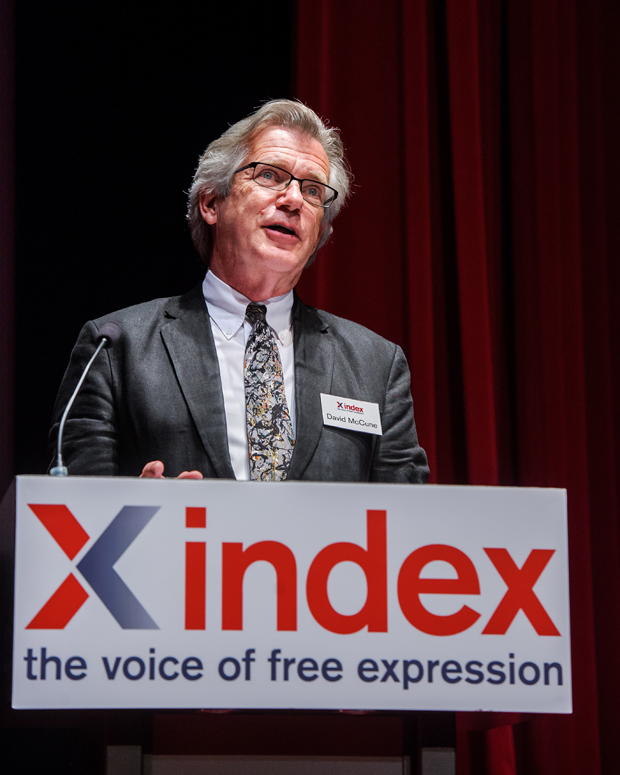
Index board member and director of Sage Publications David McCune presented the special award at the ceremony in London (Photo: Alex Brenner for Index on Censorship)
Journalist and activist Idrak Abbasov was brutally beaten by security forces and police in a 2012 attack. He accepted the special award from Oslo, where he now lives in exile, on behalf of his compatriots. “In Azerbaijan, not a single television or radio channel is free. In effect, all media are under government control with the exception of a few newspapers and the Internet. There is no freedom of expression or association,” Abbasov said in a pre-recorded speech. “There are no free elections. The country is ruled by a terrible regime. Freedom of speech has been completely stifled. Our colleagues have been murdered. Elmar Huseynov was killed in 2005. Novruzali Mamedov was murdered in prison in 2009. Rafiq Tagi was killed in 2014. No one has been called to account. Many journalists have been brutally and repeatedly beaten, and no one has been punished. This is Azerbaijan. This is the horrific way the country is being ruled.”
The eyes of the world will soon again be fixed on Azerbaijan. The inaugural European Games – organised by Europe’s Olympic Committees – are coming to Baku this summer, not long after the capital last hosted an international mega-event, the 2012 Eurovision final. The line pushed by the regime, and parroted by their supporters at home and abroad, is that this is young and developing democracy on the right path. But three years on, the situation has not improved; on the contrary. This award is for Azerbaijanis continuing their struggle for freedom, rights and dignity – in the hopes that it will soon be won.
Idrak Abbasov summarised his hopes for the future in his closing remarks: “I call upon the world community to help Azerbaijan and freedom of speech in Azerbaijan. So that our colleagues might be released. So that our country might become a normal country in which we and others might live freely.”