As the Africa Cup of Nations kicks off on Sunday and tens of thousands of football fans descend on Morocco, we should remember the thousands of Gen Z protesters who were arrested and beaten when they took to the streets following the death of eight women in a maternity hospital in Agadir. They are now being prosecuted and some – including minors under 12 – have already been sentenced to hundreds of years in prison. It was partly football that sparked the anger. Young people saw beautiful stadiums being built, but hospitals so crumbling they couldn’t even keep mothers safe. Read the full story by Omar Radi, whose piece appears in the Winter 2025 issue of Index on Censorship, Gen Z is revolting: Why the world’s youth will not be silenced, published on 18 December 2025.
Saturday, 27 September. At Casablanca’s Arab League Park, riot police and plainclothes agents gather in uneasy groups. Their presence is heavy and full of expectation, a show of state power preparing for a confrontation it doesn’t fully understand. By late afternoon the reason for the confusion is clear. For the first time, the authorities are facing a youth protest movement without leaders, without clear origins, formed not in political party offices or student unions, but on Discord – a platform that feels almost like science fiction to old-style security forces. The youth are anonymous, impossible to track, and everywhere.
At first, they were gamers and football supporters – voices echoing through Discord chat rooms, more familiar with memes than with political public life. Politics had been something happening elsewhere. But then there was a shift. The country’s quiet crisis found its way into their feeds. The trigger? Eight women admitted into a maternity ward at a public hospital in Agadir, in southern Morocco. None came out alive – a shortage of staff, a lack of resources, and a system too broken to respond until it was too late.
Football’s soft power
Following Morocco’s unexpected fourth-place finish at the 2022 FIFA World Cup in Qatar, football has become the cornerstone of the country’s soft power strategy. The momentum carried into 2023, when Morocco was awarded co-hosting rights for the 2030 World Cup alongside Spain and Portugal – a diplomatic victory dressed in sport. Since then, public policy has tilted toward a single, obsessive goal: turning parts of the country’s major cities into acceptable playgrounds for the global guests who will descend upon Morocco for one month in 2030. Billions of dollars are being poured into infrastructure, stadiums and urban makeovers.
The contradiction, however, is hard to ignore. In a country where hospitals resemble warzones and schools are crumbling, the dazzling promise of football has become, for many, a bitter spectacle. Morocco is a nation in love with the game – few would deny that. But among its citizens, the joy of hosting the World Cup is tinged with disillusion. The tragic deaths of eight women during childbirth was a tipping point. For the country’s youth, the women’s fate was no longer just about bad governance. It was personal.
“We don’t want to do politics,” one young activist who uses Discord, told Index. “We’re not asking for a new constitution or a regime change. We just want our hospitals to be as good as our football stadiums.”
At 6.00pm, as the protest was set to begin, the government issued a blanket ban on all public gatherings across Morocco. In Casablanca, police blocked access to public squares, surrounded potential meeting points, and deployed familiar intimidation tactics – threats, beatings, arrests. Undeterred, young protesters splintered into smaller groups, reappearing in alleyways and side streets, improvising a kind of urban guerrilla choreography. The same scene played out across the country: cat-and-mouse chases, baton charges, and standoffs stretching late into the night.
One thing became immediately clear to Morocco’s notoriously powerful political police. This was a new kind of activism – more agile, more defiant, and far more determined than anything they had seen before.
Minors charged over protests
Figures released on 29 October by Morocco’s judicial authorities surpassed even the bleakest estimates shared by rights groups such as the Moroccan Association for Human Rights (AMDH). Of the 2,480 people swept up during the protests, 1,473 were still behind bars awaiting trial. The others, while free, have been ordered to appear before judges in due course.
The charges are familiar, hallmarks of the state’s playbook against public dissent: armed rebellion, incitement to commit felonies, participation in armed gatherings.
Hundreds of detainees are being pushed into the criminal justice system by way of more severe accusations: violent assembly, insulting law-enforcement officers, possession of offensive weapons.
The first rounds of sentencing, swift and unyielding, have already handed down hundreds of years of prison time to several dozen people, including a significant number of minors under the age of 12, with sentences ranging from 5 to 15 years.
In Lqliâa, a town on the outskirts of Agadir in Morocco’s south, security forces killed three protesters with live ammunition before moving in to arrest others. The authorities insist that the shootings were acts of self-defence. Yet no independent inquiry has been launched, and public opinion remains divided after videos contradicting the official narrative began to circulate on Discord.
What the state is offering
When King Mohammed VI finally addressed the nation on 10 October in a speech read to members of Morocco’s parliament, the country braced itself for some acknowledgment of the turmoil that had shaken Morocco in the preceding weeks. But the King made no mention of the unrest and did not offer even an oblique response to the demands surging through the streets.
The disappointment was palpable. Yet, the movement itself did not harden its stance. Its demands remain well short of any direct criticism of the monarchy. Still, the speech was widely felt as a deliberate slight – an act of indifference toward a generation that has insisted, from the outset, on peaceful protest and loyalty to the Crown.
“The King ghosted us. I feel humiliated,” said an organiser of the GenZ212 Discord server, which has played a key role in the demonstrations and now boasts 200,000 members.
Two weeks later, the King presided over a cabinet meeting that approved increased budgets for healthcare and education, as well as a new fund to support young candidates in upcoming elections.
There was money being offered by one hand, in the other an invitation into institutional politics. But for many, the gesture was not received as good news.
“It’s hard to believe these promises,” a young protester declared during a public meeting in Rabat. “There are no details, no assurances that any of this will be implemented effectively.”
His scepticism, he added, is only strengthened by the way the police and courts have treated protesters.
“Shouldn’t they start by releasing all the detainees?” he asked.
Gen Z: a new source of protest
The demonstrations continue. Persistent, if modest in scale, they rarely attract more than a few dozen people per city. To the movement’s initial demands for better healthcare and education, new calls have been added within GenZ212’s discourse: the release of detainees, the dismissal of all charges, and the end of the hogra – a Moroccan term for the violence and arrogance wielded by authority against the powerless.
For observers, journalists and scholars alike, a paradox sits at the centre of any analysis of this movement. On one hand, it is the smallest in numbers and the most restrained in its demands when compared with earlier, more overtly political movements, like the 20 February 2011 protests of the Arab Spring. On the other hand, the repression has been astonishingly severe – disproportionate both in terms of the movement’s size and its relatively “diplomatic” aspirations.
There is also the question of the mark the GenZ212 will leave behind. For the first time, a protest movement in Morocco did not emerge from the political left, political Islam, or labour unions. Instead, it was born out of activity on online chat groups – out of a kind of virtual street. It was immediately echoed, even if only verbally, by social categories traditionally aligned with the regime: artists, influencers, sports champions.
Raid, a Casablanca-based rapper, became an early casualty of this shift. Arrested, released, then rearrested and placed in police custody before being charged with inciting illegal demonstrations, he has become one of the most emblematic figures of the movement, alongside others who lent their voices to the cause. Songs, art performances, widely followed podcasts: all rallied behind the movement, at least in its early days.
Here is a generation that declared itself apolitical from the outset – yet through just a few missteps by those in power was pushed headlong into politics. A generation now shouting to the world: “No, there is no freedom in Morocco – and we are the proof”.
On the streets, the popular dialect, laced with profanity, usually banished from state media, schools and family spaces, has forced its way into political life. As one protester yelled: “Free freedom, you sons of bitches!”
A well-known academic who teaches African studies and political history at the University of Rabat since returning from exile, Maati Monjib co-founded Freedom Now, a coalition of Moroccan human rights defenders who seek to promote the rights of Moroccan activists and journalists in a country ranked 131 out of 180 on the Reporters Without Borders Press Freedom Index. His work campaigning for press freedom – including teaching investigative journalism workshops and using of a smartphone app called Story Maker designed to support citizen journalism – has made him a target for the authorities who insist that this work is the exclusive domain of state police. For his persistent efforts, Monjib is currently on trial for “undermining state security” and “receiving foreign funds.” He faces much persecution by police and isn’t allowed to travel.
“We lead an everyday struggle to defend citizens, journalists and artists who are persecuted and slandered,” Monjib told Index on Censorship.
Monjib has twice been on hunger strike, in September and October 2015, resulting in the lifting of his ban on leaving the country. A ban was also lifted on three of his co-accused, two leaving for France and one for Holland, who now continue their struggle for freedom of expression and freedom of the press in their host countries.
In November 2016, the Administrative Court decided that Freedom Now is completely legal. On the same day, a dozen policemen, two in uniform, broke into Monjib’s home and harassed family members and neighbours.
See the full shortlist for Index on Censorship’s Freedom of Expression Awards 2017 here.[/vc_column_text][/vc_column][/vc_row][vc_row full_width=”stretch_row_content” equal_height=”yes” el_class=”text_white” css=”.vc_custom_1490258749071{background-color: #cb3000 !important;}”][vc_column width=”1/2″][vc_custom_heading text=”Support the Index Fellowship.” font_container=”tag:p|font_size:28|text_align:center” use_theme_fonts=”yes” link=”url:https%3A%2F%2Fwww.indexoncensorship.org%2Fsupport-the-freedom-of-expression-awards%2F|||”][vc_column_text]
At a time when Morocco is advocating openness, democratisation and full respect for human rights as instruments for confronting the future, we receive the news of the hunger strike begun by the journalist Ali Lmrabet. For this reason, we wish to pass on to you our deep concern for the situation of this journalist, who has received dozens of international awards and who is deprived of his national identity documents coinciding with the end of a 10-year ban on exercising the profession of journalist in Morocco and also with his announcement that he wishes to return to professional activity.
Freedom of expression and criticism are fundamental elements for the consolidation of a democratic state that is active against regression and intolerance. Any attempt to restrict freedom of expression degrades the image of Morocco and the credibility of its commitment to the rule of law.
Precisely because, from here, we wish to lend our full support to any effort to transform Morocco developed at different levels of the political world and civil society in the country, we are writing to you to express our serious concern at the current situation of Ali Lmrabet, whose life is in danger.
For all these reasons, we would ask you to reflect on this to give instructions to the administration in your country, and its diplomatic staff in Switzerland in particular, to renew all Ali Lmrabet’s Moroccan citizenship documents.
Without a residence certificate, passport and other documents related to journalistic work, Ali Lmrabet would become the first Moroccan deprived of his civil and political rights.
We do not need to give you, Your Majesty, lessons in the fact that the deprivation of these rights is contrary to all liberties, including fundamental freedoms, freedom of expression and, in the case of Ali, the internationally recognised and acclaimed right to freely exercise the profession of journalist. The only thing we would ask you, Your Majesty, in your capacity as Head of State, is to strictly apply the provisions of the Moroccan Constitution, giving the right to all citizens to fully and freely exercise their profession, in this case as journalist and editor of publications in Morocco.
We look forward to your considered response.
Yours sincerely,
Letter signed by the following:
Míriam Acebillo Baqué, President of Lafede.cat, Organisations for Global Justice
Mariano Aguirre, Director of Norwegian Peacebuilding Resource Centre (Norway)
Cinta Arasa, Coordinator of the Persecuted Writers Committee
Carmen Arenas, President of Catalan PEN
Homero Aridjis, Emeritus President of International PEN
Jordi Armadans, Director of FundiPau (Peace Foundation)
Sion Assidon, former Secretary General of Transparency-Morocco
Margaret Atwood, Vice-President of Canada International PEN, Prince of Asturias Award
Danielle Auroi, MP of the National Assembly of France
Juan Tomás Ávila Laurel, Writer, HM Award International Odón Betanzos Palacios of the New York Circle of Ibero-American writers and poets (Equatorial Guinea)
Malén Aznárez, President of Reporters without Borders (RSF- Spanish section)
Elisabeth Badinter, Philosopher
Ekbal Baraka, Chair of PEN International Women Writers Committee, former president of Egyptian PEN
Isaías Barreñada Bajo, University Professor and Human Rights activist
Ana Barrero Tiscar, Peace Culture Foundation
Mark Barwick, Policy Adviser at Human Rights Without Frontiers International (Switzerland)
David Bassa i Cabanas, Journalist, president of the Barnils Group of Journalists
Lluís Bassets, Deputy director of El Pais (Spain)
Anouar Bassi, Transparency 25 President (Tunisia)
Abdejelil Bedoui, Economist and member of the FTDES Steering committee
Sélim Ben Abdesselem, Former member of the Tunisian National Constituent Assembly
Abdelkader Benali, Writer and journalist, Libris Prize (Netherlands)
Thijs Berman, Former Dutch MP of the European Parliament
Mylène Botbol–Baum, Writer, University professor of philosophy and bioethics
Marian Botsford Fraser, Writer and journalist, Chair of Writers in Prison Committee, PEN International Canada
Jean-Marcel Bouguereau, Journalist Le Nouvel Observateur and former chief editor of Libération
Sfia Bouarfa, Belgian honorary MP and former senator
Jim Boumelha, President of the International Federation of Journalists (IFJ)
François Burgat, Political scientist, Research Director of CNRS
Teresa Cadete, Portuguese writer, board member of PEN International
Lindsay Callaghan, President of PEN South Africa
Maria Cañadas, President of Catalonia Amnesty International (AIC)
Gemma Calvet, MP of Parliament of Catalonia (Spain)
Carles Campuzano, MP of Congreso de los Diputados (Spain)
Marius Carol, Editor of La Vanguardia
Ignacio Cembrero, Journalist, former correspondent of El País in Maghreb
Nadia Chaabane, Former deputy of Tunisian National Constituent Assembly
Alain Chabod, International Consultant, former journalist of France Television
Luc Chartrand, Journalist, Radio-Canada
Larbi Chouikha, University professor; Institut de Presse et des Sciences de l’Information (IPSI) (Tunisia)
John Maxwell Coetzee, Writer, Nobel Prize in Literature 2003, Vicepresident of PEN International
Robert Coover, Writer, William Faulkner Foundation Award, American Academy of Arts and Letters, and National Endowment of the Arts (USA)
Olivier Corten, Professor; Centre of international law of ULB; Brussels
Joan Coscubiela, Deputy of Congreso de los Diputados (Spain)
Olivier Da Lage, Journalist, Vice-president of IFJ, RFI and SNJ
Luc Dardenne, Filmmaker
Eric David, Emeritus professor of International Law; Chairman of The International Law Centre of the ULB
Ascensión de las Heras, MP of Congreso de los Diputados (Spain)
Antonio Della Rocca, President of the Trieste PEN Center, Member of the Board of PEN International (Italy)
Christophe Deloire, Secretary General of Reporters Without Borders
Nicolas Dot Pouillard, Resercher of MAEE
Christos Doulkeridis, President of ECOLO group in the Parliament of the Wallonie-Bruxelles Federation (Belgium)
André du Bus, Deputy of Wallonie-Bruxelles Federation
Josy Dubié, Honorary senator (Belgium), former journalist and ONU official
François Dubuisson, Professor, International Law Centre of ULB (Brussels)
Patrick Dupriez, Co-chair of Ecolo party
Isabelle Durant, Brussels MP (Belgium)
Mohamed El Battiui, President of the Amazigh World Assembly
Najat El Hamchi, Writer, Ramon Llull Prize
Ahmed El Khannous, MP, Brussels Parliament
Mahmoud El May, MP and Member of the National Constituent Assembly (Tunisia)
Isabelle Emmery, Brussels Member of Parliament
Mathias Enard, Writer, Gouncourt Prize 2012
Charles Enderlin, Journalist, former France2 correspondent in Israel
Moris Farhi, MBE Vice-President, PEN International
Halim Feddal, Secretary General of the National Association for the Fights against corruption (Algeria)
Soledad Gallego-Díaz, Journalist of El País
Vicent Garcés, Former Member of the European Parliament
María Caridad García Álvarez, MP of Congreso de los Diputados (Spain)
Lise Garon, Professor, Laval University
Zoé Genot, Ecolo MP, Brussels Regional Parliament
François Gèze, President and chief editor of Éditions La Découverte (France)
Jodie Ginsberg, Chief Executive Officer of Index on Censorship
Henri Goldman, Editor of Politique, revue de débats and MICmag (Belgium)
Eric Goldstein, human rights activist (United States)
Elsa González, FAPE President (Spanish Press Associations Federation)
Juan Goytisolo, Writer, National Prize of Spanish Letters and Miguel de Cervantes Prize
Rafael Grasa Hernández, President of Institut Català Internacional per a la Pau
Ricardo Gutiérrez, Secretary general of European Federation of Journalists (EFJ)
Maher Hanin, Member of steering committee of FTDES
Abderrahmane Hedhili, President of Tunisian Forum for Economic and Social Rights (FTDES)
Seymour M. Hersh, American journalist
Francis Hickel, Coordinator Pâquis Solidarity Space, Geneva
Jesús Iglesias Fernández, Senator (Spain)
Jon Iñárritu García, MP of Congreso de los Diputados (Spain)
Véronique Jamoulle, MP, Brussels Parliament
Jean-Jacques Jespers, University Professor, Université libre de Bruxelles
Oriol Junqueres i Vies, Chairman of the party “Esquerra Republicana de Catalunya” (ERC) and opposition leader in Parliament of Catalonia
Lucina Kathmann, Writer, Vice-president of PEN International (United States)
Salam Kawakibi, Arab Reform Initiative, president of the Initiative for a New Syria
Melek Kefif, Doctor and member of the Steering committee of FTDES
Charefeddine Kellil, Lawyer for the families of martyrs and wounded (Tunisia)
Zakia Khattabi, Co-chair of Ecolo Party (Green Belgian)
Kamel Labidi, Tunisian journalist, former director of Amnesty International in Tunisia and former president of the National Authority to Reform Information and Communication (INRIC)
Luis Las Heras, Editor (Spain)
Gilwon Lee, Poète, Poet, Sang-Byeong Cheon Prize and Dong-Ju Yoon Literary Prize, Board Member, PEN International South Korea
Joanne Leedom-Ackerman, vice-president of PEN International (USA)
Jean-Claude Lefort, Former MP at the French Parliament
Emmanuel Lemieux, Essayist, and investigation journalist (France)
Stefano Liberti, journalist and writer, Luchetta Award to the best journalist and Anello Debole Prize
Jonathan Littell, Writer, Goncourt Award and Grand Prix du Roman of the French Academy
Robert Littell, Writer and journalist, Los Angeles Times Book Prize (USA)
Juan López de Uralde, Executive Commission Equo party, former Greenpeace-Spain Director
Bernabé López García, Professor, former member of Averroes Committee Spain-Morocco
Mehdi Mabrouk, Former Culture Minister (Tunisia)
Noël Mamère, MP of the National Assembly and Mayor of Bègles (France)
Sherif Mansour, MENA Program Coordinator, Committee to Protect Journalists (CPJ)
Christophe Marchand, Lawyer, Brussels (Belgium)
Jean-Paul Marthoz, journalist, correspondent of the Committe to Protect Journalists (CPJ) in the European Union
Sandrine Martins Espinoza, Lawyer and international consultant for elections (Argentine)
Daniel Patrick Maunier, University Professor, New York University
Fernando Maura Barandarián, Spanish MP, European Parliament
Federico Mayor Zaragoza, President of Foundation for a culture of peace, former Director of UNESCO
Daniel Menschaert, Diplomatic, Honorary Officer of the Federation Wallonia-Brussels in Morocco
Manuela Mesa Peinado, CEIPAZ Director, Peace Culture Foundation
Rosa Montero, Writer and journalist, Grinzane Cavour award and National Journalism Award (Spain)
Quim Monzó, Writer, National Literature award (Catalonia)
Alexandre Niyungeko, President of the Burundi Journalists Union (UBJ)
Elisabeth Nordgren, Chair of the Search Committee, PEN International (Finland)
Vida Ognjenovic, Vicepresident, PEN International (Serbia)
Margie Orford, Board Member, PEN International (South Africa)
Mario Orrù, Observer Coordinator at Democracy International
Bechir Ouarda, Journalist, Former Coordinator of the civil coalition in defence of freedom of expression in Tunisia
Rémy Pagani, Administrative Councillor for the city of Geneva
Andrés Perelló, Former Member of the European Parliament, Spain
Rosana Pérez Fernández, MP of the Congreso de los Diputados (Spain)
Tone Peršak, Chair of Writers for Peace Committee, Pen International (Slovenia)
Thomas Pierret, University professor, University of Edinburgh
John Ralston Saul, Writer, president of PEN International
Pedro J. Ramírez, Editor of El Español, former editor of El Mundo
Raul Rivero, Cuban writer, UNESCO / Guillermo Cano Press Freedom Prize
Raül Romeva Rueda, Former Spanish MP, European Parliament
Jean Louis Roumegas, MP of the French Parliament
Elena Ruiz Ruiz, University professor (Spain)
Hélène Ryckmans, Member of the Walloon Parliament and the Parliament of the Federation Wallonia-Brussels, Senator
Messaoud Romdhani, Member of the Executive Committee of the Euro-Mediterranean Network of Human Rights (EMHRN), and vice president of the Tunisian League of Human Rights (LTDH)
Amor Safraoui, Chairman of the Independent National Coordination for Transitional Justice (Tunisia)
Mohamed Salah Kherigi, Trade unionist, Vice-president of the Tunisian League of Human Rights (LTDH)
Raffaella Salierno, General Secretary of PEN Català, Director of the GuestWriter programme
Victoria Salvy, Artist and writer (France)
Gervasio Sánchez Fernández, Journalist, National Photography Award, and Ortega y Gasset Journalism Award (Spain)
Mhamed Seghier, Journalist of Liberté (Algeria)
Màrius Serra, Writer, Ramon Llul and Sant Jordi Awards (Catalonia)
Amira Aleya Sghaier, Tunisian historian and university professor
Mohamed Sheriff, President of PEN Sierra Leona
Ricardo Sixto Iglesias, MP at Congreso de los Diputados (Spain)
Simona Skrabec, Chair of Translation and Linguistic Rights Committee, PEN International
Mohamed Smaïn, Activist in charge of human rights, Algerian League for the Defence of Human Rights (LADDH)
Carles Solà, Journalist, TV3 program Director (Catalonia, Spain)
Carlo Sommaruga, Lawyer, MP of the Swiss parliament
Karima Souid, Former MP of the Tunisians from abroad, member of National Constituent Assembly of Tunisis
Simone Susskind, MP of Brussels – Capital Region
Abdellah Taïa, Moroccan Writer, Flore Award
Alaa Talbi, President of Alternatives, Tunisian Section
Joan Tardà, MP of Congreso de los Diputados (Spain)
Sami Tlili, Tunisian Filmmaker, Cinema and Human Rights Award of Amnesty International and Best documentary of the Arab world Award
Jarkko Tontti, Treasurer of PEN International (Finland)
Manuel Tornare, Swiss MP, former Mayor of Geneva
Carles Torner, Executive Director of PEN International
Estefania Torres, Spanish MP of the European Parliament
Mathew Tree, Writer, Octubre – Andròmina Award
Jane Unrue, Director of the Harvard Scholars at Risk (SAR) Program and Freedom to Write Committee board for PEN, New England (United States)
Miguel Urban, Spanish MP of the European Parliament)
Dominique Vidal, Journalist
Santiago Vidal i Marsal, Judge of Provincial Audience Chamber of Barcelona, Judges for Democracy
Per Wästberg, Writer, President of Nobel Committee for Literature, former President of PEN International
Lawrence Weschler, écrivain, George Polk et Lannan Literary Award (United States)
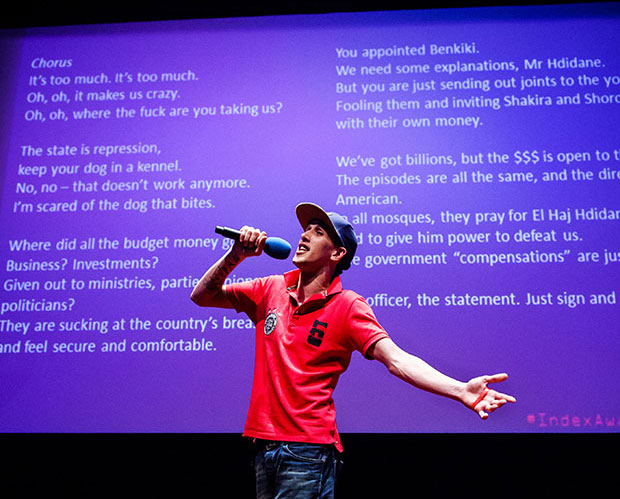
Moroccan rapper El Haqed performed in London at the Index on Censorship Freedom of Expression Awards in March 2015 (Photo: Alex Brenner for Index on Censorship)
Moroccan police prevented a planned 19 June 2015 concert by rapper Mouad “El Haqed” Belghouat, who was named the Index on Censorship Arts award winner in March 2015.
“The continued harassment of Mouad Belghouat, aka El Haqed, by Moroccan authorities must end. This latest silencing of Belghouat is another black mark for Morocco. We call on the government to allow Belghouat and other artists to be allowed to perform freely in the country,” Index on Censorship CEO Jodie Ginsberg said.
On the evening of the concert, security officials blocked streets around The Uzine, a concert venue and cultural centre supported by the Touria and Abdelaziz Tazi Foundation. At the same time, officials cut electricity to the centre. According to Moroccan press reports, police said that the building, which has hosted several concerts since it opened six months ago, was not up to safety codes, an allegation the centre’s management disputes.
Belghouat releases music under the moniker El Haqed, roughly translated as The Enraged. His lyrics describe widespread poverty and endemic government corruption in Morocco. His song Stop the Silence became popular as Moroccans took to the streets in 2011 to protest against their government. He has been imprisoned on spurious charges three times in as many years, most recently for four months in 2014.