[vc_row][vc_column][vc_column_text]In recent years, there has been a perceptible increase in far-reaching restrictions on the media across the globe. This impulse to restrain media freedom stems from a variety of real and perceived “threats” – from concerns about national security, to demands for media “ethics” and “responsibility”, to accusations of the media’s role in the dissemination of so-called “fake news”, most recently. The urge of states to regulate is also reinforced by the overall devaluation of the critical role played by a free and independent media across liberal democracies around the world.
The trend towards ramping up the regulation of the media has worrying implications in these states and others who are currently considering a similar response: the inability of the media to perform its role as a – if not, the – key public watchdog, the erosion of states’ international legal obligations and political commitments on freedom of expression, and a lessening of freedom of the media as a whole.
Under international law, specifically Article 19 of the International Covenant on Civil and Political Rights, states do not have free reign to control the media. Limitations on media freedom, as an aspect of freedom of expression, are allowed only in certain, narrowly defined circumstances, such as national security or the protection of privacy. However, a great many governments are currently approaching media regulation as though restrictions may be imposed at the complete discretion of states regardless of international law and commitments.
Anxieties about the effects of media regulation on media freedom are not limited to transitional or newer democracies, however, as the recent debate around the implementation of section 40 of the Crime and Courts Act 2013 in the UK, a traditional bastion of press freedom, suggests. As I have noted, the commencement of the provision would have punitive effects on the press for reporting on public interest issues in the UK, and have an especially onerous impact up on local and regional newspapers who are already facing significant financial challenges. It would also mean that the UK as a long-standing bastion of press freedom would send out a negative message to other states on the possibilities to regulation.
The picture is not all bad, of course. Some states have made significant positive strides in advancing freedom of the media by engaging with my office on legislative amendments, such as the government of the Netherlands on its draft Law on the Intelligence and Security Services, while others have shown advances in terms of case-law, such as Norway on the protection of sources.
Unfortunately, however, the dominant trend is a regressive one – towards control of the media rather than the reinforcement of it through, among other things, the promotion of media self-regulation and pluralism. This tendency of states to try and control the media is not just a matter of concern for my office, other international institutions, the media itself and civil society organisations. It is one that should worry all those who care about democratic values, the rule of law and human rights.
Dunja Mijatović is the Representative on Freedom of the Media for the OSCE, based in Vienna.[/vc_column_text][/vc_column][/vc_row][vc_row][vc_column][vc_basic_grid post_type=”post” max_items=”4″ element_width=”6″ grid_id=”vc_gid:1484907257319-fb6254e3-0fad-6″ taxonomies=”6380″][/vc_column][/vc_row]
Free speech campaigners Index on Censorship will host a night of forbidden music on December 7 to raise money for censored artists.
This candlelit evening features songs that have been banned or censored, which will be performed live by award-winning Norwegian musician Moddi to celebrate the launch of his ‘Unsongs’ album — 12 tracks from global artists, including Kate Bush and Pussy Riot. The one-off event will be hosted in the restored Hoxton Hall, one of the East End’s hidden Victorian gems.
Moddi’s collection unfurls stories of censorship, persecution and repression, such as A Matter of Habit, a song inspired by interviews with Israeli soldiers and which was banned from army radio in 2012.
Also included in the set will be Moddi’s version of Punk Prayer, which gained international notoriety after Russian feminist punk band Pussy Riot staged a performance of the song at Moscow’s Cathedral of Christ the Saviour. The group said it was a protest against the Orthodox church’s support for Russia’s President Vladimir Putin. Three members of the group were sentenced to two years in prison for “hooliganism motivated by religious hatred”.
Earlier this month Moddi pulled Punk Prayer from his set at a festival in Finnmark, Norway’s northernmost county on the border with Russia, after Russia’s Consulate General in expressed concerns about the song being performed.
‘Forbidden Songs’ is a festive fundraiser in support of freedom of expression charity Index on Censorship, which champions musicians, artists and others around the world who are facing censorship and repression. All proceeds from the night will go to support Index’s Freedom of Expression Awards Fellowship supporting persecuted artists, journalists and campaigners.
Previous award winners include hip-hop artist Smockey, from Burkina Faso, whose studio has been repeatedly targeted for attack because of his involvement with a campaign for democratic reforms that ousted the country’s long-serving and dictatorial president.
Tickets for the event are £15 and include a free drink courtesy of Flying Dog Brewery.
For more information or to arrange an interview, please contact Helen Galliano [email protected]
Notes to Editors
What the critics say about Moddi:
“Making banned music dangerous once again.” The Independent
“An eye-opening lesson in the importance of music” Mojo
“A brave, thought-provoking, musically adventurous project” The Quietus
“Music still has the power to confront authority” The Guardian
Index on Censorship campaigns for and defends free expression worldwide. We publish work by censored writers and artists, promote debate, and monitor threats to free speech. We believe that everyone should be free to express themselves without fear of harm or persecution – no matter what their views. www.indexoncensorship.org
Moddi & Unsongs
Unsongs is a remarkable collection of songs that have, at one stage, been banned, censored or silenced. The attempts to suppress them were as mild as an airplay ban and as brutal as murder. With great sensitivity and imagination, Norwegian singer-songwriter Moddi has given them new life and created a moving and eye-opening album. Unsongs simultaneously celebrates the censored and exposes the censors.
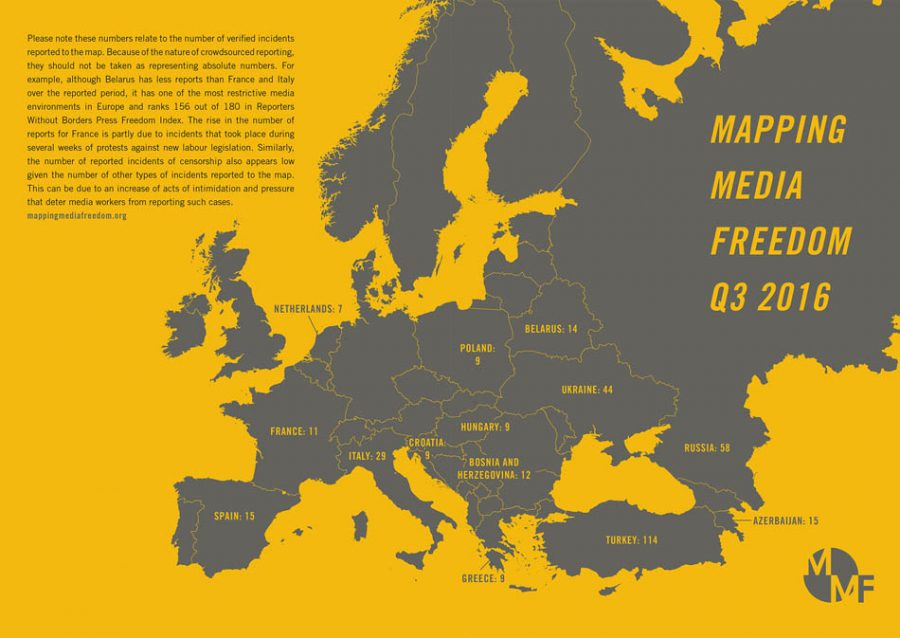
An unprecedented series of crackdowns on media professionals and news outlets took place in Europe and neighbouring countries during the third quarter of 2016, recorded by Index on Censorship’s Mapping Media Freedom project.
Between 1 July and 30 September MMF’s network of correspondents, partners and other sources submitted a total of 406 verified reports of threats to press freedom, a 19% rise from the second quarter of 2016.
An important factor in the rise in media violations was the attack on Turkey’s democratically-elected government on 15 July. Following the failed coup attempt, Turkish authorities forced more than 2,500 journalists out of their jobs, arrested and prosecuted 98 under trumped-up criminal charges, detained 133 and seized or shut down 133 media outlets. The post-coup environment in the country is explored in an extensive case study.
“The post-coup situation for media freedom in Turkey is dire. The sheer number of journalists arrested, detained and charged is without precedent in Europe. At the same time the reports collected by the map are pointing to other areas of concern in Russia and Ukraine,” Hannah Machlin, Mapping Media Freedom project officer, said.
Key findings from the third quarter 2016 report:
Four journalists were killed: Two in Ukraine, one in Russia and one in Turkey
“With nine out of every 10 murders of journalists never solved, the vicious cycle of impunity still prevails. It has to be broken. There can be no exception to the very basic rule that all attacks on journalists must be investigated quickly and thoroughly. We should never give up the fight for journalists’ safety and the struggle to end impunity for crimes committed against journalists,” Dunja Mijatović, OSCE Representative on Freedom of the Media, said.
54 incidents of physical assault were reported
107 media professionals were arrested; 150 were detained and released
112 reports of intimidation, which includes psychological abuse, sexual harassment, trolling/cyberbullying and defamation, were made
“Reporters Without Borders is deeply concerned by the many cases of the use of violent intimidation tactics to silence journalists over the past few months. Acts of violence, and impunity for these acts, has a serious chilling effect on freedom of expression and freedom of information. The increasing use of violence to silence critical voices is part of a global trend of deteriorating press freedom, which must be addressed as a matter of urgent priority”, said Rebecca Vincent, UK Bureau Director for Reporters Without Borders (RSF)
Journalistic work was censored or altered 29 times
Media professionals were blocked from covering a story in 89 cases.
For more information, please contact Hannah Machlin, Mapping Media Freedom project officer at [email protected]
About Mapping Media Freedom
Mapping Media Freedom – a joint undertaking with the European Federation of Journalists and Reporters Without Borders, partially funded by the European Commission – covers 42 countries, including all EU member states, plus Bosnia, Iceland, Kosovo, Macedonia, Montenegro, Norway, Serbia, Turkey, Albania along with Ukraine, Belarus and Russia in (added in April 2015), and Azerbaijan (added in February 2016). The platform was launched in May 2014 and has recorded over 2,500 incidents threatening media freedom.
Norwegian musician Moddi’s new album, Unsongs, is made up of renditions of songs from around the world that had been banned, censored or silenced. Unsongs includes cover versions of songs from countries including China, Russia, Mexico and Vietnam, on topics such as drugs, war and religion.
Index on Censorship caught up with Moddi on Twitter to find out more.
Moddi will hand over the stage at three of the biggest gigs on his current European tour to unleash the power of free expression, replacing the support band with the genuinely banned.
In Amsterdam on 1 October, Maryam Al-Khawaja will share her and her family’s story of imprisonment and exile in the struggle for democracy in Bahrain. In London on 3 October, Vanessa Berhe will speak about life in the prison state of Eritrea and her campaign One Day Seyoum fighting to free her journalist uncle Seyoum Tsehaye who has been in jail for 15 years. In Berlin on 6 October, Raqqa Is Being Slaughtered Silently will tell how the Syrian civil war has destroyed the free expression of a generation. Co-founder Abdalaziz Alhamza will share the story of how and why he co-founded it inside IS-controlled territory.