23 Sep 2015 | Magazine
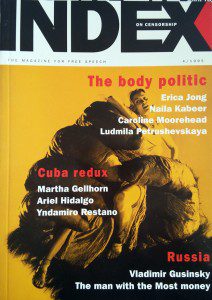
In conjunction with the Cambridge Festival of Ideas 2015, we will be publishing a series of articles that complement many of the upcoming debates and discussions. We are offering these articles from Index on Censorship magazine for free (normally they are held within our paid-for archive) as part of our partnership with the festival. Below is an article by author Erica Jong, on pornographic material in art and literature, taken from our summer 1995 issue. It’s a great starting point for those who plan to attend The body politic: censorship and the female body session at the festival this year.
Index on Censorship is a global quarterly magazine with reporters and contributing editors around the world. Founded in 1972, it promotes and defends the right to freedom of expression.
Pornographic material has been present in the art and literature of every society in every historical period. What has changed from epoch to epoch – or even from one decade to another – is the ability of such material to flourish publicly and to be distributed legally.
After nearly 100 years of agitating for freedom to publish, we find that the enemies of freedom have multiplied, rather than diminished. They are Christians, Muslims, oppressive totalitarian regimes, even well- meaning social libertarians who happen to be feminists, teachers, school boards, librarians. This should not surprise us since, as Margaret Mead pointed out 40 years ago, the demand for state censorship is usually ‘a response to the presence within the society of heterogeneous groups of people with differing standards and aspirations.’ As our culture becomes more diverse, we can expect more calls for censorship rather than fewer.
Mark Twain’s notorious 1601 ... Conversation As It Was By The Social Fireside, In The Time of The Tudors fascinates me because it demonstrates Mark Twain’s passion for linguistic experiment and how allied it is with his compulsion toward ‘deliberate lewdness’.
The phrase ‘deliberate lewdness’ is Vladimir Nabokov’s. In a witty afterword to his ground-breaking 1955 novel Lolita, he links the urge to create pornography with ‘the verve of a fine poet in a wanton mood’ and regrets that ‘in modern times the term “pornography” connotes mediocrity, commercialism and certain strict rules of narration.’ In contemporary porn, Nabokov says, ‘action has to be limited to the copulation of cliches.’ Poetry is always out of the question . ‘Style, structure, imagery should never distract the reader from his tepid lust.’
In choosing to write from the point of view of ‘the Pepys of that day, the same being cup-bearer to Queen Elizabeth’ in 1601, Mark Twain was transporting himself to a world that existed before the invention of sexual hypocrisy. The Elizabethans were openly bawdy. They found bodily functions funny and sex arousing to the muse. Restoration wits and Augustan satirists had the same openness to bodily functions and the same respect for Eros. Only in the nineteenth century did prudery (and the threat of legal censure) begin to paralyse the author‘s hand. Shakespeare, Rochester and Pope were far more fettered politically than we are, but the fact was that they were not required to put condoms on their pens when the matter of sex arose. They were pleased to remind their readers of the essential messiness of the body. They followed a classical tradition that often expressed moral indignation through scatology, ‘Oh Celia, Celia, Celia shits,’ writes Swift, as if she were the first woman in history to do so. In his so-called ‘unprintable poems’, Swift is debunking the conventions of courtly love – as well as expressing his own deep misogyny – but he is doing so in a spirit that Catullus and juvenal would have recognised. The satirist lashes the world to bring the world to its senses. It does the dance of the satyrs around our follies.
Twain’s scatology serves this purpose as well, but it is also a warm-up for his creative process, a sort of pump-priming. Stuck in the prudish nineteenth century, Mark Twain craved the freedom of the ancients. In championing ‘deliberate lewdness’ in 1601, he bestowed the gift of freedom on himself.
Even more interesting is the fact that Mark Twain was writing 1601 during the very same summer (1876) that he was ‘tearing along on a new book’ – the first 16 chapters of a novel he then referred to as ‘Huck Finn’s autobiograph’. This conjunction is hardly coincidental. 1601 and Huckleberry Finn have a great deal in common besides linguistic experimentation. According to Justin Kaplan, ‘both were implicit rejections of the taboos and codes of polite society and both were experiments in using the vernacular as a literary medium.’
In order to find the true voice of a book, the author must be free to play without fear of reprisals. All writing blocks come from excessive self-judgement, the internalised voice of the critical parent telling the author’s imagination that it is a dirty little boy or girl. ‘Hah!’ says the author, ‘I will flaun t the voice of parental propriety and break free!’ This is why pornographic spirit is always related to unhampered creativity. Artists are fascinated with filth because we know that in it everything human is born. Human beings emerge between piss and shit and so do novels and poems. Only by letting go of the inhibition that makes us bow to social propriety can we delve into the depths of the unconscious. We assert our freedom with pornographic play. If we are lucky, we keep that freedom long enough to create a masterpiece like Huckleberry Finn.
But the two compulsions are more than just related; they are causally intertwined.
When Huckleberry Finn was published in 1885, Louisa May Alcott put her finger on exactly what mattered about the novel even as she condemned it: ‘If Mr Clemens cannot think of something better to tell our pure- minded lads and lasses, he had best stop writing for them.’ What Alcott didn’t know was that ‘our pure-minded lads and lasses’ aren’t. But Mark Twain knew. It is not at all surprising that during that summer of high scatological spirits Twain should also give birth to the irreverent voice of Huck. If Little Women fails to go as deep as Twain’s masterpiece, it is precisely because of Alcott’s concern with pure mindedness. Niceness is ever the enemy of art. If you worry about what the neighbours, critics, parents and supposedly pure-minded censors think, you will never create a work that defies the restrictions of the conscious mind and delves into the world o f dreams.
The artist needs pornography as a way into the unconscious and history proves that if this licence is not granted, it will be stolen. Mark Twain had 1601 privately printed. Picasso kept pornographic notebooks that were only exhibited after his death.
1601 is deliberately lewd. It delights in stinking up the air of propriety. It delights in describing great thundergusts of farts which make great stenches and pricks which are stiff until cunts ‘take ye stiffness out of them’. In the midst of all this ribaldry, the assembled company speaks of many things – poetry, theatre, art, politics. Twain knew that the muse flies on the wings of flatus, and he was having such a good time writing this Elizabethan pastiche that the humour shines through a hundred years and twenty later. I dare you to read 1601 without giggling and guffawing.
Erica Jong became internationally famous in 1973-4 with the publication of her novel Fear of Flying, which sold over 10 million copies worldwide. She has also written several collections of poetry and six further novels, most recently Any Woman’s Blues
Excerpted from a paper delivered at a conference on Expression, Offence and Censorship, organised by the Institute for Public Policy Research in June 1995. A full report of the conference, including contributions from Bernard Williams, Michael Grade, Clare Short MP and Chris Smith MP will be published shortly. Details from IPPR, 30-32 Southampton Street, London WC2E 7RA, UK
© Erica Jong and Index on Censorship
Join us on 25 October at the Cambridge Festival of Ideas 2015 for Question Everything an unconventional, unwieldy and disruptive day of talks, art and ideas featuring a broad range of speakers drawn from popular culture, the arts and academia. Moderated by Index on Censorship CEO Jodie Ginsberg.
This article is part of the summer 1995 issue of the global quarterly Index on Censorship magazine. Click here to subscribe to the magazine.
22 Sep 2015 | Austria, mobile, News, United Kingdom
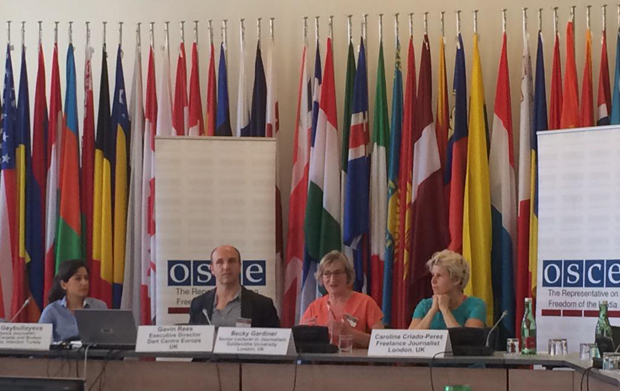
Panelists at the OSCE meet on online attacks against journalists: writer Arzu Geybulla; Gavin Rees, Europe director of the Dart Center for journalism and trauma; Becky Gardiner, from Goldsmiths, University of London; journalist Caroline Criado Perez
“This is not something that only ‘ladies’ can fix,” emphasised Dunja Mijatovic, the OSCE’s Representative on Freedom of the Media at an expert meeting on the safety of female journalists in Vienna on 17 September 2015, which Index on Censorship attended.
The importance of collectively tackling the growing problem became an overarching theme of the conference. “There is a new and alarming trend for women journalists and bloggers to be singled out for online harassment,” said Mijatovic, while highlighting the importance of media, state and NGO voices coming together to address the abuse.
Arzu Geybulla and Caroline Criado Perez, journalists from Azerbaijan and the UK respectively, started the meeting with moving testaments of their own experiences. Despite covering very different topics, they have received shockingly similar threats – sexual, violent and personal. “Shut your mouth or I’ll shut it for you and choke you with my dick” was one of the messages received by Perez after she campaigned for a woman to feature on British banknotes.
Although male journalists also receive abuse, women experience a two-fold attack, including the gendered threats. Think tank Demos has estimated that female journalists experience roughly three times as many abusive comments as their male counterparts on Twitter.
The problem, said Perez, was not just the threats but how the women who receive them are then treated. “Women are accused of being mad or attention seeking, which are all ways of delegitimising women’s speech,” she said. “People told me to stop, close my Twitter account, go offline. But why is the solution to shut up?” She added: “This is a societal problem, not an internet problem.”
“Labelling a person, and making that person an object, is particularly common in Azerbaijan,” said Geybulla, an Azeri journalist and Index on Censorship magazine contributor who was labelled a traitor and viciously targeted online after writing for a Turkish-Armenian newspaper. “Our society is not ready to speak out. You can’t go to the police. The police think it must be your fault.”
The intention of the meeting was to highlight the problem, while also proposing courses of actions. Suggestions included calls for more education in digital literacy; more training for police; more support from editors and media organisations, and from male colleagues. There was some disagreement on whether the laws were robust enough as they stand, or needed an update for the internet age.
Becky Gardiner, formerly editor of Guardian’s Comment is Free section, spoke about how her own views on dealing with online abuse had changed, having initially told writers they should develop a thicker skin. “It is not enough to tell people to get tough. Disarming the comments is not a solution either. That genie is out of the bottle.” Gardiner, who is now a lecturer at Goldsmiths, University of London, is working on research into the issue, as commissioned by the Guardian’s new editor, Kath Viner.
It was suggested that small but crucial steps could be taken by media organisations to avoid inflammatory and misleading headlines (which are not written by the journalist, but put them in the firing line) and to be careful of exposing inexperienced writers without preparation or support. Sarah Jeong from Vice’s Motherboard plaform said, in her experience, freelancers often came the most under attack because they don’t have institutional backing.
The OSCE said this will be the first in a series of meetings, with the aim of getting more organisations to take it serious and to produce more concrete courses of action.
Read more about the online abuse of women in the latest issue of Index on Censorship magazine, with a personal account by Gamergate target Brianna Wu and a legal overview by Greg Lukianoff, president of the Foundation for Individual Rights in Education (Fire).
Tweets from OSCE’s #FemJournoSafe conference:
https://twitter.com/julieposetti/status/644456066432937984
10 Sep 2015 | mobile, News, South Africa
Back in the days when the ruling National Party and their thought police ruled South Africa with an iron fist, one of the most powerful bodies tasked with enforcing Apartheid’s staunch Calvinistic values was the Film and Publications Board (FPB). A group of conservative, mainly Afrikaans men and women, it was their job to scrutinise and censor publications: books, movies and music.
Anything depicting even a hint of a mixing of races resulted in either an outright ban or, in the case of movies, ordered to make jarring cuts that often edited out key parts of the story. Suggestions of sex – between people of different colours – was verboten. Anything of a perceived political nature that didn’t fit in with ruling party’s narrow views was instantly banned.
The power to ban publications lay with the minister of the interior under the Publications and Entertainments Act of 1963. An entry in the Encyclopedia Britannica explains its purpose: “Under the act a publication could be banned if it was found to be ‘undesirable’ for any of many reasons, including obscenity, moral harmfulness, blasphemy, causing harm to relations between sections of the population, or being prejudicial to the safety, general.”
The result was that literally thousands of books, newspapers and other publications and movies were banned in South Africa – and possession of them was a criminal offence.
It led to some truly bizarre rulings, like the banning of Anna Sewell’s classic book Black Beauty because the censors, who clearly didn’t bother to read it, thought it was about a black woman.
I still have clear memories of returning from visits to multiracial Swaziland with banned publications hidden under carpets, slipped behind the dashboard or under spare wheels. That was how I got hold of a copy of murdered Black Consciousness leader Steve Biko’s I Write What Like and exiled South African editor Donald Woods’ Cry Freedom, about the life and death of Biko.
I still remember clearly how my heart skipped a beat when border guards checking through my car got uncomfortably close to uncovering my contraband literature. It was a huge risk because, had it been discovered, it would have meant prosecution and a criminal record for possession of banned literature.
Even having a copy of Playboy was a criminal offence and more than one South African found himself with a criminal record after a copy of the magazine was found stashed in his luggage on his return to South Africa from an overseas trip.
But when South Africa’s new, post-Apartheid constitution came into effect in 1996, it brought new freedoms for South Africans: books and movies banned by the Apartheid government were unbanned. Sex also came out into the open and, for those so inclined, pornography became freely available in the ubiquitous sex shops that opened their doors on high streets and side streets all over the country.
Then, the world wide web was in its infancy in South Africa, available only to the academics and privileged few who could afford it. But now, almost two decades later in a move that has raised fears of a new wave of censorship, the South African government last month approved a bill that has been widely criticised for seeking to curb internet freedoms. Informed by a draft policy drawn up by the FPB it seeks to amend the Film and Publications Act of 1996 – which had itself, replaced the Apartheid-era version of the Act – by adapting it for 21st century technological advances.
The amendments “provide for technological advances, especially online and social-media platforms, in order to protect children from being exposed to disturbing and harmful media content in all platforms (physical and online)”, according to a recent cabinet statement.
“The bill strengthens the duties imposed on mobile networks and internet service providers to protect the public and children during usage of their services,” it said, adding that the regulatory authority would not “issue licences or renewals without confirmation from the Film and Publication Board of full compliance with its legislation.”
The draft policy covers several areas including preventing children from viewing pornography online, hate speech and racist content.
But it also led to fear that it could be used to impose pre-publication censorship. These fears were allayed to some extent when a compromise was reached exempting content published by media registered with the Press Council of South Africa, which recently revised its press code to include regulation of online content exempted from the bill. But this is cold comfort for media who are not members, leaving them and bloggers, social media commentators and ordinary citizens vulnerable.
As it now stands anyone uploading content to the internet or posting content to social media would need to register with the FPB and submit their content before publishing anything. The proposed changes to the law would severely limit South Africa’s hard-earned, constitutional right to free speech, warn critics, who believe it would not pass constitutional muster.
This is reinforced by a legal opinion prepared for the Right to Know Campaign (R2K), which believes that the proposed bill is unconstitutional in several areas and also “unjustifiably limits the right to freedom of expression”. Opponents have made it clear that if it passes into law they will take it to the Constitutional Court.
There is no doubt that the battle lines have been drawn. Already 32,000 people opposing the bill have signed an Avaaz petition, while another 9,000 people have signed an R2K petition.
But the real issue is whether the FPB would be able to enforce it and whether trying to police the internet is just as bizarre as their predecessor’s banning of Black Beauty.
This column was posted on 10 Septemeber 2015 at indexoncensorship.org
28 Aug 2015 | Croatia, Mapping Media Freedom, mobile, News
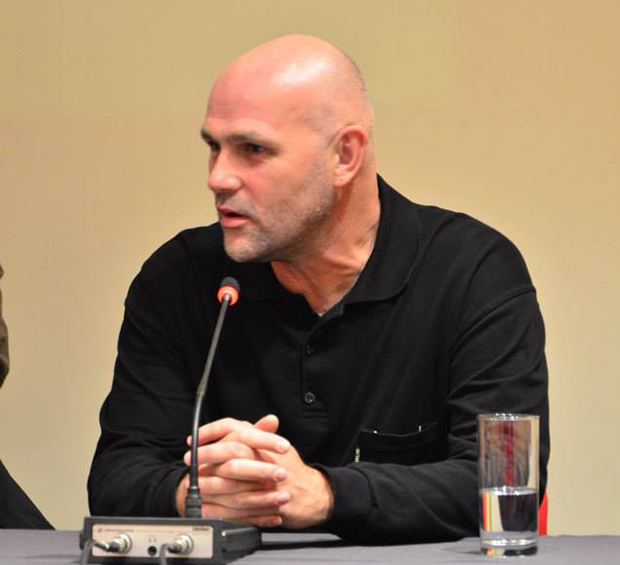
Sasa Lekovic at a Mediacentar Sarajevo event in 2013 (Photo: Mediacentar Sarajevo)
Over the past few months, death threats, physical assaults and intimidation have plagued the Croatian media. This drastic deterioration of media freedom is recorded through Index’s Mapping Media Freedom. In the first year of the campaign — from May 2014 — there were 24 verified incidents in Croatia. Between May and August 2015, there were 14, a 75% rise in verified reports over the same period last year.
This surge in media violations was recently addressed by the Croatian Journalists’ Association (CJA) and an OSCE representative on Freedom of the Media. In a statement published on its website, the CJA highlighted impunity as one of the main issues hindering media freedom throughout the country. “The CJA once again calls on authorities to find and adequately punish those who have threatened and attacked journalists, and to also find those who potentially ordered the attacks.”
The primary concern of the CJA is the long line of unresolved cases surrounding death threats and attacks on journalists. Exactly one year since freelance journalist Domagoj Margetic was brutally beaten in front of his apartment in Zagreb — an attack the Croatian State Prosecution has characterised as attempted murder — information on the attacker and the motive remain absent. Other unresolved cases include that of Antonio Mlikota, graphic editor at the Hrvatski Tjednik newsroom who was bound and threatened with a gun, and Hrvoje Simicevic, a journalist at H-Alter who was physically assaulted. There was also a series of death threats addressed to Katarina Maric Banje, a journalist for Slobodna Dalmancija, Drago Pilsel, editor-in-chief of the Autograf website, and Sasa Lekovic, the president of the CJA, along with others that have not been made public.
In light of the influx of violence, Index spoke to Lekovic, who also received a death threat. Lekovic assumes it was issued as a result of his new role, adding that the CJA makes people who want to control the media very nervous.
Discussing the most prominent threats to media freedom, he emphasised that “journalists in Croatia are under mixed pressure from politicians, media owners, mighty tycoons and organised crime.” Lekovic says this is not particularly new, adding that for almost two decades journalists have been subjected to such threats. “Generally speaking, it isn’t easy to discern the small distinction between these actors, if any.”
Although the primary threat to media freedom is self-censorship, the lack of media integrity is also a problem. “On one hand, we have a number of media outlets, especially web portals, not following any professional standard; they are actually using media freedom against the media,” Lekovic told Index. “On the other hand, we also have some laws that are used against professionals to suspend their right to serve public interest.”
In recent years, the CJA has taken multiple steps towards fostering a more relaxed and professional environment for media workers. Among other measures, they started a project called The Center for Protection of Public Speech.
“We have lawyers who are helping journalists that are in danger, including providing pro bono support and court representation. On the other hand, the CJA is going to work on ideas that better media legislation and their implementation and ones that will improve media literacy and training,” Lekovic says. “It’s all connected and is a long-term job that will not be completed overnight.”
On deteriorating media freedom, Lekovic says the current climate is notably worse than it was two years ago. He explains that “when Croatia was applying to become an EU member, it was under pressure to fulfill EU legislative requirements within the media sphere, but once the country joined the EU, nobody cared about upholding them”.
The OSCE Representative on Freedom of the Media, Dunja Mijatovic, has called on Croatian authorities to protect critical voices and to investigate the increase in attacks on journalists. Mijatovic wrote to Croatia’s Foreign Minister, Vesna Pusic, calling for swift and transparent investigations.
“As far as I am aware, all these cases remain unresolved,” Mijatovic wrote. “Condemnation coming from the highest level of government should be a clear sign that these acts of intimidation and violence against journalists will not be tolerated.”
Lekovic added that Croatia’s upcoming parliamentary election due by February 2016 is adding to the pressure.
Mapping Media Freedom
Click on the bubbles to view reports or double-click to zoom in on specific regions. The full site can be accessed at https://mappingmediafreedom.org/
|
Related:
• Croatia: 35 reports since May 2014
This article was published at indexoncensorship.org on 28/8/2015