28 May 2013 | In the News
AUSTRALIA
Photographers withdraw from Vivid over censorship claims
Two international photographers have withdrawn their works from an exhibition in Sydney in protest over what one has described as censorship. (ABC News)
AZERBAIJAN
In Azerbaijan, authorities use ‘Harlem Shake’ to silence activist
The recent arrest of Ilkin Rustamzadeh highlights how Azerbaijan’s authorities use trumped up charges to silence messages they are not comfortable with, blogger Ali Novruzov writes from Baku. (Index on Censorship)
CHINA
´Ai Weiwei´s work embodies freedom of speech´
The popularity of Chinese artist and activist Ai Weiwei in the Netherlands is largely fueled by the Dutch love of art that hovers on the edge of acceptability. This commitment to pushing the boundaries of freedom of expression is evident in the exhibition FUCK OFF 2 which he’s curated and which opens at the Groninger Museum on Sunday. (Radio Netherlands Worldwide)
ISRAEL
Al-Jazeera draws fire over self-censorship
The Qatar-based al-Jazeera network has been criticized over its decision to remove a controversial article posted on its website amid claims the story was “anti-Jewish” in a seemingly self-censoring act. (YNet.com)
RUSSIA
Interpol Rebuffs Russia in Its Hunt for a Kremlin Critic
Interpol has rejected a Russian request for a worldwide police hunt for William F. Browder, a British investment banker and a Kremlin nemesis who has made no secret of his whereabouts or of his battle against the government of President Vladimir V. Putin over accusations of human rights abuses. (New York Times)
Russia: Gay Rights Activists Arrested At Rally
Dozens of activists at a gay pride march in Moscow have been arrested by Russian police. (Sky News)
TUNISIA
Tunisia’s ‘topless feminist’ faces jail for having pepper spray
The lawyer of a Tunisian woman who gained notoriety for posting online topless pictures of herself as a protest says she faces six months in prison for carrying a dangerous object. (AP via CBS47)
TURKEY
Turkey Kissing Protest Held In Subway As Couples Defy Ban On Public Displays Of Affection
Dozens of couples have locked lips at a subway stop in Turkey’s capital, Ankara, to protest subway authorities’ admonishment of a couple that kissed in public. (AP via Huffington Post)
Turkey takes important steps to end human rights violations
Turkish Deputy Prime Minister Besir Atalay said on Thursday that Turkey has made significant improvements in human rights, especially in freedom of expression. (Turkish Weekly)
UNITED KINGDOM
Speaker’s wife faces £150,000 bill for online libel
SPEAKER’S wife Sally Bercow faces a legal bill of £150,000 after losing a libel battle with Lord McAlpine yesterday over a tweet which falsely linked him to allegations of sex abuse. (The Daily Express)
Could “snooper’s charter” stop terror attacks?
Some UK politicians have said the murder of a soldier in Woolwich, London this week demonstrates the need for greater surveillance of communications data. But would a “snooper’s charter” really have made a difference? Index asked Emma Carr of Big Brother Watch and Jamie Bartlett of Demos for their views. (Index on Censorship)
UNITED STATES
Microsoft Disables Comments For Xbox One Videos Following Harsh Criticisms
Want to let Microsoft know how you feel about the Xbox One? You won’t be able to do it on the official YouTube videos. If you head to Microsoft’s official channel for the Xbox One, the comments for the videos have been aptly disabled. (Gaming Blend)
Attacks on the press should come as no surprise
Freedom of the press. It’s a bedrock of our Constitution, right there in the very first amendment. That means it’s one of the most important freedoms and rights guaranteed to this country, freedom of religion, freedom of speech, and freedom of the press, all interlocked and interdependent. (Marietta Times)
As UN’s Censorship Alliance Lashes Out from Anonymity, UN Does Nothing
UN scribes from Reuters, Bloomberg News, Voice of America, Agence France Presse and others on the board of the UN Correspondents Association tried to get Inner City Press thrown out of the UN in 2012. In 2013 they have started anonymous social media accounts to falsely accuse Inner City Press of being funded by terrorists.
(Inner City Press)
23 May 2013 | Europe and Central Asia
Two journalists were attacked while covering a street rally in Kiev, and nine more Ukrainian reporters were in danger of losing government accreditation following a protest to support their colleagues, Andrei Alaiksandrau reports.
TV journalist Olga Snitsarchuk and her husband, Kommersant photographer Vladislav Sodel were beaten on 18 May in the centre of Kiev, while they were taking pictures of a political rally in the Ukrainian capital. The journalists began recording images of a group of young men who were attacking people at the gathering.
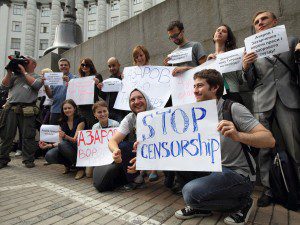
Ukrainian journalists rally in Kiev to support journalists. (Photo: ukrafoto ukrainian news / Demotix)
“Having seeing that I started taking photos, young men in tracksuits rushed at me. And Olga began to take video of how they were beating me, so the men knocked her to the ground and began to beat”, Vladislav Sodel told Ukrainskaya Pravda.
Police officers who were present at the scene ignored appeals for help from rally participants and the journalists, according to witnesses. One of the attackers was later identified as Vadim Titushko, who happens to be a member of a police sports club. Titushko was detained and interrogated, but on 22 May released on bail.
Full Coverage: Ukraine | Today on Index: Brazil’s Federal Police seize journalist’s equipment | Birthday wishes for Bassel Khartabil | Vietnamese activists appeal sentences | Free expression in the news
Index on Censorship Events
Caught in the web: how free are we online? June 10, 2013
The internet: free open space, wild wild west, or totalitarian state? However you view the web, in today’s world it is bringing both opportunities and threats for free expression. More >>>
Ukrainian journalists demanded the incident be properly investigated. On 22 May nine reporters conducted a silent action during a government meeting by turning their backs on ministers to show posters that read “Today it is a journalist, tomorrow it is going to be your wife, sister or daughter. Take action!”
Prime Minister Mykola Azarov ordered the journalists removed from the hall and, later, withdrew their press credentials for “breach of order of coverage of Cabinet of Ministers’ work.” This incident prompted about 100 Ukrainian journalists to protest outside the prime minister’s office in support of Snitsarchuk, Sodel and their nine colleagues. The government announced that the journalists would keep their accreditation. Moreover, Verkhovna Rada, a member of Ukraine’s parliament, today created an ad-hoc committee to investigate the 18 May incident.
“We are at the beginning of a new war between the state and the press,” a Ukraininan MP and a former journalist Volodymyr Ariev said yesterday in London during a conference on media regulation, organised by Parliamentary Assembly of the Council of Europe.
The Institute of Mass Information, a Ukrainian media freedom non-governmental organisation, has reported on the deterioration of the media environment in the country.
“There was a huge increase in the number of physical attacks on journalists in 2012, with 80 cases registered in comparison to just 26 in 2011. We also note an increase of instances of censorship. This year is going to be tough for journalists and free speech in Ukraine as the authorities will definitely aim at building the basis for 2015 presidential elections,” Oksana Romaniuk, a representative of Reporters Without Borders in Ukraine, told Index.
22 May 2013 | Africa, News
The so-called secrecy bill’s passage through the South African parliament mirrors an increasing political intolerance towards diverse views that in some cases has spilled over in violence, Christi van der Westhuizen reports.
After an arduous legislative process that lasted three years and saw the reactivation of a moribund civil society, the South African parliament adopted the Protection of State Information Bill. But its opponents are adamant that the law remains in contravention of the country’s constitution, which contains an explicit commitment to openness.
 The bill ostensibly puts in place a system to regulate state information. Instead, it empowers the State Security Agency to throw a blanket of control over all state information. Possessing or distributing classified state information is punishable by draconian prison sentences of up to 25 years. A public interest clause has been included after concerted civil society pressure, but is circumscribed to only apply in specific cases. Crimes in the bill include “espionage”, defined as sharing information that could benefit a foreign government. Under the terms of the bill investigative journalists, activists and others can be found guilty whether they intended to act in the interest of foreign entities or not.
Even when classified information is already in the public domain, those in possession of the information can still be prosecuted for infringing the bill’s provisions. The proposed avenue to accessing classified information is a cumbersome application process to have documents declassified. But there’s no guarantee the request will be honoured.
The bill extends the reach of the State Security Agency, which includes the Intelligence Services, beyond classified information. The agency is tasked with policing the handling of fuzzily defined “valuable information” across all state entities, whether a provincial sharks board or a local government bus company.
President Jacob Zuma’s signature is the last stop before the bill becomes law. Calls have been made to him to refer the bill to the Constitutional Court to test its compatibility with the democratic-era constitution. Should this last attempt at halting the bill fail, media and civil society organisations are prepared to take the fight to the Constitutional Court themselves.
Related: South Africa | Christi van der Westhuizen
Index on Censorship Events
Caught in the web: how free are we online? June 10, 2013
The internet: free open space, wild wild west, or totalitarian state? However you view the web, in today’s world it is bringing both opportunities and threats for free expression. More >>>
The chances are however slim that Zuma, as a former internal security head of the ruling African National Congress (ANC), would concede the possibility of error. The forceful campaign with which the State Security Agency drove the bill through parliament makes such a concession even more unlikely.
The bill’s processing was marked by unprecedented rancour from members of parliament and the executive towards opponents. Minister of State Security Siyabonga Cwele reverted to accusing Right2Know protestors during a parliamentary debate of being “local proxies” paid by “foreign spies”. Right2Know is a civil society campaign that had sprung up in response to the bill.
During public committee hearings on the bill, parliamentarians accused investigate reporters of wanting to undermine democracy through exposure of corruption. Cecil Burgess, the chairperson of the parliamentary committee, evoked the liberation struggle against apartheid: “As we said during the days of the struggle: are you with the struggle or against it? The media seems to have created an institution of its own that is not with the people.” At the adoption of the bill in parliament at the end of April, aspersions were cast on opposition parliamentarians as “being in the pay of another government”.
These utterances have echoes in ANC secretary general Gwede Mantashe branding prominent businesswoman and former World Bank director Dr Mamphela Ramphele’s new political party Agang SA as “an American initiative aimed at destabilising our country”.
The acrimony towards journalists and political opponents reverberated during rural wage protests earlier this year when reporters were targeted and two vehicles set alight or stoned. A local law enforcement officer was suspended after he posted a message on his Facebook page suggesting that AK47 assault rifles should be used against farmers who exploit their workers. In turn, he received racist threats.
During the same rural protest, the leader of the opposition Democratic Alliance and premier of the Western Cape province Helen Zille was whisked away amid threatening behaviour from the crowd. After the Marikana massacre at the Lonmin mine last year, cabinet ministers beat a hasty retreat in the face of hostile armed workers at the memorial service. A union leader at the mine was killed earlier this month. Workers at Lonmin mine have again threatened violence against the police while political representatives have been killed in inter-party violence in KwaZulu Natal province.
This trend of diminishing political tolerance which, at its extremes, involves the silencing of opponents with actual or threatened violence, is associated with the rise of Zuma.
Before his election as president of the ruling party in 2007 and of the country in 2009, a beleaguered Zuma, facing rape and corruption charges, revived a struggle song titled “Awuleth’ umshini wami” (Bring my machine gun) as war cry against his detractors. This was followed by pledges from his most devoted supporter at the time, former ANC Youth League leader Julius Malema, to “kill for Zuma”.
While crime figures show a downward trend, the levels of public violence have risen, which bodes ill as the country prepares for the next election date in 2014, which also marks 20 years of democracy.
21 May 2013 | Middle East and North Africa
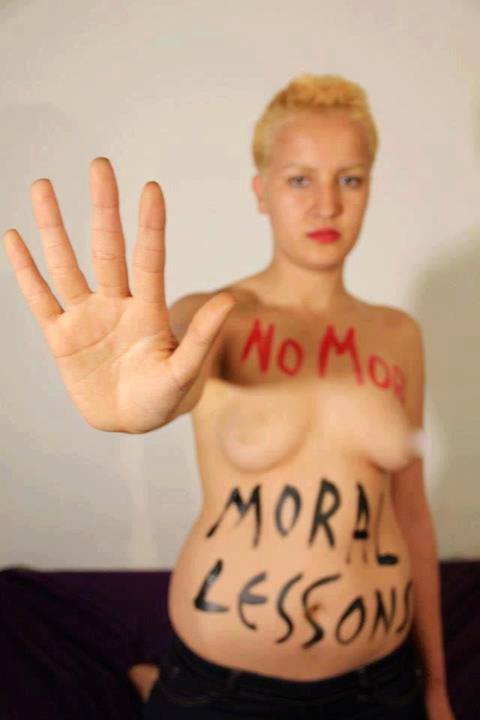
Tunisian activist Amina Tyler was arrested on Sunday (19 May), after allegedly attempting to stage a topless protest in the central Tunisian city of Kairouan.
Tyler, who heads Tunisia’s branch of feminist movement FEMEN, first faced controversy in March, after posting topless photographs online. Ukranian feminist group FEMEN is notorious for its brand of bare-chested protest.
Hardline Salafi group Ansar al-Sharia was set to hold their annual congress in Kairouan on Sunday, but authorities banned the gathering. Tyler passed through the heavily guarded checkpoints around the city, set up to enforce the ban on the Salafi gathering. Salafis in the city clashed with security forces shortly before Tyler’s arrest.
The activist reportedly painted the word “FEMEN” as well as anti-salafist slogans on a cemetery wall near al-Okba mosque, one of Tunisia’s most important and historic religious sites. Collective blog Nawaat released a video of Tyler’s arrest — which occurred shortly after she was surrounded by local residents yelling for her to leave. Local police said that residents became enraged once Tyler attempted to take off her clothes.
A spokesman for Tunisia’s Ministry of Interior on Monday called Tyler’s protest “an act of provocation”, and “against the morals and traditions of Tunisian society, which is a Muslim society.” Tyler has not yet been charged, but she will appear in court today. Public indecency is punishable under Tunisian law, and if charged Tyler could face up to six months in jail.
Sara Yasin is an Editorial Assistant at Index. She tweets from @missyasin
