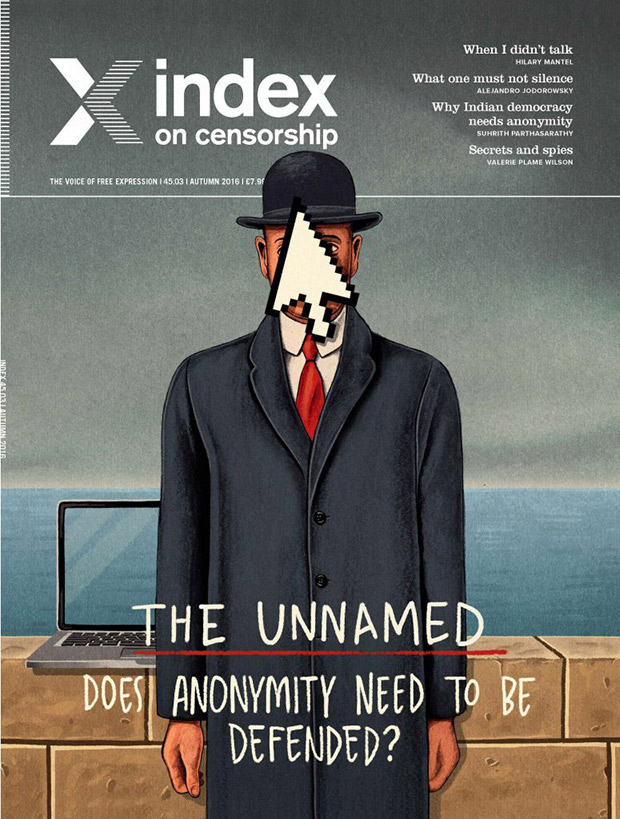
Contents: The unnamed
[vc_row][vc_column][vc_custom_heading text=”Does anonymity need to be defended? Contributors include Hilary Mantel, Can Dündar, Valerie Plame Wilson, Julian Baggini, Alejandro Jodorowsky and Maria Stepanova “][vc_row_inner][vc_column_inner width=”1/2”][vc_column_text]
The latest issue of Index on Censorship explores anonymity through a range of in-depth features, interviews and illustrations from around the world. The special report looks at the pros and cons of masking identities from the perspective of a variety of players, from online trolls to intelligence agencies, whistleblowers, activists, artists, journalists, bloggers and fixers.
[/vc_column_text][/vc_column_inner][vc_column_inner width=”1/2″][vc_single_image image=”78078″ img_size=”full”][/vc_column_inner][/vc_row_inner][vc_column_text]
Former CIA agent Valerie Plame Wilson writes on the damage done when her cover was blown, journalist John Lloyd looks at how terrorist attacks have affected surveillance needs worldwide, Bangladeshi blogger Ananya Azad explains why he was forced into exile after violent attacks on secular writers, philosopher Julian Baggini looks at the power of literary aliases through the ages, Edward Lucas shares The Economist’s perspective on keeping its writers unnamed, John Crace imagines a meeting at Trolls Anonymous, and Caroline Lees looks at how local journalists, or fixers, can be endangered, or even killed, when they are revealed to be working with foreign news companies. There are are also features on how Turkish artists moonlight under pseudonyms to stay safe, how Chinese artists are being forced to exhibit their works in secret, and an interview with Los Angeles street artist Skid Robot.
Outside of the themed report, this issue also has a thoughtful essay by novelist Hilary Mantel, called Blot, Erase, Delete, about the importance of committing to your words, whether you’re a student, an author, or a politician campaigner in the Brexit referendum. Andrey Arkhangelsky looks back at the last 10 years of Russian journalism, in the decade after the murder of investigative reporter Anna Politkovskaya. Uzbek writer Hamid Ismailov looks at how metaphor has taken over post-Soviet literature and prevented it tackling reality head-on. Plus there is poetry from Chilean-French director Alejandro Jodorowsky and Russian writer Maria Stepanova, plus new fiction from Turkey and Egypt, via Kaya Genç and Basma Abdel Aziz.
There is art work from Molly Crabapple, Martin Rowson, Ben Jennings, Rebel Pepper, Eva Bee, Brian John Spencer and Sam Darlow.
You can order your copy here, or take out a digital subscription via Exact Editions. Copies are also available at the BFI, the Serpentine Gallery, MagCulture, (London), News from Nowhere (Liverpool), Home (Manchester), Calton Books (Glasgow) and on Amazon. Each magazine sale helps Index on Censorship continue its fight for free expression worldwide.
Index on Censorship magazine was started in 1972 and remains the only global magazine dedicated to free expression. Past contributors include Samuel Beckett, Gabriel García Marquéz, Nadine Gordimer, Arthur Miller, Salman Rushdie, Margaret Atwood, and many more.
[/vc_column_text][/vc_column][/vc_row][vc_row][vc_column][vc_custom_heading text=”SPECIAL REPORT: THE UNNAMED” css=”.vc_custom_1483445324823{margin-right: 0px !important;margin-left: 0px !important;border-bottom-width: 1px !important;padding-top: 15px !important;padding-bottom: 15px !important;border-bottom-color: #455560 !important;border-bottom-style: solid !important;}”][vc_column_text]
Does anonymity need to be defended?
Anonymity: worth defending, by Rachael Jolley: False names can be used by the unscrupulous but the right to anonymity needs to be defended
Under the wires, by Caroline Lees : A look at local “fixers”, who help foreign correspondents on the ground, can face death threats and accusations of being spies after working for international media
Art attack, by Jemimah Steinfeld: Ai Weiwei and other artists have increased the popularity of Chinese art, but censorship has followed
Naming names, by Suhrith Parthasarathy: India has promised to crack down on online trolls, but the right to anonymity is also threatened
Secrets and spies, by Valerie Plame Wilson: The former CIA officer on why intelligence agents need to operate undercover, and on the damage done when her cover was blown in a Bush administration scandal
Undercover artist, by Jan Fox: Los Angeles street artist Skid Robot explains why his down-and-out murals never carry his real name
A meeting at Trolls Anonymous, by John Crace: A humorous sketch imagining what would happen if vicious online commentators met face to face
Whose name is on the frame? By Kaya Genç: Why artists in Turkey have adopted alter egos to hide their more political and provocative works
Spooks and sceptics, by John Lloyd: After a series of worldwide terrorist attacks, the public must decide what surveillance it is willing to accept
Privacy and encryption, by Bethany Horne: An interview with human rights researcher Jennifer Schulte on how she protects herself in the field
“I have a name”, by Ananya Azad: A Bangladeshi blogger speaks out on why he made his identity known and how this put his life in danger
The smear factor, by Rupert Myers: The power of anonymous allegations to affect democracy, justice and the political system
Stripsearch cartoon, by Martin Rowson: When a whistleblower gets caught …
Signing off, by Julian Baggini: From Kierkegaard to JK Rowling, a look at the history of literary pen names and their impact
The Snowden effect, by Charlie Smith: Three years after Edward Snowden’s mass-surveillance leaks, does the public care how they are watched?
Leave no trace, by Mark Frary: Five ways to increase your privacy when browsing online
Goodbye to the byline, by Edward Lucas: A senior editor at The Economist explains why the publication does not name its writers in print
What’s your emergency? By Jason DaPonte: How online threats can lead to armed police at your door
Yakety yak (don’t hate back), by Sean Vannata: How a social network promising anonymity for users backtracked after being banned on US campuses
[/vc_column_text][/vc_column][/vc_row][vc_row][vc_column][vc_custom_heading text=”IN FOCUS” css=”.vc_custom_1481731813613{margin-right: 0px !important;margin-left: 0px !important;border-bottom-width: 1px !important;padding-top: 15px !important;padding-bottom: 15px !important;border-bottom-color: #455560 !important;border-bottom-style: solid !important;}”][vc_column_text]
Blot, erase, delete, by Hilary Mantel: How the author found her voice and why all writers should resist the urge to change their past words
Murder in Moscow: Anna’s legacy, by Andrey Arkhangelsky: Ten years after investigative reporter Anna Politkovskaya was killed, where is Russian journalism today?
Writing in riddles, by Hamid Ismailov: Too much metaphor has restricted post-Soviet literature
Owners of our own words, by Irene Caselli: Aftermath of a brutal attack on an Argentinian newspaper
Sackings, South Africa and silence, by Natasha Joseph: What is the future for public broadcasting in southern Africa after the sackings of SABC reporters?
“Journalists must not feel alone”, by Can Dündar: An exiled Turkish editor on the need to collaborate internationally so investigations can cross borders
[/vc_column_text][/vc_column][/vc_row][vc_row][vc_column][vc_custom_heading text=”CULTURE” css=”.vc_custom_1481731777861{margin-right: 0px !important;margin-left: 0px !important;border-bottom-width: 1px !important;padding-top: 15px !important;padding-bottom: 15px !important;border-bottom-color: #455560 !important;border-bottom-style: solid !important;}”][vc_column_text]
Bottled-up messages, by Basma Abdel Aziz: A short story from Egypt about a woman feeling trapped. Interview with the author by Charlotte Bailey
Muscovite memories, by Maria Stepanova: A poem inspired by the last decade in Putin’s Russia
Silence is not golden, by Alejandro Jodorowsky: An exclusive translation of the Chilean-French film director’s poem What One Must Not Silence
Write man for the job, by Kaya Genç: A new short story about a failed writer who gets a job policing the words of dissidents in Turkey
[/vc_column_text][/vc_column][/vc_row][vc_row][vc_column][vc_custom_heading text=”COLUMNS” css=”.vc_custom_1481732124093{margin-right: 0px !important;margin-left: 0px !important;border-bottom-width: 1px !important;padding-top: 15px !important;padding-bottom: 15px !important;border-bottom-color: #455560 !important;border-bottom-style: solid !important;}”][vc_column_text]
Global view, by Jodie Ginsberg: Europe’s right-to-be-forgotten law pushed to new extremes after a Belgian court rules that individuals can force newspapers to edit archive articles
Index around the world, by Josie Timms: Rounding up Index’s recent work, from a hip-hop conference to the latest from Mapping Media Freedom
[/vc_column_text][/vc_column][/vc_row][vc_row][vc_column][vc_custom_heading text=”END NOTE” css=”.vc_custom_1481880278935{margin-right: 0px !important;margin-left: 0px !important;border-bottom-width: 1px !important;padding-top: 15px !important;padding-bottom: 15px !important;border-bottom-color: #455560 !important;border-bottom-style: solid !important;}”][vc_column_text]
What ever happened to Luther Blissett? By Vicky Baker: How Italian activists took the name of an unsuspecting English footballer, and still use it today
[/vc_column_text][/vc_column][/vc_row][vc_row][vc_column][vc_custom_heading text=”SUBSCRIBE” css=”.vc_custom_1481736449684{margin-right: 0px !important;margin-left: 0px !important;border-bottom-width: 1px !important;padding-bottom: 15px !important;border-bottom-color: #455560 !important;border-bottom-style: solid !important;}”][vc_column_text]Index on Censorship magazine was started in 1972 and remains the only global magazine dedicated to free expression. Past contributors include Samuel Beckett, Gabriel García Marquéz, Nadine Gordimer, Arthur Miller, Salman Rushdie, Margaret Atwood, and many more.[/vc_column_text][vc_row_inner][vc_column_inner width=”1/2″][vc_single_image image=”76572″ img_size=”full”][/vc_column_inner][vc_column_inner width=”1/2″][vc_column_text]In print or online. Order a print edition here or take out a digital subscription via Exact Editions.
Copies are also available at the BFI, the Serpentine Gallery, MagCulture, (London), News from Nowhere (Liverpool), Home (Manchester), Calton Books (Glasgow) and on Amazon. Each magazine sale helps Index on Censorship continue its fight for free expression worldwide.
 SUBSCRIBE NOW[/vc_column_text][/vc_column_inner][/vc_row_inner][/vc_column][/vc_row][vc_row][vc_column][vc_basic_grid post_type=”post” max_items=”4″ element_width=”6″ grid_id=”vc_gid:1483444808560-b79f752f-ec25-7″ taxonomies=”8927″ exclude=”80882″][/vc_column][/vc_row]