8 Jan 2016 | Belarus, Greece, Hungary, Italy, Lithuania, Macedonia, Mapping Media Freedom, News, Poland, Portugal, Serbia, Turkey
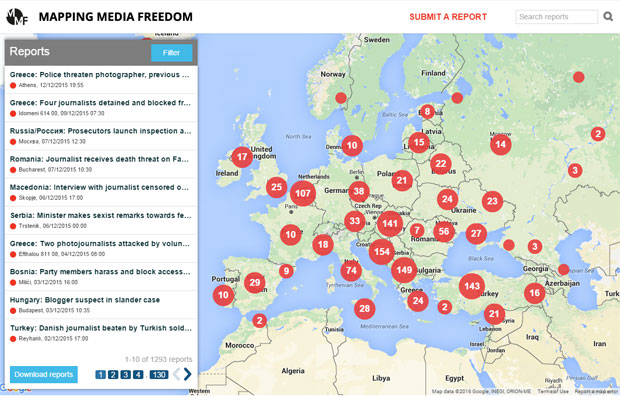
The attacks on the offices of satirical magazine Charlie Hebdo in Paris in January set the tone for conditions for media professionals in 2015. Throughout the year, Index on Censorship’s Mapping Media Freedom correspondents verified a total of 745 violations of media freedom across Europe.
From the murders of journalists in Russia, Poland and Turkey to the growing threat posed by far-right extremists in Germany and government interference in Hungary — right down to the increasingly harsh legal measures imposed on reporters right across the continent — Mapping Media Freedom exposed many difficulties media workers face in simply doing their jobs.
“Last year was a tumultuous one for press freedom; from the attacks at Charlie Hebdo to the refugee crisis-related aggressions, Index observed many threats to the media across Europe,” said Hannah Machlin, Index on Censorship’s project officer for the Mapping Media Freedom project. “To highlight the important cases and trends of the year, we’ve asked our correspondents, who have been carefully monitoring the region, to discuss one violation each that stood out to them.”
Belarus / 19 verified reports between May-Dec 2015
Journalist blocked from shooting entrance to polling station
“It demonstrates the Belarusian authorities’ attitude to media as well as ‘transparency’ of the presidential election – the most important event in the current year.” — Ольга К.-Сехович
Greece / 15 verified reports in 2015
Four journalists detained and blocked from covering refugee operation
“This is important because it is typical ‘attempt to limit press freedom’, as the Union wrote in a statement and it is not very hopeful for the future. The way refugees and migrants are treated is very sensitive and media should not be prevented from covering this issue.” — Christina Vasilaki
Hungary / 57 verified reports in 2015
Serbian camera crew beaten by border police
“These physical attacks, the harsh treatment and detention of journalists are striking because the Hungarian government usually uses ‘soft censorship’ to control media and journalists, they rarely use brute force.” — Zoltan Sipos
Italy / 72 verified reports in 2015
Italian journalists face up to eight years in prison for corruption investigation
“I chose it because this case is really serious: the journalists Emiliano Fittipaldi and Gianluigi Nuzzi are facing up to eight years in prison for publishing books on corruption in the Vatican. This case could have a chilling effect on press freedom. It is really important that journalists investigate and they must be free to do that.” — Rossella Ricchiuti
Lithuania / 9 verified reports in 2015
Journalist repeatedly harassed and pushed out of local area
“I chose it because I found it relevant to my personal experience and the fellow journalist has been the only one to have responded to my hundreds of e-mails — including requests to fellow Lithuanian journalists to share their personal experience on media freedom.” — Linas Jegelevicius
Macedonia / 27 verified reports in 2015
Journalist publicly assaults another journalist
“I have chosen this incident because it best describes the recent trend not only in Macedonia and my other three designated countries, Croatia, Bosnia and Montenegro, but also in the whole region. And that is polarization among journalists, more and more verbal and, like in this unique case, physical assaults among colleagues. It best describes the ongoing trend where journalists are not united in safeguarding public interest but are nothing more than a tool in the hands of political and financial elites. It describes the division between pro-opposition and pro-government journalists. It is a clear example of absolute deviation from the journalistic ethic.” — Ilcho Cvetanoski
Poland / 11 verified reports in 2015
Law on public service broadcasting removes independence guarantees
“The new media law, which was passed through Poland`s two-chamber parliament in the last week of December, constitutes a severe threat to pluralism of opinions in Poland, as it is aimed at streamlining public media along the lines of the PiS party that holds the overall majority. The law is currently only awaiting president Duda’s signature, who is a close PiS ally.” — Martha Otwinowski
Portugal / 9 verified reports in 2015
Two-thirds of newspaper employees will be laid off
“It’s a clear picture of the media in Portugal, which depends on investors who show no interest in a healthy, well-informed democracy, but rather in how owning a newspaper can help them achieve their goals — and when these are not met they don’t hesitate to jump boat, leaving hundreds unemployed.” — João de Almeida Dias
Russia / 37 verified reports between May-Dec 2015
Media freedom NGO recognised as foreign agent, faces closure
“The most important trend of the 2015 in Russia is the continuing pressure over the civil society. More than 100 Russian civil rights advocacy NGOs were recognized as organisations acting as foreign agents which leads to double control and reporting, to intimidation and insulting of activists, e.g., by the state-owned media. Many of them faced large fines and were forced to closure.” — Andrey Kalikh
Russia / 37 verified reports between May-Dec 2015
TV2 loses counter claim to renew broadcasting license Roskomnadzor
“It illustrates the crackdown on independent local media, which can not fight against the state officials even if they have support from the audience and professional community.” — Ekaterina Buchneva
Serbia / 41 verified reports in 2015
Investigative journalist severely beaten with metal bars
“It’s a disgrace and a flash-back to Serbia’s dark past that a journalist, who’s well known for investigating high-level corruption, get’s beaten up with metal bars late at night by ‘unknown men’.” — Mitra Nazar
Turkey / 97 verified reports in 2015
Police storm offices of Koza İpek, interrupting broadcast
“The raid on Bugün and Kanaltürk’s offices just days ahead of parliamentary elections was a drastic example — broadcasts were cut by police and around 100 journalists ended up losing their jobs over the next month — of how the current Turkish government tries to strong-arm media organisations.” — Catherine Stupp
Mapping Media Freedom
Click on the bubbles to view reports or double-click to zoom in on specific regions. The full site can be accessed at https://mappingmediafreedom.org/
|
7 Jan 2016 | Campaigns, Europe and Central Asia, France, mobile, Statements
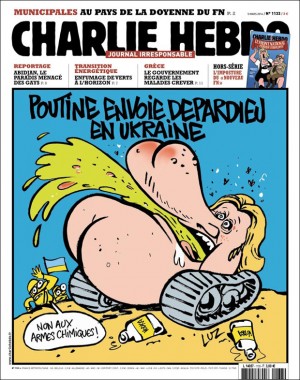
On the anniversary of the brutal attack on the offices of Charlie Hebdo we, the undersigned, reaffirm our commitment to the defence of the right to freedom of expression, even when that right is being used to express views that some may consider offensive.
The Charlie Hebdo attack, which left 11 dead and 12 wounded, was a horrific reminder of the violence to which journalists, artists and other critical voices are subjected in a global atmosphere marked by increasing intolerance of dissent. The killings inaugurated a year that has proved especially challenging for proponents of freedom of opinion.
Non-state actors perpetrated violence against their critics largely with impunity, including the brutal murders of four secular bloggers in Bangladesh by Islamist extremists, and the killing of an academic, M M Kalburgi, who wrote critically against Hindu fundamentalism in India.
Despite the turnout of world leaders on the streets of Paris in an unprecedented display of solidarity with free expression following the Charlie Hebdo murders, artists and writers faced intense repression from governments throughout the year. In Malaysia, cartoonist Zunar is facing a possible 43-year prison sentence for alleged ‘sedition’; in Iran, cartoonist Atena Fardaghani is serving a 12-year sentence for a political cartoon; and in Saudi Arabia, Palestinian poet Ashraf Fayadh was sentenced to death for the views he expressed in his poetry.
Perhaps the most far-reaching threats to freedom of expression in 2015 came from governments ostensibly motivated by security concerns. Following the attack on Charlie Hebdo, 11 interior ministers from European Union countries including France, Britain and Germany issued a statement in which they called on Internet service providers to identify and remove online content ‘that aims to incite hatred and terror.’ In July, the French Senate passed a controversial law giving sweeping new powers to the intelligence agencies to spy on citizens, which the UN Human Rights Committee categorised as “excessively broad”.
This kind of governmental response is chilling because a particularly insidious threat to our right to free expression is self-censorship. In order to fully exercise the right to freedom of expression, individuals must be able to communicate without fear of intrusion by the State. Under international law, the right to freedom of expression also protects speech that some may find shocking, offensive or disturbing. Importantly, the right to freedom of expression means that those who feel offended also have the right to challenge others through free debate and open discussion, or through peaceful protest.
On the anniversary of the Charlie Hebdo attacks, we, the undersigned, call on all Governments to:
- Uphold their international obligations to protect the rights of freedom of expression and information for all, and especially for journalists, writers, artists and human rights defenders to publish, write and speak freely;
- Promote a safe and enabling environment for those who exercise their right to freedom of expression, and ensure that journalists, artists and human rights defenders may perform their work without interference;
- Combat impunity for threats and violations aimed at journalists and others exercising their right to freedom of expression, and ensure impartial, timely and thorough investigations that bring the executors and masterminds behind such crimes to justice. Also ensure victims and their families have expedient access to appropriate remedies;
- Repeal legislation which restricts the right to legitimate freedom of expression, especially vague and overbroad national security, sedition, obscenity, blasphemy and criminal defamation laws, and other legislation used to imprison, harass and silence critical voices, including on social media and online;
- Ensure that respect for human rights is at the heart of communication surveillance policy. Laws and legal standards governing communication surveillance must therefore be updated, strengthened and brought under legislative and judicial control. Any interference can only be justified if it is clearly defined by law, pursues a legitimate aim and is strictly necessary to the aim pursued.
PEN International
ActiveWatch – Media Monitoring Agency
Adil Soz – International Foundation for Protection of Freedom of Speech
Africa Freedom of Information Centre
ARTICLE 19
Bahrain Center for Human Rights
Belarusian Association of Journalists
Brazilian Association for Investigative Journalism
Bytes for All
Cambodian Center for Human Rights
Canadian Journalists for Free Expression
Center for Independent Journalism – Romania
Center for Media Freedom and Responsibility
Comité por la Libre Expresión – C-Libre
Committee to Protect Journalists
Electronic Frontier Foundation
Foundation for Press Freedom – FLIP
Freedom Forum
Fundamedios – Andean Foundation for Media Observation and Study
Globe International Center
Independent Journalism Center – Moldova
Index on Censorship
Initiative for Freedom of Expression – Turkey
Institute for the Studies on Free Flow of Information
Instituto de Prensa y Libertad de Expresión – IPLEX
Instituto Prensa y Sociedad de Venezuela
International Federation of Journalists
International Federation of Library Associations and Institutions
International Press Institute
International Publishers Association
Journaliste en danger
Maharat Foundation
MARCH
Media, Entertainment and Arts Alliance
Media Foundation for West Africa
National Union of Somali Journalists
Observatorio Latinoamericano para la Libertad de Expresión – OLA
Pacific Islands News Association
Palestinian Center for Development and Media Freedoms – MADA
PEN American Center
PEN Canada
Reporters Without Borders
South East European Network for Professionalization of Media
Vigilance pour la Démocratie et l’État Civique
World Association of Community Radio Broadcasters – AMARC
PEN Mali
PEN Kenya
PEN Nigeria
PEN South Africa
PEN Eritrea in Exile
PEN Zambia
PEN Afrikaans
PEN Ethiopia
PEN Lebanon
Palestinian PEN
Turkish PEN
PEN Quebec
PEN Colombia
PEN Peru
PEN Bolivia
PEN San Miguel
PEN USA
English PEN
Icelandic PEN
PEN Norway
Portuguese PEN
PEN Bosnia
PEN Croatia
Danish PEN
PEN Netherlands
German PEN
Finnish PEN
Wales PEN Cymru
Slovenian PEN
PEN Suisse Romand
Flanders PEN
PEN Trieste
Russian PEN
PEN Japan
6 Jan 2016 | Mapping Media Freedom, mobile, News, Serbia
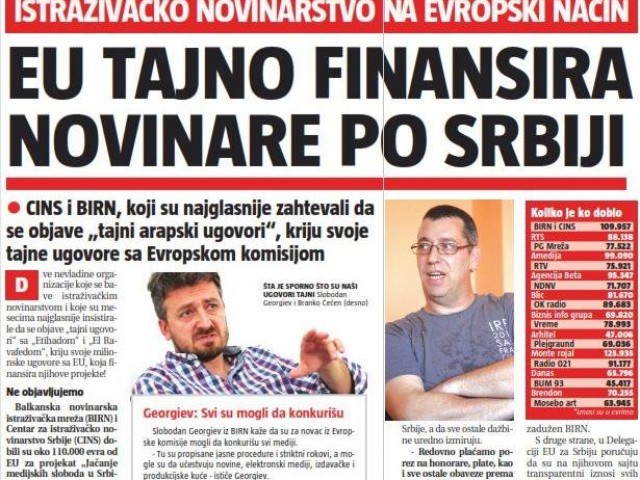
It was a Wednesday morning in early November when investigative journalist Slobodan Georgijev opened Informer, one of Serbia’s notorious tabloids. He had just arrived at his office, the newsroom of Balkan Investigative Reporting Network (BIRN), one of Serbia’s few independent media outlets. When he turned the page he was shocked by what he saw; a picture of his own face amongst two others, in an article calling three media outlets known for critical reporting of the Serbian government, including BIRN, “foreign spies”.
“It was funny and unpleasant at the same time,” Georgijev recalled, speaking to Index on Censorship. “Funny because I knew that this is just a campaign by Informer to undermine the credibility of independent journalists.” More importantly, he had begun worry about his own safety. “It’s also unpleasant because you never know how people will interpret such defamations.”
Several independent media houses — including BIRN, as well as Crime and Corruption Reporting Network (KRIK) and Center for Investigative Journalism Serbia (CINS) — have alleged that pro-government tabloids like Informer are running a smear campaign against them.
The first major incident followed the publication of a story about the cancellation of Prime Minister Aleksandar Vucic’s vacation in August 2015. Informer published an article saying that Vucic was forced to cancel his two day vacation in Serbia due to reporters from BIRN and CINS allegedly booking a room next to his.
The same newspaper also wrote that BIRN and CINS were meeting with European Union representatives on a weekly basis to plan to bring down the government.
“We are basically accused of being financed by the EU to work against our government,” Branko Cecen, director of CINS, told Index on Censorship. Cecen, like Georgiev, was also pictured and called a foreign spy in Informer. “Expressions like ‘foreign mercenaries’ and ‘joint criminal activity against their own state’ have been used.”
Informer newspaper is openly affiliated with the Serbian Progressive Party (SNS) of prime minister Aleksandar Vucic and has frequently been accused of political bias in favour of the party and the prime minister.
CINS, KRIK and BIRN have long reported on what they see as a slew of regular negative articles about themselves in tabloid newspapers with close ties to the government. There is no doubt that the three news outlets are targets because of their critical reporting on the government.
One of BIRN’s stories revealed a contract the Serbian government had signed with the national carrier of United Arab Emirates, Etihad Airways, to take over it’s state-owned counterpart Air Serbia. The deal had been financially damaging for Serbia, which was kept from the public until BIRN obtained and published the contract.
Another story investigated alleged corruption concerning a project for pumping out a flooded coal mine. BIRN found out that Serbia’s state-owned power company had awarded a contract to dewater the mine to a company who’s director is a close friend of the prime minister.
The coal mine revelations led to an angry speech about BIRN by Vucic on national television saying: “Tell those liars that they have lied again(.”
He also attacked the EU delegation in Serbia for being involved in discrediting the government by financing BIRN. “They got the money from Davenport and the EU to speak against the Serbian government,” the prime minister said, naming Michael Davenport, the head of the EU delegation in Belgrade.
BIRN’s editor-in-chief Gordana Igric told Index on Censorship she sees a resemblance to Serbia’s difficult nineties. “This reminds me of the regime of Slobodan Milosevic, a time when the prime minister also had a prominent role and critical journalists and NGOs were marked as foreign mercenaries,” she said. “What’s happening in Serbia today makes you feel sad and confused.”
Independent journalists find the path that the prime minister is taking alarming. Some compare him with the Turkey’s Recep Tayyip Erdoğan or the Russia’s Vladimir Putin. According to Cecen, the level of freedom of expression is at the lowest level since the time of strongman Milosevic. “There is an aggressive campaign against anybody and anything criticising the prime minister and his policies”, he said. “The prime minister has taken over most media in Serbia, especially national TV networks, but also local ones. His small army of social media commentators is terrorising the internet. It is quite bleak and frustrating.”
Regardless of Vucic’s verbal attacks towards the EU delegation, Serbia has opened the first two chapters in its EU membership negotiation in December 2015. This represents a big step towards eventual membership of the European Union. But the latest progress report on Serbia (November 2015) says the country needs to do much more in terms of fighting corruption, the independence of the judiciary and ensuring media freedom.
“The concern over freedom of expression is always expressed in these reports,” Cecen said. “But we see no influence of such reports since situation with media and freedom of expression is deteriorating daily.” Cecen is disappointed in the European Union’s support for independent media in Serbia and finds that EU officials show too much support for the Serbian government and the prime minister.
After he had seen his own face in the paper, Georgiev picked up the phone and called up Informer’s editor-in-chief Dragan Vučićević to ask for a better picture in the next paper. Georgiev jokes about it and clearly doesn’t let accusations and threats hold him back. “People around me are making jokes”, he said. “They call me a foreign mercenary, an enemy of the state.”
Georgiev pressed charges for defamation against Informer. “We are living in a state of constant emergency,” he continued, concerned about the state of press freedom in his country. “Serbia is not like Turkey. But it goes very fast in that direction.”
Mapping Media Freedom
Click on the bubbles to view reports or double-click to zoom in on specific regions. The full site can be accessed at https://mappingmediafreedom.org/
|
15 Dec 2015 | Europe and Central Asia, Germany, Mapping Media Freedom, mobile, News
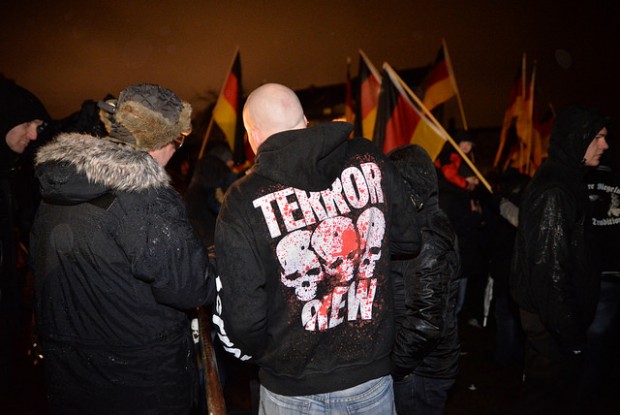
Pressure is mounting on journalists in Germany from right-wing groups that intimidate, insult and sometimes physically assault them, according to an analysis of reports filed to Index on Censorship’s project Mapping Media Freedom. In 2015 there were 29 attacks on media in Germany, 12 of those incidents were connected with the far right.
Starting in autumn 2014, the anti-immigrant, right-wing extremist group PEGIDA (Patriotic Europeans Against the Islamisation of the Occident) began as a protest movement that a year later still holds large demonstrations in cities around the country. PEGIDA, along with the populist right-wing political party Alternative für Deutschland (AfD) and similar extremist splinter groups frequently hold rallies that have become sites of aggression and violence against journalists reporting on them.
In 2014, Germany’s annual prize for Un-word of the Year for the most offensive new or recently popularised term went to “Lügenpresse” (lying press), a motto chanted at protests to smear journalists. Angry demonstrators call journalists part of a biased political elite. When journalists try to interview rally participants, they’re often turned away, yelled at or attacked.
“Index is extremely disturbed by the continuous attacks on journalists by right-wing protesters in Germany,” said Index on Censorship’s Mapping Media Freedom project officer, Hannah Machlin. “Media workers have been repeatedly assaulted and insulted in their line of work and these aggressions must be addressed by public officials in order to preserve press freedom in the country.”
Below are five recent stand-out cases of right-wing extremist intimidation of journalists.
1. “Left-wing pig” attacked
On 30 October, Helmut Schümann, a columnist for the Berlin daily newspaper Tagesspiegel, was attacked by several assailants in front of his apartment building in the city’s Charlottenburg neighbourhood. An attacker asked “Are you Schümann for Tagesspiegel?” and then called him a “left-wing pig”.
On the day before the assault, Schümann had published an article about the rise in xenophobia coming out of right-wing extremist groups, headlined: Is that still our country?
Schümann filed a complaint of physical assault and insult with Berlin police. Following the attack, he said: “I’ll keep running my column, positioning myself and won’t let myself be intimidated.”
2. PEGIDA’s anniversary celebrated true to form
At a PEGIDA rally in Dresden on 19 October, several journalists were physically attacked. The demonstration was held to mark the one-year anniversary of the protest group and attracted thousands of people.
A reporter for German international broadcaster Deutsche Welle, Jaafar Abdul Karim, was surrounded by protestors while filming with his crew. He was prevented from filming and called a racial slur before being hit in the neck. His attacker ran away.
Jose Sequeira, a cameraman for the Russian TV channel Ruptly, had his gear thrown to the ground by protesters. He was then beaten in the back and head by a group of six or seven men.
At the same protest, an employee of German public radio station Deutschlandradio was attacked by a drunk protestor and mildly injured.
3. Belittling the “lying press”
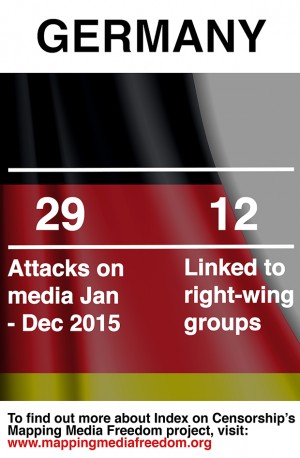
Right-wing attacks against media workers include insults, intimidation and physical attacks
On 3 September, the offices of the newspaper Bad Hersfelder Zeitung in central Germany were graffitied with disparaging comments about the paper’s coverage of asylum seekers. The graffitied comments read “stop asylum craziness”, “no Islam” and, lo and behold, “lying press”.
The newspaper had been covering conditions in reception centres for asylum seekers before the vandalism.
On 15 November, another newspaper in the small eastern German city of Glauchau was attacked by at least one man seen throwing six rocks through the Freie Presse‘s office windows.
Police did not immediately identify a right-wing motive behind the assault while they looked for suspects.
4. Physical assault on cameraman
Aggressive protesters at another large PEGIDA rally on 23 November physically assaulted a cameraman who was filming the protest with a Russian TV crew. The 43-year-old suffered non-serious injuries and was brought to a nearby hospital.
Police arrested one 28-year-old suspect in connection to the attack.
5. Reporters punched and kicked at Dresden rally
Dresden, where PEGIDA began, was host to several shameful attacks against journalists in 2015. On 28 September, one reporter from state public broadcaster Mitteldeutscher Rundfunk (MDR) was kicked and another from the newspaper Dresdner Neueste Nachrichten was punched in the face while covering a large rally organised by the extremist group.
The MDR broadcast journalist reported after the assault that he was standing with colleagues adjusting his camera when he was approached from behind by a protester. When the journalists ignored the man’s questions, several other demonstrators joined in and began attacked the reporter.
Other protesters tried to grab the camera out of the hands of the Dresdner Neueste Nachrichten reporter and then punched him in the face.
As with many of the assault cases reported from protests this year, the assailants managed to escape into the crowd before police appeared at the scene.
Mapping Media Freedom
Click on the bubbles to view reports or double-click to zoom in on specific regions. The full site can be accessed at https://mappingmediafreedom.org/
|