18 May 2015 | Digital Freedom, Draw the Line, mobile
Former NSA contractor Edward Snowden attempted to explain mass surveillance through a conversation around dick pics during an interview with John Oliver on Last Week Tonight, a satirical current affairs show aired by American network HBO.
“Even if you sent it to somebody within the United States, your wholly domestic communication between you and your wife can go from New York to London and back and get caught up in the database,” Snowden said in the interview, conducted in his temporary residence in Russia after the United States cancelled his passport for leaking details about NSA domestic spying in June 2013.
The elimination of complicated terminology in the discussion has allowed us to understand that although emails sent between Gmail accounts are encrypted and unidentifiable to outsiders as they move from Google’s data centres in the US and across the world, in reality the racy pictures embedded in these emails can actually be stored in several data centres worldwide as a way to provide backups in case one centre fails.
These encryption techniques have been around since 1991, when hacker Philip Zimmermann uploaded a free encryption program called Pretty Good Privacy – better known today as PGP – to the internet. Using a form of cryptography developed in the 1970s known as public-key cryptography, users are given a public key that can be shared which encrypts messages that are sent to them, and another one they keep private to decrypt messages they receive.
As public-key cryptography was generally reserved for military and government use prior to the release of PGP, the availability of these advanced encryption algorithms to the general public was a significant step in the realm of free expression at the time. But while web-based communication has become part of daily life, the average citizen is only beginning to grapple with the idea of mass surveillance let alone the tools associated with it.
Should individuals accept the surveillance environment, allowing – for example – government officials to obtain personal photographs shared between two consenting adults through a corporate service, as raised by Snowden?
Just months before Snowden blew the whistle, India began implementing a Centralised Monitoring System in April 2013 to monitor all phone and internet communications in the country. Following his disclosures on mass US secret surveillance programs, other governments around the world such as Brazil and Russia began debating on how to pressure companies to store user data locally. During this period, Turkey began drafting new regulations that would make it easier to get data from internet companies following the eruption of Gezi Park protests.
To what extent is it possible to escape everyday surveillance amidst these developments and how would this affect our communications? And even if technological advancement brings us newer tools providing stronger privacy protection, where should governments draw a line in monitoring what we share with friends and family?
Join the discussion on twitter with #IndexDrawTheLine
1 May 2015 | Campaigns, mobile, Statements
On World Press Freedom Day, 116 days after the attack at the office of the satirical newspaper Charlie Hebdo that left 11 dead and 12 wounded, we, the undersigned, reaffirm our commitment to defending the right to freedom of expression, even when that right is being used to express views that we and others may find difficult, or even offensive.
The Charlie Hebdo attack – a horrific reminder of the violence many journalists around the world face daily in the course of their work – provoked a series of worrying reactions across the globe.
In January, the office of the German daily Hamburger Morgenpost was firebombed following the paper’s publishing of several Charlie Hebdo images. In Turkey, journalists reported receiving death threats following their re-publishing of images taken from Charlie Hebdo. In February, a gunman apparently inspired by the attack in Paris, opened fire at a free expression event in Copenhagen; his target was a controversial Swedish cartoonist who had depicted the prophet Muhammad in his drawings.
A Turkish court blocked web pages that had carried images of Charlie Hebdo’s front cover; Russia’s communications watchdog warned six media outlets that publishing religious-themed cartoons “could be viewed as a violation of the laws on mass media and extremism”; Egypt’s president Abdel Fatah al-Sisi empowered the prime minister to ban any foreign publication deemed offensive to religion; the editor of the Kenyan newspaper The Star was summoned by the government’s media council, asked to explain his “unprofessional conduct” in publishing images of Charlie Hebdo, and his newspaper had to issue a public apology; Senegal banned Charlie Hebdo and other publications that re-printed its images; in India, Mumbai police used laws covering threats to public order and offensive content to block access to websites carrying Charlie Hebdo images. This list is far from exhaustive.
Perhaps the most long-reaching threats to freedom of expression have come from governments ostensibly motivated by security concerns. Following the attack on Charlie Hebdo, 11 interior ministers from European Union countries, including France, Britain and Germany, issued a statement in which they called on internet service providers to identify and remove online content “that aims to incite hatred and terror”. In the UK, despite the already gross intrusion of the British intelligence services into private data, Prime Minister David Cameron suggested that the country should go a step further and ban internet services that did not give the government the ability to monitor all encrypted chats and calls.
This kind of governmental response is chilling because a particularly insidious threat to our right to free expression is self-censorship. In order to fully exercise the right to freedom of expression, individuals must be able to communicate without fear of intrusion by the state. Under international law, the right to freedom of expression also protects speech that some may find shocking, offensive or disturbing. Importantly, the right to freedom of expression means that those who feel offended also have the right to challenge others through free debate and open discussion, or through peaceful protest.
On World Press Freedom Day, we, the undersigned, call on all governments to:
• Uphold their international obligations to protect the rights of freedom of expression and information for all, especially journalists, writers, artists and human rights defenders to publish, write and speak freely;
• Promote a safe and enabling environment for those who exercise their right to freedom of expression, especially for journalists, artists and human rights defenders to perform their work without interference;
• Combat impunity for threats and violations aimed at journalists and others threatened for exercising their right to freedom of expression and ensure impartial, speedy, thorough, independent and effective investigations that bring masterminds behind attacks on journalists to justice, and ensure victims and their families have speedy access to appropriate remedies;
• Repeal legislation which restricts the right to legitimate freedom of expression, especially such as vague and overbroad national security, sedition, blasphemy and criminal defamation laws and other legislation used to imprison, harass and silence journalists and others exercising free expression;
• Promote voluntary self-regulation mechanisms, completely independent of governments, for print media;
• Ensure that the respect of human rights is at the heart of communication surveillance policy. Laws and legal standards governing communication surveillance must therefore be updated, strengthened and brought under legislative and judicial control. Any interference can only be justified if it is clearly defined by law, pursues a legitimate aim and is strictly necessary to the aim pursued.
PEN International
Adil Soz – International Foundation for Protection of Freedom of Speech
Africa Freedom of Information Centre
Albanian Media Institute
Article19
Association of European Journalists
Bahrain Center for Human Rights
Belarusian PEN
Brazilian Association for Investigative Journalism
Cambodian Center for Human Rights
Canadian Journalists for Free Expression
Center for Media Freedom and Responsibility
Centre for Independent Journalism – Malaysia
Danish PEN
Derechos Digitales
Egyptian Organization for Human Rights
English PEN
Ethical Journalism Initiative
Finnish PEN
Foro de Periodismo Argentino
Fundamedios – Andean Foundation for Media Observation and Study
Globe International Center
Guardian News Media Limited
Icelandic PEN
Index on Censorship
Institute for the Studies on Free Flow of Information
International Federation of Journalists
International Press Institute
International Publishers Association
Malawi PEN
Media, Entertainment and Arts Alliance
Media Institute of Southern Africa
Media Rights Agenda
Media Watch
Mexico PEN
Norwegian PEN
Observatorio Latinoamericano para la Libertad de Expresión – OLA
Pacific Islands News Association
PEN Afrikaans
PEN American Center
PEN Catalan
PEN Lithuania
PEN Quebec
Russian PEN
San Miguel Allende PEN
PEN South Africa
Southeast Asian Press Alliance
Swedish PEN
Turkish PEN
Wales PEN Cymru
West African Journalists Association
World Press Freedom Committee
World Press Freedom Day 2015
• Media freedom in Europe needs action more than words
• Dunja Mijatović: The good fight must continue
• Mass surveillance: Journalists confront the moment of hesitation
• The women challenging Bosnia’s divided media
• World Press Freedom Day: Call to protect freedom of expression
1 May 2015 | Denmark, European Union, France, Germany, Greece, Hungary, Ireland, Italy, Macedonia, mobile, News, Poland, Spain, Turkey, Ukraine, United Kingdom
As we approach World Press Freedom Day, the right to freedom of expression will again be celebrated as an inalienable European value across the continent — by the public, the media and politicians alike. But to many, this will mean little more than engaging in a well trodden mental routine. We hardly consider the difficulties that freedom of expression faces in practice.
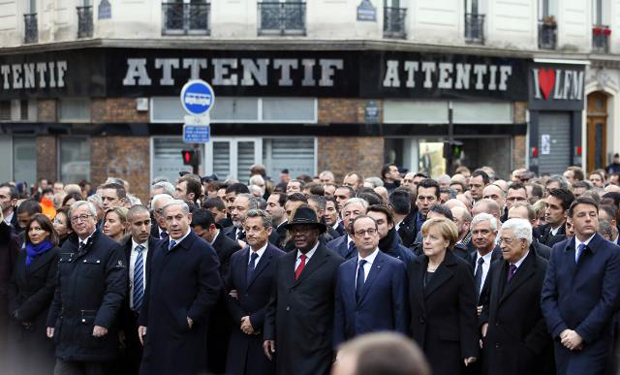
In the first part of 2015, more than a third of journalist killings in the word took place in two European countries; France and Ukraine. If it is true that Europe’s reactions to the Charlie Hebdo attack — the majority of them very emotional — were salubrious, they simultaneously gave rise to ambiguous situations. Many of the leaders that will on 3 May reaffirm their commitment free expression, supported the same message by taking part in the historic march in Paris on 11 January.
But upon seeing Angela Merkel, some were also reminded that Germany continues to treat blasphemy as a crime — as do Denmark, Spain, Poland and Greece, among others. Ireland, whose Enda Kenny was also in attendance, has a constitution which specifically mentions blasphemy and in 2010 enacted a new law against it. All these European countries defend themselves by saying that they do not apply their laws against “blasphemers”. That argument does not carry much weight when it comes to opposing those countries — Saudi Arabia, Iran, various Asian countries — that have tried to turn blasphemy into a universal crime recognised by the UN.
Spain’s Mariano Rajoy too marched in solidarity, but his government has taken steps to promote changes in the penal code that would “represent a serious threat to freedom of information, expression and the press”.
And what was Viktor Orban doing in Paris? The Hungarian president has reunified Hungary‘s public media so as to better bind them to his own party. Despite being the leader of an EU country, Orban has followed Vladimir Putin’s example. In this experimental model, the Andrei Sakharov Center and Museum is no longer ordered to close as it was in the old days, but rather fined 300,000 roubles (€5,000) for failing to register as a “foreign agent”. One day brings an announcement of compulsory registration for bloggers in Russia; another day, harassment against Russian and Hungarian NGOs perceived as “unpatriotic”.
Turkish Prime Minister Ahmet Davutohlu traveled to Paris, only to later label Charlie Hebdo’s post-attack issue a “provocation”. A reminder: Turkey is an EU candidate country where dozens of journalists have been sentenced to prison, and where various internet sites, including those that dared to reproduce some of Charlie Hebdo’s caricatures, have been blocked.
But also present at the march, were various representatives of European journalists — myself included. Just behind the Charlie Hebdo survivors, we carried a banner with the message “Nous sommes Charlie”.
Walking next to me was Franco Siddi, of the Italian National Press Federation. He talked to me about how imprisonment for defamation is still a possibility in Italy, though the European Court of Human Rights has ruled it a disproportionate punishment.
In my home country Spain too, this possibility of imprisonment remains, even if under Spanish jurisprudence freedom of expression consistently prevails over the demands of plaintiffs. In Italy, the situation is the same, yet my Italian colleagues point out that in 2014 alone, 462 journalists in the country were threatened with legal action for alleged acts of defamation. And while the current proposal for reform being considered foresees eliminating the possibility of jail time, it increases the potential fines.
This is not the only potential legal threat facing European journalists. Long before 9/11, there existed a reflexive habit of passing “urgent” laws under security pretexts, as in the UK during the most difficult years of the Northern Ireland conflict. The current model is the United States’ Patriot Act, which has recently been discussed in France. Meanwhile, in Britain and Spain are debating what free expression activists describe as “gag laws”. In Macedonia, the sentencing of the investigative journalist Tomislav Kezarovski to two years in prison under one of these security inspired laws stands out as a warning sign.
Against this worrying backdrop, across Europe journalists, freedom advocates, campaigners and even politicians are standing up for press freedom. When Gvozden Srecko Flego, member of the Parliamentary Assembly of the Council of Europe, recently highlighted the cases of Russia, Ukraine, Turkey and Azerbaijan as particularly problematic, he also suggested a countermeasure. He recommends “organising annual debates […], with the participation of journalists’ organisations and media outlets” in the respective parliaments of each state.
Media concentration, one of the most serious challenges to media pluralism and free expression in Europe, is being tackled. One proposal, which some international bodies have already accepted, would create a “Media Identity Card” requiring owners to publicly identify themselves and thus create an environment of more open and transparent media ownership.
When defending freedom of expression as a European value, we cannot allow ourselves to simply fall in into mental routines. This World Press Freedom Day we need both words and actions.
Paco Audije is a member of the Steering Committee of the European Federation of Journalists (EFJ)
World Press Freedom Day 2015
• Media freedom in Europe needs action more than words
• Dunja Mijatović: The good fight must continue
• Mass surveillance: Journalists confront the moment of hesitation
• The women challenging Bosnia’s divided media
• World Press Freedom Day: Call to protect freedom of expression
This column was posted on 1 May 2015 at indexoncensorship.org