Senior lieutenant Alexey Kozlov, responsible for educational work at Butyrka pre-trial prison in Moscow, has virtually lost his job after having publically criticised the penitentiary system. He has appealed to rights activists and journalists whistleblowing on prisoners’ rights abuse.
Butyrka pre-trial prison (the accused are kept there at the time of criminal proceedings) became notorious when Hermitage Capital lawyer Sergey Magnitsky died after spending almost half a year there in conditions rights activists later called torturous. Kozlov came to Butyrka soon after Magnitsky died and eyewitnessed violations which, in his perspective, could lead to similar tragedies. Alexey Kozlov told Index about his concerns and consequences of his whistleblowing.
– Why have you decided to work in the Russian penitentiary system and particularly Butyrka prison?
– I wanted to become a general one day; I found it romantic. I’ve been in the system for eight years: I worked in Moscow pre-trial prison Medvedkovo and in the convoy department. In February 2010 I came to work in Butyrka. I’ve been doing my job in line with the law and did everything to enhance its prestige.
– What made you criticise the system you worked in?
– I’ve been a witness of double standards towards prisoners. Some get everything, some are unfairly oppressed. Here’s how it works. Prison staff are supposed to convoy inmates to working places – prison premises repairs, for example. Normally they don’t do this because the prison is simply out of staff. Prisoners are unofficially told to go to their working places on their own, having to unlock the doors with handmade passkeys. If they follow the rules and don’t go alone, they may get punishment for not arriving to their working place. If they do go, they may get punishments for going alone. A prisoner is put in a position when he can have penalties imposed on him either way. This triggers corruption.
I’ve also never seen a prisoner who spent a day in court be brought to shower, although this is staff duty.
And I am concerned about medical care in prisons. One of the inmates, HIV-positive, told me he hasn’t received proper medical care for three months. He ended up having high fever and pneumonia. Only then was he delivered to hospital. I’ve also seen that when a prisoner gets sick and acute care arrives, they in the prison for an unjustified long time before taking the prisoner out to the hospital.
All these violations have been evident to the prison’s superiors, but no one seems to do anything about them.
– What are the consequences of your allegations?
– Before talking to rights activist Vladimir Osechkin I talked to my bosses about violations I saw and heard of from prisoners. First they told me to mind my own business. Then they subjected me to full examination — that is undressed me — in front of the prisoners. After I made the violations public, they called on extraordinary meeting to criticise me. The Moscow Department of the Russian Correction Service, together with Moscow Prosecutor’s Office said they investigated the facts I made public and didn’t find any confirmations. As far as I know they were uninterested and haven’t checked properly. According to my sources the head of the prison has signed papers to fire me. Actually I have already lost my job as my superiors told me I was no longer in charge of educational work and had to guard the entrance to Butyrka.
– Weren’t you going to quit yourself or do you still think the system can be improved from within?
– My bosses in Butyrka told me I shouldn’t have brought facts “to the outside”. But long before that I was taught to tell the truth, which I did. I am ready to repeat them in court if needed. it is not impossible to improve the system from within, one should just stay honest. And if they fire me, I’ll most probably become a human rights activist fighting not just for prisoners, but for honest prison workers. They do exist and they support me.
Index on Censorship’s Mike Harris joined a panel debate at the OSCE parallel conference on adopting a joint resolution on Belarus, giving consideration to the country’s suspension from the OSCE, which will now go to the Council of Ministers.
Media freedom is not one of those areas where too many cooks spoil the broth. The debate about freedom of expression – of which the role of the press is an important sub-section — has gone mainstream over the past couple of years. Around the world, free expression has crashed against issues of privacy, confidentiality, sensibility, and a panoply of other concerns. The black and white cases of egregious censorship, involving violence, intimidation and abuse of law, remain as pressing as ever.
Now thanks to social media, and the availability of instant information, free expression has become more complicated and varied. In the UK, the ongoing phone hacking scandal has focused attention on poor journalistic standards.
Therefore the arrival of a new organisation devoted to assisting and promoting “good” journalism is welcomed. The Journalism Foundation, led by former Independent Editor Simon Kelner and funded by the Lebedevs — owners of that newspaper and others including Russia’s Novaya Gazeta — intends to sponsor and assist media, starting in Tunisia and the English Midlands. It is an eclectic first stab, but only the beginning. Its most valuable contribution will be “hands on” support for those wishing to hold the rich and powerful to account. The boundaries between “established” and “citizen” journalism are breaking down, and initiatives such as this help to hasten that process.
Through our reporting and our advocacy, Index on Censorship leads the way in promoting free expression and combating censorship in all its manifestations. We welcome a new partner in this brave and not-so-new world.
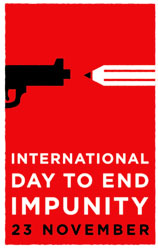
To mark the inaugural International Day to End Impunity on 23 November, join Index in demanding justice for journalists’ murdered in the line of duty
Freedom of Expression Organisations Call for Justice on International Day to End Impunity
London, November 23, 2011
Today Index on Censorship, Article 19, the Committee to Protect Journalists and English PEN join dozens of freedom of expression organisations around the world to mark the inaugural International Day to End Impunity.
In the past 10 years, more than 500 journalists have been killed. In nine out of 10 cases, the murderers have gone free. Many others targeted for exercising their right to freedom of expression — artists, writers, musicians, activists — join their ranks.
On this day two years ago the single deadliest event for the media took place when 30 journalists and two support workers were brutally killed in Ampatuan, Maguindanao province, The Philippines. The journalists were part of a convoy accompanying supporters of a local politician filing candidacy papers for provincial governor. In total the “Maguindanao Massacre” as it has come to be known, claimed 58 victims. Not one of more than a hundred individuals suspected of involvement in the atrocity has been convicted yet.
We join those in the Philippines not only in honouring their slain colleagues, friends and family members, but demanding justice for them and hundreds more in Russia, Belarus, Pakistan, Sri Lanka, Mexico, Colombia, Iraq and Somalia and other countries where killings of journalists and free expression activists have repeatedly gone unpunished. Above all we demand an end to the cycle violence and impunity.
This year alone at least 17 journalists were murdered for their work. These include Pakistani journalist Saleem Shahzad, whose body was found May 31 showing signs of torture. They include Mexican journalist and social media activist Maria Elizabeth Macías Castro Macías, whose killers left a computer keyboard and a note with the journalist’s body saying she had been killed for writing on social media websites. These heinous acts not only silence the messenger, but are intended to intimidate all others from bringing news and sharing critical voices with the public.
We call on governments around the world to investigate and prosecute these crimes and bring an end to impunity.
Article 19 English PEN
Committee to Protect Journalists Index on Censorship
23 November marks the anniversary of the 2009 Ampatuan massacre, in which 34 journalists were murdered in an election-related killing in the Philippines, making it the single deadliest incident for journalists in recent history.