23 Sep 2015 | Magazine, mobile, Volume 44.03 Autumn 2015
Today the bulk of the media in the Balkans has “been bought by people with no history in, or understanding of, the media business; they promote narrow interests of their owners or new political elites; sometimes without even pretence of objectivity,” said Kemal Kurspahic, former editor of Oslobodjenje, an independent newspaper published during the Bosnian war, reflecting on the development of media freedom over the past 25 years.
While in the 1990s nationalism was the order of the day, today a whole host of challenges – including murky media ownership – face independent journalists across the region. The Balkan Investigative Journalism Network in Serbia, for instance, has documented the campaign against them from authorities and pro-government press on a dedicated website, BIRN Under Fire. Television journalist Jet Xharra and BIRN Kosovo took the government to court over the right to report on the prime minister’s accounts, and to set a legal precedent for press freedom in the state. But Xharra, country director of BIRN in Kosovo, said there is a sense of disbelief among those who had to report during war, that these kinds of battles still need to be fought.
“We cannot understand why, 20 years later, you have to deal with [such] a strain on your reporting,” said Xharra.
During the war years that tore Yugoslavia apart, press freedom, like pretty much every other aspect of society, experienced a profound crisis. Large swathes of the media in the former republics became propaganda tools for ruling elites, even before the fighting started. In fact, concerted media campaigns of hate and fear-mongering played an important part in priming people who had lived side by side for decades for war. As British historian Mark Thompson put it in his 1999 book Forging War, on the media’s role in the conflicts in Bosnia, Croatia and Serbia: “War is the continuation of television news by other means.”
|
Dangers of reporting in the Balkins
Attacks on journalists and journalism in the Balkans, compiled from Index’s Mapping Media Freedom project
SERBIA
Independent online news outlet Peščcanik has been targeted on several occasions after reporting in June 2014 that a senior minister had plagiarised parts of his doctoral dissertation. The site has faced distributed denial-of-service (DDoS) attacks, and hackers have altered text and blocked IP addresses, thus preventing readers from accessing content.
MONTENEGRO
In May 2015, after reporting on corruption in local government, journalist Milovan Novovic’s car was vandalised. In June, journalist Alma Ljuca’s car was attacked in a similar way. This comes after a car belonging to the daily Vijesti was torched in early 2014.
BOSNIA
In December 2014, police raided the Sarajevo offices of news site Klix.ba, looking for a recording in which the prime minister of the country’s Republika Srpska entity spoke about “buying off” politicians. This came after the site’s director and a journalist were interrogated and asked to reveal their source for the recording, which they refused to do.
CROATIA
In May 2015, journalist and blogger Željko Peratović was attacked by three men outside his home, and hospitalised with head injuries. Peratović is known for his investigative reporting, and has covered the trial of two agents of the former Yugoslav Security Agency.
MACEDONIA
Deputy Prime Minister for Economic Affairs Vladimir Peshevski was filmed physically assaulting Sashe Ivanovski, a journalist and owner of the news site Maktel, who has been critical of the government.
SLOVENIA
In March 2015 photojournalist Jani Bozic received a suspended prison sentence for publishing a photo of Alenka Bratusek, then prime minster elect, which showed him receiving a congratulatory text message from a prominent businessman 20 minutes before results were announced.
KOSOVO
Express journalist Visar Duriqi, who has covered radical Islamists in Kosovo, has received a number of death threats, including threats of beheading.
Index on Censorship’s Mapping Media Freedom project launched as in 2014 to record threats to media freedom throughout the European Union and EU candidate countries. It has recently expanded to cover Russia and Ukraine. |
Yet during the Balkan wars beginning in the 1990s there were local journalists who, in the face of enormous pressure, rejected nationalist and propagandist lines, and attempted to sift truth from lies and distortion. Beyond the daily struggle that came with just existing in a war zone, independent journalism was dangerous work. As Human Rights Watch points out in a new report on the state of media freedom in the Balkans, journalists who were, at the time, “critical of official government positions were often labelled as traitors or spies working on behalf of foreign interests and against the state”.
Serbia’s B92, a rare dissenting voice in a media landscape shaped by President Slobodan Milosevic’s propaganda strategy, is perhaps the most famous example of independent journalism. Set up in 1989 as a youth-focused radio station (later branching out into TV and web platforms), B92 bravely covered a turbulent time – from the war in Bosnia, to the Nato bombing of Serbia, to the protest movement that eventually saw Milošević ousted. For this, it was continuously hounded by the government. At one point in 1999 authorities commandeered its offices and radio frequency, forcing the station off air, before it could resume broadcasting from a different studio and frequency, under the name B2-92.
In Croatia, President Franjo Tudjman also made sure ultra-nationalism had a place in column inches and on airwaves. Feral Tribune, which started out in 1983 as a satirical supplement in the newspaper Slobodna Dalmacija, had other ideas. Under sustained pressure from the authorities, it covered stories of human rights and conflict that many other outlets avoided, in addition to its biting satire. It was taken to court, publicly burned, and one journalist was even drafted into the army after Feral published an edited photo of Tudjman and Milosevic in bed together on the front page.
Bosnia was the country in the region that would be by far the hardest hit by fighting. But even as war came to Sarajevo, independent journalism survived in some small way. Oslobodjenje, which started out as an anti-Nazi paper in 1943, had a track record of editorial independence. In 1988, staff for the first time voted for their own editor – Kemal Kurspahic – instead of accepting one appointed by the authorities. Just three years later they fought for their freedom again, this time in the constitutional court, as the newly elected nationalist parties agreed to adopt a law whereby they could appoint the editors and managers of Bosnian media. In 1992 came their toughest challenge yet. With the two towers of their office building under fire – in one night they lost six floors on one side and four on the other – they decided to go underground, and continue their work from a nuclear bomb shelter, with no newsprint supplies and no phone links.
“If dozens of foreign journalists could come to report on the siege of Sarajevo and Bosnian war, how could we – whose families, city and country were under attack – stop doing our job?” Kurspahic, now managing editor of Connection Newspapers, told Index. They felt an obligation to their readers: “We could not leave them without news at the worst time of their lives.”
Oslobodjenje even celebrated its 50th anniversary during the war, with 82 papers around the world printing some of their stories. With that they achieved “the ultimate victory”, Kurspahic said, “if the aim of the terror against Oslobodjenje was to silence us as a voice of multiethnic Bosnia”.
“People were getting killed, so we were reporting it. The risk was physical at that time to journalists,” Xharra told Index. Today she hosts Kosovo’s most watched current affairs programme, as well as fulfilling her role at BIRN Kosovo. But she cut her reporting teeth as a translator, fixer and field producer for UK broadcasters – the BBC and Channel 4 – during the Kosovo war. She recalled going through frontlines for a story, and hiding tapes from paramilitary checkpoints, painting a vivid picture of a time when practicing journalism in the western Balkans meant near constant risk of physical harm.
Journalists could be caught in crossfire, or targeted specifically for their work. Kurspahic remembers the Oslobodjenje reporter Kjasif Smajlovic in Zvornik, who sent his wife and children away, and stayed to report on the fall of the town until he was killed by Serbian paramilitary forces in April 1992. In 1999, Slavko Curuvija, known for his critical reporting, was shot 17 times in a Belgrade side street, just days after a pro-government daily had labelled him a Nato supporter. In many cases, there has been little to no accountability for such crimes, breeding a culture of impunity that still hangs over the region.
Because while the darkest days for press freedom in the Balkans came during wartime, peace has not brought the improved conditions many hoped for. At a talk in March, Dunja Mijatovic, the OSCE’s free expression representative, went as far as to say that the situation now is worse than in the aftermath of the conflicts.
And today the media itself remains part of the problem, especially when journalists turn on their colleagues. One prominent example is the story of BIRN Serbia. Following their critical investigation into a state-owned power company, Prime Minister Aleksandar Vucic labelled the group liars who had been funded by the EU to speak against his government. That attack was then taken forward by the pro-government Serbian press, including in the newspaper Informer. Just one example where the media has been a less than staunch defender of its own rights.
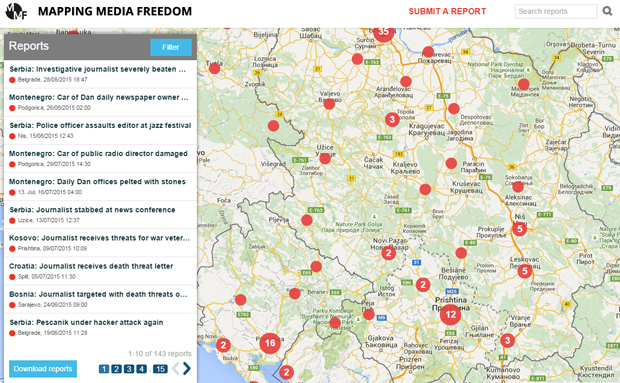
Data from Index’s Mapping Media Freedom project, which tracks media freedom across Europe, indicates that worries of threats to media rights are justified. In just over a year it has received more than 170 reports of violations from the countries of the former Yugoslavia. Incidents included a Croatian journalist who received a letter saying she would “end up like Curuvija”; a Bosnian journalist threatened over Facebook by a local politician; Kosovan journalists depicted as animals on several billboards; a Montenegrin daily that had a company car torched; a Macedonian editor who had a funeral wreath sent to his home; and a Slovenian who faced charges for reporting on the intelligence agency. Online and offline, physical and verbal, serious threats to press freedom remain, some 20 years on.
© Milana Knezevic
This article is part of the autumn issue of Index on Censorship magazine looking at comparisons between old censors and new censors. Copies can be purchased from Amazon, in some bookshops and online, more information here.
18 Sep 2015 | Bosnia, Croatia, Macedonia, Mapping Media Freedom, mobile, Montenegro, News, Serbia
“Media has a significant role in the theatre of the absurd,” a participant in a conference on the security and protection of journalists in western Balkan countries claimed.
Media workers and representatives from journalists’ associations in Croatia, Bosnia and Herzegovina, Serbia and Montenegro joined representatives of international organisations in Sarajevo in June 2015 to debate key issues facing the media in the region: attacks on journalists, impunity, the effectiveness of the legal system and institutional mechanisms to create a safe environment to work in.
Conference participants said media freedom is deteriorating and assigned responsibility for the decline on governments in the region, local media ownership and, especially, international institutions and organisations.
Goran Miletic, programme director for the western Balkans at Civil Rights Defenders, an NGO working in the area, said that in 2004 some of the international organisations decided to withdraw funding from local media to focus on other projects. Miletic said that reduced level of funding for media was a lost opportunity to prevent human rights abuses and further democratise the region.
International funding is vital to professionalising the media, which cannot rely on local government support. “If we analyse research on what people think of human rights defenders or journalists, they are often characterised as spies, foreign mercenaries, or enemies of the state,” said Miletic.
A lack of media plurality and news illiteracy were identified as concerns that have had a detrimental effect on the advancement of press freedom and professionalism in the region.
“Media freedom is once again one of the key challenges for the region,” said Andy McGuffie, head of the communication office of the Delegation of the European Union to Bosnia and Herzegovina and a European Union Special Representative.
Presidents of journalists’ associations focused on attacks on journalists and the effectiveness of the legal system and institutional components. Addressing the current situation in Croatia, Zdenko Duka, then president of the Croatian Journalists’ Association, underlined that “fortunately, [in recent months], there have not been too many physical assaults. Comparing assaults and threats against journalists to other countries in the region, the situation in Croatia is better.”
Croatia has a checkered history on media freedom. During the 1990s journalists were widely targeted and were under surveillance by the secret service. In the 2000s, the journalist Ivo Pukanic, was assassinated in a bomb attack at his Zagreb office. Though a court convicted six men for the murder, the person who ordered the crime has not been brought to justice.
Duka emphasised two 2014 physical assaults: an incident in Rijeka in which football club officials attacked a journalist and a photographer and the brutal attack on journalist Domagoj Margetic who was assaulted by several people near his home in Zagreb. Margetic sustained head injuries as a result of the attack, for which he received medical treatment.
Sanja Mikleusevic-Pavic, a journalist from Zagreb, agreed with Duka. “Croatia is in a much better situation than other countries,” she said. Key reasons for this include the Trade Union and the Journalists’ Association, which are very well organised and powerful, but most of all, the key role played by the public broadcaster HRT. “HRT is a strong, independent and professional public broadcaster,” said Mikleusevic-Pavic.
From her point of view, the main threat to independence and professionalism are pressures from tycoons and politicians, which, in her experience, are significant. The case of Croatian TV broadcaster RTL, which was found guilty of slander for airing a live show during which Croatian Prime Minister Zoran Milanovic accused Zagreb Mayor Milan Bandic of corruption, sets a negative precedent, particularly because another TV station that aired the same statement was not charged. As punishment, RTL has been ordered to pay 6,500 euros to the mayor.
Croatia’s new criminal code presents another obstacle to media freedom. It includes Article 148, introduced in 2013, which establishes an offence of “humiliation”, “shaming” or “vilification”. Osservatorio Balcani e Caucaso said the article would allow judges to sentence a journalist if the information published is not considered being in the public interest and “for the court, it is of little importance that the information is correct – it is enough for the principal to state that he felt humbled by the publication of the news.”
In April 2014, Jutarnji List journalist Slavica Lukic became the first Croatian journalist to be prosecuted under the article. She was found guilty of vilification. Lukic reported that a company had economic problems despite the substantial public funding it received. The company stated it felt “humiliated” and the judge fined her 4,000 Euros.
Dunja Mijatovic, OSCE Representative on Freedom of the Media, said in a letter to the Croatian officials that the current legal definitions of “insult” and “shaming” are “vague, open to individual interpretation and, thus, prone to arbitrary application.”
Duka said that there are more than 40 criminal insult cases pending against journalists in the country and this is clear evidence that “truth can be punishable.” Furthermore, he believes judges are not well prepared for defamation, slander and libel cases. Defamation in Croatia has not been decriminalised as it has been in Montenegro, Serbia and Bosnia and Herzegovina.
“The situation in Serbia is alarming. As long as there is a brutal assault on journalists, we cannot talk about freedom of speech and media freedom,” Vukasin Obradovic, president of the Independent Journalists’ Association of Serbia (NUNS), said in a speech at the conference.
From 2008 to 2014, Serbia has seen a total of 365 physical and verbal assaults, intimidation and attacks on the property of media professionals. Since May 2014 alone, Index’s European Union-funded Mapping Media Freedom project has received over 48 reports of violations against Serbian media, including attacks to property, intimidation and physical violence.
In his talk, Obradovic described several incidents to illustrate the media situation in Serbia. On 14 April 2007 a bomb exploded outside the apartment of journalist Dejan Anastasijevic. No one was injured. In a statement to international media, Anastasijevic said: “It was just before 3 am on Saturday when a hand grenade went off outside the bedroom window of my Belgrade apartment, filling the room with smoke and shards of glass, leaving shrapnel holes on the ceiling and walls — some only inches above the bed. Despite the damage, we were lucky: When the police arrived, they found a second unexploded grenade on the sidewalk nearby.”
Anastasijevic was targeted because of his investigative reporting on crimes in the former Yugoslavia and criminal syndicates in Serbia, local media reported. The most recent attack followed Anastasijevic’s criticism of a lenient verdict for members of Serb paramilitaries called “Scorpions,” journalists associations said. The case has still not been resolved.
Obradovic emphasised that attacks on journalists in Belgrade often get more attention than violations that take place outside the capital.
Vladimir Mitric, a journalist from the town of Loznica, has been under police protection since October 2005 after being subjected to a brutal assault. He was attacked as he entered his apartment and struck with a blunt instrument from behind several times. He ended up with a broken hand and was very badly bruised all over his body. He is disabled as a result of that attack.
“I live under police protection that I was granted by court, not police, at my request, which is important,” said Mitric in an interview with SEEMO. A former police officer was identified as the attacker and was sentenced to six months in jail by the Loznica Basic Court. The Belgrade Court of Appeal later doubled the sentence.
However, a few months after the trial, Tomislav Nikolic, the president of Serbia, granted amnesty to the attacker and the remainder of his sentence was vacated. Threats against Mitric continue despite 24-hour police protection. Human Rights Watch reported: “The person making the threats was accompanied by a police officer who had been responsible for Mitric’s protection. The person making the threats was charged with minor offences in September, but at this writing the police officer had not been disciplined.”
Sladjana Novosel, a journalist from Novi Pazar, was targeted three times between September 2010 and March 2013. Novosel was subjected to verbal attacks, shaming and bullying. Police have, so far, failed to pursue investigations of these threats.
In another incident, Davor Pasalic, the editor-in-chief of FoNet, was attacked twice early in the morning of 3 July 2014 as he made his way home from his office. The two attacks left him with cuts and bruises, and four of his teeth were broken or knocked out. After seven months of investigation and zero progress, Pasalic sarcastically said that his case is “no big deal.” But he added that the assault has had no impact on his work.
Obradovic finished his talk by saying that “the impunity and recklessness of institutions obviously encourage attacks.”
Branislava Opranovic, member of the executive board of the Independent Journalists’ Association of Vojvodina (NDNV), focused on economic issues and ownership transparency in the media. She described the lack of ownership transparency in the media, sharing her personal experience. “I have been working for the daily Dnevnik for years and years, but still don’t know who the owner of the newspaper is.” She also mentioned other cases, including one where a man in his twenties wanted to buy nine media outlets in Vojvodina, or the episode where her coworkers were waiting patiently in a line to collect bonuses of 5 Euros despite having not received their salaries.
Though Bosnia and Herzegovina was the first country from the region to decriminalise defamation, in 1999, the situation is no better than in Serbia. Borka Rudic, Secretary General of the BH Journalists Association, said: “The raid of the Klix.ba offices in late December 2014 just proves this conclusion.”
In that incident, police entered and searched Klix.ba’s Sarajevo offices for a recording of a phone call in which the Republika Srpska Prime Minister Željka Cvijanović talks about “buying off” politicians. Local media reported that police were copying material from the newsroom’s computers. The police also seized computers, documents, notes and other items from the offices, according to media reports.
Despite positive developments in the law over the past 15 years, the situation has shown little improvement, as institutions are failing to properly implement new legislation, meaning protection on journalists is weak. Between 2006 and 2014, there have been approximately 400 registered cases of media rights violations, including 40 physical assaults and 17 death threats.
Bosnian journalists use a name and shame strategy, in which the identity of every person who threatens or attacks a journalist is publicised. Rudic said that the most serious incident was the attack of Professor Slavo Kukic, a prominent writer and columnist, who was severely beaten with a baseball bat in his office at the University of Mostar, on 23 June 2014.
Marko, a journalist present at the event, shared his and a colleague’s personal experiences. While working for a public broadcaster they were both victims of constant harassment by one of their deputy editors, receiving no support from senior editors or directors. This resulted in them both being admitted to a psychiatric hospital for mental health issues.
Montenegrin TV host and journalist, Darko Ivanovic, told how one of his country’s prominent politicians stated: “it is customary law to hit journalists,” when asked why he slapped a journalist.
Over the last few years Ivanovic has had his car vandalised on a number of occasions, though only one incident resulted in the arrest of a suspect, who admitted the vandalism. However, when interviewed by Ivanovic, the suspect admitted that the police gave him 5 Euros so he confessed to the crime. “There is always someone found guilty, but usually they’re not the real perpetrators. And this puts into the question the effectiveness of the system,” Ivanovic said.
Marijana Camovic, President of the Trade Union of Media of Montenegro, said at the conference “the mindset of local politicians is that for them it is impossible that a journalist could be impartial and professional.”
Tabloids in Montenegro are used for smear campaigns. Civil rights activist Vanja Calovic became the victim of just such a campaign by Informer, a daily newspaper. The tabloid’s mid-June attack against the head of the MANS NGO began with the release of a video recording that, according to the paper, proved that Calovic was “an animal abuser” and alleged that she had sexual relations with her dogs.
The NGO Human Rights Action (HRA) highlighted the perilous state of journalism in its report, “Prosecution of Attacks on Journalists in Montenegro”. The HRA outlined 30 cases of threats, violence and assassinations of journalists as well as attacks on media property between May 2004 and January 2014. “Most of these attacks have not been clarified to date. In most cases certain patterns can be observed, for example: victims are the media or individuals willing to criticise the government or organised crime,” the report said.
One-third of all incidents happened in the the last year, which to the HRA shows the atmosphere of impunity is escalating. “Such an atmosphere of impunity threatens journalists in particular, who are often victims of unresolved attacks. If the state treats these attacks passively, it becomes responsible for the suppression of freedom of speech, the rule of law and democracy.”
The assassination of Editor-in-chief of the Daily Dan, Dusko Jovanovic, who was killed in a drive-by shooting on the evening of 27 May 2004, has not been solved nine years later. Damir Mandic, the only defendant in the recent trial, claims he is innocent and accused the police of planting evidence, Balkan Insight reported. Mandic said he was in prison for 10 years although he was innocent, and his human rights had been violated. He remains the only perpetrator to be convicted.
Seven years after the brutal attack that nearly took the life of journalist Tufik Softic, Montenegrin police detained two men suspected of involvement in his attempted murder. For media unions and observers, the detentions were long overdue, but emblematic of the atmosphere of impunity in Montenegro. In November 2007, Softic was brutally beaten in front of his home by two hooded assailants wielding baseball bats. Then in August 2013, an explosive device was thrown into the yard of his family home. The journalist has been provided with constant police security since February 2014.
Besides this atmosphere of impunity that threatens journalists, Camovic spoke of other phenomena. Approximately 80 per cent of all active media workers in Montenegro are not members of any journalist’s association. When asked why they’re not active in the organisations, they had no answer.
In summing up the situation, Ivanovic said that states and political parties deliberately tolerate grey or criminal activities of media owners so they can control them easily.
Mapping Media Freedom
Click on the bubbles to view reports or double-click to zoom in on specific regions. The full site can be accessed at https://mappingmediafreedom.org/
|
17 Sep 2015 | Campaigns, Mapping Media Freedom, mobile, News
Ukrainian President Petro Poroshenko signed a decree on Wednesday 16 September banning at least 38 international journalists and bloggers from Ukraine for one year. The decree, published on the presidential website, says those listed are banned for being “actual or potential threat to national interests, national security, sovereignty and territorial integrity of Ukraine.”
Poroshenko said the people targeted were involved in Russia’s 2014 annexation of Crimea and the current aggression in eastern Ukraine.
“This ban is a serious blow to media freedom,” Index senior advocacy officer Melody Patry said. “There is no explanation whatsoever on what press coverage constitutes an actual or potential threat to national security. We appreciate that the situation in eastern Ukraine is sensitive but preventing journalists from reporting from within the country is not the solution and it’s undermining freedom of information.”
The Committee to Protect Journalists reports that the 34 journalists and seven bloggers named in the ban come from Bulgaria, Estonia, Germany, Hungary, Israel, Kazakhstan, Latvia, Macedonia, Moldova, Poland, Russia, Serbia, Slovakia, Spain, Switzerland and the United Kingdom.
The original list included three BBC media staff members – Moscow correspondent Steve Rosenberg, producer Emma Wells and cameraman Anton Chicherov – who were later removed from the ban list, media reported.
“We cannot accept that kind of censorship”, said Mogens Blicher Bjerregård, president of the European Federation of Journalists. Censorship is never the right answer, even to counter propaganda or to sanction journalists who allegedly crossed the Russian-Ukrainian border illegally. The ban is simply inappropriate. Peace and Development of our democracies need press freedom not banning journalists. We and the international society must firmly urge the Ukraine government to lift immediately the ban on named journalists.”
Over 380 people in total have been banned, including activists and Russian officials.
This measure was added to the Mapping Media Freedom platform, which monitors and map threats and violations to media freedom in Europe, including Ukraine and Russia.
The environment for media freedom in Ukraine has been deteriorating against the backdrop of the conflict in the eastern part of the country, making it one the the deadliest countries for journalists, with at least eight media workers killed since the beginning of 2014.
This statement was updated to reflect the later removal of three BBC journalists from the ban list.
Mapping Media Freedom
Click on the bubbles to view reports or double-click to zoom in on specific regions. The full site can be accessed at https://mappingmediafreedom.org/
|
27 Jul 2015 | Campaigns, mobile, Morocco, Statements
To Your Majesty Mohammed VI,
At a time when Morocco is advocating openness, democratisation and full respect for human rights as instruments for confronting the future, we receive the news of the hunger strike begun by the journalist Ali Lmrabet. For this reason, we wish to pass on to you our deep concern for the situation of this journalist, who has received dozens of international awards and who is deprived of his national identity documents coinciding with the end of a 10-year ban on exercising the profession of journalist in Morocco and also with his announcement that he wishes to return to professional activity.
Freedom of expression and criticism are fundamental elements for the consolidation of a democratic state that is active against regression and intolerance. Any attempt to restrict freedom of expression degrades the image of Morocco and the credibility of its commitment to the rule of law.
Precisely because, from here, we wish to lend our full support to any effort to transform Morocco developed at different levels of the political world and civil society in the country, we are writing to you to express our serious concern at the current situation of Ali Lmrabet, whose life is in danger.
For all these reasons, we would ask you to reflect on this to give instructions to the administration in your country, and its diplomatic staff in Switzerland in particular, to renew all Ali Lmrabet’s Moroccan citizenship documents.
Without a residence certificate, passport and other documents related to journalistic work, Ali Lmrabet would become the first Moroccan deprived of his civil and political rights.
We do not need to give you, Your Majesty, lessons in the fact that the deprivation of these rights is contrary to all liberties, including fundamental freedoms, freedom of expression and, in the case of Ali, the internationally recognised and acclaimed right to freely exercise the profession of journalist. The only thing we would ask you, Your Majesty, in your capacity as Head of State, is to strictly apply the provisions of the Moroccan Constitution, giving the right to all citizens to fully and freely exercise their profession, in this case as journalist and editor of publications in Morocco.
We look forward to your considered response.
Yours sincerely,
Letter signed by the following:
Míriam Acebillo Baqué, President of Lafede.cat, Organisations for Global Justice
Mariano Aguirre, Director of Norwegian Peacebuilding Resource Centre (Norway)
Cinta Arasa, Coordinator of the Persecuted Writers Committee
Carmen Arenas, President of Catalan PEN
Homero Aridjis, Emeritus President of International PEN
Jordi Armadans, Director of FundiPau (Peace Foundation)
Sion Assidon, former Secretary General of Transparency-Morocco
Margaret Atwood, Vice-President of Canada International PEN, Prince of Asturias Award
Danielle Auroi, MP of the National Assembly of France
Juan Tomás Ávila Laurel, Writer, HM Award International Odón Betanzos Palacios of the New York Circle of Ibero-American writers and poets (Equatorial Guinea)
Malén Aznárez, President of Reporters without Borders (RSF- Spanish section)
Elisabeth Badinter, Philosopher
Ekbal Baraka, Chair of PEN International Women Writers Committee, former president of Egyptian PEN
Isaías Barreñada Bajo, University Professor and Human Rights activist
Ana Barrero Tiscar, Peace Culture Foundation
Mark Barwick, Policy Adviser at Human Rights Without Frontiers International (Switzerland)
David Bassa i Cabanas, Journalist, president of the Barnils Group of Journalists
Lluís Bassets, Deputy director of El Pais (Spain)
Anouar Bassi, Transparency 25 President (Tunisia)
Abdejelil Bedoui, Economist and member of the FTDES Steering committee
Sélim Ben Abdesselem, Former member of the Tunisian National Constituent Assembly
Abdelkader Benali, Writer and journalist, Libris Prize (Netherlands)
Thijs Berman, Former Dutch MP of the European Parliament
Mylène Botbol–Baum, Writer, University professor of philosophy and bioethics
Marian Botsford Fraser, Writer and journalist, Chair of Writers in Prison Committee, PEN International Canada
Jean-Marcel Bouguereau, Journalist Le Nouvel Observateur and former chief editor of Libération
Sfia Bouarfa, Belgian honorary MP and former senator
Jim Boumelha, President of the International Federation of Journalists (IFJ)
François Burgat, Political scientist, Research Director of CNRS
Teresa Cadete, Portuguese writer, board member of PEN International
Lindsay Callaghan, President of PEN South Africa
Maria Cañadas, President of Catalonia Amnesty International (AIC)
Gemma Calvet, MP of Parliament of Catalonia (Spain)
Carles Campuzano, MP of Congreso de los Diputados (Spain)
Marius Carol, Editor of La Vanguardia
Ignacio Cembrero, Journalist, former correspondent of El País in Maghreb
Nadia Chaabane, Former deputy of Tunisian National Constituent Assembly
Alain Chabod, International Consultant, former journalist of France Television
Luc Chartrand, Journalist, Radio-Canada
Larbi Chouikha, University professor; Institut de Presse et des Sciences de l’Information (IPSI) (Tunisia)
John Maxwell Coetzee, Writer, Nobel Prize in Literature 2003, Vicepresident of PEN International
Robert Coover, Writer, William Faulkner Foundation Award, American Academy of Arts and Letters, and National Endowment of the Arts (USA)
Olivier Corten, Professor; Centre of international law of ULB; Brussels
Joan Coscubiela, Deputy of Congreso de los Diputados (Spain)
Olivier Da Lage, Journalist, Vice-president of IFJ, RFI and SNJ
Luc Dardenne, Filmmaker
Eric David, Emeritus professor of International Law; Chairman of The International Law Centre of the ULB
Ascensión de las Heras, MP of Congreso de los Diputados (Spain)
Antonio Della Rocca, President of the Trieste PEN Center, Member of the Board of PEN International (Italy)
Christophe Deloire, Secretary General of Reporters Without Borders
Nicolas Dot Pouillard, Resercher of MAEE
Christos Doulkeridis, President of ECOLO group in the Parliament of the Wallonie-Bruxelles Federation (Belgium)
André du Bus, Deputy of Wallonie-Bruxelles Federation
Josy Dubié, Honorary senator (Belgium), former journalist and ONU official
François Dubuisson, Professor, International Law Centre of ULB (Brussels)
Patrick Dupriez, Co-chair of Ecolo party
Isabelle Durant, Brussels MP (Belgium)
Mohamed El Battiui, President of the Amazigh World Assembly
Najat El Hamchi, Writer, Ramon Llull Prize
Ahmed El Khannous, MP, Brussels Parliament
Mahmoud El May, MP and Member of the National Constituent Assembly (Tunisia)
Isabelle Emmery, Brussels Member of Parliament
Mathias Enard, Writer, Gouncourt Prize 2012
Charles Enderlin, Journalist, former France2 correspondent in Israel
Moris Farhi, MBE Vice-President, PEN International
Halim Feddal, Secretary General of the National Association for the Fights against corruption (Algeria)
Soledad Gallego-Díaz, Journalist of El País
Vicent Garcés, Former Member of the European Parliament
María Caridad García Álvarez, MP of Congreso de los Diputados (Spain)
Lise Garon, Professor, Laval University
Zoé Genot, Ecolo MP, Brussels Regional Parliament
François Gèze, President and chief editor of Éditions La Découverte (France)
Jodie Ginsberg, Chief Executive Officer of Index on Censorship
Henri Goldman, Editor of Politique, revue de débats and MICmag (Belgium)
Eric Goldstein, human rights activist (United States)
Elsa González, FAPE President (Spanish Press Associations Federation)
Juan Goytisolo, Writer, National Prize of Spanish Letters and Miguel de Cervantes Prize
Rafael Grasa Hernández, President of Institut Català Internacional per a la Pau
Ricardo Gutiérrez, Secretary general of European Federation of Journalists (EFJ)
Maher Hanin, Member of steering committee of FTDES
Abderrahmane Hedhili, President of Tunisian Forum for Economic and Social Rights (FTDES)
Seymour M. Hersh, American journalist
Francis Hickel, Coordinator Pâquis Solidarity Space, Geneva
Jesús Iglesias Fernández, Senator (Spain)
Jon Iñárritu García, MP of Congreso de los Diputados (Spain)
Véronique Jamoulle, MP, Brussels Parliament
Jean-Jacques Jespers, University Professor, Université libre de Bruxelles
Oriol Junqueres i Vies, Chairman of the party “Esquerra Republicana de Catalunya” (ERC) and opposition leader in Parliament of Catalonia
Lucina Kathmann, Writer, Vice-president of PEN International (United States)
Salam Kawakibi, Arab Reform Initiative, president of the Initiative for a New Syria
Melek Kefif, Doctor and member of the Steering committee of FTDES
Charefeddine Kellil, Lawyer for the families of martyrs and wounded (Tunisia)
Zakia Khattabi, Co-chair of Ecolo Party (Green Belgian)
Kamel Labidi, Tunisian journalist, former director of Amnesty International in Tunisia and former president of the National Authority to Reform Information and Communication (INRIC)
Luis Las Heras, Editor (Spain)
Gilwon Lee, Poète, Poet, Sang-Byeong Cheon Prize and Dong-Ju Yoon Literary Prize, Board Member, PEN International South Korea
Joanne Leedom-Ackerman, vice-president of PEN International (USA)
Jean-Claude Lefort, Former MP at the French Parliament
Emmanuel Lemieux, Essayist, and investigation journalist (France)
Stefano Liberti, journalist and writer, Luchetta Award to the best journalist and Anello Debole Prize
Jonathan Littell, Writer, Goncourt Award and Grand Prix du Roman of the French Academy
Robert Littell, Writer and journalist, Los Angeles Times Book Prize (USA)
Juan López de Uralde, Executive Commission Equo party, former Greenpeace-Spain Director
Bernabé López García, Professor, former member of Averroes Committee Spain-Morocco
Mehdi Mabrouk, Former Culture Minister (Tunisia)
Noël Mamère, MP of the National Assembly and Mayor of Bègles (France)
Sherif Mansour, MENA Program Coordinator, Committee to Protect Journalists (CPJ)
Christophe Marchand, Lawyer, Brussels (Belgium)
Jean-Paul Marthoz, journalist, correspondent of the Committe to Protect Journalists (CPJ) in the European Union
Sandrine Martins Espinoza, Lawyer and international consultant for elections (Argentine)
Daniel Patrick Maunier, University Professor, New York University
Fernando Maura Barandarián, Spanish MP, European Parliament
Federico Mayor Zaragoza, President of Foundation for a culture of peace, former Director of UNESCO
Daniel Menschaert, Diplomatic, Honorary Officer of the Federation Wallonia-Brussels in Morocco
Manuela Mesa Peinado, CEIPAZ Director, Peace Culture Foundation
Rosa Montero, Writer and journalist, Grinzane Cavour award and National Journalism Award (Spain)
Quim Monzó, Writer, National Literature award (Catalonia)
Alexandre Niyungeko, President of the Burundi Journalists Union (UBJ)
Elisabeth Nordgren, Chair of the Search Committee, PEN International (Finland)
Vida Ognjenovic, Vicepresident, PEN International (Serbia)
Margie Orford, Board Member, PEN International (South Africa)
Mario Orrù, Observer Coordinator at Democracy International
Bechir Ouarda, Journalist, Former Coordinator of the civil coalition in defence of freedom of expression in Tunisia
Rémy Pagani, Administrative Councillor for the city of Geneva
Andrés Perelló, Former Member of the European Parliament, Spain
Rosana Pérez Fernández, MP of the Congreso de los Diputados (Spain)
Tone Peršak, Chair of Writers for Peace Committee, Pen International (Slovenia)
Thomas Pierret, University professor, University of Edinburgh
John Ralston Saul, Writer, president of PEN International
Pedro J. Ramírez, Editor of El Español, former editor of El Mundo
Raul Rivero, Cuban writer, UNESCO / Guillermo Cano Press Freedom Prize
Raül Romeva Rueda, Former Spanish MP, European Parliament
Jean Louis Roumegas, MP of the French Parliament
Elena Ruiz Ruiz, University professor (Spain)
Hélène Ryckmans, Member of the Walloon Parliament and the Parliament of the Federation Wallonia-Brussels, Senator
Messaoud Romdhani, Member of the Executive Committee of the Euro-Mediterranean Network of Human Rights (EMHRN), and vice president of the Tunisian League of Human Rights (LTDH)
Amor Safraoui, Chairman of the Independent National Coordination for Transitional Justice (Tunisia)
Mohamed Salah Kherigi, Trade unionist, Vice-president of the Tunisian League of Human Rights (LTDH)
Raffaella Salierno, General Secretary of PEN Català, Director of the GuestWriter programme
Victoria Salvy, Artist and writer (France)
Gervasio Sánchez Fernández, Journalist, National Photography Award, and Ortega y Gasset Journalism Award (Spain)
Mhamed Seghier, Journalist of Liberté (Algeria)
Màrius Serra, Writer, Ramon Llul and Sant Jordi Awards (Catalonia)
Amira Aleya Sghaier, Tunisian historian and university professor
Mohamed Sheriff, President of PEN Sierra Leona
Ricardo Sixto Iglesias, MP at Congreso de los Diputados (Spain)
Simona Skrabec, Chair of Translation and Linguistic Rights Committee, PEN International
Mohamed Smaïn, Activist in charge of human rights, Algerian League for the Defence of Human Rights (LADDH)
Carles Solà, Journalist, TV3 program Director (Catalonia, Spain)
Carlo Sommaruga, Lawyer, MP of the Swiss parliament
Karima Souid, Former MP of the Tunisians from abroad, member of National Constituent Assembly of Tunisis
Simone Susskind, MP of Brussels – Capital Region
Abdellah Taïa, Moroccan Writer, Flore Award
Alaa Talbi, President of Alternatives, Tunisian Section
Joan Tardà, MP of Congreso de los Diputados (Spain)
Sami Tlili, Tunisian Filmmaker, Cinema and Human Rights Award of Amnesty International and Best documentary of the Arab world Award
Jarkko Tontti, Treasurer of PEN International (Finland)
Manuel Tornare, Swiss MP, former Mayor of Geneva
Carles Torner, Executive Director of PEN International
Estefania Torres, Spanish MP of the European Parliament
Mathew Tree, Writer, Octubre – Andròmina Award
Jane Unrue, Director of the Harvard Scholars at Risk (SAR) Program and Freedom to Write Committee board for PEN, New England (United States)
Miguel Urban, Spanish MP of the European Parliament)
Dominique Vidal, Journalist
Santiago Vidal i Marsal, Judge of Provincial Audience Chamber of Barcelona, Judges for Democracy
Per Wästberg, Writer, President of Nobel Committee for Literature, former President of PEN International
Lawrence Weschler, écrivain, George Polk et Lannan Literary Award (United States)