15 Jul 2019 | Magazine, News, Volume 48.02 Summer 2019
[vc_row][vc_column][vc_custom_heading text=”Index editor Rachael Jolley argues in the summer 2019 issue of Index on Censorship magazine that it is vital to defend the distance between a nation’s leaders and its judges and lawyers, but this gap being narrowed around the world” google_fonts=”font_family:Libre%20Baskerville%3Aregular%2Citalic%2C700|font_style:400%20italic%3A400%3Aitalic”][vc_column_text]
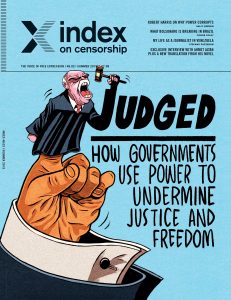 It all started with a conversation I had with a couple of journalists working in tough countries. We were talking about what kind of protection they still had, despite laws that could be used to crack down on their kind of journalism – journalism that is critical of governments.
They said: “When the independence of the justice system is gone then that is it. It’s all over.”
And they felt that while there were still lawyers prepared to stand with them to defend cases, and judges who were not in the pay of – or bowed by – government pressure, there was still hope. Belief in the rule of law, and its wire-like strength, really mattered.
These are people who keep on writing tough stories that could get them in trouble with the people in power when all around them are telling them it might be safer if they were to shut up.
This sliver of optimism means a great deal to journalists, activists, opposition politicians and artists who work in countries where the climate is very strongly in favour of silence. It means they feel like someone else is still there for them.
I started talking to journalists, writers and activists in other places around the world, and I realised that although many of them hadn’t articulated this thought, when I mentioned it they said: “Yes, yes, that’s right. That makes a real difference to us.”
So why – and how – do we defend the system of legal independence and make more people aware of its value? It’s not something you hear being discussed in the local bar or café, after all.
Right now, we need to make a wider public argument about why we all need to stand up for the right to an independent justice system.
[/vc_column_text][vc_row_inner][vc_column_inner width=”1/4″][vc_icon icon_fontawesome=”fa fa-quote-left” color=”custom” size=”xl” align=”right” custom_color=”#dd3333″][/vc_column_inner][vc_column_inner width=”3/4″][vc_custom_heading text=”On an ordinary day, most of us are not in court or fighting a legal action, so it is only when we do, or we know someone who is, that we might realise that something important has been eroded” font_container=”tag:h3|text_align:left” google_fonts=”font_family:Libre%20Baskerville%3Aregular%2Citalic%2C700|font_style:400%20italic%3A400%3Aitalic”][/vc_column_inner][/vc_row_inner][vc_column_text]
We need to do it because it is at the heart of any free country, protecting our freedom to speak, think, debate, paint, draw and put on plays that produce unexpected and challenging thoughts. The wider public is not thinking “hey, yes, I worry that the courts are run down, and that criminal lawyers are in short supply”, or “If I took a case to trial and won my case I can no longer claim my lawyer’s fees back from the court”. On an ordinary day, most of us are not in court or fighting a legal action, so it is only when we are, or when we know someone who is, that we might realise that something important has been eroded.
Our rights are slowly, piece by piece, being undermined when our ability to access courts is severely limited, when judges feel too close to presidents or prime ministers, and when lawyers get locked up for taking a case that a national government would rather was not heard.
All those things are happening in parts of the world right now.
In China, hundreds of lawyers are in prison; in England and Wales since 2014 it has become more risky financially for most ordinary people to take a case to court as those who win a case no longer have their court fees paid automatically; and in Brazil the new president, Jair Bolsonaro, has just appointed a judge who was very much part of his election campaign to a newly invented super-ministerial role.
Helpfully, there are some factors that are deeply embedded in many countries’ legal histories and cultures that make it more difficult for authoritarian leaders to close the necessary space between the government and the justice system.
Many people who go into law, particularly human-rights law, do so with a vision of helping those who are fighting the system and have few powerful friends. Others hate being pressurised. And in many countries there are elements of the legal system that give sustenance to those who defend the independence of the judiciary as a vital principle.
Nelson Mandela’s lawyer, Sir Sydney Kentridge QC, has made the point that judges recruited from an independent bar would never entirely lose their independence, even when the system pressurised them to do so.
He pointed out that South African lawyers who had defended black men accused of murder in front of all-white juries during the apartheid period were not easily going to lose their commitment to stand up against the powerful.
Sir Sydney did, however, also argue that “in the absence of an entrenched bill of rights, the judiciary is a poor bulwark against a determined and immoderate government” in a lecture printed in Free Country, a book of his speeches.
So it turned out that this was the right time to think about a special report on this theme of the value of independent justice, because in lots of countries this independence is under bombardment.
It’s not that judges and lawyers haven’t always come under pressure. In his book The Rule of Law, Lord Bingham, a former lord chief justice of England and Wales, mentions a relevant historical example. When Earl Warren, the US chief justice, was sitting on the now famous Brown v Board of Education case in 1954, he was invited to dinner with President Dwight Eisenhower. Eisenhower sat next to him at dinner and the lawyer for the segregationists sat on his other side. According to Warren, the president went to great lengths to promote the case for the segregationists, and to say what a great man their lawyer was. Despite this, Warren went on to give the important judgement in favour of Brown that meant that racial segregation in public schools became illegal.
Those in power have always tried to influence judges to lean the way they would prefer, but they should not have weapons to punish those who don’t do so.
In China, hundreds of lawyers who stood up to defend human-rights cases have been charged with the crime of “subverting state power” and imprisoned. When the wife of one of the lawyers calls on others to support her husband, her cries go largely unheard because people are worried about the consequences.
This, as Karoline Kan writes on p23, is a country where the Chinese Communist Party has control of the executive, judicial and legislative branches of government, and where calls for political reform, or separation of powers, can be seen as threats to stability.
As we go to press we are close to the 30th anniversary of the Tiananmen Square killings, when thousands of protesters all over China, from all kinds of backgrounds, had felt passionately that their country was ready for change – for democracy, transparency and separation of powers.
Unfortunately, that tide was turned back by China’s government in 1989, and today we are, once more, seeing China’s government tightening restrictions even further against those who dare to criticise them.
Last year, the Hungarian parliament passed a law allowing the creation of administrative courts to take cases involving taxation and election out of the main legal system (see p34). Critics saw this as eroding the gap between the executive and the justice system. But then, at the end of May 2019, there was a U-turn, and it was announced that the courts were no longer going ahead. It is believed that Fidesz, the governing party in Hungary, was under pressure from its grouping in the European Parliament, the European People’s Party.
If it were kicked out of the EPP, Hungary would have in all likelihood lost significant funding, and it is believed there was also pressure from the European Parliament to protect the rule of law in its member states.
But while this was seen as a victory by some, others warned things could always reverse quickly.
Overall the world is fortunate to have many lawyers who feel strongly about freedom of expression, and the independence of any justice system.
Barrister Jonathan Price, of Doughty Street Chambers, in London, is part of the team advising the family of murdered journalist Daphne Caruana Galizia over a case against the Maltese government for its failure to hold an independent inquiry into her death.
He explained why the work of his colleagues was particularly important, saying: “The law can be complex and expensive, and unfortunately the laws of defamation, privacy and data protection have become so complex that they are more or less inoperable in the hands of the untrained.”
Specialist lawyers who were willing to take on cases had become a necessary part of the rule of law, he said – a view shared by human-rights barrister David Mitchell, of Ely Place Chambers, in London.
“The rule of law levels the playing field between the powerful and [the] powerless,” he said. “It’s important that lawyers work to preserve this level.”
Finally, another thought from Sir Sydney that is pertinent to how the journalists I mentioned at the beginning of this article keep going against the odds: “It is not necessary to hope in order to work, and it is not necessary to succeed in order to hope in order to work, and it is not necessary to succeed in order to persevere.”
But, of course, it helps if you can do all three.
[/vc_column_text][/vc_column][/vc_row][vc_row][vc_column][vc_column_text]
Rachael Jolley is editor of Index on Censorship. She tweets @londoninsider. This article is part of the latest edition of Index on Censorship magazine, with its special report on local news
Index on Censorship’s spring 2019 issue is entitled Is this all the local news? What happens if local journalism no longer holds power to account?
Look out for the new edition in bookshops, and don’t miss our Index on Censorship podcast, with special guests, on Soundcloud.
[/vc_column_text][/vc_column][/vc_row][vc_row][vc_column width=”1/3″][vc_custom_heading text=”How governments use power to undermine justice and freedom” font_container=”tag:h3|text_align:left” link=”url:https%3A%2F%2Fwww.indexoncensorship.org%2F2019%2F06%2Fmagazine-judged-how-governments-use-power-to-undermine-justice-and-freedom%2F|||”][vc_column_text]The summer 2019 Index on Censorship magazine looks at the narrowing gap between a nation’s leader and its judges and lawyers.[/vc_column_text][/vc_column][vc_column width=”1/3″][vc_row_inner][vc_column_inner][vc_single_image image=”107686″ img_size=”full” onclick=”custom_link” link=”https://www.indexoncensorship.org/2019/06/magazine-judged-how-governments-use-power-to-undermine-justice-and-freedom/”][/vc_column_inner][/vc_row_inner][/vc_column][vc_column width=”1/3″][vc_custom_heading text=”Subscribe” font_container=”tag:h3|text_align:left”][vc_row_inner][vc_column_inner][vc_column_text]In print, online. In your mailbox, on your iPad.
Subscription options from £18 or just £1.49 in the App Store for a digital issue.
Every subscriber helps support Index on Censorship’s projects around the world.
 SUBSCRIBE NOW[/vc_column_text][/vc_column_inner][/vc_row_inner][/vc_column][/vc_row]
5 Jul 2019 | News, Volume 48.02 Summer 2019 Extras
[vc_row][vc_column][vc_column_text]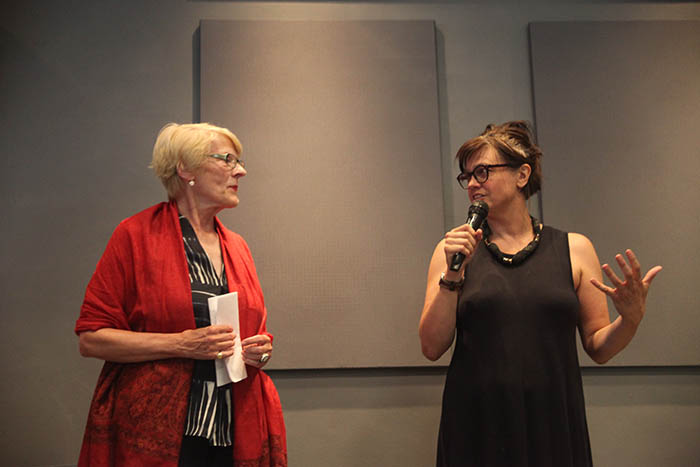
“What is said and what is written is unbelievably important,” said Trevor Phillips, chairman of the board of Index on Censorship, at the close of the recent launch party for the Summer 2019 edition of Index Magazine.
The summer 2019 edition, Judged: How Governments Use Power to Undermine Justice and Freedom, looks at attempts to undermine freedom of expression through attacks on the judiciary. The magazine covers issues ranging from new laws in Venezuela intended to limit freedom of the press to instances of self-censorship due to government control of content-sharing platforms in China to new technology created by journalists to check back against threats from politicians regarding the coverage of recent elections in South Africa.
Rachael Jolley, editor of Index magazine, explained that the idea behind the theme came from conversations she had with journalists in Italy covering areas with limited press freedom and hostile environments for journalists. She said, “one of the things that [the journalists] said kept them going was that there were still lawyers who were willing to stand up with them and defend them when they were attacked, when they had libel suits against them, when all the things that happen to them mean that they end up having to stand before a judge.”
This inspired Jolley to curate the latest edition of the magazine around legal issues, to address the legal fight for free speech behind the work of journalists to liberate the media under repressive regimes.
The keynote speaker of the evening was German writer Regula Venske, whose article What Does Weimar Mean to us 100 Years On? was published in the issue. Venske spoke about the history and ultimate downfall of the Weimar Republic, which is now known for fraught democracy and the promotion of freedom of expression, though Venske spoke about how attempts to preserve free speech in the republic were often complicated or insufficient. She walked the audience through some of the influential writing and art produced before the republic’s fall to Nazism.
To conclude, Venske quoted Weimar-era author and poet Erich Kästner: “You cannot fight the avalanche once it has developed into an avalanche, you have to crush the snowball.”
Venske added: “I think that is quite a good saying for the times we are now living in, though unfortunately, he did not leave a recipe for how one could prevent this. I think we need to keep on working for it.”
Phillips, the last speaker of the evening, lamented the state of media freedom in the multiple countries where right-wing leaders have recently come to power. He mentioned specifically the rise of Viktor Orbán in Hungary and Jair Bolsonaro in Brazil, two countries covered in the summer issue. “My time at Index has been marked not by the incredible march of progress but actually a reminder, pretty much every week, why what this organisation does is so important,” he said.
He applied Kästner’s quote to the work Index on Censorship continues to do around the globe. Like Kästner, he explained, Index works to warn the people before the snowballs represented by the arrest of a journalist or the censorship of an artwork become an avalanche of fascism.
“The avalanche starts long before you hear it,” Phillips concluded. “A large part of what we do is give the avalanche warning.”
[/vc_column_text][/vc_column][/vc_row][vc_row][vc_column width=”1/3″][vc_custom_heading text=”Subscribe”][vc_column_text]In print, online, in your mailbox, on your iPad.
Subscription options from £18 or just £1.49 in the App Store for a digital issue.
Every subscriber helps support Index on Censorship’s projects around the world.
SUBSCRIBE NOW[/vc_column_text][/vc_column][vc_column width=”1/3″][vc_single_image image=”107175″ img_size=”medium”][/vc_column][vc_column width=”1/3″][vc_custom_heading text=”Listen”][vc_column_text]The summer 2019 magazine podcast, featuring interviews with best-selling author Xinran; Italian journalist and contributor to the latest issue, Stefano Pozzebon; and Steve Levitsky, the author of the New York Times best-seller How Democracies Die.
LISTEN HERE[/vc_column_text][/vc_column][/vc_row]
1 Jul 2019 | Awards, Fellowship 2020, News, Press Releases
[vc_row][vc_column][vc_row_inner][vc_column_inner width=”1/2″][vc_single_image image=”107432″ img_size=”full”][/vc_column_inner][vc_column_inner width=”1/2″][vc_column_text]
- Awards Fellowship honours journalists, campaigners, digital activists and artists fighting censorship globally
- Fellows receive a year-long package of assistance
- Nominate at indexoncensorship.org/nominations
- Public nominations are open from 1 July to 31 July 2019
- #IndexAwards2020
[/vc_column_text][/vc_column_inner][/vc_row_inner][vc_column_text]This press release is also available in Arabic, Chinese, Portuguese, Russian, Spanish[/vc_column_text][vc_column_text]Nominations for the Index on Censorship Freedom of Expression Awards Fellowship are open. Now in their 20th year, the Awards honour some of the world’s most remarkable free expression heroes.
2020 will mark 20 years of the Freedom of Expression Awards, with 87 winners awarded over the years. Since 2015, Index has expanded the Awards programme to include the Awards Fellowship, supporting and championing 22 fellows in their work defending freedom of expression internationally.
The Awards Fellowship seeks to support activists at all levels and spans the world. Past winners include Honduran investigative journalist Wendy Funes, Syrian cartoonist Ali Farzat, Pakistani education campaigner Malala Yousafzai, Saudi investigative journalist Safa Al Ahmad and South African LGBTI photographer Zanele Muholi.
Index invites the general public, civil society organisations, non-profit groups and media organisations to nominate anyone (individuals or organisations) who they believe should be celebrated and supported in their work tackling censorship worldwide.
We are offering four fellowships, one in each of the following categories:
- Arts for artists and arts producers whose work challenges repression, injustice and celebrates artistic free expression. This could include visual artists, musicians, cartoonists, creative writers, whether solo or collectives.
- Campaigning for activists and campaigners who have had a marked impact in fighting censorship and promoting free expression on the ground. This could include individuals or organisations.
- Digital Activism for ground-breaking technology that circumvents censorship enabling the free and independent exchange of information. This could include new apps, digital tools or software.
- Journalism for courageous and determined journalism that exposes censorship, threats to free expression and demands access to information. This could include bloggers, news outlets and investigative nonprofits.
All winners become Awards Fellows who receive 12 months of mentorship, networking and strategic support. The year commences with a week-long, all-expenses-paid residential in London (April 2020) with workshops, training and public events. Over the course of the year, Index works with the fellows to significantly enhance the impact, profile and sustainability of their work.
Jodie Ginsberg, CEO of Index, said: “The Freedom of Expression Awards have showcased some of the world’s most fearless and unsung defenders of free expression for 20 years. We’ve sought to recognise the work of groups and individuals who have enhanced freedom of expression, often in the face of immense obstacles and great danger. In recent years, we’ve expanded the Awards programme to include fellowships that help winners amplify their efforts through targeted support and training. Use your voice by nominating a free expression champion to make sure their voice is heard.”
The 2020 Awards shortlist will be announced in early 2020. The fellows will be selected by a high profile panel of judges and announced in London at a ceremony in April 2020. Nominations will be open from 1 July 2019 to 5pm BST 31 July 2019.
The Freedom of Expression Awards were launched in 2001 to raise the profile of individuals and organisations that were defending freedom of expression globally.
For more information on the Awards and Fellowship, please contact Sean Gallagher, [email protected].
About the Freedom of Expression Awards Fellowship
2020 will mark 20 years of the Freedom of Expression Awards, with 87 winners honoured over the years. Since 2015, Index has expanded the Awards programme to include the Awards Fellowship, supporting and championing 22 fellows in their work defending freedom of expression internationally. Winners of the 2020 Awards Fellowship will receive 12 months of mentorship, networking and strategic support. More information
About Index on Censorship
Index on Censorship is a London-based non-profit organisation that publishes work by censored writers and artists and campaigns against censorship worldwide. Since its founding in 1972, Index on Censorship has published some of the greatest names in literature in its award-winning quarterly magazine, including Samuel Beckett, Nadine Gordimer, Mario Vargas Llosa, Arthur Miller and Kurt Vonnegut. It also has published some of the world’s best campaigning writers from Vaclav Havel to Elif Shafak.[/vc_column_text][vc_row_inner][vc_column_inner][vc_column_text]This press release is also available in Arabic, Chinese, Portuguese, Russian, Spanish[/vc_column_text][/vc_column_inner][/vc_row_inner][vc_basic_grid post_type=”post” max_items=”4″ element_width=”6″ grid_id=”vc_gid:1561623587103-71ce28d9-6c09-8″ taxonomies=”5692″][/vc_column][/vc_row]
19 Jun 2019 | Press Releases
Judged: How governments use power to undermine justice and freedom. The summer 2019 edition of Index on Censorship magazine
In a world when journalists are operating in increasingly harsh and difficult conditions, and are hit by lawsuits to stop them doing that, they need lawyers independent enough to stand up with them in court. This is an issue that the latest edition of Index on Censorship magazine looks at in detail.
“While at a conference, I spoke to journalists under extreme pressure. They told me: ‘When the independence of the justice system is gone then that is it. It’s all over.” We need to make a wider public argument about the importance of the judiciary. It’s something we should all be talking about in the local cafe. The average citizen needs to be vigilant to make sure the line between those making the laws and those sitting in judgement is not blurred. Our fundamental rights depend on it,” Rachael Jolley, editor of Index on Censorship, said.
In the latest magazine we look at a global phenomena where powerful governments are trying to unpick the independence of legal systems, to bring them under more direct influence, and the implications for global freedom of expression and freedom of the media.
With contributions from Kaya Genc in Turkey; Stephen Woodman on the Mexican government’s promises to rebuild the pillars of democracy and what hasn’t happen; Jan Fox on Donald Trump’s trampling of democratic norms; Karoline Kan on China’s retaliation against lawyers who argue for human rights, Caroline Muscat on independent news in Malta, Melanio Escobar and Stefano Pozzeban on Venezuela’s abuse of judicial power, Viktoria Serdult on how the Hungarian prime minister is pressurising independence in all its forms, Silvia Nortes on the power of the Catholic church in increasingly secular Spain.
In China, hundreds of human rights lawyers are in prison; in England and Wales, it has become more of a financial risk for ordinary people to go to court; in Brazil, the new president has appointed a judge who was very much part of the election campaign to a super-ministerial role. In Turkey, the Erdogan government is challenging the opposition candidate’s win in Istanbul’s mayoral elections. Hungary’s Orban has been set out plans to introduce new types of courts under the nose of the EU (although there appears to have been a U-turn).
We have an exclusive interview with imprisoned author and journalist Ahmet Altan, who was accused of inserting subliminal messages in support of the attempted July 2016 coup into a television broadcast and was sentenced to life in prison, told us: “I came out against the unlawful practices of both the era of military tutelage and that of the AKP [the ruling Justice and Development Party]: I believe I am a target of their anger.” The issue also includes the first English translation of an extract from his 2005 novel The Longest Night.
“Ahmet’s case is a perfect illustration of what can happen when the rule of law and courts are aligned with the political will of an increasingly authoritarian government,” Jolley commented.
About Index on Censorship Magazine
Since its establishment in 1972, Index on Censorship magazine has published some of the greatest names in literature including Samuel Beckett, Nadine Gordimer, Mario Vargas Llosa, Hilary Mantel and Kurt Vonnegut. It also has published some of the greatest campaigning writers of our age from Vaclav Havel to Amartya Sen and Ariel Dorfman plus journalism from Mexico, Argentina, South Africa, China, India, Turkey and more. Editor Rachael Jolley was named British Society of Editors’ editor of the year in the specialist publication category (2016) and the magazine has received numerous awards including the APEX Award for Excellence and the Hermann Kesten prize.
With each new issue of the magazine, an archival issue will become available for students, researchers and supporters of free expression. The four latest issues of the magazine are available for purchase in print or digital formats via SAGE Publishing, bookshops and Exact Editions.
Subscription information
Annual digital subscription (four issues) £18
A complete digital replica of the magazine
Annual print subscription (four issues) £35
Four high-quality print editions delivered to your door
Available at these bookshops
BFI, Serpentine Gallery and MagCulture (London), News from Nowhere (Liverpool), Home (Manchester) and Red Lion Books (Colchester).
Apps
- iPad/iPhone £1.49 (USD $2.90) per issue
- Buy one or more issues. Download the preview app (21 pages of latest issue for free), free upgrade the preview app to a 30-day subscription.
- Android tablets/phones
- Download the Exactly app from the Google Play store. A one-year subscription is £17.99 | $17.99
- Kindle Fire
- Download the Exactly app from Amazon. A one-year subscription is £17.99 | $17.99
