16 Sep 2014 | Magazine, Volume 43.03 Autumn 2014
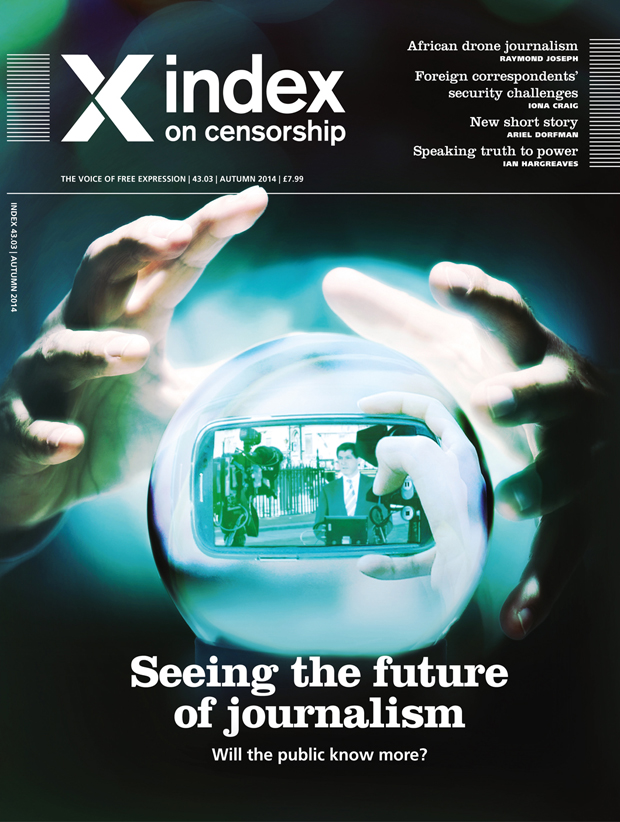
Index on Censorship autumn magazine
In the autumn issue of Index on Censorship magazine, don’t miss: Burmese-born author Wendy Law-Yone on the challenges the Burma’s media face in the run-up to the next election; TV journalist Samira Ahmed on how television channels should respond to viewers’ complaints; award-winning foreign correspondent Iona Craig reports from Yemen on threats to journalism in conflict zones; plus a brand new short story from playwright and author Ariel Dorfman.
While debates on the future of the media tend to focus solely on new technology and downward financial pressures, we ask: will the public end up knowing more or less? Will citizen journalists bring us in-depth investigations? Will crowd fact-checking take over from journalists doing research? Who will hold power to account? The subject is tackled from all angles, from our writers from across the globe.
Also writing for this issue are Australia’s race commissioner Tim Soutphommasane; human rights lawyer Tamsin Allen on defamation; and novelist Kaya Genc. From South Korea Steven Borowiec talks to controversial artist Lee Ha, and in London political editor Ian Dunt walks the corridors of political power in the UK’s Houses of Parliament and asks if journalists there get too close to government.
Other articles include:
- African digital journalism by Ray Joseph
- Generation why by Ian Hargreaves
- Funding news freedom by Glenda Nevill
You can buy the print version magazine or subscribe for £31 per year here, or download a digital version for your iPad for just £1.79. All subscriptions help fund Index’s work, protecting freedom of expression worldwide.
Read about our magazine launch at the Frontline Club on 22 October.
FULL CONTENTS: ISSUE 43, 3 – The future of journalism
Back to the future: Iona Craig on journalists trying to stay safe in war zones
Digital detectives: Ray Joseph on the new technology helping Africa’s journalists investigate
Re-writing the future: Five young journalists talk on their hopes and fears for the profession – from Yemen, India, South Africa, Germany and the Czech Republic
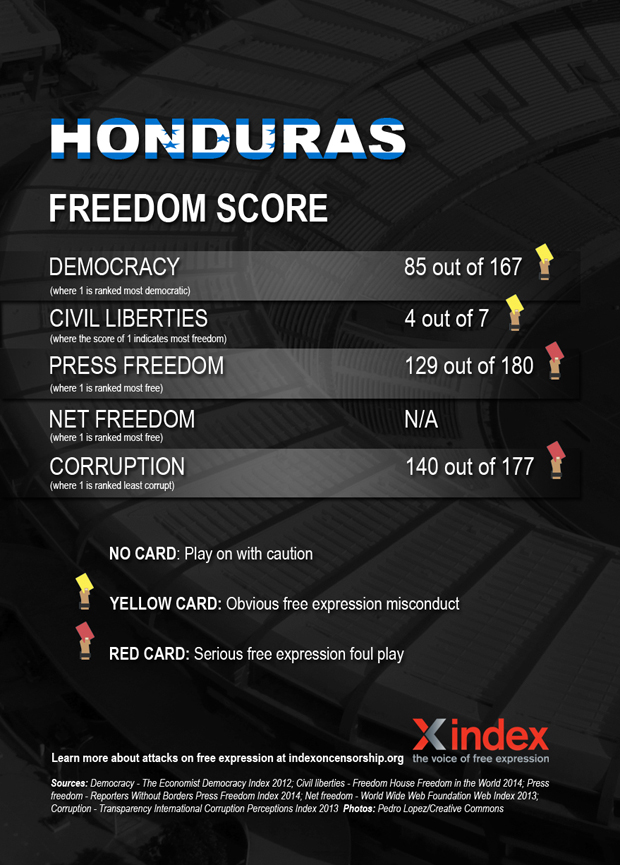
Attack on ambition: Dina Meza on a Honduran generation ground down by fear
Stripsearch cartoon: Martin Rowson envisages an investigative reporter meeting Deep Throat
Generation why: Ian Hargreaves asks on how the powerful may or may not be held to account in the future
Making waves: Helen Womack reports from Russia on the radio station standing up for free media
Switched on and off: US journalist Debora Halpern Wenger on TV’s power shift from news producers to news consumers
TV news will reinvent itself (again): Taylor Walker interviews a veteran TV reporter on the changes ahead
Right to reply: Samira Ahmed on how the BBC tackles viewers’ criticism
Readers as editors: Stephen Pritchard on how news ombundsmen create transparency
Lobby matters: Political reporter Ian Dunt on the push/pull of journalists and politicians inside Britain’s corridors of power
Funding news freedom: Glenda Nevill looks at innovative ways to pay for reporting
Print running: Will Gore on how newspapers innovate for new audiences
Paper chase: Luis Carlos Díaz on overcoming Venezuela’s newsprint shortage
IN FOCUS
Free thinking? Australia’s race commissioner Tim Soutphommasane on bigotry
Guarding the guards: Jemimiah Steinfeld on China’s human rights lawyers becoming targets
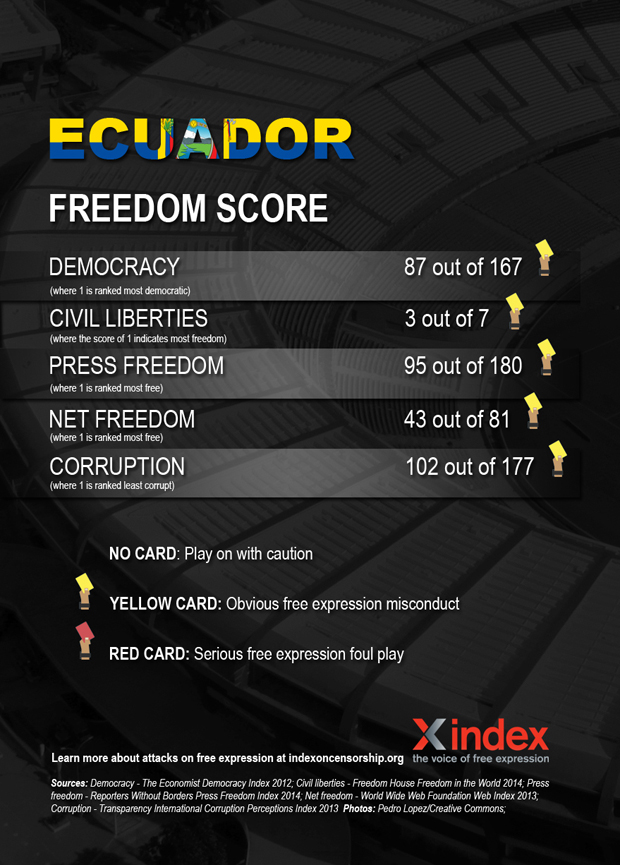
Taking down the critics: Irene Caselli investigates allegations that Ecuador’s government is silencing social media users
Maid equal in Brazil: Claire Rigby on the Twitter feed giving voice to abuse of domestic workers in Brazil
Home truths in the Gulf: Georgia Lewis on how UAE maids fear speaking out on maltreatment
Text messaging: Indian school books are getting “Hinduised”, reports Siddarth Narrain from India
We have to fight for what we want: our editor, Rachael Jolley, interviews the OSCE’s Dunja Mijatovic on 20 years championing free speech
Decoding defamation: Lesley Phippen’s need-to-know guide for journalists
A hard act to follow: Tamsin Allen gives a lawyer’s take on Britain’s libel reforms
Walls divide: Jemimah Steinfeld speaks to Chinese author Xiaolu Guo about a life of censorship
Taking a pop: Steven Borowiec profiles controversial South Korean artist Lee Ha
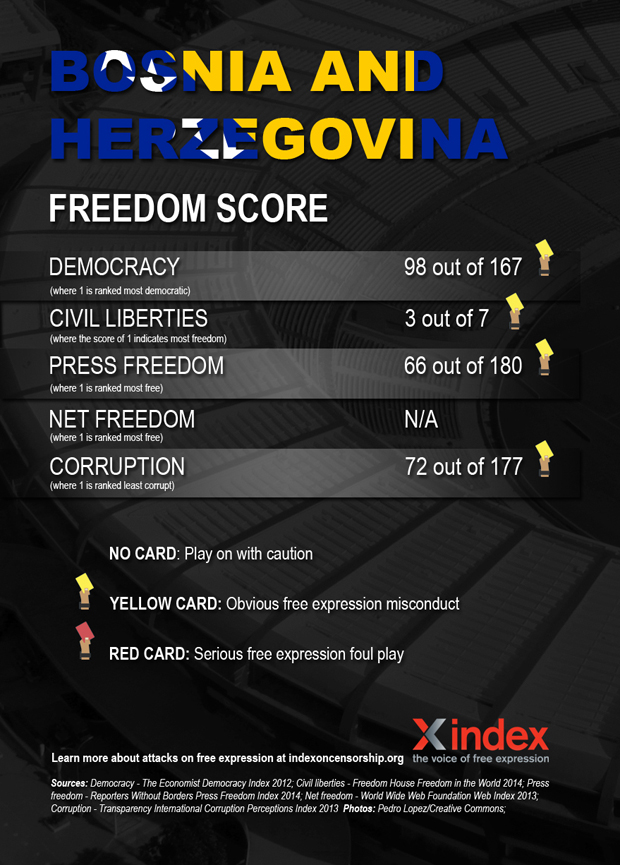
Mapping media threats: Melody Patry and Milana Knezevic look at rising attacks on journalists in the Balkans
Holed up in Harare: Index’s contributing editor Natasha Joseph reports from southern Africa on the dangers of reporting in Zimbabwe
Burma’s “new” media face threats and attack: Burma-born author Wendy Law-Yone looks at news in the run up to the impending elections
Head to head: Sascha Feuchert and Charlotte Knobloch debate whether Mein Kampf should be published
CULTURE
Political framing: Kaya Genç interviews radical Turkish artist, Kutlug Ataman
Action drama: Julia Farrington on Belarus Free Theatre and the upcoming Belarus election
Casting away: Ariel Dorfman, a new short story by the acclaimed human rights writer
ALSO
Index around the world: Alice Kirkland gives a news update on Index’s global projects
From the factory floor: Vicky Baker on listening to the world’s garment workers via new technology
23 Dec 2013 | Volume 42.04 Winter 2013
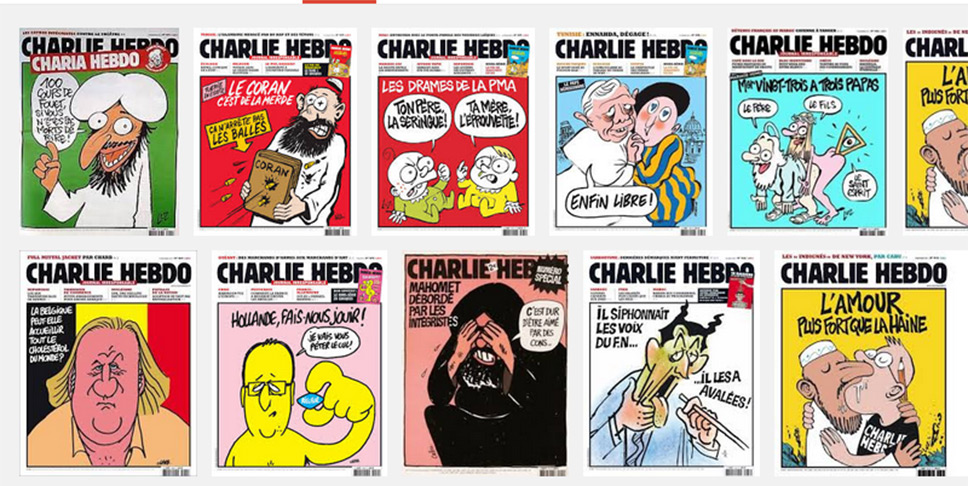
In conjunction with the Cambridge Festival of Ideas 2015, we will be publishing a series of articles that complement many of the upcoming debates and discussions. We are offering these articles from Index on Censorship magazine for free (normally they are held within our paid-for archive) as part of our partnership with the festival. Below is and article by Samira Ahmed on how 15 years of multiculturalism and how some people’s ideas of it are getting in the way of freedom of expression from the winter 2013 issue. This article is a great starting point for those planning to attend the Faith and education: an uneasy partnership session at the festival.
Index on Censorship is a global quarterly magazine with reporters and contributing editors around the world. Founded in 1972, it promotes and defends the right to freedom of expression.
In 1999, the neo-Nazi militant David Copeland planted three nail bombs in London – in Brixton, Brick Lane and Soho – targeting black people, Bangladeshi Muslims and gays and lesbians. Three people died and scores were injured.
In response, the government awarded funds to local charities and community groups working on projects to build cohesion among the people that had been the targets of Copeland’s bloody campaign.
The intention was honorable, the impact underwhelming. According to Angela Mason, then head of Stonewall, the gay rights pressure group, the assumption was that all the people targeted by Copeland were “on the same side”. The truth as she sees it was that the government-funded projects exposed the uncomfortable reality that there were strong anti-gay prejudices among Muslim, Christian and black communities in Britain.
How realistic is it to expect a cohesive society could emerge from this kind of climate?
Today, the tensions between freedom of speech and religious belief remain acute – and they are systematically exploited by political groups of all stripes, from the English Defence League to radical Islamists who threaten to disrupt the repatriation of dead British soldiers at Wootton Bassett. The story consistently makes the headlines. The idea that there is an Islamist assault on British freedoms and values is widespread.
The Muslim campaign against Salman Rushdie’s The Satanic Verses in 1988 was the crucial moment in all this. It forced writers and artists from an Asian or Muslim background, whether they defined themselves that way or not, to take sides. They had to declare loyalty – or otherwise – to the offended.
The results have been appalling, and not only in Britain. Most notoriously, the Somali writer and Dutch politician Ayaan Hirsi Ali had her citizenship withdrawn by the Dutch authorities just as Muslim expressions of outrage and death threats in response to her writing about Islam reached their peak.
In the UK, local authorities have been all too ready to cave in to pressure under cover of preventing community unrest, maintaining public order or resisting perceived cultural insensitivity.
Sensitivity to religious insult, too often conflated with racism, has frequently taken precedence over concern for free expression. In 2004 violent protests by Birmingham Sikhs led to the closure of Behzti, Gurpreet Kaur Bhatti’s play on rape and abuse of women in a Sikh temple.
But the problem is not always obvious. In September 2012, Jasvinder Sanghera, founder of Karma Nirvana, a charity campaigning against forced marriage, ran a stall at the National Union of Teachers conference, distributing posters for schools. She told the Rationalist Association: “Many teachers came to my stall and many said, ‘Well, we couldn’t put them up. It’s cultural, we wouldn’t want to offend communities and we wouldn’t get support from the headteacher.’ And that was the majority view of over 100 teachers who came to speak to me.”
Sanghera said that one teacher who did take a poster sent her photographs of it displayed on a noticeboard in his school. But “within 24 hours of him putting up the posters, the headteacher tore them all down”. The teacher was summoned to the head’s office and told: “Under no circumstances must you ever display those posters again because we don’t want to upset our Muslim parents.”
The delayed prosecution of predominantly Asian Muslim grooming gangs in Rochdale and Oxford has to be seen in the context of the long-standing local authority fear of causing offence. Women’s rights, artistic free speech, even child protection have repeatedly been downgraded in order to avoid the accusation of racism or religious insult.
It’s not as bad as it used to be, according to Peter Tatchell, whose organisation OutRage! promotes the rights of lesbian, gay, bisexual and transgender people and has campaigned against homophobic and misogynist comments by Islamic preachers and organisations. “Official attitudes are better in terms of defending free speech but still far from perfect,” he says. However, he adds, “Police and prosecutors still sometimes take the view that causing offence is sufficient grounds for criminal action, especially where religious and racial sensitivities are involved.”
The pressure isn’t necessarily overt but individual writers say they are struggling to work out where the lines are being drawn.
Writer Yasmeen Khan’s work ranges from making factual programmes, including documentaries for BBC Radio Four, to writing and performing comedy and drama. She says: “The pressure not to ‘offend’ has certainly increased over the past few years,” though she adds that it has probably affected writers and performers outside a particular religion more than believers.
Being seen as a religious believer can be an advantage when it comes to commissioning or applying for grants, she says. “But the downside is that you’re sometimes only viewed through that lens; you don’t want to be seen as a ‘Muslim writer’ – you just want to be a writer. It can feel like you’re being pigeon-holed by others, and that holds you back as being seen as ‘mainstream’. I’ve seen that issue itself being used for comedy – I was part of an Edinburgh show for which we wrote a sketch about an Asian writer being asked to ‘Muslim-up’ her writing.”
Luqman Ali runs the award-winning Khayaal Theatre company in Luton. It has built a strong critical reputation for its dramatic interpretation of classical Islamic literature. He dismisses the assertion that political correctness has shut down artistic freedom: “There would appear to be an entrenched institutional narrative that casts Muslims as problem people and Muslim artists as worthy only in so far as they are either prepared to lend credence to this narrativeor are self-avowedly irreligious,” he says. He contrasts what he sees as the “retrospective acceptance” of historic Islamic art and literary texts in museum collections with “very little acceptance of contemporary Muslim cultural production, especially in the performing arts”.
In 2011, the TLC channel in the US cancelled the reality TV series All American Muslim, a programme about a family in Michigan, after only one season. The cancellation followed a campaign by the Florida Family Association that was reminiscent of the UK group Christian Voice’s campaign against Jerry Springer: The Opera in 2005. Lowe’s, a national home-improvement chainstore and major advertiser, pulled out of sponsoring the show after the group claimed the series was “propaganda that riskily hides the Islamic agenda’s clear and present danger to American liberties and traditional values”.
Lowe’s denied its decision was in response to the Florida Family Association campaign. But amid the hysteria generated, including protests outside Lowe’s stores, ratings for the show plummeted. Many Americans decided not to watch it. As with Jerry Springer: The Opera, a small group had created a momentum of outrage that led to a fatal atmosphere of threat and intimidation around a piece of mainstream – and until then, highly successful – entertainment. The Bollywood thriller Madras Café was withdrawn from Cineworld and Odeon cinemas in the UK and Tamil Nadu, India, after a campaign by Tamil groups who found it “offensive”.
Veteran comedy writer John Lloyd, speaking at a British Film Institute event marking the 50th anniversary of the broadcast of the satirical news programme That Was The Week That Was in 2012, said there was now an obsession with “compliance” by tier after tier of broadcast managers, which he felt had suffocated satire. “Now,” said Lloyd, “everyone’s jibbering in fright if you do anything at all.” He contrasted the current climate to his experience working for Not The Nine O’ Clock News when, he said, he was “encouraged to provoke and challenge”.
Writer and stand-up comedian Stewart Lee, who co-wrote Jerry Springer: The Opera, is currently working on a new series of his award-winning Comedy Vehicle for BBC Two. He believes a general uncertainty about British legislation on religious offence is affecting what gets produced: “It’s all very confusing. I don’t know what I am allowed to say. There is a culture of fear generally now in broadcasting. No one knows what they are allowed to do.”
“In Edinburgh in August 2013, a (nonbroadcast) show in a tent funded by the BBC at 9.30pm saw the BBC person running it pull a song by the gay musical comedy duo Jonny and the Baptists about laws concerning gays giving blood because it ‘promoted homosexuality’. This at 9.30pm, in a country where it is not illegal to promote homosexuality, and not for broadcast.
“In series one of Comedy Vehicle, I had a bit on imagining Islamists training dogs to fly planes into buildings. This was pulled on the grounds that it appeared deliberately provocative to Muslims because of the dog taboo in Islam. I looked into this, and read a load of stuff on it. There is no dog taboo in the Muslim faith.”
A BBC spokesman said: “The band were invited to perform on our open garden stage which was run as a family friendly venue for the 24 days it was open to the public. With the possibility of children and young people in the audience, we asked the band to tailor their short set to reflect the audience. They did so, and in one of these, a late night notfor- broadcast show, their set included the song which Stewart Lee refers to. The BBC has a strong track record of offering comedians opportunities to perform their edgiest material without restraint during the festival and we will continue to do so.”
Lee described the Jerry Springer: The Opera debacle, explaining that the pressure group Christian Voice “were able to scupper the viability of the 2005-2006 tour” of the play by informing theatres they would be prosecuted under the forthcoming incitement to religious hatred bill if they staged the play. The bill was later defeated by one vote in the Commons, and soon after the House of Lords scrapped the blasphemy laws. “But,” says Lee, “I think the public perception is that both these laws still exist.”
He says he doesn’t like to make a fuss: “The BBC is beset on all sides by politically and economically interested partners who want to see it destroyed. I wouldn’t expect the BBC, any more, to go to the wall about something I wanted to say. I’d just say it somewhere else – on a long touring show for example – and get better paid for it anyway! I am also anxious not to appear to contribute to the notion that ‘political correctness has gone mad’. People say, ‘ah but you’ve never done stuff about Islam’. I have. Nothing happened. But I have not done stuff about Islam in the depth I have stuff about Christianity as it is not relevant to me in the same way.”
Lee says his writing for tours isn’t affected by the fear of offence because his solo tours are “cost-effective and largely off the radar of the anti-PC brigade or people looking for things to complain about”.
However, he says, when it comes to the television series, he does consider the power of offence. “It affects what I write,” he says. His new show addresses the Football Association’s objection to the word “nigger”. He suspects that the BBC might get cold feet about this bit. “So I will drop it and use it live and on DVD. I don’t see TV as the place to experiment with certain types of content any more.”
But he says that one of the most important things about freedom of speech is that it applies to everyone. “I don’t think a lot of the jokes that, say, Jimmy Carr and Frankie Boyle do are worth the annoyance they cause, but I would defend their right to say them.”
So what, if anything, has changed for writers and what they feel they can write about since his experience with Jerry Springer?
“It’s all much worse,” Lee says. “But for many reasons: lack of funding mainly.” In April 2013, culture secretary Maria Miller addressed members of the arts industry at the British Museum, arguing that: “When times are tough and money is tight, our focus must be on culture’s economic impact.”
But as Lee points out, “it’s harder to justify funding something worthwhile in the current climate if people are storming the publicly funded theatre, such as Behzti, in protest.” “It has lost its moral authority in many ways,” he says, adding that ratings are at the forefront of commissioners’ minds.
There have been high-profile attempts to link comedy and Islam, such as the recent Allah Made Me Funny international standup tours. The Canadian CBC sitcom Little Mosque on the Prairie defied self-styled Muslim community leaders’ complaints about insult and offence to run for six highly-rated seasons, finishing in 2012. The BBC’s own Citizen Khan, which begins its second series in 2014, has similarly ignored claims of insult. Both sitcoms combine a Muslim family setting with very familiar sitcom themes.
In Britain, the overly cautious attitude to free speech and religion supposed to create community harmony has coincided with growing fundamentalist intimidation often promoted within enclosed immigrant communities. Sikh gangs have targeted mixed weddings in temples, and there have been tense stand-offs between Sikhs and Muslims over allegations of sexual grooming in Luton and elsewhere. British Ahmadiyya Muslims, who fled persecution in Pakistan, have struggled to draw media attention to the orchestrated hate campaigns being conducted against them by some Sunni groups. We need to feel free to criticise religious groups when they cross lines and commit crimes, without worrying about the cultural upset.
As Kenan Malik has said, the refusal to confront these issues in open and frank discussion, is “transforming the landscape” of free speech. Even in the United States, where free speech is enshrined in the constitution, there are serious questions being asked about what free speech actually means – particularly when it comes to religion.
The right to free speech should never be half-hearted. People have the right to be offended, but they don’t have the right to stop others speaking, discussing and debating ideas.