26 Apr 2021 | Asia and Pacific, China, News
This article first appeared in volume 50, issue 1 of Index on Censorship, A century of silencing dissent, which was published in April 2021.
Sometimes, from the most trivial event or seemingly insignificant interaction, you can gauge the health of a society and decide: “This is a place I’d like to live, a place conducive to happiness.”
A few years ago, while in Taiwan for a literary festival, I went to a night market to look for tangyuan – the sticky rice dumplings that are traditionally eaten on the final day of Chinese New Year. As their name is a homophone for the word “union”’, Chinese families eat them on this day to ensure that during the coming year they will remain united. As I’d recently been cast into exile from mainland China, I thought the dumplings could assuage my longing for home.
After a long search, I found a small dumpling stall and asked the elderly owner if she had any. She told me she’d sold out, but that if I bought a bag of frozen ones from the supermarket across the road she would boil them up for me on her stove. I did as she suggested and she served them to me in a big bowl, handed me a spoon and invited me to sit at one of her rickety tables. She fervently refused my offer of payment. As I sat there savouring the hot, translucent dumplings stuffed with sweet black sesame paste, I felt closer to home than I had done in years.
It was not the dumplings themselves or the memories they evoked that made me feel close to home. It was the simple act of kindness from this old woman who didn’t know me. Her kindness struck me as peculiarly Chinese. It was imbued with what we call renqing: a sentiment, a human feeling that inspires one person to perform a favour for another simply because they can, with no thought of recompense.
Traditional Chinese society was glued together by such sentiments. Their roots lie in Confucian values of benevolence, righteousness and propriety. At the heart of them all is the idea that to lead a good life you must treat others with compassion, that each human being has the potential to be good and is worthy of dignity and respect. Almost 500 years before the birth of Christ, Confucius devised his own Golden Rule: “When you leave your front gate, treat each stranger as though receiving an honoured guest … Do not do to others what you do not wish for yourself.”
But in China, these ancient values have been bludgeoned by 70 years of Chinese Communist Party rule. Since the days of Mao, the CCP has clung to power through violence, propaganda and lies, viewing its subjects as senseless cogs that it can blind with promises of a future Utopia while confining them to a present hell. How easy it is for humans to be stripped of reason by a tyrant’s deceit and malice. At 13, having survived the Great Famine caused by Mao’s reckless Great Leap Forward campaign, when my siblings and I had had to eat toothpaste and tree bark to stave off starvation, I nevertheless longed to join Mao’s party.
When he launched his Great Proletarian Cultural Revolution, I was incensed that the class background of my grandfather, who had perished in a Communist jail, disqualified me from joining Mao’s Red Guards. The deepest hope of my generation was that after purging China of bourgeois elements, we could travel to Britain and the USA to liberate their populations from the yoke of capitalist oppression and welcome them into the CCP’s revolutionary fold.
Slowly, as I witnessed horrific scenes of mob violence, I began to see this march to Utopia for what it was: a dehumanising nightmare that divided people into class categories, pitting one against the other in constant struggle, “rightist” against “leftist”, neighbour against neighbour. Time-honoured values of family loyalty and respect for elders were shattered as sons were encouraged to betray their fathers and daughters their mothers. No thought other than Mao Zedong Thought was allowed. Anyone who, however inadvertently, strayed from party orthodoxy was branded a class enemy and destroyed.
At least 45 million people are estimated to have died in Mao’s Great Famine. Millions more were killed or persecuted in his Cultural Revolution. Mao’s ideas and values caused catastrophic suffering and death, and corroded the hearts of the nation.
In the 40 years since Mao’s death, the Chinese have been forbidden to reflect on their traumatic past or contest any current injustices. Like a cunning and obdurate virus, the CCP has mutated. While other communist regimes around the world have fallen, it lives on, still suppressing free thought, still whitewashing history, but embracing, with increasing vigour, the capitalism Mao strove to eliminate. The party has loosened tethers it itself placed on the economy, and the Chinese have got rich. Although it continues to spout Marxist-Leninist jargon, its overarching obsession is power, and how to cling on to it. It still views the Chinese people as senseless cogs it can manipulate or flatten as it pleases. It still tells them that the material life is all that matters and that happiness is the China Dream of wealth and national glory conceived by the party’s current leader, Xi Jinping. Freedom, democracy, human rights, the desire to become master of one’s own fate: all of these are unnecessary, absurd, dangerous, it says. The Chinese people have no need for them!
In George Orwell’s Nineteen Eighty-Four, Winston is told that if he wants a picture of the future, he must “imagine a boot stamping on a human face – forever”.
This totalitarian nightmare is not some fictional future, though. Published in 1949, the year Mao rose to power, the novel prophetically describes China’s fate under CCP rule.
For moments, sometimes for days or weeks during the dark decades of China’s recent history, a hand has pushed the boot aside and the human face has looked up. It looked up with hope and joy during the Tiananmen Square protests of 1989, when millions gathered across the nation to call for freedom and democracy. In 2008, it looked up when 303 Chinese dissidents signed Charter 08 that argued for an end to one-party rule and asserted that freedom and human rights are universal values that should be shared by all humankind. In Hong Kong, the human face has looked up defiantly as the territory bravely struggles to retain what few freedoms it has left. And last year, back on the mainland, the face looked up for a few short hours when, after Dr Li Wenliang was reprimanded for raising the alarm about Covid-19 and then died of it, Chinese social media became flooded with the courageous hashtag #IWantFreedomOfSpeech.
Every time citizen journalists like Fang Bin upload independent reports on social media, civil rights activists like Xu Zhiyong call openly for political reform, dissidents like Gao Yu shine a light on the secret workings of the oppressive state, the human face looks up and proclaims: “without freedom of speech we are all enslaved”.
But each time, the CCP boot stamps back down again. In 1989, it sent the tanks to Tiananmen Square to crush the unarmed protesters. In 2009, it imprisoned the leading dissident Liu Xiaobo who co-authored Charter 08, banned him from collecting the Nobel Peace Prize he was awarded the following year, and in 2017, humiliated him even in death by stage-managing his funeral, forcing his family to drop his ashes unceremoniously into the sea. Fang Bin has been disappeared, Xu Zhiyong is in prison, Gao Yu and countless other dissidents like Ding Zilin, who courageously persists in dragging the Tiananmen massacre from state-imposed amnesia, are under intense surveillance. In Hong Kong, the party has violated the Sino-British Joint Declaration, beaten protesters and arrested every prominent critic. In Tibet, decades of CCP oppression have driven 156 Tibetans to set fire to themselves in anguish.
“But look how much richer the Chinese have become!” CCP apologists cry out. “Western democracies like the USA and Britain are a sham, corrupt and incompetent – see how they failed to contain the Covid-19 epidemic! Does this not prove the superiority of China’s authoritarian regime?”
They ignore that the CCP’s obsession with secrecy caused the initial outbreak’s catastrophic spread, and that democratic Taiwan far outperformed China, recording only 10 Covid deaths, without the government having to imprison whistleblowers or weld Covid patients into their homes.
It’s true that UK prime minister Boris Johnson and US president Donald Trump failed disastrously to contain the virus. (Is it a coincidence that both leaders share Xi’s disregard for the truth?)
But Trump could be voted out, Johnson can be vilified in the press, and no one loses their freedom of speech. This is the power of democracy – however embattled it may become, it guarantees, more than any other system yet invented, that every citizen can have their say and that political change is always constitutionally possible.
“The Chinese just aren’t suited to democracy, though – it’s not in their culture,” the apologists retort. But Taiwan destroys this argument – it proves that the Chinese can be both prosperous and free.
“It’s different on the mainland,” the apologists insist. “Look at the popular support for the party!” But the apologists fail to understand that when people have been governed by lies and fear, their gratitude to their leaders is little different from the affection some hostages develop for their captors.
The truth is, everyone in China is a hostage. Some may be wealthier than others, some more aware than others of the prison bars that surround them, but everyone is spiritually incarcerated by the CCP. They have all been denied the most fundamental human right: the right to form independent thought. Without freedom of thought, one loses respect for oneself and the ability to respect and feel compassion for others. China may be rich, but 70 years of CCP rule has plunged the country into an ever-deepening moral abyss.
It is impossible to make a hierarchy of misery, to judge the death and persecution of one person or of one people as worse than those suffered by others. But the horror of the current situation in Xinjiang seems to be in a category of its own. The images of Uighur convicts, handcuffed and blindfolded, heads shaven and bowed, being herded onto trains; of hastily-erected internment camps with watchtowers, barbed wire fencing and high perimeter walls; of inmates forced to smile and sing to foreign inspection teams, despair welling in their eyes; the accounts of torture, rape, forced sterilisations and indoctrination from the few Uighurs who have managed to escape. These images and accounts recall the worst atrocities of the 20th century. In the name of “anti-terrorism”, a people and a culture are being annihilated. Determined to eradicate any perceived threat to its rule, the CCP is stamping its boot down on an entire ethnic group, aiming to extinguish the Uighurs “root and branch”.
When reports first emerged of the Xinjiang camps, I found the images too dreadful to bear. Wanting to convey my grief and solidarity, I sought out a Xinjiang restaurant in London, which has now closed. After I paid for my meal, I asked the owner to join me outside, so that we could speak without being overheard. I asked him about the camps, and whether he still had family in the province. It turned out he was not a Uighur but a Han Chinese who had moved to Xinjiang in the 1990s. “Those Uighurs – they deserve what’s happened to them!” he said with a smirk. “Good thing they’ve been locked up in the camps. My family say the streets are much quieter now.”
His words were abhorrent, but he was expressing views many Han Chinese on the mainland share. These Chinese mainlanders are not evil, of course. The corrupted moral view that some of them may have is the tragic product of an evil regime.
On the hundredth anniversary of its founding, the CCP will reassert that ‘Without the Communist Party, there is no New China!’ Xi wants his model of authoritarian capitalism to be applauded and replicated by the entire world. He wants the UN to move its headquarters to Beijing – the ultimate validation of his ideas and values.
For anyone who cherishes human rights and freedom of speech it is repugnant that, while hundreds of millions of victims of the CCP’s man-made disasters lie rotting in their graves, while Chinese dissidents continue to be jailed and disappeared, while Hong Kong turns from a place that once offered refuge to mainland dissidents into a place from which its own citizens flee, while Tibetans continue to set themselves on fire, and while a genocide is taking place right now in Xinjiang – it should be repugnant to everyone that in the face of such unending injustice, some Western commentators could suggest that the CCP is winning the battle of values and ideas in the world.
But more appalling still is that for the sake of some grubby trade deals with China, the political leaders of Western democracies are doing little more than offering asylum to Hong Kong citizens and expressing “concern” at China’s human rights abuses. As China’s economy grows and CCP values spread across the nation’s borders, freedom of speech, liberal values and renqing – that essential human capacity for kindness and compassion – will become increasingly endangered. Unless Western leaders defend, not with gunboats or empty rhetoric but with unwavering commitment, the enlightenment values of liberty, fraternity and reason that should form the foundation of every civilised country, then there will soon be very few places left in the world that are conducive to human happiness.
1 Apr 2021 | China, Hong Kong, Media Freedom, Opinion, Ruth's blog, Taiwan
[vc_row][vc_column][vc_column_text]
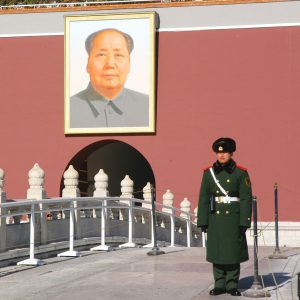
Photo: PublicDomainPictures
The awful actions of the Chinese government over the last month have dominated our news agenda. The collective actions of the government and their outliers have been designed to silence dissent, to intimidate and to bully.
They have repeatedly attacked core democratic principles both at home and abroad, undermining fair political participation. They’ve arrested democracy activists, changed the law to restrict electoral access to the Hong Kong Legislative Council to sanctioned ‘patriots’ otherwise known as the allies and friends of the Government of China.
The ruling Chinese Communist Party (CCP) has also sanctioned British parliamentarians and activists for daring to speak out about the acts of genocide, happening as I type, in Xinjiang province against the Uighur community. The CCP chose not to target members of the British Government nor key businesses with sanctions.
Instead, it sent a political message and targeted backbench Conservative MPs, two think-tanks and an academic, those who had been most vocal in exposing the actions of the CCP in both Xinjiang and Inner Mongolia. This was a move intended to silence criticism not impose economic sanction, a clumsy and ineffectual effort to restrict free speech outside China’s borders.
This week, these aggressive actions by the CCP culminated with yet another attack on media freedom when the BBC’s lead China correspondent, John Sudworth, was forced to relocate with his family from Beijing to Taiwan after a campaign of state-sanctioned threats and intimidation. Sudworth and his wife, a fellow journalist for the Irish RTE, Yvonne Murray, were faced with no other option than to leave after months of personal attacks in Chinese state media and by Chinese government officials. They will both continue to report on events in China from Taiwan.
The harassment of international journalists in China (and now in Hong Kong) is becoming normalised, with dozens of journalists having to leave in recent months; threats of visas being withheld are now commonplace. This is simply unacceptable.
China seeks to be a loud voice on the global stage – they need to live up to their commitments under the Universal Declaration of Human Rights. They need to remember they are signatories to Article 19 and that media freedom and free expression are protected rights.
Index stands in solidarity with John and Yvonne.[/vc_column_text][/vc_column][/vc_row][vc_row][vc_column][three_column_post title=”You may also want to read” category_id=”41669″][/vc_column][/vc_row]
24 Dec 2020 | Opinion, Ruth's blog
[vc_row][vc_column][vc_single_image image=”115942″ img_size=”full” add_caption=”yes”][vc_column_text]2020 will undoubtedly be a year studied for generations, a year dominated by Covid-19.
A year in which 1.77 million people have died (as of this week) from a virus none of us had heard 12 months ago.
We have all lived in various stages of lockdown, some of our core human rights restricted, even in the most liberal of societies, in order to save lives.
A global recession, levels of government debt which have never been seen in peacetime in any nation.
Our lives lived more online than in the real world. If we’ve been lucky a year dominated by Netflix and boredom; if we weren’t so lucky a year dominated by the death of loved ones and the impact of long Covid.
Rather than being a year of hope this has been a year of fear. Fear of the unknown and of an illness, not an enemy.
Understandably little else has broken through the news agenda as we have followed every scientific briefing on the illness, its spread, the impact on our health services, the treatments, the vaccines, the new virus variants and the competence of our governments as they try to keep us safe.
But behind the headlines, there have been the stories of people’s actual lives. How Covid-19 changed them in every conceivable way. How some governments have used the pandemic as an opportunity to bring in new repressive measures to undermine the basic freedoms of their citizens. Of the closure of local newspapers – due to public health concerns as well as mass redundancies of journalists due to a sharp fall in revenue.
2020 wasn’t just about the pandemic though.
We saw worldwide protests as people responded under the universal banner of Black Lives Matter to the egregious murder of George Floyd.
In Hong Kong, the CCP enacted the National Security Law as a death knell to democracy and we saw protestors arrested and books removed from the public libraries – all under the guise of “security”.
The world witnessed more evidence of genocidal acts in Xinjiang province as the CCP Government continues to target the Muslim Uighur community.
In France, the world looked on in horror as Samuel Party was brutally murdered for teaching free speech to his students.
Genuine election fraud in Belarus led to mass protests, on many occasions led by women – as they sought free and fair elections rather than the sham they experienced this year.
In America, we lived and breathed the Presidential Election and witnessed the decisive victory of a new President – as Donald Trump continued to undermine the First Amendment, the free press and free and fair democracy.
In Thailand, we saw mass protests and the launch of the Milk Tea Alliance against the governments of Hong Kong, Thailand and Taiwan, seeking democracy in Southeast Asia.
In Egypt, the world witnessed the arrest of the staff of the EIPR for daring to brief international diplomats on the number of political prisoners currently held in Egyptian jails.
Ruhollah Zam was executed by his government for being a journalist and a human rights activist in Iran.
This is by no means an exhaustive list. From Kashmir to Tanzania to the Philippines we’ve heard report after report of horrendous attacks on our collective basic human rights. 72 years after United Nations adopted the Universal Declaration of Human Rights we still face daily breaches in every corner of the planet.
While Index cannot support every victim or target, we can highlight those who embody the current scale of the attacks on our basic right to free expression.
Nearly everybody has experienced some form of loneliness or isolation this year. But even so we cannot imagine what it must be like to be incarcerated by your government for daring to be different, for being brave enough to use your voice, for investigating the actions of ruling party or even for studying history.
So, as we come to the end of this fateful year I urge you to send a message to one of our free speech heroes:
- Aasif Sultan, who was arrested in Kashmir after writing about the death of Buhran Waniand has been under illegal detention without charge for more than 800 days;
- Golrokh Emrahimi Iraee, jailed for writing about the practice of stoning in Iran;
- Hatice Duman, the former editor of the banned socialist newspaper Atılım, who has been in jail in Turkey since 2002;
- Khaled Drareni, the founder of the Casbah Tribune, jailed in Algeria for two years in September for ‘incitement to unarmed gathering’ simply for covering the weekly Hirak protests calling for political reform in the country;
- Loujain al-Hathloul, a women’s rights activist known for her attempts to raise awareness of the ban on women driving in Saudi Arabia;
- Yuri Dmitriev, a historian being silenced by Putin in Russia for creating a memorial to the victims of Stalinist terror and facing fabricated sexual assault charges.
Visit http://www.indexoncensorship.org/JailedNotForgotten to leave them a message.
Happy Christmas to you and yours and here’s to a more positive 2021.[/vc_column_text][/vc_column][/vc_row][vc_row][vc_column][three_column_post title=”You may also want to read” category_id=”41669″][/vc_column][/vc_row]
1 Jul 2020 | China, News, Student Reading Lists
[vc_row][vc_column][vc_column_text]
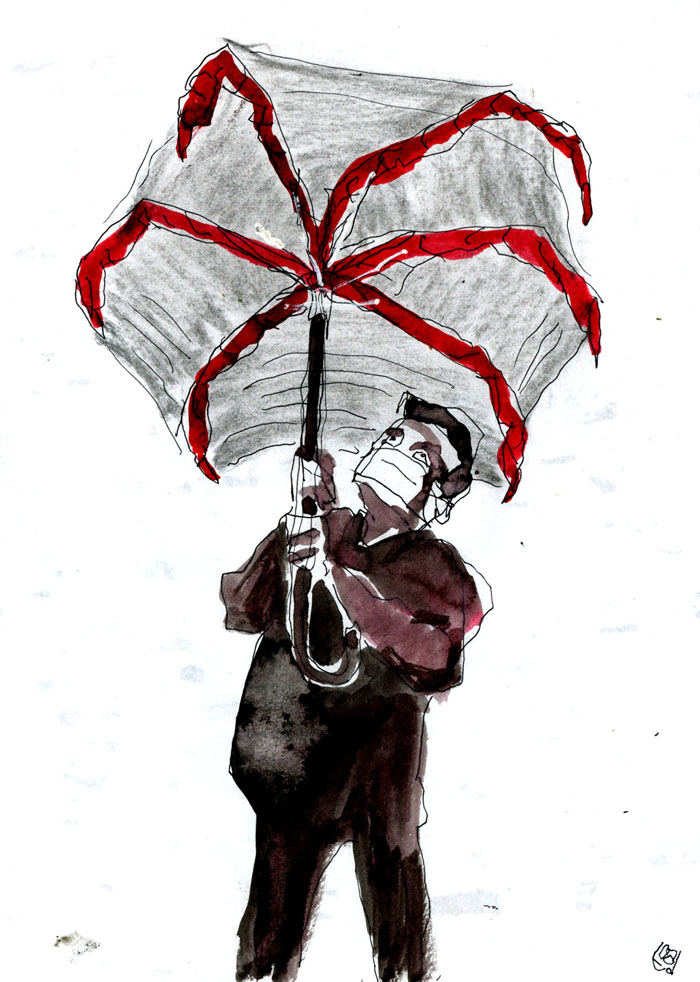
Illustration from cartoonist tOad published today in response to the new law. twitter.com/t0adscroak, www.unsitesurinternet.fr
The National Security Law passed on 30 June in Hong Kong has dealt a massive blow to the city’s status as an autonomous region into which the Chinese government’s suppression of freedom of expression doesn’t encroach. The new law will criminalise “any act of secession, subversion of the central government, terrorism or collusion with foreign or external forces”.
Language like this, as those on the mainland may have experienced, could be manipulated to apply to any behaviour the Chinese government doesn’t like, leaving journalists, activists, protesters and campaigners at risk. Activists in Hong Kong have already begun to shut down their operations out of fear of reprisal in the wake of the law.
Since 1997, when Hong Kong was handed back to China having previously been a British colony, Hongkongers have enjoyed freedom of expression, including a flourishing free press, under the “one country, two systems” constitutional principle. As this principle begins to crumble, we look back at pieces published in Index magazine in 1997 which explored the implications of the handover and the future relationship between mainland China and Hong Kong.
In this edited version of the speech given by Professor Helen Fung-Har Siu in Hong Kong in 1996, she explored the national identity of Hong Kongers and how it intersected with the oppressive nature of the Chinese authorities. In the years preceding the 1997 handover, the people of Hong Kong enjoyed freedom of expression; Siu noted that one in six people there marched in protest at the 1989 Tiananmen Square Massacre. Dissecting the socioeconomic developments in Hong Kong through the 1970s and 80s, Siu questioned how the region and its people, who are accustomed to independence from China, would adapt to its new relationship with the People’s Republic.
Published in early 1997 in anticipation of the handover, Geremie R Barmé, author of Shades of Mao: The Posthumous Cult of the Great Leader, wrote on the flow of popular culture from Hong Kong and Taiwan to mainland China through the 1980s. He explored how the lure of Beijing’s culture waned through the 70s, leading people to soak up the film and music coming from the south, despite attempts by the authorities to censor it. Hong Kong, independent from the Chinese authorities, acted as a conduit between the people in mainland China and Taiwan, and indeed the rest of the world. Barmé predicted that, as Hong Kong returned to China, the subsection of society supporting communist ideals would be brought to the fore by the mainland.
He wrote: “The patriotic significance of Hong Kong’s return to the mainland is lost on no-one. It is part of the final process of what the Communist authorities, and many people in China, see as the reunification of a divided nation.”
Ma Jian, an artist who left Beijing for Hong Kong in 1990, shared his feelings of liberation as he crossed the border and reflects on the suppression of his art on the mainland. Demanding rights and freedom from the Chinese authorities was, he wrote “like being on a battlefield”. Jian wrote that he would remain in Hong Kong after the handover, but projected a lack of optimism about his future freedoms.
“As we watch, incredulously, pre-ordained history advances, or rather, steps backwards to meet us,” he wrote. “No-one asks whether we accept the past, whether we can go and live the time we have already lived. It is as though, studying at middle school, we are suddenly sent back to kindergarten.”
In July 1998, Edward Lucie-Smith visited Hong Kong to find out how the city was acclimatising to the handover one year on. Finding local people unwilling to discuss at length the direction freedom of speech had taken, Lucie-Smith looked to global economic developments and how they could impact Hong Kong’s political future, and in turn the future of freedom of expression. Hong Kong faced an economic downturn in 1998, along with other so-called ‘tiger-economies’, meaning the Hong Kong Chinese elite, who were middlemen between the democratic forces in Hong Kong and the Chinese authorities, may have chosen to move to other parts of the world, leaving Hong Kong and its people more at risk of being ideologically swallowed up by the mainland.
He wrote: “The general feeling was that the British were handing over an economic jewel – a financial mechanism so successful and so finely tuned that the mainland Chinese government would be foolish to interfere with its functioning. But would it be able to resist tinkering, on ideological grounds, with the ‘special economic zone’ within China that Hong Kong was now to become?”
Published in January 1997, Jonathan Mirsky, then East Asia editor of The Times, wrote on how freedom of expression began to crumble in Hong Kong in anticipation of the handover. He described how news channels reported on China in a “vapid or grovelling” manner, to avoid attempts at censorship by Chinese representatives in Hong Kong.
Outspoken democratic politicians told Mirsky how their colleagues no longer wanted to be associated with them. Organisations were expected to plan celebrations for the handover, and comply. Mirsky predicted a dismal future for Hong Kong where loyalty to the Party would be an overriding expectation.
Charles Goddard, at the time of writing a member of the Hong Kong Journalists Association, discussed Hong Kong’s position as eyes on China for the rest of the world, where issues such as human rights abuses in mainland China could be discussed and dissidents from the Chinese authorities could find a relatively safe haven. Goddard, however, highlighted the dangers to journalists in Hong Kong reporting negatively about China, predicting that the status of the city as a place where freedom of expression could flourish would only diminish.
Liu Dawen, at the time of writing the editor of Front Line magazine, took an optimistic view of Hong Kong’s future, believing that the spirit of democracy would not wane.
“In the longer term, the Party cannot stem the ‘raging tide’ of democracy indefinitely either in Hong Kong or in the People’s Republic. When things reach a certain pitch, the pendulum must swing back in the opposite direction,” he wrote.
Charting the arrests and imprisonments of Chinese journalists, Asia-Pacific researcher for Reporters San Frontieres Barbara Vital-Durand painted a picture of China as a country which cracked down harshly on outspoken dissidents from the party line. She foreshadowed a world in which, post-handover, Chinese authorities would extend the jaws of censorship to crush Hong Kong journalists, and access to the internet on the mainland would be tightly controlled.
“Journalists’ organisations and free speech groups have been unsuccessful in getting the British authorities – or subsequently China’s Preparatory Working Committee (PWC) – to abolish several legislative measures which, if left in place, will provide the Chinese authorities with some powerful weapons to use against the media,” she wrote.[/vc_column_text][/vc_column][/vc_row][vc_row][vc_column][vc_basic_grid post_type=”post” max_items=”3″ grid_id=”vc_gid:1593615252756-723f64f2-cdee-10″][/vc_column][/vc_row]
