12 Aug 2022 | Magazine, News, Student Reading Lists
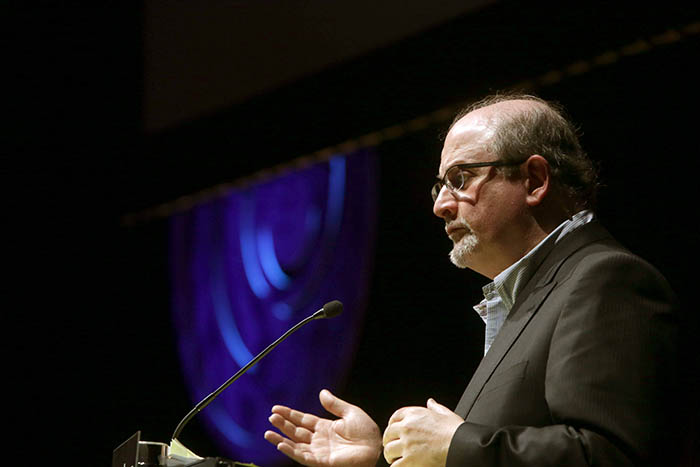
Salman Rushdie. Credit: Fronteiras do Pensamento
On 12 August 2022, Salman Rushdie, the author of the book The Satanic Verses, was attacked as he prepared to give a lecture at the Chautauqua Institution, an arts and education centre in New York state.
Index on Censorship has supported Rushdie’s right to express himself ever since he came into the public eye more than three decades ago.
On 14 February 1989 Iran’s Ayatollah Khomeini issued a fatwa ordering Muslims to execute Rushdie over the publication of The Satanic Verses, along with anyone else involved with the novel.
Published in the UK in 1988 by Viking Penguin, the book was met with widespread protest by those who accused Rushdie of blasphemy and unbelief. Death threats and a $6 million bounty on the author’s head saw him take on a 24-hour armed guard under the British government’s protection programme.
The book was soon banned in a number of countries, from Bangladesh to Venezuela, and many died in protests against its publication, including on 24 February when 12 people lost their lives in a riot in Bombay, India. Explosions went off across the UK, including at Liberty’s department store, which had a Penguin bookshop inside, and the Penguin store in York.
Book store chains including Barnes and Noble stopped selling the book, and copies were burned across the UK, first in Bolton where 7,000 Muslims gathered on 2 December 1988, then in Bradford in January 1989. In May 1989 between 15,000 to 20,000 people gathered in Parliament Square in London to burn Rushdie in effigy.
In October 1993, William Nygaard, the novel’s Norwegian publisher, was shot three times outside his home in Oslo and seriously injured.
Rushdie came out of hiding after nine years, but as recently as February 2016, money has been raised to add to the fatwa, reminding the author As that for many the Ayatollah’s ruling still stands.
As his supporters around the world, including Index, pray for a positive outcome, we highlight key articles from our archives from before, during and after the issue of the fatwa, including two from Rushdie himself.
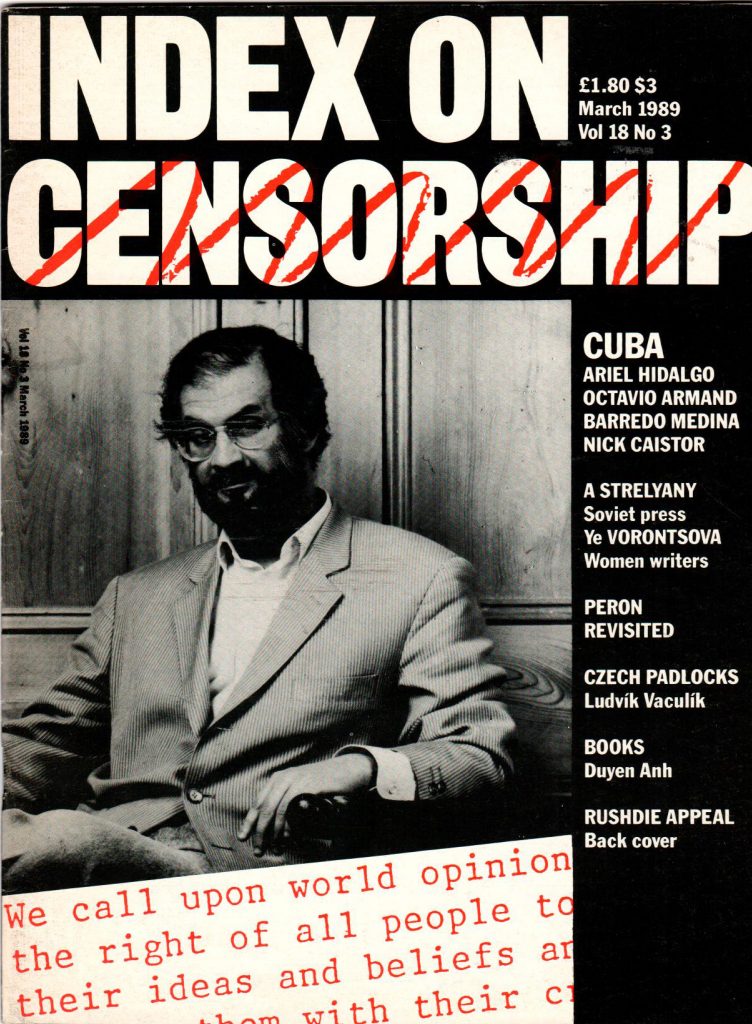
Cuba today, the March 1989 issue of Index on Censorship magazine.
World statement by the international committee for the defence of Salman Rushdie and his publishers
March 1989, vol. 18, issue 3
On 14 February the Ayatollah Khomeini called on all Muslims to seek out and execute Salman Rushdie, the author of The Satanic Verses, and all those involved in its publication. We, the undersigned, insofar as we defend the right to freedom of opinion and expression as embodied in the Universal Declaration of Human Rights, declare that we also are involved in the publication. We are involved whether we approve the contents of the book or not. Nonetheless, we appreciate the distress the book has aroused and deeply regret the loss of life associated with the ensuing conflict.
Read the full article

Islam & human rights, the May 1989 issue of Index on Censorship magazine.
Pandora’s box forced open
Amir Taheri
May 1989, vol. 18, issue 5
‘What Rushdie has done, as far as Muslim intellectuals are concerned, is to put their backs to the wall and force them to make the choice they have tried to avoid for so long’. Last year, when poor old Mr Manavi filled in his Penguin order form for 10 copies of Salman Rushdie’s third novel, The Satanic Verses, he could not have imagined that the book, described by its publishers as a reflection on the agonies of exile, would provoke one of the most bizarre diplomatic incidents in recent times. Mr Manavi had been selling Penguin books in Tehran for years. He had learned which authors to regard as safe and which ones to avoid at all costs.
Read the full article
Islam & human rights, the May 1989 issue of Index on Censorship magazine.
Jihad for freedom
Wole Soyinka
May 1989, vol. 18, issue 5
This statement is not, of course, addressed to the Ayatollah Khomeini who, except for a handful of fanatics, is easily diagnosed as a sick and dangerous man who has long forgotten the fundamental tenets of Islam. It is useful to address oneself, at this point, only to the real Islamic faithful who, in their hearts, recognise the awful truth about their erratic Imam and the threat he poses not only to the continuing acceptance of Islam among people of all religions and faiths but to the universal brotherhood of man, no matter the differing colorations of their piety. Will Salman Rushdie die? He shall not. But if he does, let the fanatic defenders of Khomeini’s brand of Islam understand this: The work for which he is now threatened will become a household icon within even the remnant lifetime of the Ayatollah. Writers, cineastes, dramatists will disseminate its contents in every known medium and in some new ones as yet unthought of.
Read the full article
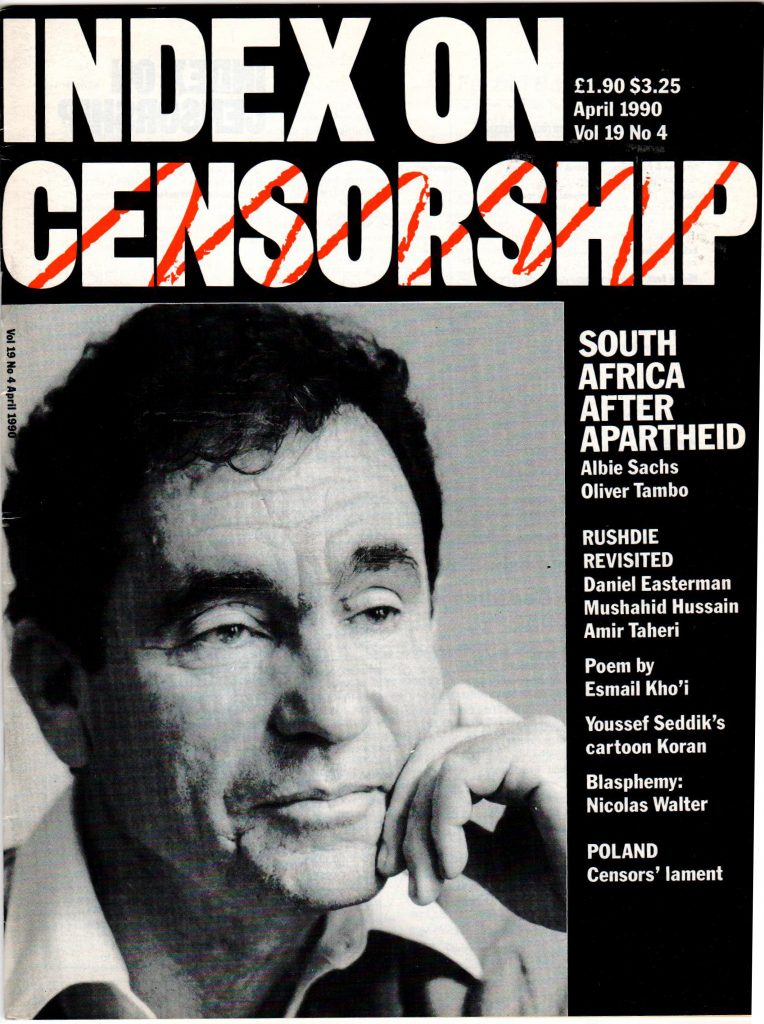
South Africa after Apartheid, the April 1990 issue of Index on Censorship magazine.
Reflections on an invalid fatwah
Amir Taheri
April 1990, vol. 19, issue 4
Broadly speaking, three predictions were made. The first was that Khomeini’s attempt at exporting terror might goad world public opinion into a keener understanding of Iran’s tragedy since the Islamic Revolution of 1979. The fact that the Ayatollah had executed thousands of people, including many writers and poets since his seizure of power in Tehran had provoked only mild rebuke from Western governments and public opinion. With the fatwa against Rushdie, we thought the whole world would mobilise against the ayatollah, turning his regime into an international pariah. Nothing of the kind happened, of course, and only one country, Britain, closed its embassy in Tehran – and that because the mullahs decided to sever.diplomatic ties. In the past twelve months Federal Germany and France have increased their trade with the Islamic Republic to the tune of II and 19 per cent respectively. The EEC countries and Japan have, in the meantime, provided the Islamic Republic with loans exceeding £2,000 million. The stream of European and Japanese businessmen and diplomats visiting Tehran turned into a mini-flood after Khomeini’s death last June.
Read the full article
South Africa after Apartheid, the April 1990 issue of Index on Censorship magazine.
Salman Rushdie and political expediency
Adel Darwish
April 1990, vol. 19, issue 4
When I reviewed Salman Rushdie’s Satanic Verses in September 1988, it never crossed my mind to make any reference to possible offence to Muslim readers, let alone to anticipate the unprecedented international crisis generated in the months that followed. I do not think I was naive – as an LBC radio reporter suggested when she interviewed me at the first public reading from The Satanic Verses in June 1989. On the contrary, I can claim more than many that I am able to understand what Mr Rushdie was trying to say in his book, and the way the crisis has developed. Like Mr Rushdie, I am a British writer, born to a Muslim family. Born in Egypt, I was educated and am employed in Britain, and have been preoccupied and engaged, mainly in the 1960s and 1970s, with the issues that Mr Rushdie has fought for and with which he seemed to be very much concerned in his book.
Read the full article
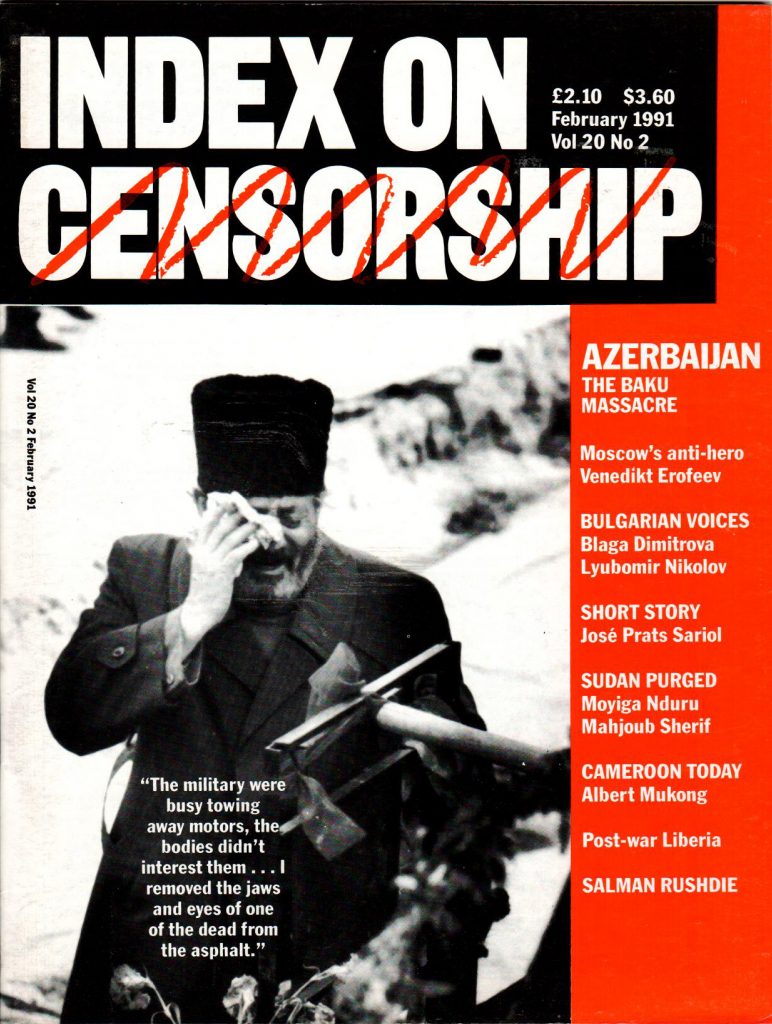
Azerbaijan, the February 1991 issue of Index on Censorship magazine.
My decision
Salman Rushdie
February 1991, vol. 20, issue 2
A man’s spiritual choices are a matter of conscience, arrived at after deep. reflection and in the privacy of his heart. They are not easy matters to speak of publicly. I should like, however, to say something about my decision to affirm the two central tenets of Islam — the oneness of God and the genuineness of the prophecy of the Prophet Muhammad —and thus to enter into the body of Islam after a lifetime spent outside it. Although I come from a Muslim family background, I was never brought up as a believer, and was raised in an atmosphere of what is broadly known as secular humanism. I still have the deepest respect for these principles. However, as I think anyone who studies my work will accept, I have been engaging more and more with religious belief, its importance and power, ever since my first novel used the Sufi poem Conference of the Birds by Farid ud-din Attar as a model. The Satanic Verses itself, with its portrait of the conflicts between the material and spiritual worlds, is a mirror of the conflict within myself.
Read the full article
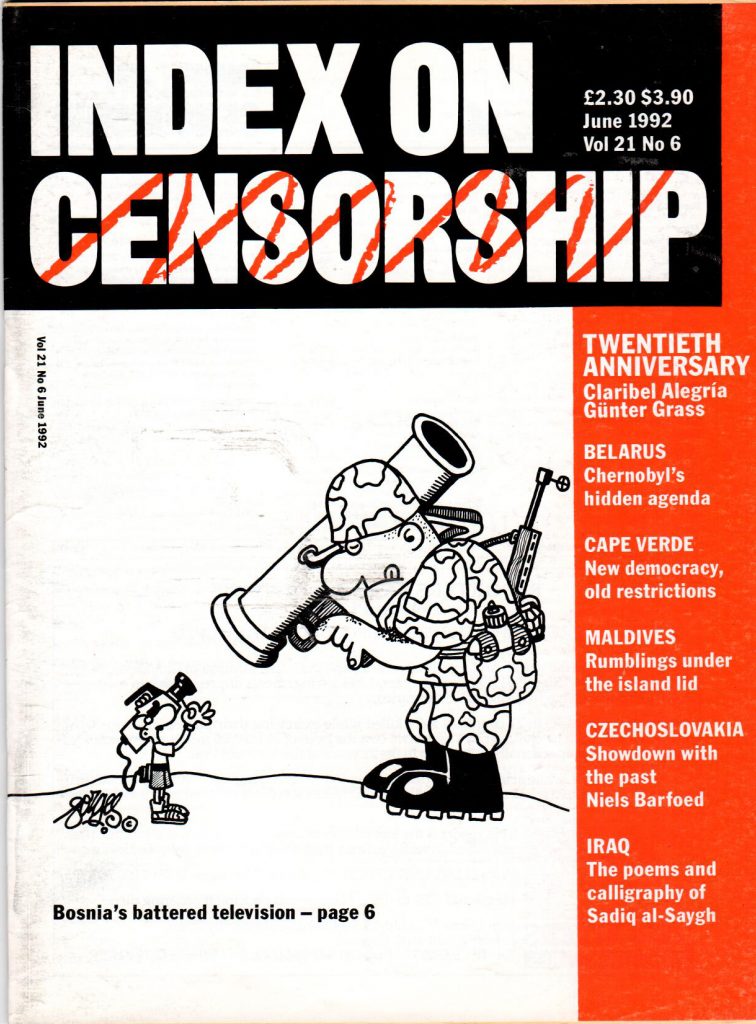
20th Anniversary: Reign of terror, the June 1992 issue of the Index on Censorship magazine.
Offending the high priests
Gunter Grass
June 1992, vol. 21, issue 6
When George Orwell returned from Spain in 1937, he brought with him the manuscript of Homage to Catalonia. It reflected the experiences he had gathered during the Civil War. At first, he was unable to find a publisher because a multitude of influential, left-wing intellectuals had no wish to acknowledge its shocking observations. They did not want to accept the Stalinist terror, the systematic liquidation of anarchists, Trotskyists and left-wing socialists. Orwell himself only narrowly escaped this terror. His stark accusations contradicted a world image of a flawless Soviet Union fighting against Fascism. Orwell’s report, this onslaught of terrible reality, tarnished the picture-book dream of Good and Evil. A year later, a bourgeois Western publisher brought out Homage to Catalonia; in the areas of Communist rule, Orwell’s works – among them the bitter Spanish truth – were banned for half a century. The minister responsible for state security= in the German Democratic Republic, right to its end, was Erich Mielke. During the Spanish Civil War, he was a member of the Communist cadre to whom purge through liquidation became commonplace. A fighter for Spain with an extraordinary capacity for survival.
Read the full article[/vc_column_text][/vc_column][/vc_row][vc_row][vc_column][vc_column_text]

Russia’s choice, the November-December 1993 issue of Index on Censorship magazine.
The Rushdie affair: Outrage in Oslo
Hakon Harket
November 1993, vol. 22, issue 10
The terrorist state of Iran must face the consequences of refusing to lift the fatwa that condemns Salman Rushdie, and those associated with his work, to death. When someone, in accordance with the express order of the fatwa, attempts to murder one of the damned, the obvious consequence is that Iran must be held responsible for the crime it has called for, at least until there is conclusive proof that no connection exists. The shooting of William Nygaard has reminded the Norwegian public of what the Rushdie affair is really about: life and death; the abuse of religion; the fiction of a free mind. This war of terror against freedom of speech is not one we can afford to lose. Since the nightmare clearly will not disappear of its own accord, it must be engaged head-on.
Read the full article

New censors, the March 1996 issue of Index on Censorship magazine.
From Salman Rushdie
March 1996, vol. 25, issue 2
This statement is not, of course, addressed to the Ayatollah Khomeini who, except for a handful of fanatics, is easily diagnosed as a sick and dangerous man who has long forgotten the fundamental tenets of Islam. It is useful to address oneself, at this point, only to the real Islamic faithful who, in their hearts, recognise the awful truth about their erratic Imam and the threat he poses not only to the continuing acceptance of Islam among people of all religions and faiths but to the universal brotherhood of man, no matter the differing colorations of their piety. Will Salman Rushdie die? He shall not. But if he does, let the fanatic defenders of Khomeini’s brand of Islam understand this: The work for which he is now threatened will become a household icon within even the remnant lifetime of the Ayatollah. Writers, cineastes, dramatists will disseminate its contents in every known medium and in some new ones as yet unthought of.
Read the full article
The Rushdie affair: Outrage in Oslo
Hakon Harket
November 1993, vol. 22, issue 10
The terrorist state of Iran must face the consequences of refusing to lift the fatwa that condemns Salman Rushdie, and those associated with his work, to death. When someone, in accordance with the express order of the fatwa, attempts to murder one of the damned, the obvious consequence is that Iran must be held responsible for the crime it has called for, at least until there is conclusive proof that no connection exists. The shooting of William Nygaard has reminded the Norwegian public of what the Rushdie affair is really about: life and death; the abuse of religion; the fiction of a free mind. This war of terror against freedom of speech is not one we can afford to lose. Since the nightmare clearly will not disappear of its own accord, it must be engaged head-on.
Read the full article
New censors, the March 1996 issue of Index on Censorship magazine.
From Salman Rushdie
March 1996, vol. 25, issue 2
This statement is not, of course, addressed to the Ayatollah Khomeini who, except for a handful of fanatics, is easily diagnosed as a sick and dangerous man who has long forgotten the fundamental tenets of Islam. It is useful to address oneself, at this point, only to the real Islamic faithful who, in their hearts, recognise the awful truth about their erratic Imam and the threat he poses not only to the continuing acceptance of Islam among people of all religions and faiths but to the universal brotherhood of man, no matter the differing colorations of their piety. Will Salman Rushdie die? He shall not. But if he does, let the fanatic defenders of Khomeini’s brand of Islam understand this: The work for which he is now threatened will become a household icon within even the remnant lifetime of the Ayatollah. Writers, cineastes, dramatists will disseminate its contents in every known medium and in some new ones as yet unthought of.
Read the full article

Tolerance and the intolerable, the May 1994 issue of Index on Censorship magazine
Bosnia on my mind
Salman Rushdie
May 1994, vol. 23, issue 1-2
When the Balkans War broke out, Rushdie had never been to Sarajevo, but felt that he belonged to it. He imagined a Sarajevo of the mind, whose ruination and torment exiled everyone.
He wrote: “Sarajevo’s truth is that its citizens, who reject definition by religion or confession, who wish to be simply Bosnians, have for their pains been labelled by the outside world as ‘Muslims’. It is instructive to imagine how things might have gone in former Yugoslavia if the Bosnians had been Christians and the Serbs had been Muslims, even Muslims ‘in name only’. Would Europe have supported a ‘Serbian Muslim’ carve-up of the defunct state? It’s only a guess, but I guess that it would not. Which being true, it must also be true that the ‘Muslim’ tag is part of the reason for Europe’s indifference to Sarajevo’s fate.”
Read the full article
 The right to publish
Peter Mayer
December 2008, vol. 37, issue 4
As publisher of The Satanic Verses, Peter Mayer was on the front line. He writes here for the first time about an unprecedented crisis:
Penguin published Salman Rushdie’s The Satanic Verses six months before Ayatollah Khomeini issues his fatwa. When we decided to continue publishing the novel in the aftermath, extraordinary pressures were focused on our company, based on fears for the author’s life and for the lives of everyone at Penguin around the world. This extended from Penguin’s management to editorial, warehouse, transport, administrative staff, the personnel in our bookshops and many others. The long-term political implications of that early signal regarding free speech in culturally diverse societies were not yet apparent to many when the Ayatollah, speaking not only for Iran but, seemingly, for all of Islam, issued his religious proclaimation.
Read the full article
Emblem of darkness
Bernard-Henri Lévy
December 2008, vol. 37, issue 4
As publisher of The Satanic Verses, Peter Mayer was on the front line. He writes here for the first time about an unprecedented crisis:
Salman Rushdie was not yet the great man of letters that he has since become. He and I are, though, pretty much the same age. We share a passion for India and Pakistan, as well as the uncommon privilege of having known and written about Zulfikar Ali Bhutto (Rushdie in Shame; I in Les Indes Rouges), the father of Benazir, former prime minister of Pakistan, executed ten years earlier in 1979 by General Zia. I had been watching from a distance, with infinite curiosity, the trajectory of this almost exact contemporary. One day, in February 1989, at the end of the afternoon, as I sat in a cafe in the South of France, in Saint Paul de Vence, with the French actor Yves Montand, sipping an orangeade, I heard the news: Ayatollah Khomeini, himself with only a few months to live, had just issued a fatwa, in which he condemned as an apostate the author of The Satanic Verses and invited all Muslims the world over to carry out the sentence, without delay.
Read the full article
40 years of Index on Censorship March 2012
Last chance?
Salman Rushdie
March 2012, vol. 41, issue 1
Salman Rushdie’s first memories of censorship are cinematic: screen kisses brutalised by prudish scissors which chopped out the moments of actual contact. (Briefly, before comprehension dawned, he wondered if that were all there was to kissing, the languorous approach and then the sudden turkey-jerk away.) The effect was usually somewhat comic, and censorship still retains, in contemporary Pakistan, a strong element of comedy. When the Pakistani censors found that the movie El Cid ended with a dead Charlton Heston leading the Christians to victory over live Moslems, they nearly banned it until they had the idea of simply cutting out the entire climax, so that the film as screened showed El Cid mortally wounded. El Cid dying nobly, and then it ended. Muslims 1, Christians 0.
Read the full article
The winter 2013 issue of Index on Censorship magazine.
Defending the right to be offended
Samira Ahmed
December 2013, vol. 42, issue 4
The tensions between freedom of speech and religious belief remain acute – and they are systematically exploited by political groups of all stripes, from the English Defence League to radical Islamists who threaten to disrupt the repatriation of dead British soldiers at Wootton Bassett. The story consistently makes the headlines. The idea that there is an Islamist assault on British freedoms and values is widespread.
The Muslim campaign against Salman Rushdie’s The Satanic Verses in 1988 was the crucial moment in all this. It forced writers and artists from an Asian or Muslim background, whether they defined themselves that way or not, to take sides. They had to declare loyalty – or otherwise – to the offended.
Read the full article
23 Jun 2021 | News, United Kingdom
[vc_row][vc_column][vc_column_text]
- Leading experts brand government’s Online Safety Bill “catastrophic” at press conference today
- Members including David Davis MP, Ruth Smeeth and Gavin Millar QC launch the ‘Legal to Say. Legal to Type.’ campaign to scrutinise and push back against the proposed bill
- The proposed bill as it stands will “likely be challenged in the courts” for breaching right to freedom of speech
- New report warns that the “Duty of Care” model outlined in the Bill will see perfectly legal posts from ordinary people blocked online and turns Ofcom into a free speech “super regulator”
- Anger as the new law does NOT punish the abusers who post harmful content online but instead outsources internet policing to Silicon Valley
London, UK – A coalition of experts including David Davis MP, Index on Censorship chief executive Ruth Smeeth, and Gavin Millar QC savaged the government’s proposed Online Safety Bill today, branding it “catastrophic” for freedom of speech as they launched the ‘Legal to Say. Legal to Type.’ campaign to scrutinise and push back against the bill.
The emergency session was called by the group of leading experts to warn the public that the bill will create two tiers of free speech online: free speech for journalists and politicians, and censorship for ordinary citizens.
 A new report from Index On Censorship launched at the conference warns that the bill’s introduction of the “Duty of Care model” which comes from Health and Safety legislation is overly simplistic. The new rule would force tech platforms to delete posts that are legal under laws passed by Parliament but considered “harmful”. The bill does not define what is and is not “harmful”, the group says this will result in many perfectly legal posts from ordinary people being banned online. The bill effectively outsources internet policing from the police, courts and Parliament to Silicon Valley.
Legal expert Gavin Millar QC deems the Duty of Care framework will enable vast amounts of speech online to be deleted – and suggests it will likely be challenged in the courts.
While the bill’s aim of ensuring platforms remove illegal images of child sexual abuse, terrorist material and content which incites racial hatred and violence from screens is welcomed by the group, its members today criticised the government’s bill for actually making it harder for law enforcement to properly hold online abusers accountable. The bill forces platforms to delete valuable evidence before the victims of targeted harassment or threats to kill can see the criminal content and ensure it is reported to the police.
In its current form, the legislation protects trolls, making them feel safer to abuse online because the platforms are punished for hosting the harmful content as opposed to the people who create it. Members of the coalition are demanding the government puts criminals behind bars rather than simply deleting their posts. The group also raises concerns about the bill potentially resulting in an increase in popularity of the ‘dark web’, which the Online Safety Bill does not cover.
The Index on Censorship report criticises the role of Ofcom as the final adjudicator as highly problematic and could lead to the over-censorship of free speech by the Silicon Valley giants as they attempt to avoid huge fines. As the report notes, since the abolition of press licensing in 1695, people in England have been free to publish ideas without direct government interference. By turning Ofcom into a “super regulator” of free speech, the government is imposing a state regulator over the written word for the first time in over 300 years. In place of a formal court process to deal with potentially illegal publication, instead Ofcom will be given new powers in the Online Safety Bill to fine technology companies for allowing content to be posted that is perfectly legal, but thought to be “harmful” by Ofcom. The definition of “harmful” is open to interpretation and the group is concerned this could be used to regulate ideas that people in the UK should be free to express. The fines that Ofcom will be able to levy will be eye-watering, with the potential fines as high as 10% of turnover. The report by Index on Censorship notes there will be a commercial incentive to over-censor, to remove content once deemed as perfectly acceptable, as to defend free speech online could cause significant financial risk.
The group have expressed fears that black and ethnic minority Britons will be censored by Artificial Intelligence that doesn’t understand the nuances of human language – especially when it comes to irony loving Brits. For example a 2019 study by Washington University found that tweets from African-American users were two times more likely to be labeled as offensive than tweets from other users.
Ruth Smeeth, Chief Executive at Index on Censorship states:
“The Government’s bill is catastrophic for freedom of speech. It’s plan to force tech platforms to delete “harmful” content or face big fines will lead to many legal posts being deleted. At Index on Censorship we work with people across the globe who are being censored by oppressive regimes. It might not be the UK Government’s intention but this bill sets a worrying international precedent. Dictators around the world will be taking notes. Also as someone who has experienced online abuse, I am dismayed that the bill would force platforms to delete offending comments. These comments are vital evidence for law enforcement and will make it harder for the authorities to catch people who actually break the law online.”
Rt Hon David Davis MP states:
“The Online Safety Bill is a Censor’s Charter. Lobby groups will be able to push social networks to take down content they view as not politically correct, even though the content is legal. The idea we should force Silicon Valley companies to police Briton’s speech online, seems out of Orwell’s 1984, and is not what our voters expect of us.”
Gavin Millar QC states:
“The bill proposed by the government is likely to lead to perfectly legal speech being removed from the internet and it seems inevitable that this will be challenged in the courts.
The scale of the task given to platforms, and the vagueness of wording in the legislation will force broad “technical” solutions to content moderation – such as overly restrictive algorithms which will make decisions without context, nuance and an understanding of our laws and culture. This could lead to large quantities of content being blocked wrongly.
Judgments that should be reserved for UK prosecutors and the courts will be outsourced to global tech companies.
As someone who has undertaken many free speech missions for international organisations to countries with repressive free speech regimes such as China, Turkey, Azerbaijan there is a real risk that this legislation, if passed, will be used to justify repressive measures aimed at closing down free speech on the internet in these countries.”
Jim Killock, Chief Executive at Open Rights Group states:
“Outsourcing decision making around free speech to Silicon Valley and taking away this responsibility from the UK’s Parliament and Courts would be a huge mistake. The threat of colossal fines or even jail time for Directors will cause tech platforms to overreact, prompting them to remove content that is perfectly legal. Worse still, politicians and journalists are opted out of the law, creating an unhealthy two-tier system online.”
-ENDS-
Notes to Editors
For more information please contact:
[email protected]
Or [email protected] / 07596 177849
About ‘Legal to Say. Legal to Type.’
The ‘Legal to Say. Legal to Type.’ campaign is calling on the government to table amendments and ensure the internet is kept “free, open and secure”. The assembly consists of notable experts including:
- Ruth Smeeth, Chief Executive at Index on Censorship
- Jim Killock, Chief Executive at Open Rights Group
- David Davis MP, Member of Parliament for Haltemprice and Howden
- Gavin Millar QC, Barrister at Matrix Chambers
- Graham Smith, Of Counsel, Bird & Bird LLP
- Penelope Gibbs, Founder and Chief Executive, Transform Justice
[/vc_column_text][/vc_column][/vc_row]
